• Facebook
  • Facebook
  • Facebook
  • Facebook

Search This Blog

Visit our new website.
Showing posts with label corbett. Show all posts

Friday, June 24, 2011

Rewarded for being completely wrong


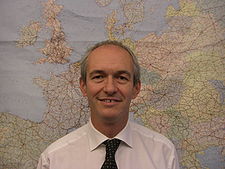
Emerging from his bureaucratic hole in Brussels, former Labour MEP Richard Corbett made an appearance on yesterday's Newsnight to discuss the ongoing eurozone crisis (joined by a Greek communist and Tory MP Douglas Carswell - the discussion wasn't exactly smooth). Corbett is one of those old EU federalists still hanging around and clinging on. Having lost his MEP seat in 2009, he now works for EU President Herman Van Rompuy. And last night Corbett did his best to keep up the appearance that he hadn't been completely found out by the eurozone crisis. You almost felt a bit of sympathy for him as he tried to explain "actually the euro as a whole is strong."

Corbett, you see, is a strong contender for the not so flattering prize of "the worst eurozone prediction ever" (and keep in mind that the competition is pretty tough). In 2009, Corbett kindly informed readers of the Bradford Telegraph that,
"The euro has been a rock of stability, as illustrated by the contrasting fortunes of Iceland and Ireland. Joining the single currency would be a major step."
Right Richard. Fast forward to 2011.
Iceland's borrowing costs (10yr bonds): 2.9%
Ireland's borrowing costs (10yr bonds): 12.3%

For his profound knowledge of economics and monetary policy, Corbett now holds a position in Van Rompuy's court, as an "adviser" to the Man himself.

Why does that make us feel even more nervous about the future of the euro?

Tuesday, November 23, 2010

Clueless politicians

We were reminded of this spectacularly inaccurate assessment the other day (from our "How the EU-elite got it wrong on the euro" briefing):
"The euro has been a rock of stability, as illustrated by the contrasting fortunes of Iceland and Ireland. Joining the single currency would be a major step [for the UK]".
- Former MEP Richard Corbett, back in 2009.

Having lost his seat in last year's European elections, Corbett is now working as an adviser to EU President Herman Van Rompuy (hopefully staying well clear of anything to do with monetary policy).

More quotes from clueless politicans to follow...

Thursday, April 09, 2009

Sounds familiar

In a rant in the Yorkshire Post Richard Corbett MEP churns out his familiar and tired old claim that critics of the European Union such as Open Europe are "anti-Europe".

Great to see we have MEPs who want to engage in a grown-up debate.

His particular beef is our report about the escalating cost of EU regulation - which he claims is "one-sided and misleading propaganda" - despite the fact that it is based on information from more than 2,000 of the Government's own Impact Assessments.

However, we note with much amusement that every single one of his suggestions about how to improve things are lifted straight from our report.

Corbett: "At Westminster, we could improve parliamentary scrutiny of EU legislation by having a more effective European Scrutiny Committee and departmental select committees more focused on EU legislation."

Our report: "There also needs to be real-time scrutiny of EU proposals at Westminster, with a bolstered new committee system... Every Departmental Committee should become far more focussed on EU legislation."

Corbett: "We could establish a Danish-style mandate system whereby Ministers have to appear before committee ahead of negotiation in the EU Council, to explain their position, allowing Parliament to help shape the position of the Minister."

Our report: "One proposal for reform would be to make the system more like the Danish or Swedish models, where Ministers set out their negotiation positions to the Committee ahead of European Council meetings, and gain its approval."

Corbett: "The Government could also increase transparency by introducing an 'audit trail' for each new legislative proposal. "

Our report: "One of the simplest reforms the UK Government could pursue is to publish proper ‘audit trails’ for each new legislative proposal."

Corbett: "In a bid to finally end the debate about how much UK law emanates from the EU, the Government could follow the Swedish and Polish governments and draw up a definitive list of laws that originate from legislation or decisions made at EU level."

Our report: "If we want to achieve accountability in regulation, we need to know who the regulator actually is. That means finding out where and how our laws our made. In October 2008 Mark Harper attempted – unsuccessfully – to pass a Bill in Parliament which would have required a Minister to certify on a Government Bill or a Statutory Instrument whether or not it was a result of a decision of the EU."

On this last point, of course Corbett neglects to mention that this very sensible proposal was voted down by his own Labour friends in Westminster when the Government whipped them to oppose it back in October.

Wednesday, August 01, 2007

Miow

Richard Corbett writes that:

Shame that a couple of Labour MPs, who lost their ministerial jobs several years ago and are no doubt disappointed at not returning to ministerial office under Gordon Brown, have sought to embarrass him by calling for a referendum on the proposed EU Reform Treaty.

They made their calls in the Eurosceptic Tory press (Frank Field in the Sun and Gisela Stuart in the Sunday Telegraph), knowing that, there at least, they would obtain a headline or two. I somehow doubt Gordon will be impressed by such disloyal tactics, but there is always a danger that it might influence the odd party member, especially if they believe the nonsense that they wrote on the subject, which could well have been drafted for them by Bill Cash or UKIP.

Oooh, nasty. He goes on to say:

Frank Field even tells the outright lie that the new treaty would mean Britain giving up its seat at the UN Security Council.

Obviously, the constitutional treaty would not immediately mean "giving up our seat at the UN." But in fairness to Frank Field, in his piece he appears to be predicting that this will eventually happen, rather than saying that it will immediately happen:

It is true that in the first instance the European Foreign Secretary will be given a different title. But titles, to quote the Spanish Foreign Minister again, will be part of the wrapping. This decisive shift in power will all too quickly be followed by the EU taking Britain's seat at the UN Security Council.

And there certainly is a real problem for the Government here. The new version of the constitutional treaty states that:

"When the Union has defined a position on a subject which is on the United Nations Security Council agenda, those Member States which sit on the Security Council shall request that the High Representative be asked to present the Union's position."

Initially the UK Government (represented by Peter Hain) put down an amendment in the European Convention saying that this whole paragraph should be struck out.

Peter Hain wrote: "The UK cannot accept any language which implies that it would not retain the right to speak in a national capacity on the UN Security Council."

This was ignored, and so the UK then fell back to saying that it had to at least be changed, in order to remove the minister's seemingly automatic right to speak. In a second amendment the UK proposed a change to say that the Minister could only request to speak on its behalf.

"When the Security Council holds a meeting at which non-members of the Council are permitted to speak, and when the Union has defined a common position on a the subject of the meeting, which is on the United Nations Security Council agenda, those Member States which sit on the Security Council shall request that the Minister for Foreign Affairs may request an opportunity be asked to present the Union's position."

But again this was ignored. This automatic right to speak on issues where the Union has a common position is more significant given the simultaneous introduction of majority voting into so many areas of foreign policy in the new text.

Overall, it's pretty obvious that the Government would have preferred not to see this new power. But nonetheless, they have decided to go quietly, and avoided kicking up a fuss. Perhaps Richard Corbett will post a reply and tell us why? (Or turn on comments on his own blog?)