• Facebook
  • Facebook
  • Facebook
  • Facebook

Search This Blog

Visit our new website.
Showing posts with label EU president. Show all posts

Monday, January 14, 2013

Why national interests still rule in Europe

In an interview with Estonian daily Postimees, the country's bow-tie wearing President, Toomas Hendrik Ilves, said that he is opposed to the idea of directly electing the President of the European Commission (something the Germans are quite keen on). He gave the following justification:
"A directly elected President would always be either French, or Portuguese, Spanish, Italian or Romanian, as these nationalities find it easier to learn French... If Europe had direct Presidential elections, no candidate would ever come to Estonia to campaign for Estonian votes."
Ilves also argues that the European Parliament should acquire a second chamber in which nation states would receive equal representation, and where issues such as EU foreign policy could be decided. This serves as a useful reminder that for all the EU federalists' talk of supranationalism, the rationale for many small and medium size EU states to proceed with further integration is to maximise their impact on EU decision making. The art is to exert as much influence as possible over an area of pooled competence on one hand, while securing institutional safeguards to avoid being circumvented by the bigger states on the other.

Thursday, April 21, 2011

The terminator for EU President?

This is a bit risqué (or the picture at least), but latest on the grapevine is that Arnie 'I'll be back' Schwarzenegger could be eyeing up his chances as next European Council President.

According to his chief of staff, "In the next few years, the EU will be looking for a much more high-profile president - somebody who can unify Europe".

To go from being Governor of California to EU President would arguably be a bit of a fall from grace. Despite the attractive pay packet, it's difficult to see what would possess anyone to want to take over from Herman Van Rompuy.

All the same, Arnie evidently has valuable experience in dealing with huge levels of public debts (in terms of running up its credit card, California could compete with the likes of Greece and Ireland, though not quite as bad). And given the pretty bad shape the EU is in, the Austrian giant could hardly make things worse.

But despite Arnie's obvious talents and dedication to politics (cue photo), we can forsee certain problems in his bid. Though he might go down well with voters, alas, it's the EU leaders he'll have to convince (and they don't like to be overshadowed by people with personality, hence Van Rompuy). Perhaps a change in rules would help him out? God forbid suggesting that the post should be democratically elected, so how about an arts and crafts contest - haiku reading versus wooden acting?

Wednesday, May 05, 2010

The accidental EU President?

In an interview with Le Pèlerin Magazine, Herman Van Rompuy reveals that he tried everything in his power not to become EU President. “Until the last minute, I did anything I could to refuse this appointment”, he says, adding that he even asked Swedish PM Fredrik Reinfeldt to remove his name from the list of candidates.

Hmm, doesn't sound particularly credible.

Back in November 2009, Belgian newspaper De Standaard reported the following:
at a dinner on 28 October the French-German axis went to work: Sarkozy supported Merkel's candidate, Herman Van Rompuy. The day after at the European summit in Brussels the two asked whether the Belgian would possibly accept the job. The PM was up for that, and started a tour of the capitals in order to present himself. He was liked.
He may be the accidental EU President, but he's not that accidental. Politicans, after all, tend to be attracted by power - even haiku-writing ones.

Monday, March 29, 2010

How many presidents does it take to change a...

Following the infamous "Obama snub", the ‘EU as global power’ project has suffered another humiliating dressing down this week. This time the reality check comes from the Director-General of the World Trade Organisation, Pascal Lamy, who, in his frustration with the shambolic organisation of the EU representation has set out some guidelines as to how the member states should behave at future WTO meetings:
“If one European takes the floor on one topic, and then another European takes the floor on the same topic, nobody listens. Nobody listens because either it’s the same thing and it gets boring, or it’s not the same thing and it will not influence the result at the end of the day….So the right solution, if I may, is at least to make sure that they speak with one mouth. Not one voice—one mouth—on each topic on the agenda. That would be a great improvement.”
More than a little patronising and far from the “unified EU voice” that those supporters of the Lisbon Treaty suggested. Gideon Rachman, reporting from the Brussels Forum of the German Marshall Fund on his FT blog, has offered an insight into how the EU is actually viewed by American diplomats:
“In the lobby of the conference hotel, I just bumped into some official Americans who had been to see senior people at the commission. They had delicately raised the question of which of the two European 'presidents' would represent the EU at future international summits. 'Oh that’s all settled,' they were told, 'they’re both going.' With enormous self-restraint, the Americans apparently refrained from laughing out loud, or banging their heads against the wall. Meanwhile European officials still maintain, with a straight face, that the Treaty has 'simplified' Europe's structures.
Which pretty much sums it up.

Wednesday, February 03, 2010

Obama's not the only one confused by Lisbon

The Obama "snub" continues to gather headlines in today's papers. PJ Crowley, the US Assistant Secretary of State, today confirmed that the uncertainty created by the new posts created under the Lisbon Treaty had been a major factor in Obama's decision to withdraw, saying:

"Because of the changes involving the establishment of a EU council president and a European commission president on top of the rotating EU presidency, I think it's taking some time to work through exactly how various high-level meetings will happen."


And it seems it's not only the Americans who haven't got a clue who they're meant to be talking to. Le Figaro notes that, on his visit to the EU this week, Mongolian President Tsakhia Elbegdorj was left perplexed as to which of the EU's various presidents he was speaking to at any one time. After one meeting, he said:

“I have just been received by the European Council President, I was received yesterday by the President of the European Parliament and after this meeting I will meet the President of the European Council...Er...”

Quite.

Friday, November 20, 2009

Stitch-up

See here for Open Europe's reaction to the outcome of yesterday's EU summit.

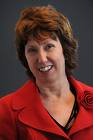
According to the Telegraph the UK's Cathy Ashton was told at 5pm yesterday that she had been put forward for the job. Two hours later she had bagged the job and was celebrating with the other EU leaders, with Jose Barroso handing a Rubiks cube to Sweden's Fredrik Reinfeldt to congratulate him for engineering the whole stitch-up.

Can anyone remember the Laeken Declaration, the original impetus behind the original EU Constitution, which later became the Lisbon Treaty? It talked about bringing the EU decision-making process closer to its citizens. What a terrible joke that has turned out to be.

Thursday, November 19, 2009

Crikey

Rumours are swirling thick and fast from the EU summit in Brussels...

Apparently Herman Van Rompuy is still leading the pack as the frontrunner for the EU President job - especially now that Merkel and Sarkozy are doing their best to stitch it up for him.

However, the sticking point is who would partner him as Foreign Minister to make up a 'dream ticket' that ticks all of the boxes of the horse trading behind the scenes to ensure the process favours no single bloc too heavily (regional balance, political balance, gender balance, big/small balance etc.)

The surprise is that the UK's EU Trade Commissioner, Baroness Catherine Ashton, could be creeping up as a wild card for a late burst onto the summit scene in the role of EU Foreign Minister. With an Ashton/Rompuy ticket, it would mean that the newer member states would miss out - so that could still prove to be a sticky wicket over dinner tonight.

The EU Foreign Minister could well turn out to be even more influential than the EU President, with a budget of up to £45bn and a diplomatic staff of 7,000 to wield at their disposal. And this is a candidate who has never run for office in her political career, nor for so much as the President of the PTA (as far as we know): an EU Foreign Minister who has never had to face the electorate nor had experience representing the interests of a single constituent.

So in a funny way she is just the person for an unelected and unaccountable job like this. But hang on, why are we surprised at all? Maybe this is her reward for pushing the Lisbon Treaty through the House of Lords when she was leader of the House last Spring. In fact, maybe she had her eye on the cushy new job all along?? Who knows.

Update: PA reports that Gordon Brown has ditched Tony Blair for EU President in order to back Catherine Ashton for Foreign Minister

Monday, November 16, 2009

Soon to be your President?

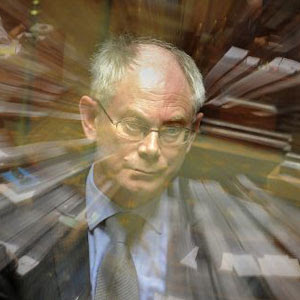
There's some interesting background on the frontrunner for the Presidency of the European Union, Belgian PM Herman Van Rompuy.

Last week, he laid out his views on how the EU’s budget should be financed in the future at a dinner of the secretive Bilderberg group, pleading for direct EU taxes.

And as noted by the Telegraph yesterday, he was an architect of the Flemish Christian Democrats’ federalist manifesto, which calls for more EU symbols in town halls, schools and sporting events. The story is also picked up in Belgian daily De Standaard today.

The manifesto says: “Apart from the euro, also other national symbols need to be replaced by European symbols (licence plates, identity cards, presence of more EU flags, one time EU sports events”.

On the EU Constitution, under the headline "EU Constitution. The sooner, the better", the manifesto reads:

"Of course CD&V - Christian Democrat Party - would have wished for a bit more with regards to making decisionmaking procedures in the Council easier, in the field of social and fiscal policy and in the field of foreign policy. But because politics is the art of the possible, we think the text of the Convention is a great success."

It notes: “we plead for the preservation of EU structural funds”, (note that the EU Court of Auditors has now for the 15th time in a row refused to sign off the EU books, due in no small part to the mismanagement of these funds.)

Furthermore, Van Rompuy's manifesto pleaded for a social Europe - wanting Europe to "formulate social minimum norms”, and calling for the things that ended up in the Lisbon Treaty: the removal of veto powers for Justice and Home Affairs legislation, an EU Prosecutor, and a harmonised asylum policy.

On EU defence, the manifesto states that a “credible European defence policy requires the EU to receive the necessary competences, structures and means", including:

- easier decision making procedures in the Council
- a workable procedure for enhanced cooperation
- a credible input of means by the member states and a better coordination among national contributions
- a common defence structure
- EU representation in NATO

Last but not least the manifesto notes that "taking decisions by majority needs to become to rule, also in domains which are traditionally very closely connected with national sovereignty, such as justice, internal affairs, fiscal matters, social policy and foreign policy."

Van Rompuy himself was an avid supporter of the European Constitution, and is reported to have been very relieved that there was no referendum in Belgium. He reportedly hated the debates in France and the Netherlands, in which he discovered a sort of demagogy to which “even the calculating citizen lends a willing ear”.

Following the No votes to the European Constitution in 2005, Van Rompuy gave a speech to the Belgian Parliament, in which he said: “We go on with the ratification of the European Constitution in all our parliaments, but we need to admit that for the moment the project is over. However, this doesn’t mean that we cannot continue to work in a creative way in the direction which the Constitution points. I don’t mind if we break up the Constitution into smaller parts, as long as we continue to work in the same direction: in the direction of more Europe.” And so it was.

He has also blamed the financial crisis on the “Anglosaxon model”, saying: “The Anglosaxon model of full economic freedom was celebrated. But it was there that the crisis originated, not with us”. In one of his books, he added that: “The logic of the market is often stronger than any deontological code. There is barely a stronger force in the world than the force of money. Today it mops up societies all over the world. Only Islam is resisting, although it is doing so often because of complete intolerance." (Vernieuwing in hoofd in hart: een tegendraadse visie, 1998)

Van Rompuy is an avid supporter of an EU superstate. In 1998 he said: “European harmonisation, which is being imposed through a unified currency, is running smoothly. Only fiscal harmonisation will still demand a lot of effort” (De Morgen, 28 maart 1998).

And back in 1989, as President of the Flemish Christian Democrat Party, he was calling for monetary and political union in a new set of treaties. He said: “Once EMU has been realised, the realisation of political union will get an extra boost as a logical and indispensable complement of EMU”. He said: “Council, Parliament and Commission would have to speak out first in favour of the attempt to achieve a monetary and political union, if necessary in one Treaty or in two separate treaties”. (De Tijd, 5 December 1989)

As well as being a classic EU federalist, Von Rompuy's democratic credentials are also fit for the EU. On publication of the de Larosiere report, which called for greater financial regulation in Europe, he commented: “Let’s not discuss it too much, let’s implement it as soon as possible.”

(As Speaker of the Belgian Parliament, Van Rompuy once cancelled a session of the Belgian Parliament, on the instigation of the PM. It sparked much commotion, especially as the locks of the plenary session room had been replaced, leading furious opposition MPs unable to get in to claim this was a 'coup d’Etat' and “this is Belgicistan!"(De Morgen, 3 May 2008)).

Interestingly, he criticised former Belgian PM Jean-Luc Dehaene for wanting to leave Belgium in 1994 to become EU Commission President, saying: "I was furious at Dehaene when he wanted to go to the European Commission. I have sent him a letter twice, hopefully for him he has thrown it away. I did not want it and I found it a shame that he would leave us in the lurch." (De Morgen, 11 February 2006).

Is he about to leave Belgium in the lurch too, and fulfill a wish to become EU President?

Van Rompuy seems pretty good at doing the opposite of what he has pledged. In 2007 he warned: “I know that some are contemplating having a Belgian Federal government backed only by a minority of Flemish MPs in the Belgian Parliament. A government which only has a majority in Wallonia is playing with fire. I am now speaking in the interest of the country: this is dangerous for the sake of the State” (De Morgen, 27 januari 2007). One year later he was and still is the leader of such a government.

In fact, van Rompuy is an avid supporter of the credo: “Don’t remind politicians of earlier statements”. Last summer, he said:

“Everybody has a history, but nobody is as often reminded about it as us. (…) You said this, but you used to say that. That’s a vicious circle, very perverse. In order to be noticed, you have to be controversial, but if you’re being noticed enough and thus get elected, you have to make compromises. And then journalists start reminding about your controversial statements in the past: you’re suffering a loss of face and you get a credibility problem.” (Humo, 3 June 2009)

Yup.

Wednesday, October 14, 2009

A popular Europe, or a politician's Europe?

Open Europe organised an event at the Conservative Party Conference in Manchester last week, entitled "What priorities for a Conservative government in Europe?" You can read a summary of the event here or, for the really keen, listen to a recording.

A couple of days later, on Friday last week, the Centre for European Reform organised a conference entitled, "What future for the EU?" Keynote speeches came from Lib Dem leader Nick Clegg, and Giuliano Amato, the former Italian Prime Minister and Vice President of the Convention on the future of Europe (which drew up the EU Constitution).

The various speakers largely addressed their comments based on the (increasingly likely) scenario that the Lisbon Treaty is done and dusted, and likely to be in force before long.

In particular, there was a great deal of discussion about what shape the new Lisbon Treaty institutions of Foreign Minister and permanent President might look like - perhaps worth summarising here.

The conference reinforced the fact that there are two different visions of what the permanent President should actually look like. One of those is the consensus builder, devoting their time to creating harmony within the European Council and speeding up progress toward ever-closer union, and the other being a figure for the global stage, a big name to represent the EU externally. No prizes for guessing which category a Tony Blair presidency would come under.

Giuliano Amato favoured an EU President more in line with the first description, saying that when they (delegates at the Convention on the Future of Europe) were drawing up the Treaty, "we thought of the President of the Council not as a world leader, but as a consensus builder in the Council", later adding "We did not want a European Obama."

Lord Kerr, a member of the House of Lords' EU Select Committee and a former diplomat and Ambassador, agreed , saying that for the President, "the first task is cohesion and coherence", rather than external representation.

However, the Economist's Europe Editor John Peet said that whatever the language of the Treaty, the rest of the world would look to the President as a "symbol and spokesman of the EU," adding: "this choice is going to say something about how seriously the EU sees itself as a world power".

Lord Kerr said, "I think the European Council next week should do nothing about the President, because they don't have a Treaty base", but added that a new EU High Representative for Foreign Policy (currently Javier Solana), should be appointed immediately, taking on the EU Foreign Minister role as soon as the Treaty comes into force.

It was argued that they could get around the pesky provisions in the Nice Treaty to reduce the size of the Commission by telling whichever country takes the Foreign Minister job they would be without a Commissioner until a new one was formed under Lisbon.

Lord Kerr summed up the mood in the room, saying, "most people here reflect the general European boredom with institutional fatigue."

However, David Heathcoat-Amory, MP for Wells, and also a former member of the European Convention which drew up the Lisbon Treaty, pointed out that "the public don't want to move on from institutional questions", because they still want to be consulted about the Treaty, on which they were promised a referendum. He said that despite this, "the EU will try to leave these institutional questions behind... I think they will rely on the self-amending parts of the Treaty, such as the passarelle clause, so you won't have to ask the people again [in a referendum]".

Indeed David was the only speaker at the conference who recognised that there is still a strong public appetite for some kind of overdue consultation on the Treaty, saying "we're trying to make a popular Europe, not a politician's Europe".

Well said.

Irony alert

In the corridors of the European Parliament today Lib Dem MEP Chris Davies climbed onto a chair and announced his bid to apply for the prestigious new role of EU President, should the Lisbon Treaty come into force.

Challenging the idea that the role should go to an ex-Prime Minister or President, as outlined in a recent paper circulated to EU capitals by the Benelux countries, Davies said: "This is a job that should be open to anyone to apply for. And if that means there are millions of applicants to sift through, then it will be worth it in the interests of democracy."

According to PA:

Mr Davies has written to all EU leaders insisting his qualifications for the job are as good as the other candidates suggested so far - including Tony Blair and former Irish president Mary Robinson.

In a dig at Mr Blair, Mr Davies points out that he has never deceived a parliament or been responsible for the illegal invasion of another country. Mr Davies said the "circle of individuals" who could be considered was too small, adding: "The backroom manoeuvrings now taking place are a very poor substitute for an open selection process. We have millions of talented people in Europe, and more than half of them are women, so why is the recruitment net not being cast wider?

"European citizens should be told whether this is just a beauty contest for middle aged males or a professional recruitment exercise intended to select the best person for the job, someone with ideas about how to shape Europe's future."

Mr Davies' letter to EU leaders says: "I am a man in my 50s, with a Cambridge University education and 30 years of political experience, I believe I possess qualifications similar to those of other potential candidates named in the media.

"To my credit I can claim that, unlike some of my rivals, I have never deceived either of the two parliaments to which I have belonged, and I bear no responsibility for the illegal invasion of another country that led to the death of many thousands of innocent people. I hope these facts will not prejudice my application."

The letter adds: "Although the position has not yet been advertised, and the criteria for selection has not been determined, I have no doubt that the Council (of EU leaders) will want to follow good employment practice and to select the best person for the job."


Now, here at Open Europe we rather like Chris Davies - he is a dedicated transparency campaigner and did well on these issues in our ranking of all MEPs earlier in the year.

And he's quite right about the lack of democracy in this EU President post - he or she will be nominated by a qualified majority of 27 heads of state meeting in the EU Council, with no input from national parliaments, let alone the people. (Compare that with the 70 million-strong mandate Barack Obama has).

And the idea that it must be an ex-Prime Minister or President underlines this lack of democracy even further - it basically means we are very likely to end up with someone who has fallen from grace and/or failed to get re-elected in their own country. (Compare that to the current situation, where the democratically-elected heads of state, who have a current mandate from the people, take it in turns to be EU President for 6 months at a time).

All that said, however, it is pretty hypocritical for a Lib Dem politician, of all people, to be complaining about this now. It's a bit late, Chris. Why didn't you raise any of these objections when the Treaty was still being negotiated? Why didn't ANY of the Lib Dems' representatives in either the European Parliament, the Commons or the House of Lords want to discuss all this stuff when they had the opportunity, when the Treaty was going through the Houses of Parliament last year?

Why, instead, have the Lib Dems pushed this Treaty and argued it's the best thing since sliced bread? And when Tory MPs and peers tried in Parliament for the promised referendum to be given to the British people, did the Lib Dems go back on their word and block the motions?

Davies says he doesn't want Tony Blair to become EU President, and neither do a majority of delegates attending the Lib Dem conference in Bournemouth earlier this month. But, as we've said before, it is precisely thanks to these so-called 'Liberal Democrats' that this job has been created in the first place. And even if the British government decided it didn't want Tony, that would be tough luck if the a majority of the other EU leaders did.

Welcome to the post-Lisbon Treaty reality.