• Facebook
  • Facebook
  • Facebook
  • Facebook

Search This Blog

Visit our new website.
Showing posts with label capital requirements. Show all posts

Friday, December 05, 2014

EU falling short on implementing bank capital rules

The BIS Basel Committee has today released its assessment of the EU’s (and the USA’s) implementation of the Basel III rules on bank capital and it does not make good reading for the EU. They key findings of the report are (as detailed in the press release and the graphic below, click to enlarge):

  • “Eight of the 14 components meet all minimum provisions of the relevant Basel standards and these were therefore graded as "compliant".”
  • “Four of the components were assessed as "largely compliant", reflecting the fact that most but not all provisions of the global standard were satisfied.”
  • “One component - the Internal Ratings-based (IRB) approach for credit risk - was assessed "materially non-compliant" and pertained primarily to the treatment of exposures to SMEs, corporates and sovereigns.” In particular, the report notes that exposures to SMEs are given concessionary risk weightings, presumably to try to encourage this specific type of lending, however it is nonetheless not in line with the rules. Furthermore, it finds that banks are given a significant amount of leeway in how to value their sovereign debt holdings, with most across the EU simply applying zero-risk weighting – again this is a deliberate attempt to limit any distortions to the sensitive Eurozone government debt markets.
  • “Another component was found to be "non-compliant". This relates to the EU's counterparty credit risk framework, which provides an exemption from the Basel framework's credit valuation adjustment (CVA) capital charge for certain derivatives exposures.” Essentially the current rules allow exemptions for instruments which are not traded on exchanges or the wider market and therefore may be hard to value. Furthermore, this “materially boosts bank capital ratios,” though the report accepts that the EU is considering changes to these specific rules.
  • Overall the EU was given the second lowest rating (on a scale of four) of “materially non-compliant”, making it the first jurisdiction to be found on the whole not the be complying with the Basel rules. The assessment is also particularly poor compared to the US, which was found to be “largely compliant” with the rules, in general its failings also seem to be more minor as well as less numerous.
The European Commission’s response can be found here, while there is also a response section following the executive summary in the main report. The EC claims the EU’s approach is “particularly ambitious approach, unique in the world”, which is true to an extent given the diverse nature of national banking systems. The response notes that some changes are already in the pipeline, but largely challenges the interpretation which the Basel Committee makes of the rules. On the whole it is not entirely convincing but then, since the Committee cannot force the EU to change, it seems the Commission is largely happy to ‘agree to disagree’ on a number of areas.

While all of this may seem rather mundane and technical it does have some important implications.

First off, it raises questions about the quality and thoroughness of the recent ECB and European Banking Authority stress tests. We, along with plenty of others, have already raised concerns about this and the report adds further weight to those concerns. Furthermore, the specific problems outlined would certainly have helped present European banks as having higher capital ratios largely by reducing the perceived riskiness of certain assets they hold.

A report by Yalman Onaran for Bloomberg earlier this week highlighted the problems relating to the use of banks internal models to weight risk by contrasting this approach to that of using the pure leverage ratio. As the article notes, under the leverage ratio approach 12 large European banks would need to raise a further €66bn in capital. While neither approach is perfect, the Basel Committee’s indictment of the bank’s internal models and the way a large number of exposures in a number of sectors are valued seems to support such analysis and criticisms.

The second important implication is that is once again clearly highlights that the EU probably remains the more important level of policy making and legislation than international level or international organisations – at least when it comes to how things are structure on the ground.

Despite agreeing to follow the Basel III rules the EU is the one that designs and implements the specific legislation. In this case it has clearly altered the rules significantly to suit its own needs – the gap with the original rules as well as how they are interpreted and implemented in other jurisdictions is clear. Furthermore, while the Basel Committee can issue a damning judgement of the EU’s approach, it cannot force it to change. In this relationship all the hard (legal) power lies with the EU. This also extends beyond just implementation to interpretation. Despite writing the Basel III rules the Basel Committee is not even able to guarantee primacy on how they should be interpreted as the EU’s response to the report clearly shows.

Tuesday, July 30, 2013

Is Cyprus eyeing up an exit from its capital controls?

As expected the Cypriot government has finally reached a deal with the EU/IMF/ECB Troika over the final stage of the restructuring of the Bank of Cyprus (BoC).

As we noted in today’s press summary this was not an easy decision to reach, and has dragged on since Spring, for a couple of reasons:
  • The Cypriot government was keen to limit the haircut and insisted that the BoC only had to reach a tier one capital ratio of 9% at the current point in time.
  • The Troika however insisted that this 9% target applied to the end point of the bailout (2016) and therefore the bank needed a ratio of 12% currently since it will deteriorate overtime.
  • As the Cyprus Mail notes the Memorandum of Understanding signed by both sides clearly fits the Troika view. Unsurprisingly it won out (as always) but the Cypriot government is still seemingly bitter about the whole affair (which doesn’t bode well for the many, many interactions between the two sides yet to come).
In the end the two sides settled on a 47.5% haircut for uninsured deposits over €100,000 – although these funds will not be completely lost but converted into shares of the bank. This is above the original target of 37.5% but below the potential limit of 60% (for the most part).

The most interesting part of this whole deal might be the following though:
“Following the recapitalisation, 12% of deposits that were previously blocked will be released (5% in total).

The balance will be split evenly into three separate time deposits of six, nine and twelve months, respectively. BoC will have the option to renew the time deposits once for the same time duration. These deposits will receive a rate of interest which will be higher than the corresponding market rates offered by the BoC.”
Of the remaining frozen deposits 12% will be released then, while the rest will first be converted to time deposits, meaning people may not have access to their money for between 6 and 24 months. There are likely a couple of motivating factors here:
  1. Firstly, this eases the funding transition for the bank as it looks to return to normal operations since it locks in part of its deposit base.
  2. Secondly, and more importantly, it locks in a large amount of deposits which would be liable to flee the country as soon as the capital controls are removed (not least because they tend to belong to rich and/or foreign depositors who would likely find it easier to shift their funds).
These funds are only likely to be worth around €6bn, so not a huge amount in a country with a deposit base still around €50bn and far from enough to settle the question of capital flight once the controls are removed.

But it suggests that both Cyprus and the Troika are planning for an exit from capital controls and looking for ways to stem the potential outflow. The quicker this can be done in a managed way the better for the Cypriot economy. As we have noted before, as long as the capital controls apply the hope of a recovery is slim to none in Cyprus and the euro continues to look incredibly fragmented.

(Note: the blog has been updated with new calculations. Previously it suggested the total coverted to term deposits would be €2bn, however, it is likely to be closer to €6bn). 

Monday, March 04, 2013

The triple challenge behind EU move to cap banker bonuses

In a comment piece in yesterday's Sunday Telegraph - trailing today's meeting of EU finance ministers that can seal the deal on capping banker bonuses - Mats Persson looks at the three challenges that form the backdrop of this discussion: 
  • The mis-match between the relative importance of financial services to the UK and its limited voting weight in the EU's decision-making machine
  • The tendency of EU politicians to engage in displacement activities and avoid tackling the root causes of the banking (and eurozone) crisis
  • The "out of the euro but run by the euro" risk created by the creation of an EU banking union
Here's the article:
With this week’s well-publicised European Union move to cap bank bonuses, the UK now faces the prospect of being outvoted on a major piece of EU financial law for the first time. This may only be the beginning.

Fundamentally, the EU’s voting system – where almost all financial laws are decided by majority voting – leaves the UK vulnerable. While the UK accounts for 36pc of the EU’s financial wholesale market and 61pc of the EU’s net exports in financial services, it has only 73 out of 754 seats in the European Parliament and 8.3pc of votes in the Council of finance ministers. That trade-off is acceptable as long as the UK wields significant influence over EU rules – with the City serving as a global entry point to the single market, which is still does. In the 1990s and 2000s, this model served the UK well, with most EU laws aimed at facilitating trade.

Unsurprisingly, the focus of EU regulation started to change in 2008 with the financial crash. Of the 50 or so EU financial measures currently floating around, only a handful are aimed at boosting trade, most are about limiting or controlling financial activity in different ways – some of them fully justified. For many EU politicians and governments it is convenient to see the financial crash – and by extension “Anglo-Saxon capitalism” – as the fundamental cause of the eurozone crisis. Bank bonuses and the financial transaction tax, they say, help tackle excessive risk-taking and, therefore, the eurozone crisis.

This is ironic, since the same governments have simultaneously resisted many measures that would address systemic threats – such as sufficiently robust capital requirements and liquidity rules and enforcing losses on creditors. The EU has supported and approved €4.6 trillion (£4 trillion) in taxpayer-backed aid to banks over the course of the financial crisis. To think that capping bonuses will address moral hazard against trillions of state aid, borders on the bizarre.

What lies behind this self-delusion? A deliberate attempt to kill the City and drive business to Frankfurt and Paris? To some extent, but much of the motivation is, in fact, displacement activity. The tough sweeping reforms really needed to stabilise Europe’s financial sector – such as recapitalising or restructuring regional banks – often clash with regional or local politics or economics. But as politicians cannot be seen to do nothing, they take the easy route: we may not be able to create a mechanism to wind down banks but we can tell voters that we have limited the bonuses of greedy bankers. This invariably puts the City in the firing line, as that is where most of the bankers are.

This is exacerbated by a third problem – the City is a trading hub for a single currency of which the UK is not a member. The emerging union of EU banking, designed to align a supra-national currency with an interconnected banking system, creates incentives for euro states to collude in writing common financial rules that risk the City gradually being pushed “offshore”. The European Central Bank has already demanded that transactions cleared in euros move to the eurozone, which the UK has challenged in court. If we lose, it would lead to a two-tier single market, with a protectionist eurozone bloc – and trillions of euros worth of transactions could leave London.

The UK Government has taken steps to ensure a competitive financial services sector against the backdrop of an EU banking union. But the City and the finance sector are on the front line of the EU debate. If this hub of economic activity becomes a casualty, how could a UK government still defend EU membership? 
The FT today needs two separate comment pieces (behind pay wall) to make the same points - but worth a read nonetheless.

Tuesday, February 19, 2013

EU caps on bankers' bonuses: the perfect regulatory storm?

The discussion over bank bonuses has been heating up inrecent days. Discussions between EU ministers, the European Parliament and the Commission (so-called trialogues) are restarting today as the three try to reach an agreement on the rules for bank bonuses to be included in CRD IV (the EU’s legislation implementing the Basel III rules and more).

The parliament is pushing for a stringent cap on bank bonuses of 1:1 ratio with fixed salaries, which could be increased to 2:1 with approval from a majority of shareholders.

There is a lot going on here, beyond the actual proposal, including:
  • The UK is in a clear minority in categorically rejecting a cap, but unable to block a rule with disproportionate impact on the UK - courtesy of QMV and co-decision.
  • Germany being the swing state - no surprises there - having first supported the UK's position, it has shifted as part of a wider political push to get tough on bankers, which strikes a chord with German voters. The revelation in December that Deutsche Bank hid $12bn worth of losses during the crisis and the growing Libor and Euribor rates scandals, haven't exactly helped...
  • The European Parliament flexing its muscles, successfully managing to tap into the public mood, breaking the Council common position, which is unusual. (Don't worry, any favour EP thinks it wins with the electorate, would be ruined if it voted down Ministers' proposal for a reduced long-term EU budget).
  • "Anglo-Saxon capitalism" in the docks - perception is one of a continental attack on British bankers (ironic since a large part of the talks have focused on making CRD4 more flexible to allow the UK and others pursuing tougher capital rules for banks). This will not make the City any more EU-enthusiastic.
  • No one wants to be publicly seen to back bankers - even the UK government itself is keeping a low profile.
  • Changing incentives as part of the eurozone banking union, with the club within a club dynamic again coming to the fore (see our December 2011 report to see what we mean). Looking forward, the question is, if a country decides to remain outside the banking union - therefore signalling that it will stand behind its own banks, come what may - should it not also have more discretion in getting the incentive structure in the banking sector right?
So what does the UK want?

On Friday the UK submitted a paper to its EU partners to put forward it’s case. We've seen the paper, and here are some thoughts / points - which also have been largely reported in the media:
  • The UK argues against a firm cap. Any extended remuneration should be determined by shareholders (although the UK proposal does water down the size of the majority needed to approve remuneration slightly).
  • The UK is pushing for a focus on non-cash deferred bonuses. This is included in the current proposal to some extent but the UK fears (with some grounding) that the current proposal will encourage an increase in fixed salaries and a focus on upfront cash bonuses - and reduce firms' ability to cut costs during a downturn, potentially leading to more lay-offs and less lending (on a bit less solid ground here, we think).
  • It also argues that deferred non-cash bonuses (over three years) should not fall under any cap, while also rejecting the proposal that all employee benefits, above those mandated by law, should be categorised as a ‘bonus’.
  • The government is also keen to see that subsidiaries of EU banks located in the rest of the world should not have to adhere to the rules. Furthermore, EU subsidiaries of banks headquartered outside the EU should not have to implement the rules (although their bonus plans will still need to be judged ‘prudential’ by the relevant financial supervisor).
So is this special pleading? Well, to some people in the City, the world will end if this comes into force - which is not quite the case. In fact, there's no surprise that politicians seize the opportunity to strike down on bankers' pay, given that many banks have been forced to seek taxpayer-backed bailouts and the rest of it. So the first message to the financial sector is: if you don't want to be subject to tougher regulations, stop screwing up.

But it could still be damaging and there are questions over how much difference a cap would really make on incentives and the distorting effects this could have across the board. Ultimately, the risk taken on and the decisions made by banks are dictated by much more than just bonuses - it is just a small part of a wider culture which needs to be reassessed. Targeting and correcting perverse behaviour still seems to be better done through more effective supervision and tighter regulation - the irony should not be lost that many of those pushing for a cap are also the ones advocating a maximum limit to capital levels and supporting watering down the Basel III liquidity requirements (see here for details). And there should be no doubt that this could make talent less likely to choose the EU over other part of the world, which clearly isn't in anyone's interest.
In the end, bank bonuses are also only a small part of the much larger CRD IV legislation. There is unlikely to be a formal vote on bank bonuses itself - and Ministers rarely vote in the Council - but the UK seems to be heading for a defeat on a pretty symbolic issue at a sensitive time.

On the other hand, if the UK government can pull this one off, it should be given a lot of credit. Ultimately, the final outcome of CRD IV as a whole will be the more important bellwether by which to judge UK success or failure.

Wednesday, October 03, 2012

The quest for a healthy European banking sector

Yesterday saw the release of the hefty Liikanen report (a dense 153 pages) on the European banking sector. We’re yet to fully sift through the report but there a quite a few eye catching graphs and statistics which we thought worth flagging up.

In brief, the Group recommends actions in the five following areas:
  • Mandatory separation of proprietary trading and other high-risk trading activities. 
  • Possible additional separation of activities conditional on the recovery and resolution plan. 
  • Possible amendments to the use of bail-in instruments as a resolution tool. 
  • A review of capital requirements on trading assets and real estate related loans. 
  • A strengthening of the governance and control of banks. 
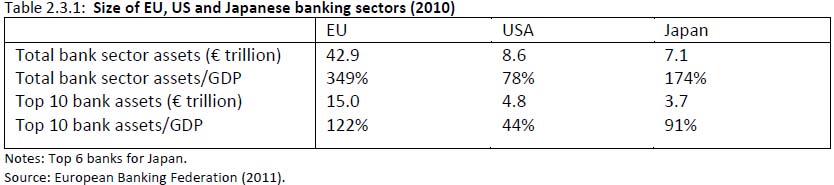
Many ideas which will be familiar to those in the UK and there are plenty of reasonable suggestions - which we'll return to. We would note though that in Europe even small banks caused problems while the largest banks which caused the initial financial crisis were investment banks with no retail element. In some cases better supervision and enforcement of regulations is more important than the actual structure of the banking sector itself. But for now, take a look at these graphs - from the report - which raise some interesting questions over the proposition of a eurozone banking union:


The table and graphs above demonstrate the simply massive size of some of Europe's banks, even in comparison to those in the US and Japan. This drives home the fact that, for a banking union to ever really work or be effective there must be combined deposit and resolution fund backing it up, something which the eurozone is now shying away from. This is also a much larger decision than the eurozone is currently making out the banking union and single supervisor creation out to be.

Monday, September 10, 2012

Banking Union Part II – now for the safeguards

Here’s the continuation of the EU banking union saga – the document (also leaked, see here) that sets out how the single market and banking union are meant to fit together. A crucial point for the UK and others. As we noted on Friday, the Commission was set to table a series of documents establishing the first step towards a banking union. Well, there will be three of them, to be precise:
  • A regulation to make the ECB the supervisor for “all” banks in the Eurozone, with non-euro countries able to join if they wish. This is the one we looked at – and published – on Friday.  
  • A regulation making adjustments to the European Banking Authority in light of the new powers of the ECB, with the objective to avoid the banking union fragmenting the single market. This is the one that we look at below. 
  • A “communication” which sets out the Commission’s vision of the banking union long-term, including a deposit guarantee scheme and a single resolution fund (also known as wishful thinking, at least for now).
Following our analysis of the first document, here are our thoughts on the adjustment to the EBA’s rules and whether the ‘safeguards’ proposed by the Commission will address the risk of the Eurozone/ECB/banking union encroaching on single market territory or the 17 outvoting the non-euro 10 on financial regulation in particular (i.e. Eurozone caucusing at the EBA).

The EBA will have powers over roughly the same areas as before and the same voting weight too, and will continue to serve as the bank supervisor-cum-regulator for the EU-27 (which was already a quite confusing arrangement). However, the EBA may, in a round-about way, actually gain powers vis-a-vis the UK (which we'll return to). To avoid the ECB over-ruling or undercutting it on matters of the single market, the following safeguards have been proposed:
  • Interestingly, when within its remit, the EBA would be able to circumvent the ECB in an “emergency situation” and impose a decision directly applicable to an individual bank or financial institution. In such cases, therefore, the ECB would be ‘junior’ to the EBA – much like national authorities. 
  • A new “independent panel” of experts could be created by the EBA to judge on breaches of EU law i.e. when a country breaks single market rules or when two “competent authorities” (of which the ECB could presumably be one) disagree on whether rules have been breached. The panel’s decision could be over-turned by a simple majority at the EBA’s supervisory board, which needs to include at least three votes from non-euro members (if they have not opted into the banking union) and three votes from euro-members. This is an interesting one, and we need more details to make a clear assessment as to what this would mean in practice – or how effective it’ll be. Who will the independent experts be (drawn from the EBA itself)? How will they be appointed? Will it always be ad hoc or more permanent? And will this, in effect, make the EBA more powerful at the expense of UK authorities (this will be a tricky one, stay put)?
  • Decisions on capital requirements for banks is addressed specifically. This is a key concern for the UK government and an area we’ve pointed to consistently where the Eurozone could face a fresh incentive to act as a block under banking union. The proposal suggests that issues relating to capital requirements – over which the EBA has some moderate powers – will be decided by QMV within the Board of Supervisors but can be overturned by a simple majority, again including at least three non-euro states. 
  • The management board of the EBA must consist of at least two non-participating member states (out of six).
Marks for creative solutions, and it seems the Commission genuinely wants to preserve, as it puts it, “the proper functioning of the EBA in the interest of the union as a whole.” Part of the UK financial services industry might be reasonably happy that the UK would have a seat at the table, at least in the EBA. But this remains an awkward patchwork, and it probably won't be enough to eliminate British anxiety over the banking union.

And remember, this only addresses the relationship between the EBA and the ECB, which is only one of the many relationships within a banking union that needs to be clarified. As we’ve argued before, the biggest worry remains an incremental, de facto institutional shift from the EU-27 to the Eurozone 17, involving the Commission and the European Parliament as well, which is why we want to see stronger single market safeguards, also at Council-level.

And it ain’t getting any easier to work out who has final accountability over financial supervision in Europe…