• Facebook
  • Facebook
  • Facebook
  • Facebook

Search This Blog

Visit our new website.
Showing posts with label catalonia. Show all posts

Monday, November 10, 2014

Catalonia's symbolic independence referendum: What it means and why it would be wrong to ignore it

UPDATE (1:00pm) - As promised, here's an update on the results of Catalonia's symbolic independence referendum now that all votes have been counted.

Turnout: 2,305,290 people (around 37% of those eligible to vote)
Votes in favour of independence: 1,861,753 (80.76%)

 *****

ORIGINAL BLOG POST (9:55am)

Catalonia's symbolic independence referendum eventually went ahead yesterday. With 88.4% of votes counted, the Catalan government puts turnout at over two million people. Nearly 1.7 million of them (80.7%) voted in favour of Catalonia's independence from Spain. We will update the blog with the final results as soon as they come in.

This infographic from El País compares yesterday's turnout (far right column) with the 2012 Catalan regional elections and the 2006 (binding) referendum on the amended Statute of Autonomy of Catalonia:


In other words, less than a third (32.8%) of those eligible to vote cast their ballot yesterday. However, this is still quite impressive considering that Catalan voters knew yesterday's vote was purely symbolic. Furthermore, the percentage is calculated on a broader electoral base - since young Catalans aged 16 were allowed to vote in yesterday's referendum, unlike in regional elections where the voting age is 18.

On the other hand, the outcome of yesterday's vote is probably not a great indication of where the majority of Catalans stand on independence. Due to the non-binding nature of the referendum, there is likely to be a significant amount of self-selection bias. Many Catalans who felt strongly about independence thought it was worth queuing at polling stations to cast a non-binding vote and show defiance of the Spanish government, while many of those who would vote against independence in a real referendum, or were undecided, stayed home since they knew the result would have no legal validity. 

This certainly helped push up the pro-independence vote to nearly 81%. As a reference, the four pro-independence parties currently holding seats in the Catalan parliament won a total 2,093,709 votes in the 2012 regional elections. 

Recent opinion polls clearly show that the split is much more even than that. For example, a Metroscopia poll published by El País two weeks ago found that 44% of Catalans would vote for independence in a referendum and 42% would vote against. Interestingly, when offered a third option involving "new and bulletproof exclusive competences" for Catalonia, 46% of respondents said they would choose this option, while 29% would vote for independence and 17% would opt for the status quo.

So where does yesterday's vote leave the debate on Catalan independence?  

Pep Guardiola was one of over 2m Catalans who cast their vote
As we argued in our previous blog posts (see here, here and here), the situation in Catalonia has got to a point where the status quo is looking increasingly untenable. The issue has so far been handled quite poorly by both the Spanish and the Catalan governments, who have failed to engage in any meaningful negotiations.

Unsurprisingly, Spanish Prime Minister Mariano Rajoy has talked down the significance of yesterday's vote and stressed that, if anything, it makes future talks between him and Catalan President Artur Mas more difficult. However, Rajoy's unwillingness to engage in any real discussions with Mas so far makes this position look somewhat strange.

Furthermore, this approach sort of misses the point. The Spanish government continues to use a legal argument (the Spanish Constitution forbids regions from organising binding referenda without the authorisation of Madrid) to address a political problem. In this regard, the fact that the next Spanish general election is due next year is clearly an incentive for Rajoy to show even more inflexibility vis-à-vis Catalan demands.

That said, Madrid and Barcelona can't just keep talking past each other indefinitely. Constitutional reform giving Catalonia (and, why not, other Spanish regions) more powers to set and collect taxes, for instance, would probably go a long way to address Catalan voters' concerns that the wealthy region is paying too much towards the national coffers and getting too little out of it - although it would be simplistic to boil the Catalan question down to money only.

Incidentally, constitutional reform is being openly backed by the new Spanish Socialist leader Pedro Sánchez, the Matteo Renzi of Spain. Going forward, as we already argued no less than two years ago, a reform of the Spanish Constitution envisaging further devolution of powers may well impose itself as the most sensible solution for everyone.

Tuesday, October 14, 2014

Catalan government calls off independence referendum, but it's not the end of the story

UPDATE (10:55am): 

Catalan President Artur Mas has just been speaking to the press. His remarks were broadly in line with the blog analysis we published earlier (see below).

Two key points from the presser:
  • The planned independence referendum will not take place on 9 November. However, somewhat confusingly, Mas said "there will be polling stations and ballot papers" available to hold a "preliminary" vote on the same day. In other words, a purely symbolic, informal referendum (as opposed to the formal, non-binding one previously planned). It remains to be seen how this offer will go down with Catalan voters.
  • As we expected, the Catalan leader said he is "at the disposal of the other [Catalan] parties" to call early regional elections. However, he suggested that these elections could only be credible as a proxy for a "definitive" referendum if all the pro-independence parties were to run "as a joint list and on a single programme". Therefore, Mas is clearly using the prospect of early elections to put pressure on the Spanish government, while at the same time trying to hedge his CiU party against the risk of being outflanked by the strongly pro-independence ERC (as we explained below) and taking a beating. 
Meanwhile, Spanish Prime Minister Mariano Rajoy has hailed the cancellation of the Catalan referendum as "excellent news" and reiterated that he's open to dialogue with the Catalan government.

ORIGINAL POST (9:15am):  

The Catalan government has called off the non-binding independence referendum planned for 9 November. It was really just a matter of time. Catalan President Artur Mas had repeatedly stressed that he wanted the consulta to be legal, so that the outcome of the independence vote could be recognised as valid in Spain and beyond. However, the Catalan law used by Mas to call the independence referendum has been temporarily suspended by the Spanish Constitutional Court after the Spanish government lodged a legal challenge against it. Hence, going ahead with the referendum would have meant breaching the law - something the Catalan leader wants to avoid.

Clearly, though, this is not the end of the story. Mas will reportedly set out an alternative 'participative process' (proceso participativo) in a press conference this morning - but his new proposal is unlikely to be welcomed by the other pro-independence parties.

As we noted in previous blog posts, the 'Catalan question' seems to have got to a point where the option of going back to business as usual is not on the table anymore. The decision to call off the 9 November referendum may have opened a window of opportunity for the Spanish and the Catalan governments to engage in real talks.

Spanish Prime Minister Mariano Rajoy may be tempted to shut the door and just ignore Catalan demands, especially after Mas has backed down. However, the Catalan leader still has an ace up his sleeve: he can put further pressure on Madrid by threatening to step down and call early regional elections. A snap vote in Catalonia would very likely see a victory for the hardcore pro-independence Catalan Republican Left (ERC).

The party leader, Oriol Junqueras, said of the decision to cancel the independence referendum yesterday:
"We will have to build up a parliamentary majority to issue a declaration of independence and begin the constituent process of the Catalan Republic".
With a Spanish general election due in November 2015, Rajoy would probably want to avoid having to deal with an ERC-led Catalan government and would therefore be more willing to listen. On the other hand, Mas would be taking a huge gamble himself by threatening to call early elections. The Catalan leader fought the 2012 electoral campaign on the pledge of an independence referendum that he has failed to deliver. Hence, his moderate nationalist Convergence and Union (CiU) party would face the risk of harsh punishment by disappointed pro-independence voters.

One thing is certain: the time of political posturing on either side is coming to an end. The sooner the Spanish and the Catalan government agree to sit at the negotiating table, the better.

Saturday, September 27, 2014

Catalan President calls non-binding independence vote: legal battle with Madrid looms

The signature of Catalan President Mas on today's decree
The die is cast in Barcelona. Catalan President Artur Mas has just signed the decree calling an independence vote on 9 November.

The Spanish government will hold an emergency cabinet meeting on Monday, once Prime Minister Mariano Rajoy is back from his state visit to China, to officially announce that it will lodge a legal challenge at the Spanish Constitutional Court.

The immediate effect of the move will be that the decree signed by Mas today will be suspended until the Constitutional Court issues its ruling. However, Catalonia's pro-independence parties are expected to keep campaigning while waiting for the verdict.

It is important to bear in mind that, based on a separate Catalan law that came into effect this morning, the legal status of the 9 November vote is 'non-referendum consultation' (consulta no referendaria). This means the vote would not be binding.

The Catalan government believes this should provide a sufficient safeguard against legal challenges from Madrid, but is clearly also taking a gamble: even if non-binding, the outcome of an independence vote would be politically very difficult to ignore.

A legal battle is most certainly ahead, and we will keep monitoring the situation very closely. If you want more background on Catalonia, you can read our previous blog posts (see here and here).

Thursday, September 18, 2014

Scotland votes, Catalonia waits: Will there soon be another independence referendum in Europe?

FC Barcelona supporters waving Scottish flags at Camp Nou
The world is watching Scotland today, and the Catalans will watch closer than most.

Spanish news sites are featuring pictures of FC Barcelona supporters waving Scottish flags during their team's Champions League game yesterday, and it is widely reported that delegations from the Catalan (and Basque) nationalist parties have travelled to Scotland to follow the latest developments on the ground.

This is because the debate around Catalonia's independence referendum is approaching its own moment of truth:
  • Catalonia's ruling parties agreed long ago that the independence referendum (carefully described as la consulta, the consultation) would take place on 9 November. However, the Catalan government has yet to officially call such a referendum. 
  • The Spanish government maintains the referendum is unconstitutional (and as we explained here, the Spanish Constitution is actually on Prime Minister Mariano Rajoy's side).
  • The Catalan government will tomorrow try to get around the legal obstacles by asking the Catalan parliament to adopt a new law on 'non-referendum consultations' (consultas no referendarias). Catalan President Artur Mas is then expected to convene one of these consultations for 9 November. However, the legal status of the result of such a consultation is unclear at the moment.     
  • Reports in the Spanish press suggest the Spanish government has everything ready to launch a legal challenge against la consulta at the Spanish Constitutional Court, as soon as it is officially announced.
  • If the Spanish Constitutional Court were to strike down the referendum (which is what Rajoy expects), the 'Plan B' of Artur Mas would be to resign and call early regional elections - and then present the election results as a referendum on Catalonia's future. Recent polls suggest the strongly pro-independence Catalan Republican Left (Esquerra Republicana de Catalunya, ERC) would come out as the largest party, albeit short of an absolute majority. For Rajoy, having to deal with ERC instead of Mas would be like jumping out of the frying pan and into the fire.
Are the Scottish and the Catalan cases similar?

There are similarities between Catalonia and Scotland. Both are proud regions with long histories of independence movements, and both have also been embedded in decentralised systems. Also with respect to the consequences of leaving there are similarities, not least the prospect of joining the EU and the difficulties that could potentially arise.

However, there are at least two fundamental differences:
  • The Spanish government has never considered accepting the outcome of an independence referendum in Catalonia. On the contrary, it is determined to use all the legal instruments at its disposal to stop the referendum taking place. Spanish Foreign Minister José Manuel García-Margallo has not even ruled out making use of Article 155 of the Spanish Constitution - which gives the central government the power to "adopt the necessary measures" to force a regional government to comply with its constitutional obligations. In practice, despite the planned date for the referendum being less than two months away, the Catalans still don't know whether - and in what form - it will actually happen.
  • Constitutional reform and greater devolution of powers to Spanish regions as an alternative to independence has so far not been discussed properly, mainly because the Spanish and Catalan governments have never really engaged in negotiations. 
Will there be a 'contagion effect'?

Pro-independence Catalans would no doubt get a boost in case of a 'Yes' victory in the Scottish referendum, whilst, naturally, Madrid would love to see the 'No' camp win. Irrespective of the outcome in Scotland, the status quo doesn't seem to be an option anymore for Catalonia. Just think of the 500,000 to 1.8 million people, depending on the estimates, who took to the streets last week to celebrate La Diada, Catalonia's National Day.
Sooner rather than later, the Spanish and Catalan governments will need to give up posturing and start talking to each other. At that point, reforming the Spanish Constitution to give regions greater power to set and collect taxes may well appear as a valid alternative. The Scottish episode, whichever way the referendum goes, may ultimately serve to accelerate further devolution in Spain.

Friday, May 23, 2014

Belgium's general election: Will we see another 541 days without a government?

This Sunday, on the same day as the European Parliament elections, Belgium will hold a general election, electing both new federal and regional assemblies to govern 11 million people. The key question is how strong the Flemish nationalist N-VA, which is already the biggest political party, will perform this time around.

Background

The N-VA, a "eurorealist"  formation, wants to reform the country, a mini-EU/Eurozone composed of Flemish and Francophones, into a confederation (although it favours splitting it up in the very long term). It became the biggest party in 2010, but was ultimately excluded from a federal government because it appeared impossible to wrap up a coalition deal with Francophone parties, resulting in 541 days without a federal government.

A coalition of six parties led by Francophone socialist Elio Di Rupo eventually emerged. One big issue was that the coalition did not enjoy support among the majority of Flemish MPs in the federal Parliament. European Council President Herman Van Rompuy, who has been Belgian PM himself, once warned that if such a government would ever be formed, this would be “dangerous for the existence of the state”. His party, the Flemish Christian-Democrats, have now pledged not to enter such a coalition again.  This Sunday, it will become clear how voters have judged this.  For more background on the complexities, we refer you to this comment piece by our resident Belgian expert. 

Post-election scenarios

Scenario 1: Business as usual (most likely)

Opinion polls are notoriously unreliable in Belgium, but suggest that, in the Flemish districts, the N-VA will improve on their 2010 showing, while the three traditional parties will remain broadly at the same level. If they again fail to command a majority of Flemish seats but, nevertheless, prefer to avoid complicated talks with the N-VA, the Flemish Christian-Democrats will need to break their promise, something which they may do if one of them becomes PM and the incumbent Elio Di Rupo is offered a job in the European Commission, for example. Di Rupo's Socialist Party is expected to suffer considerable losses, but would easily remain the biggest party in the Francophone part of the country.

Scenario 2: A federal government which includes the N-VA

Bart De Wever, the N-VA's leader, has himself indicated he's willing to enter a federal government and not make new demands to decentralise powers, if centre-right policies are implemented. The N-VA hopes this pressure may drive the Francophone socialists to return to their historic demands for more decentralisation (in his maiden speech to the Belgian Parliament in 1988, PM Di Rupo himself proclaimed that "there are no Belgians", while demanding "a confederal Belgium").

Such a federal government without Francophone socialists (who have been in power since 1988) but with Francophone liberals and Christian-Democrats is an unlikely scenario, also because this time around it would probably not command a majority of the Francophone seats in Parliament. However, if the N-VA does better than expected, this scenario could materialise.

Scenario 3: Prolonged stalemate 

Last but not least, there is the scenario of another one and a half years of stalemate, prolonged to an indefinite period without a federal government, which could result in negotiations on an eventual divorce. We rate this as very unlikely.

As you can see, it's complicated.

Monday, February 17, 2014

If EU law is followed, Scotland will join the EU just before Serbia

Our Director Mats Persson writes on his Telegraph blog:
The UK must be the first country, with the forthcoming Scottish and EU referenda, to simultaneously have an intense political debate about the difficulty or otherwise of both joining and leaving the EU. Traditional assumptions are being bent in all sorts of directions, with senior UK politicians approvingly citing EU Commission President Jose Manuel Barroso for suggesting it would be “very difficult, if not impossible” for an independent Scotland to join the EU.

Like Catalonia in Spain, rightly or wrongly, Alex Salmond’s case rests in part on the argument that "if we leave one club, we can safely join another." It’s an insurance policy against the uncertainty which is a such a killer in any referendum to change the status quo. So is Barroso right?

Iceland’s accession talks with the EU – which were terminated since the Icelanders turned cold on the idea – would, in purely legal terms, come close to those of Scotland. Iceland is part of the European Economic Area, and therefore almost an EU member. Scotland has been an EU member for 40 years. Both would face tricky negotiations, like protecting their fishing industries.

There are basically six steps (by my rough categorisation). Salmond’s biggest problem is that for half of these, each of the 28 EU states, including rUK and Spain, has a veto:

Step 1 – Scotland applies to join the EU: Under EU law, it would have to be an independent country to apply.

Step 2 – The European Commission “screens” Scottish law to see if the country is compatible with EU membership – this won’t be an issue.

Step 3 – EU governments decide whether to approve Scotland’s EU application. All EU states have a veto.

Step 4 – The EU and Scotland begin negotiations over individual EU policy areas. There are now 35 so-called “accession chapters” covering everything from the euro to employment law to the EU budget. Each country has a veto over the decision to both open and then to close every single chapter – ask Turkey how easy that has proven (read: Cyprus and France). It’s in these talks that Salmond would need to deliver on his pledge to get an opt-out from the euro, as well as replicating the UK’s special deals on the EU budget, crime and immigration and passport controls.

Step 5 – When the 35th chapter is agreed, the Accession Treaty with the Scottish terms of entry is drafted.

Step 6 – This Treaty must then be ratified by the Parliaments of each EU country and the European Parliament. If one says no, the deal falls.

Iceland officially applied to the EU in June 2009. In 2013, when the bid was dropped, it had completed about a third of the negotiations. So if the letter of the law is followed, Scotland might join the EU just before Serbia, several years from now.

However, in the EU, political expediency tends to trump the letter of the law. I suspect that, given the stakes, if the Scots do pull the trigger, the EU will engage in the kind of legal acrobatics that it’s proven so good at in order to fast-track an independent Scotland to membership, with or without a euro opt-out (though, as Andrew Lilico has pointed out, there might be a range of practical currency issues).

No matter what, it would be a mess. In truth, we have little idea what’s going to happen if Scotland goes independent. And I suspect that in itself undermines Salmond’s case.

Thursday, October 17, 2013

Not what London or Madrid want to hear

 
According to the Scotsman, Professor Dr Roland Vaubel, who is an adviser to Germany’s economics ministry, has written the following for the journal Economic Affairs:
The opinion of the European Union institutions that Catalonia and Scotland, after seceding, would have to reapply for EU membership has no basis in the European treaties.
Nor does the UN Charter envisage dispositions with regard to secession.
The treaties are also consistent with automatic succession of both the seceding state and the rump state.
 We don't have to point out that this isn't the view in London or Madrid.

Tuesday, January 22, 2013

Spain back under the spotlight soon?

We haven't blogged on Spain for a bit, but a couple of interesting developments have caught our attention today. Spain will presumably disclose its final deficit figure for 2012 shortly, and everything seems to suggest that Madrid will let its eurozone partners down once again.

Spanish Industry Minister José Manuel Soria (pictured) told a conference this morning that Spain's public deficit for 2012 will be somewhere around 7% of GDP - higher than the target of 6.3% of GDP agreed with the European Commission.

It is also probably not just a coincidence that Soria's words came just before the European Commission put out its latest update on Spain's compliance with the conditions attached to its bank bailout. The content of the report was not entirely new to us (and the readers of our daily press summary), given that a draft was leaked to El País last week. The document reads,  
Fiscal consolidation advanced in the third quarter, but the 2012 deficit target will likely be missed.
Most importantly, it adds,
The 2012 deficit target for the regions of 1.5% of GDP can...still be within reach for the regional level as a whole, but risks are substantial and a number of regions will most likely exceed their target.
You won't hear us say this very often, but well done to the European Commission for making the right prediction. Of course, we (and others) warned of the risk of several Comunidades Autónomas overshooting their deficit target as early as last July.

Anyway, Catalonia (Spain's wealthiest region) has just announced that its deficit at the end of 2012 stood at 2.3% of GDP - with the overall target for Spanish regions fixed at 1.5% of GDP. With the wealthiest region missing its targets, and few others likely to undershoot theirs to pick up the slack, it seems unlikely that the overall target will be met.

A day of bad news for Spanish Prime Minister Mariano Rajoy and his government - not least because Spain had already obtained a relaxation of its deficit target for this year. The risk is that, once the official deficit figures come out, Spain could face fresh pressure from the markets. Before complaining about being "underrepresented" in the EU institutions (see Spanish Economy Minister Luis de Guindos remarks from this morning), the Spanish government should probably do more to regain its credibility vis-à-vis its eurozone partners. Top EU/eurozone jobs would surely follow.

Monday, November 26, 2012

The Catalans have voted: for what exactly?

It does not happen very often, but the final result of yesterday's Catalan elections was almost completely unpredicted by polling. Artur Mas (in the picture) and his centre-right Convergència i Unió (CiU) party were always going to win - and they did so. However, according to most opinion polls, Mas was, at worst, going to consolidate the 62 seats that his party currently holds in the Catalan parliament - but he failed to do so, and by a wide margin.

CiU only secured 50 seats - 18 short of the 68 needed to command an absolute majority. Needless to say, Spanish Prime Minister Mariano Rajoy's party has immediately described the result as a bofetada (a "slap in the face") to Artur Mas - claiming he has failed in his attempt to lead Catalonia towards independence.

So have the Catalans suddenly given up on independence? Not quite. The exploit of the left-wing independentist, anti-austerity and anti-monarchic Esquerra Republicana de Catalunya (ERC, Catalan Republican Left) won them 21 seats - eleven more than in the previous elections. Therefore, Mas could certainly try to push ahead with his plans for a referendum on Catalonia's independence with the support of ERC. 71 votes from a total of 135 seats in the Catalan parliament (without counting the smaller pro-independence parties) is not the "exceptional sovereignist majority" Mas hoped for - but is a majority nonetheless.

This is exactly what the Catalan President noted in his first remarks after the election results were made official yesterday night. He said,
Those who want to abort the [sovereignist] process should take into account that…the sum of political forces in favour of the [Catalans’] right to decide is very much a majority in the parliament.
However, CiU and ERC are hardly natural allies or the makings of a stable and durable coalition. In particular, the two parties clearly do not see eye-to-eye on the need for Catalonia to continue with fiscal consolidation. At this stage, it is difficult to predict how things will evolve within the next few weeks or months. But the following should be kept in mind:
  • Under the Spanish Constitution (see here, Article 149.1), any referendum needs to be authorised by the central government. During the electoral campaign, Artur Mas has repeatedly suggested that he would get around the problem by holding such a referendum within an 'alternative' legal framework - i.e. a new Catalan law which would provide for the necessary legal base. However, this would be unlikely to stop the Spanish central government from taking the referendum to the Constitutional Court to invalidate it.
  • Great uncertainty remains over how Catalonia would declare its independence in practice - not least because an amicable divorce seems to be out of the question for Rajoy and his cabinet. In any case, it would be wrong to see Catalan independence as a short-term prospect.
  • Finally, and most importantly, an independent Catalonia would find itself out of the EU. Many have argued that the EU would have a strong interest in letting Spain's economic powerhouse back in as quickly as possible. A fair point, but under the current EU Treaties, Catalonia's accession would need to be endorsed by all member states - including Spain. This is arguably the biggest stumbling block for Artur Mas's hope of making Catalonia "a normal nation in Europe". Crucially, previous opinion polls have showed that the prospect of continued EU membership would be a big factor in a hypothetical referendum on independence.
Everything else, at this stage, is far from clear - especially given that the new Catalan government is not yet in place, and forming one may not be the easiest of tasks.  

Tuesday, October 23, 2012

Spanish regional elections: Why the victory for Rajoy's party in Galicia should not be overplayed

Following the latest round of regional elections in Spain on Sunday, the foreign media clearly seem to have focused their attention on the victory of Spanish Prime Minister Mariano Rajoy's Partido Popular (PP) in Galicia (see, among others, this article from today's FT). Of course, the fact that outgoing Galician President and PP candidate Alberto Núñez Feijóo (pictured with Rajoy) has not only confirmed his absolute majority, but also managed to consolidate it by winning three more seats than he had during his previous term is remarkable, given the nationwide drop in the party's popularity.

However, the significance of the victory in Galicia should not be exaggerated, for a number of reasons. Firstly, Rajoy is Galician. Although, as noted by the Spanish press, he avoided appearing next to Feijóo during most of the electoral campaign, Rajoy did travel quite a lot across the region - and it would be naïve to think that his personal involvement did not win Feijóo a few extra votes.

Secondly, Galicia is a region with solid right-wing credentials. The region has been governed by centre-right forces for much of the time since Spain returned to democracy - including fifteen consecutive years between 1990 and 2005 under Manuel Fraga Iribarne, a former minister under Francisco Franco (a Galician native himself) and the founder of Alianza Popular in 1976, which became Partido Popular in 1989.

Therefore, we definitely think the results of the Basque elections were far more interesting - for one very simple reason. Unlike after the previous elections in 2009, Rajoy's Partido Popular and the opposition Socialist party together do not command a sufficient majority to stop the candidate of the Basque Nationalist Party (PNV) Íñigo Urkullu becoming the region's new President - although he will need the support of other parties to secure a majority in the Basque parliament.

It is not unusual for nationalist parties to be in government in the Basque Country, but the context looks quite different this time. During the electoral campaign, Urkullu has clearly said that he wants to make the Basque Country a "European nation". The expression must sound worryingly familiar to Rajoy and his cabinet, as it clearly echoes Catalan President Artur Mas's recent calls for Catalonia to become "a normal nation within Europe".

Incidentally, a new Feedback poll for Catalan TV channel RAC1 this morning credited Mas’s party with 67 seats in the 25 November regional elections – only one seat short of an absolute majority in the Catalan parliament. The same poll also found that over 70% of Catalans are in favour of pushing ahead with plans for a referendum on the relationship between Spain and Catalonia, even if the Spanish government prohibits it.

The Catalan elections are yet to take place, but there is clearly the potential for a major 'sovereigntist' headache here - and at a time when the Spanish government can least afford it.

Tuesday, October 16, 2012

European regionalisation: do two negatives make a positive?

As we've argued before, there's a lesson for the eurozone to learn from the all the semi or full-blown separatist movements across Europe; trying to impose central control on an inherently regionalised structure is extremely difficult and artificially imposing a top-down identity remains as challenging as ever. At the same time, should a region choose to leave an EU county it could, after negotiations, be absorbed by the European structure, which in turn would have a stabilising effect on the tumultuous politics that will follow.

Therefore, separatist movements across Europe simultaneously showcase both the weakness and strengths of the European project. However, what's clear is that the austerity sweeping Europe is not only creating tensions between national capitals and Brussels, but also national capitals and regions. Just in case you thought the eurozone was on the verge of a agreeing a transfer union....

Belgium

The Flemish are as unhappy as ever about their domestic transfer union, and this weekend, local elections in Belgium saw the moderate Flemish nationalist N-VA party make substantial gains, using the €16bn a year that Flanders sends to the Francophone region as a political springboard. A leader in Belgian daily De Morgen notes that that the N-VA's objections to "the left-wing tax government of [Belgian PM Elio] Di Rupo don't differ that much from "the criticism in other countries of the [eurozone] solidarity mechanism which keeps the Greeks or Spaniards afloat".

Spain

In Spain, the Catalan independence movement is stepping up a notch off the back of Madrid (and Brussels) imposed austerity measures. In September, a pro-independence rally in Barcelona (pictured) mustered between 600,000 and 1.5 million people depending on whether you ask the Catalan or national police. The Catalan government has said it wants to hold a referendum on independence, with a majority of Catalans in favour according to some polls. A motion to permit a referendum was voted down by a majority in the Spanish lower house and could trigger a constitutional crisis if Catalan PM Artur Mas goes ahead with the plans regardless. Spanish Prime Minister Mariano Rajoy has said holding a referendum without the central government's approval would violate the Spanish Constitution.

Italy

The Lega Nord party has been calling for the separation of Italy's northern regions from the rest of the country. Possibly the main difference between the Italian case and the others, is the fact that the geographical entity evoked by Lega Nord (the so-called 'Padania', including all the regions above the Po river) has never existed as an independent state. Furthermore, Lega Nord has usually been more or less aggressive in its pro-independence claims depending on whether the party was in government or in opposition. Nonetheless, many northern Italians do feel that too big a chunk of the taxes they pay is then used to fund 'dysfunctional' Southern regions. Potentially one to watch, especially if Lega Nord (as it looks likely at the moment) will stay in opposition after next year's elections. 

Germany

While there is no talk in Germany of an independent Bavaria just yet, in July the regional government announced that it will launch a complaint at the German Constitutional Court against the German system of "Equalization payments" between richer and poorer German Bundesländer. Bavaria is the main net contributor to this system with €7.3bn, sharing the burden with only three other states - Hessen and Baden-Württemberg and Hamburg). The rhetoric of Bavarian politicians on the eurozone crisis has also been notably tougher than that of other German politicians as we've noted here. Meanwhile, a recent Bild poll found that 46% of Germans were against the separate West-East solidarity income tax levy compared with 42% in favour.

United Kingdom 

In Scotland the Scottish National Party has won its battle for a independence referendum with Scots being given a single Yes/No question on independence to be held in 2014. The prospects of Scotland becoming independent have however, in contrast to other regions, been damaged by the eurozone crisis with previously favourable comparisons with Ireland and Iceland being turned into examples of the problems of small economies with oversized financial services industries. Other questions that are beginning to be asked are whether an independent Scotland will use the euro (decreasing in popularity) or retain the pound, remain in the EU or have to have border controls. It has also been noted, including by the EU Commission, that Scotland would have to negotiate its EU membership afresh rather than opting in by default off the UK's entry in 1973.

Meanwhile in Brussels...

European Council President Herman Van Rompuy has presented a report calling for a central eurozone 'Treasury' with a shared budget and eurobonds - very close to a full-blown trasnfer union.

In Brussels, the logic seems to be that two negatives make a positive.

Wednesday, October 03, 2012

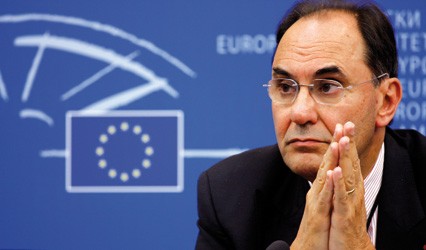
EP Vice-President: send the military police to Catalonia

What happened to the EU as a peace project? 

To many of our readers, Alejo Vidal-Quadras (see picture) will not ring a bell, but he is one of the Vice-Presidents of the European Parliament, and a member of Spanish Prime Minister Mariano Rajoy's Partido Popular. In the category 'unhelpful comments', Señor Vidal-Quadras has hit the jackpot.

Commenting on the tense situation in Catalonia - and the recent calls for a referendum on independence - he said,
Things must be said clearly. The [pledge to call a] referendum is illegal. An institution of the Spanish government, the Catalan parliament, has made a decision against the existing system.
Further to taking this decision to court, the government has to get in touch with [Catalan President Artur] Mas and tell him, ‘What you’ve done breaches the law. Rectify it, or else we will have to intervene’. If [Mas] refuses to do so, the [Spanish] Senate seats, votes, the [Catalan] parliament is dissolved, the Catalan government goes home and a delegation of the [central] government takes over power in Catalonia.
A Brigade General [of the Spanish Guardia Civil]…takes over from the Mossos d’Esquadra [Catalonia’s regional police corps]. And that’s it. If people take to the street, so be it, but they can’t go on demonstrating for more than a month. Demonstrations don’t feed the people. If [the Catalans] persist with this rebel attitude, the government has to intervene in the rebel region.
Vidal-Quadras is Catalan himself, by the way...

Now, this is a very tricky debate involving a huge number of aspects. But, unsurprisingly, Vidal-Quadras was shut down by his own party. In a TV interview this morning, Alicia Sánchez-Camacho (the leader of the Catalan branch of Partido Popular) said Vidal-Quadras was speaking in his personal capacity, as he does not hold any 'significant' position within the party - which goes to show how important many national politicians consider the European Parliament to be... 
 

Wednesday, September 26, 2012

Pressure mounts again for Don Mariano

Spanish Prime Minister Mariano Rajoy's trip to New York for the meeting of the UN General Assembly is coinciding with a particularly eventful week for Spain, on several fronts.

The Rodea el Congreso ('Encircle the Congress') anti-austerity rally outside the Spanish parliament building in Madrid turned violent yesterday, with 35 people arrested and 64 injured. The day before the rally, the Secretary General of Rajoy's party, María Dolores de Cospedal, recalled that the last time the Spanish parliament was 'encircled' was on the occasion of the failed military coup on 23 February 1981. The day after the rally, Spanish Interior Minister Jorge Fernández Díaz congratulated the police for handling the situation "magnificently". We assume these remarks have not done much to placate the protesters.

The demonstrations are clearly not good news for Rajoy and his cabinet. The Spanish government is due to unveil a new reform plan tomorrow, which may constitute the basis of the new Memorandum of Understanding, if (or should we say 'when'?) Spain decides to make its official request for EFSF/ECB bond-buying. As Rajoy himself anticipated in an interview with today's WSJ, the plan will include measures to cut the number of early retirements and the creation of an independent body in charge of monitoring Spain's compliance with EU-mandated deficit targets. Expect further protests fairly soon.

Meanwhile, the deficit of the Spanish central government stood at 4.77% of GDP at the end of August - with the target for the entire 2012 fixed at 4.5% of GDP. The Bank of Spain has this morning warned that, based on data available so far, Spanish GDP is continuing to fall "at a significant pace" during the third quarter of the year.

On the regional front, the rift between the Spanish government and Catalonia seems to be widening by the day. Catalan President Artur Mas announced yesterday that early elections will take place in Catalonia on 25 November. The autumn is going to be very tense, given that the Basque Country and Galicia will also hold early elections on 21 October. Crucially, Mas went one step further this morning, when he made clear that the Catalan people will be consulted on the issue of independence, with or without the authorisation of the Spanish government.

Furthermore, Andalusia's Treasury Minister Carmen Martínez Aguayo said yesterday that the region will “very likely” seek a bailout from the Spanish government. If confirmed, the request would be for a loan of over €4.9 billion. This means that Catalonia, Comunidad Valenciana, Murcia and Andalusia would, in total, need around 80% of the money in the bailout fund set up by the Spanish government to help all the 17 Comunidades Autónomas.

What else? Oh yes, in case you were wondering, Spain's borrowing costs are going up again. The interest rate on ten-year bonds is above 6% today.

In this context, it looks like Rajoy will not be able to hold out for much longer. The time for key decisions looks to be approaching - potentially marking a turning point for the future of Spain and the eurozone crisis. 

Friday, September 14, 2012

¡Cuidado, Señor Rajoy! The Catalans mean business (and the lesson is for the eurozone)

As we have noted before, whether you sit in Brussels, Berlin or Madrid - and like the idea of more central control - beware regionalism.

The relations between the Spanish central government and Catalonia seem to have reached a new level of tension in the past few days. Somewhat paradoxically, fresh from asking Madrid for a €5 billion bailout, Catalan leaders are starting to talk tough. There have been plenty of hints at independence - although the actual I-word has not been used in public speeches so far.
 
A pro-independence rally also brought Barcelona to a standstill on Tuesday, 11 September - when Catalans celebrate their national day, La Diada. In a perfect illustration of the forces of regionalism, local police said up to 1.5 million attended the rally, while the Guardia Civil (Spain's national police), cited 600,000 as a more realistic number. In any case, there were a lot of Catalans out on the streets.

Fueling the reinvigorated independence mood is Catalan Governor Artur Mas. The "success" of the pro-independence rally, he argued, shows that Catalonia can become "a normal nation in Europe" (during his speech he had only the Catalan and the EU flag behind him, see picture).

Yesterday, the Catalan Governor drew an interesting parallel with the eurozone crisis. He said,
"I think the same is happening between Catalonia and Spain as between northern and southern Europe. Northern Europe has grown tired of southern Europe. And southern Europe has grown tired of northern Europe because of its way of acting. I think that there is mutual fatigue between Catalonia and Spain, too. Catalonia has grown tired of not making progress and Spain [has grown tired] of Catalonia’s way of acting. Catalonia thinks it contributes a lot and is not respected. And Spain thinks Catalonia is always asking and complaining."
He said the time had come for a referendum on Catalonian independence, threatening early elections if Catalonia does not get greater tax collection powers. However, taking his eurozone parallell to its logical end point, he did not say whether the north and south in the eurozone should also opt for a divorce.

Because, as we have argued before (see here and here) and just as the Governor suggests (though, just to be clear, we're not taking any positions in the debate on Catalan independence!), Spain is a microcosm of what may be to come in the eurozone:
  • Catalonia wants greater taxation powers since it feels that is losing out under the current system. Only two out of 17 Comunidades Autónomas (the Basque Country and Navarra) are allowed to collect all taxes by themselves, and then send part of the money (the so-called cupo) to the central government. If Catalonia gets the same deal, it says it will save cash. So Catalonia wants to opt out of most of Spain's transfer union. If Spain finds it difficult to hold its together, how much more complicated will it be for the euro to move to a transfer union - and then hold it together?
  • And in a perfect illustration of what individual responsibility does: Basque Country and Navarra, the two regions that raise and spend most of their own taxes, are amongst the Spanish regions with the strongest finances (and likely to meet their deficit target at the end of the year). Catalonia is the has the highest debt/GDP ratio of all Spanish regions (see here).
Catalonia is not about to go independent. But this debate is a huge flashing warning sign for the eurozone.         
  

Thursday, August 30, 2012

Catalonia's bailout request is a test of Rajoy's mettle

In today's City AM we look at what Catalonia's decision to request a bailout from the Spanish government means for Spain, its Prime Minister Mariano Rajoy, and the eurozone. Here it is:
Catalonia's decision to seek a bailout from the Spanish government was just a matter of time. With over €5.7bn (£4.5bn) of debt maturing before the end of the year, Spain’s wealthiest – but also most heavily indebted – region had very little chance of paying its bills without some form of external assistance. The request is going to be a huge test of Prime Minister Mariano Rajoy’s mettle.
Despite asking for a loan of over €5bn – that is, almost one third of the money the Spanish government has earmarked to help all 17 of the Comunidades Autónomas – the Catalan government has so far shown no signs of graciousness towards the central government.
In fact, a Catalan government spokesman provocatively told the press that Catalonia will not even say “thank you” to the Spanish government for its help. The logic being that the money the region is going to borrow was Catalan taxpayers’ money in the first place – previously confiscated in order to pay for transfers to the rest of Spain. Most importantly, Catalonia has said it will reject any “political conditions” and has no intention to make further cuts to meet the deficit target imposed by the central government for this year.
The upcoming negotiations over the details of the bailout will therefore turn into a key credibility test for Rajoy, on two fronts. Domestically, his government simply cannot afford to display any weakness throughout the talks with the Catalan leaders. If Rajoy rolls over for Catalonia, other regions will feel encouraged to claim their share of cash from the central government, with little or no strings attached.
This will raise questions over whether the €18bn in the bailout fund set up by the Spanish government to help cash-strapped regions is going to be enough. At this stage, half of the money in the pot has already been committed, with only three of the 17 regions deciding to tap the fund, so far. 
At the European level, the Spanish government desperately needs to prove that it is capable of reining in the regions’ spending. As European Council president Herman Van Rompuy recalled during his visit to Madrid earlier this week, internal problems resulting from the way the Spanish state is organised are not Brussels’s, but Madrid’s. In other words, domestic inter-regional Spanish politics will not be considered a valid justification for Spain missing its EU-mandated deficit targets once again. 
With the markets broadly expecting Spain to ask the Eurozone’s temporary bailout fund, the European Financial Stability Facility, to start buying Spanish bonds in a bid to reduce its unsustainable borrowing costs, the Spanish government needs to make sure that it comes out of the negotiations with Catalonia in a position of strength.
If, on the other hand, Rajoy is shown to be unable to exert control in his own backyard, his negotiating position in Brussels will surely be weakened – and his Eurozone counterparts will be increasingly reluctant to take his promises of reform and fiscal consolidation seriously.

Tuesday, July 31, 2012

Spanish government vs Spanish regions: Episode 98,640 (and counting)

Fresh skirmishes between the Spanish government and some Spanish regions have taken place this afternoon, both ahead and during the meeting of the so-called Fiscal and Financial Policy Council - a forum for the Spanish Treasury Minister Cristóbal Montoro (pictured) to meet his regional counterparts.

The meeting is currently still under way, and the main item on the agenda is the 1.5% of GDP deficit target that Spanish regions will have to meet by the end of the year. As we argued in our recent briefing, the target seems unattainable for at least seven of Spain's 17 Comunidades Autónomas - which are expected to make cuts worth over 2.5% of their GDP.

Despite recently having its deficit targets relaxed by the European Commission, the Spanish government has refused to do the same for its regions. Reports in the Spanish press widely suggested that today's meeting was simply going to confirm that all regions will have to cut their deficits to 1.5% of GDP by the end of the year - even if this involves making additional budget cuts.

The government's decision has not gone down well with certain regions - to put it mildly. Thus, Catalonia this morning decided that it would boycott the meeting altogether. In the words of the Catalan government spokesman, Francesc Homs,
There's no point attending a meeting when everything has already been decided before.
Fair enough. But quite controversial, given that Catalonia is one of the three Spanish regions which have already declared that they will ask the central government for a bailout. Furthermore, Catalonia's minority government, led by nationalist Convergència i Unió party, is only able to govern with external support from Spanish Prime Minister Mariano Rajoy's Partido Popular.

And there is more. Andalusia - Spain's most populous region along with Catalonia - did go to the meeting with Mr Montoro, but abandoned the 'negotiating' table in protest against the government's decision to leave the 2012 deficit target for regions unchanged.

As we have argued here, regions will not make or break Spain financially. However, the latest events are yet another indication of how the clear difficulties in reining in spending at the regional level can undermine the Spanish government's credibility vis-à-vis its eurozone partners and the European Commission.

P.S.: Not really a regional issue, but still related to Madrid's credibility. The Spanish government was due to send its budgetary plans for 2013-14 to Brussels by the end of today, but has failed to do so. Perhaps not the biggest of deals, but the deadline was part of the agreement under which Spain was given an extra year to bring its deficit below 3% of GDP.  


Tuesday, May 29, 2012

Spain races against time

Things are looking sticky in Spain.

Firstly, the Spanish government announced a bail out of Bankia to the tune of €19bn in addition to the €4.5bn already put in - and is currently looking at the least painful way of getting cash to the bank. The plan is still up in the air. Yesterday there was talk about swopping government bonds for shares in the bank (Bankia could then use the bonds as collateral to get more cash from the ECB). This made a lot of people nervous, not least the Germans, who already worry that the link between states and ECB funding, via banks, is getting a bit too strong. Today's talk has instead focused on issuing bonds from Spain's specific bank bailout fund, FROB, to raise the cash Bankia needs.

Secondly, Catalonia - Spain’s wealthiest region - has asked the central government for financial assistance to repay its €13bn debt; bad news for the central government's debt and deficit. Thirdly, the the spread between Spain and Germany’s ten-year bonds reached its highest level since the introduction of the euro, with Spanish ten year bonds currently at around 6.4%.

There are a huge number of issues on the table here, but these events highlight three things that we pointed to in our April 3 briefing on Spain:
  • Despite Spanish PM Rajoy's remarks to the contrary, it looks increasingly as if Spain is slowly realising that it may not be able to afford to directly fund Bankia or other banks that run out of cash. And the numbers could well go up. This, in combination with talks and leaks over recent days that European money will be needed to backstop the Spanish banking system (Rajoy is very keen on more from the ECB), indicates that Spain is now moving ever closer to bank bailout via the EFSF.
  • A huge battle looms over the finances and economic autonomy of Spanish regions, that remain a massive liability for the central government's attempt to cut its debt and deficits.
  • Spain is racing against the clock. Naturally it will take time for the structural reforms that Spain is pursuing to have an impact - time that markets just won't give it at the moment.
Instead, it looks as though that time may soon have to be bought by eurozone taxpayers.