• Facebook
  • Facebook
  • Facebook
  • Facebook

Search This Blog

Visit our new website.
Showing posts with label repatriation of powers. Show all posts

Wednesday, May 07, 2014

Bonjour Monsieur Cameron, there are potential allies on EU reform on the other side of the Channel

Henri Guaino, a French MP from the centre-right UMP party and a former special advisor to President Nicolas Sarkozy, has an interesting interview on Europe in today's Le Figaro. Here are some key excerpts:
Q: What is the European Union, according to you?

A: The EU is France, Italy, Germany, Spain, Belgium...The [European] Commission, Parliament, Court of Justice are just institutions at the service of the states and the peoples of Europe. It doesn't make sense to speak of a general interest of the EU that transcends the interests of these peoples and these states. Institutions never transcend anything.

Q: Europe is peace...

A: It's not the EU that created peace, it's peace that created the EU, and the idea that one guarantees peace on the continent by weakening the states is a dangerous one: for years, the weakening of states has been going hand-in-hand with the rise in Europe of populism, extremism and social tensions. Let's be wary that the federalist dream doesn't turn into a nightmare.

Q: Are the European institutions in need of reform?

A: The institutional Meccano has hit its limits: every reform has just given birth to a bit more bureaucratic monster. There are only two democratic institutions: the [European] Council of heads of state and government, and the [European] Parliament. The Council is more democratic than Parliament because heads of state are more accountable to their fellow citizens than MEPs. It is not certain that democracy has gained a lot from shifting from an assembly composed of delegations from national parliaments to a directly elected assembly. But if there were only one decisive reform to be made, it would be to eliminate the prerogatives of the European Commission and turn it into an administration under the authority of the Presidency of the Council.
On subsidiarity, Monsieur Guaino said:
[Subsidiarity] is working the wrong way round. The EU tends to leave to member states what it can't do. On the contrary, it needs to be asserted that the EU is only destined to do what member states can't do. This principle must allow member states to take competences back from the EU, which has too many.
He also suggested that the principle of 'variable geometry' (in plain English, different levels of integration within the EU) should be "applied systematically".       
 
Finally, asked whether the EU "contributes to making politicians look increasingly powerless", Guaino replied:
Yes...The EU has buried the historical, geographical, cultural and demographic realities underneath the rules, the bureaucracies and the procedures. But realities always avenge themselves when they are ignored.
To put this interview into context, Henri Guaino belongs to the same party as pro-integration MEPs such as Alain Lamassoure or Joseph Daul - which illustrates that 'Europe' is an issue that cuts across parties in a number of countries, not just the UK. Secondly, David Cameron may have allies in unlikely places, which if cultivated could prove helpful in a future negotiation.

Wednesday, March 19, 2014

Where are the real fault lines in the EU?

Ipsos Mori has this week published an interesting poll on public attitudes* in ten EU member states. Across the ten countries as a whole relatively few people want to leave the EU outright (18% on average), but the single most popular option is staying in the EU but reducing its powers (34%).

Just over a third want to see either the EU’s powers strengthened further (19%), or even a long-term policy of working towards a single European government (18%) - click to enlarge the charts.


Broken down by country, the British (68%), along with the Swedes and Dutch (69% and 68% respectively) are most in favour of leaving or reducing the EU’s powers:


The research suggests that, on average, two in three (68%) think things across the EU are moving in the wrong direction. People from the Netherlands, Sweden, Belgium and Britain are in line with the average, but those in the Mediterranean countries are the most pessimistic.


France, is the most pessimistic of the countries polled, whch seems to have a lot to do with the state of the country's economy. People in France, Italy and Spain are all particularly negative about the EU’s impact on the economy (74%, 74%, and 68% respectively are critical), and many feel that their economy has been damaged by the demands of austerity (75%, 70%, and 75% respectively).

The UK political debate on Europe may be a few years ahead of many other countries (perhaps with the exception of the Netherlands), but at the level of the individual, there are many people disenchanted with the European project. Many countries are deeply split but, on average, there is clearly an appetitie for the EU to do less. Most interesting though is the striking fault line in the eurozone. Francois Hollande has had precious little influence on EU policy since his election as president, but the question is, how long before the French public's disenchantment is reperesented by its politicians?

If you think the UK is the awkward partner, imagine if French politicians actually started telling Chancellor Merkel what their people think about Europe.

* It should be noted that the poll is not representative of the entire electorate in Belgium, France, Great Britain, Germany, Hungary, Italy, Poland, Spain and Sweden (where 16-64 year olds were interviewed), while the Dutch panel is representative of voters. Why they chose not to poll people over 65 is unclear and in our view is likely to skew the results somewhat (in different directions for different countries).

Monday, February 03, 2014

Rückführung alert: CDU says repatriation of EU powers must be possible

This is interesting from today’s Handelsblatt. The paper has apparently seen the CDU’s draft manifesto ahead of the European elections. As a reminder: the CDU is Angela Merkel's party, which, along with its sister party, the CSU, won a landslide with 41.5% of the vote in the last federal election. It's what you would call the very definition of mainstream. 
 
The CDU manifesto calls for an “an effective regulation brake” with decisions needing to be “effective and more transparent.” Interestingly, the CDU manifesto suggests that the European Commission should be required to scrap an EU law if a majority of national parliaments says it could be handled better at the national or regional level . This seems to be very similar to the idea of a “red card”, which we long have argued for and which Dutch Foreign Minister Frans Timmermans, for example, has championed.

Perhaps even more interestingly, according to Handelsblatt, the CDU draft manifesto  also explicitly states that:
“a repatriation of competences to the national level should be possible.”
This is significant since German politicians tend to avoid using the word “repatriation” – or Rückführung – since it has strong connotations, instead preferring a range of other more guarded expressions including Dezentralisierung, Regionalisierung, Übertragung, Subsidiarität and Verhältnismäßigkeit.

Handelsblatt’s take on this is that that the :
“CDU is reacting to growing euroscepticism in the country” including to anti-euro party Alternative für Deutschland (AfD).
However, the take of CDU's campaigners is (as to be expected) that the party is simply becoming more realistic - which is a neat way of putting it:
 
Meanwhile, the Today programme has an interview with Hans-Olaf Henkel – formerly the head of the BDI (The German equivalent of the CBI) – now with AfD.

Henkel argues that though he wants return of EU powers, he also wants Germany to stay in the EU. Today's take on this is that "British sceptics may be disappointed" if they look to Berlin, concluding that “Even the German sceptics are not very sceptical when compared to their British counterparts.” Now, this isn't necessarily right nor wrong -- but just not very insightful.
  • First, as we’ve argued before, the main clash in Germany is not between the “pro-European” and “anti-European” schism that the BBC is constantly looking for, but rather between two key pillars of post-WWII Germany: Europe and sound money.
  • Secondly, is the BBC saying that the definition of “Eurosceptic” is now wanting to leave the EU?  If so -- it will have made a lot of "Better Off Outers" very happy. However, that also means that it can no longer use the "Eurosceptic" label for a whole of host of other actors, including large chunks of the current Conservative government which, irrespective of the rights or wrongs, want to stay in a reformed EU.

This isn't becoming too complicated for black-and-white labels, is it?

Sunday, December 29, 2013

CSU calls for devolution of EU powers and new subsidiarity safeguards

Der Spiegel this morning reports that the CSU has started an "anti-Brussels election campaign" citing an internal CSU strategy paper which will form the basis of the party's campaign for the 2014 European elections entitled "Europas Zukunft: Freiheit, Sicherheit, Regionalität und Bürgernähe" (which translates as Europe's future: Freedom, Security, Localism and closeness to the citizens). The paper is certainly highly critical of many aspects of the EU but it also sets out concrete reform proposals which include:

The return of certain competencies to member states: The possibility of this was already hinted at by Angela Merkel during the recent election campaign but the CSU are going one step further by providing some additional details by specifying regional policy (as recommended by Open Europe and Open Europe Berlin) and "parts of the over-regulated single market". It is not clear what exactly would come under the latter category but it is possible that it could include areas like social and employment law which are not strictly part of the single market but which have come to be seen as ancillary to it.

A new EU "subsidiarity" or "competences" Court: Der Spiegel quotes the paper as saying that "We need a form of withdrawal therapy for Commissioners intoxicated by regulation". The antidote it would seem will be a new EU subsidiarity or competences Court - composed of national constitutional judges/legal experts - which would mediate in cases where the Commission has allegedly overstepped its limits. This option has been voiced in Germany before but it looks like the CSU will give it a serious push. If combined with new powers for national parliaments, such as binding 'red card', this could be an effective way of keeping the Commission's desire to accrue new powers in check.

The paper also strongly reiterates the party's support for referenda to be held on EU issues in Germany and for shrinking the EU Commission.

Given that Cameron has not enjoyed the best headlines in Europe recently this late Christmas present will be very welcome at Number 10.

Thursday, November 07, 2013

France must take inspiration from David Cameron on Europe

This is the argument made in a very interesting op-ed penned by French MEP (and former Justice Minister) Rachida Dati, of the centre-right UMP party, for today's Le Figaro. We reported on the article in today's press summary, but we thought it was worth translating it (almost) in its entirety.

Here it is:
Is a new wind blowing through Brussels? The old myth of [European] federalism may be falling...The elite cheers the self-proclaimed 'Europeans', who, to preserve their post, write pamphlets lamenting this technocratic Europe, rejected by the peoples and origin of all populist movements. Some others want to change things, acting against the tide of the 'Brussels elite'. These are the modern, the courageous, the defenders of a realist Europe. David Cameron is one of them.

When he proposes to the British people a referendum on the UK's future in the EU, he acts responsibly. To deny [a referendum] to the British people, who are asking for it, would be the best means to exacerbate the anti-European sentiment that is on the rise not only across the Channel, but everywhere in Europe. When [David Cameron] proposes repatriating certain competences from Brussels to the national level, that's what we want too!

We believe, like David Cameron, that the future of Europe depends on it. It's with this same spirit that we must move forward with useful deregulation. David Cameron has had the audacity to put this idea onto the European agenda. Even [European Commission President] Barroso, the 'pusillanimous', has been forced to launch the REFIT programme, aimed at simplifying and easing EU law.

[...]

[French President] François Hollande is right to be cautious with the British offensive, which is good in the form, but whose exact outline we don't know yet. An ultra-liberal initiative would backfire against the people we say we are listening to. It is imperative to simplify [EU regulation] to boost the competitiveness of European businesses, especially SMEs. But this simplification must not be done to the detriment of certain rights of workers or the safeguard of citizens’ private life. However, this is a debate that deserves to be opened.
Ms Dati then goes on to address a specific EU policy area:
I plead for this simplification to be applied to the domain of energy as a matter of priority...The most serious problem [with EU energy policy] is the multiplicity of contradictory environmental, energy, and climate targets. Taken individually, these targets are laudable. But the facts have proven that, combined, they could cancel each other out - not to speak of the damage done to the competitiveness of our businesses. 

This is the case with renewable energy. Due to the subsidies it benefits from, the market is distorted as its use is prioritised. By their own nature, these sources of energy are intermittent, and cannot cope with energy demand on their own...I intend to make the ambition for a European energy policy that is more flexible in its targets and, finally, consistent, one of the priorities of the UMP's campaign for [next year's] European elections.

The UMP must finally stop hesitating about its European stance. We have never been listened to so much as when we knew how to talk and listen to the [French] people, particularly the popular classes. On Europe, they are asking us for a realist revolution. Let's listen to them!   

Wednesday, August 14, 2013

Boom! Merkel opens up for the return of powers from Brussels

Well, here’s an essential development for those of us who think reform in the EU – including “less Europe” - is fully possible. 

Speaking on an interview to Deutschlandfunk radio and Phoenix TV yesterday, German Chancellor Angela Merkel said decentralisation of powers from Brussels should be discussed once the German election is out of the way. Merkel said:
“I believe that in Europe at the moment we have to take care to coordinate our competitiveness more closely, and for that we don’t have to do everything in Brussels.
‘More Europe’ can not only mean transferring competences from national states to Europe, but you can also have ‘more Europe’ by coordinating national political actions more intensively and rigorously with others. So we discuss if we need even more competences for Europe.
However, we can also consider whether we can give something back. The Dutch are currently discussing this. And we will also have this discussion after the Bundestag elections. Or we can give more competences to the Commission in order to set agreements on specific issues with national states.”
We shouldn't get overly excited – it’s only one statement – but this is the first time, to our knowledge, that Merkel has explicitly opened for the return of powers from Brussels.  This will clearly be welcomed in Whitehall.

Merkel’s comments come at an interesting time. Just this morning it emerged that the eurozone has finally emerged from recession. Is this when Merkel turns away from an inward ‘crisis containment’ policy, towards a reform agenda? This agenda would be  designed, in part, to keep the UK inside the tent (which Berlin wants for a number of reasons), and in part, to kick-start desperately needed reform for the EU to become more competitive.

What's often lost on observers of this scene is that the two go together. As people in Berlin will tell you, Merkel is convinced that Cameron is one of the few EU leaders who understands the ‘global race’. He is seen an ally in ending Europe’s dependence on cheap cash (which is why the UK government simply has to stop lecturing the Germans on the need for turning the eurozone into a debt union).

As we've argued before,  the eurozone is unlikely to take the quantum leap towards more integration, after the German elections (as some still think).  However, a window of opportunity will open up for the UK and other reform-minded governments to come up some credible and concrete proposals for change. Berlin will no doubt be listening.

Also, the October European Council is likely to be a rare occasion when EU leaders won't focus all their energy on solving the eurozone crisis – instead they can now turn to wider question of how to make the EU as a whole to work for growth and competitiveness.

Cameron has a massive opportunity here.

To temper stuff a bit. Merkel hasn't turned into a Tory MP - she chooses her words on Europe carefully. Also, the comments did not make a splash in the German press at all. None of the major newspapers reported them – they were all rather more concerned about the on-going NSA scandal, and Merkel comments on that instead.

However, it would be a typical ‘Merkel coup’ to slowly, step-by-step, start rolling out a reform agenda in the EU, which – in a German way, wrapped in pro-EU rhetoric – would also involve less Europe.

This is getting interesting. 

Friday, June 21, 2013

Dutch government: "Time of ‘ever closer union’ in every possible area is behind us”

Dutch PM Mark Rutte (VVD) and Foreign Minister Frans
Timmermans (PVdA) discussing what the EU should
and should not be doing?
For anyone involved in the EU reform debate, this is a must-read. The Dutch government has today published its “subsidiarity review” – an assessment of what the EU should and shouldn't be involved in. Again, we're first to the punch in publishing an English version of the document on our blog.

This is likely to be welcomed with open arms in Whitehall – and should be studied carefully by MPs in Westminster. Though not all good news for David Cameron’s renegotiation strategy – the Dutch have explicitly said they don’t want EU treaty change for example – this is clearly a major step towards a reformed Europe.

First, it shows that discontent with the EU status quo is not simply a UK phenomenon – or a Tory problem as some commentators would have us believe. Secondly, the ideas the Dutch are putting forward are in themselves pertinent, and would go quite some way in achieving a better functioning, more democratic and better focused EU. Finally – and this is where it gets really good news for Cameron - countries like Sweden. Denmark and Germany are far more likely to be persuaded down the reform path if the Dutch are prepared to take a lead with the UK.

So what does the document say? Well, it sets out nine broad principles and 54 specific recommendations, relating to what the EU should and shouldn't do. Many of the proposals have also been championed by Open Europe in various forms (it’s worth re-visiting our “European localism” paper). Most significantly, in the press release, the Dutch government proclaims that the “time of an ‘ever closer union’ in every possible policy area is behind us”. This is not going to go down well in certain corners in Brussels.

The guiding principle is described as “European where necessary, national where possible”, and the tone of the entire document chimes well with Cameron’s EU speech, calling for a “European Union that is a more modest, more sober and at the same time more effective.” Interestingly, it notes that the Dutch EU Presidency in the first half of 2016 “could play a role in promoting such an agenda” – this could coincide with the beginning of the EU referendum campaign in the UK should Cameron be in power.

The 9 general principles include:
  • Where the European Court of Justice interprets EU law in a way that EU legislators had not provided for and/or did not intend, then this should be possible to address by amending the EU rules on which the Court based its ruling (this could well be a key plank in Cameron’s renegotiation strategy. An example of where the ECJ ruled in precisely such a way is the Working Time Directive, where the ECJ's interpretation of rules governing on-call time and rest periods for doctors has caused havoc in the NHS);
  • Every EU intervention needs to be motivated by a clear legal basis in the EU Treaties, and the Commission shouldn't be making proposals on a legal basis that is tenuous or insecure. The Dutch Government explicitly mentions the English term “creeping competences” (this is very similar to what the UK government wants); 
  • EU legislation should focus on main points to achieve shared goals rather than to prescribe in detail how those goals should be achieved (again echoes Cameron’s speech);
  • When there are widely shared objections to EU legislation, there should be a mechanism to stop the Commission taking any further initiative in that area – this is a bid to stop new EU laws in areas where national governments don’t want them.
As regards the 54 specific recommendations, they mention individual measures where EU power should be scaled back. There are many overlaps with UK ideas. These include:
  • Halting the further harmonisation of social security systems. The document says: “It is necessary to combat the negative impact of labour migration, including the abuse of social security systems” – an issue UK Home Secretary Theresa May has been keen to highlight; 
  • Limiting the EU budget - the Dutch hint at scrapping the EU's Globalisation Adjustment Fund and structural funds outside of the poorest regions in the poorest countries on the basis that these do not demonstrate added value (the latter is a proposal Open Europe has championed and which the previous Labour government had pushed for. It’s also gaining traction amongst Tory backbenchers) 
  • No expansion of agencies’ remits and no increases in their budgets – Cameron was very critical of EU quangos in his EU speech;
  • Working conditions, which should only be regulated in broad outline (health and safety and working time, for example);
  • No EU regulation of media pluralism; 
  • A two-year freeze in salaries of EU officials;
  • Sunset clauses should be incorporated in EU proposals (an old UK demand);
  • The Financial Transaction Tax is heavily criticised, because "it has been designed in such a way that even parties outside the FTT area, like Dutch pension funds, will be taxed when they trade financial instruments issued in FTT countries";
  • CO2 emissions should be dealt with at the global level rather than via EU legislation.  
There are also some further detailed examples of where the EU has gone too far and where powers should be rolled back. For example, the suggestion is made that flood risk management should only be harmonised at European level for truly trans-boundary water courses. The report also recommends the phasing out of the EU programmes for school milk and school fruit, and heavily criticises the recent proposal to ban refillable olive oil jugs from restaurant (which was eventually dropped by the European Commission).

However, the document also sets out clear limits to what the Dutch government says it is prepared to consider and it does not does call for entire policy areas to be returned to national governments. The Dutch government also says it is “not interested in treaty change or opt-outs” for itself.

Nonetheless, the fact that one of the EU’s founding members has stated that "the time of ever closer union is behind us" is clearly a major development.

Tuesday, May 28, 2013

New Open Europe/ComRes poll: British voters want changed relationship with EU rather than outright withdrawal

There has been a lot of debate recently about what the UK public really want in terms of the UK’s relationship with the EU. In an attempt to shed some further light on this Open Europe has today released a new poll conducted by ComRes.


The results show that among those certain to vote in next year’s European elections, UKIP would come first overall with 27%, closely followed by Labour on 23%. The Conservatives would come third with 21%. Two-fifths (39%) of Conservative voters from 2010 would vote UKIP in a European election if it were held tomorrow – this remains a major problem for the Conservatives.


However, paradoxically, there’s substantial support for David Cameron’s EU policy. If a referendum on Britain’s membership of the EU were held now, 37% say that they would vote to remain in the EU compared to 41% that say they would vote to leave. But, if there was a significant return of powers to Westminster followed by a referendum, 47% would vote to stay in the European Union, including one in five (20%) voters who say that they would vote UKIP in a UK General Election. Only one third of all voters (32%) would still vote to leave.

Of the individual party leaders, the public still has the most faith in David Cameron to negotiate a better deal for the UK in EU – though it’s clear that there’s a high degree of scepticism about whether a new deal can be delivered by anyone. In order address this 'credibility deficit', Cameron must start to press ahead with substantial reforms now.


In general, one thing is clear. That is the desire for a wider choice between simply In or Out. When asked to choose between different possible relationships that Britain could have with the EU, the public’s preferred option is to remain a member of the EU, without the Euro as their currency, but with the significant return of EU powers to the UK (38%). Surprisingly for an anti-EU party, “only” 61% of UKIP voters said they favoured completely withdrawing from the EU, with 30% saying they would be content with “significant return of EU powers”. For every other main party, a slimmed down EU was the single most popular option, suggesting that Ed Millband and Nick Clegg risk ending up out of step with their own voters if they continue to sit on their hands.

Here are some other interesting findings from the poll:
- In a General Election, Labour would win 37% of votes, followed by the Conservatives on 26%, UKIP on 20% and the Liberal Democrats on 9%. Under current constituency boundaries, Labour would win a majority of 110 seats with the Conservatives losing 102 seats. UKIP would not win any seats.

- More than half (55%) of the British public think that the Government should prioritise allowing the UK to have its own immigration policy when seeking to reform Britain’s relationship with the EU. Other areas of priority include giving the UK Parliament more powers to block un-wanted EU laws (42%), reducing Britain’s contribution to the EU budget (36%) and allowing the UK to have control over police and criminal justice laws (32%).

- 38% support the Prime Minister’s policy of negotiating new EU membership terms for the UK and then having an in/out referendum versus 32% who oppose it because they think meaningful renegotiation is impossible or want to withdraw altogether. Only one in ten voters (11%) say they favour the status quo and fear Cameron’s strategy creates “uncertainty”. 68% of Conservative voters, a surprising half of Lib Dem voters (52%), 32% of Labour voters and 21% of UKIP voters support Cameron’s strategy.

- However, when asked the question differently, six in ten (60%) think that it is unlikely that the Government will be able to deliver the changes it wants in the UK’s relationship with the EU – showing that whilst there’s support for Cameron’s strategy in principle, there remains a ‘credibility deficit’ which he must seek to close by pressing ahead with substantial reforms now.
See here for our full briefing on the poll results.

Friday, March 15, 2013

Will one of the Conservative 'Big Beasts' convert the party to 'better off out'?

Every Tory Big Beast needs to say something on Europe...
It is an essential qualification of the exclusive Conservative club of 'Big Beasts' - a group of high-profile Tories competing to succeed David Cameron, or who at least have considered themselves leadership contenders at one point or another - to have made an intervention on the UK's fraught relationship with Europe, preferably in a powerful article followed up by a substantial and well-thought through speech. With the half way mark in this Parliament crossed, and with the possibility of the Tories winning the 2015 general elections seemingly shrinking by the day (though much could still change), the Conservative Party is quietly contemplating a life in opposition, and who might possibly take over from Cameron.

For a range of reasons, Europe will feature prominently in any leadership campaign, and one particularly uncomfortable question will be difficult to avoid: will any of the contenders openly advocate the UK leaving the EU, thereby (if selected) making the Tories a 'better off out' party in opposition?

Well, here's our Big Beast watch, in chronological order (based on interventions in the debate over the least year). If we've omitted anyone, our apologies.

Michael Gove: A serving Cabinet Minister he nevertheless let if be known in the Mail on 13 October 2012 that he wants Britain to give other EU nations an ultimatum: "Give us back our sovereignty or we will walk out."

Philip Hammond: Not to be outdone he added his name to Goves's comments telling the BBC on 14 October 2012 that "What Michael is reflecting, and many of us feel, is that we are not satisfied with the current relationship between the EU and the UK."

Owen Paterson: He ventured outside of his pursuit of EU agricultural and fisheries reform on 7 December 2011 to tell the Spectator that "If there was a major fundamental change in our relationship, emerging from the creation of a new bloc which would be effectively a new country from which we were excluded, then I think inevitably there would be huge pressure for a referendum."

David Davis: A former Minister and Shadow Home Secretary, runner-up to Cameron in the last leadership contest and senior member of the BB club. He made a speech on the 19 November 2012 saying "We should seek the repatriation of a whole range of powers to create a new relationship between Britain and the EU" based on the original "Common Market [via] the so-called double referendum strategy." One referendum to approve a negotiation strategy and another to "approve the new negotiated relationship, or if it was not good enough, it would trigger the negotiation to leave the Union."

Boris Johnson: The Mayor of London on 4 December 2012 delivered his speech (video here) setting out a similar theme of renegotiation and referenda saying the UK should "Boil it to down to the single market, that's the great achievement of the European Union, I think we could easily scrap the social chapter, the fisheries policy." He concluded "The choice is going to be very simple: it's between staying in on our terms or getting out."

Dr Liam Fox: The Former Defence Secretary and leadership contender was next on 10 December 2012. In his speech to RUSI and Open Europe he argued that there was a new consensus forming that the "debate has centred on the need for a defined negotiating period over the EU issue ending in a much needed referendum." Concluding "To be frank, if the choice is between the current trajectory towards ever closer union and leaving, then I would choose to leave, albeit reluctantly. If the choice is between a looser, more economic relationship and leaving, then I would choose to stay. It is a view that, I believe, is gaining ever greater traction with the British people."

George Osborne: The Chancellor made an intervention in an interview with Die Welt saying: "I very much hope that Britain remains a member of the EU. But in order that we can remain in the European Union, the EU must change."

Adam Afriyie: The young pretender to the BB club and a former shadow Minister. He wrote an article for the Telegraph on 11 January 2013 arguing that "It is now time to ask the British people what they want. If the Government is to fulfil its commitment to offer people a real choice and a real change in our EU relations, then in my view it would be wise to offer two referendums: one in this parliament and a conclusive one in the next."

Andrea Leadsom: A new MP and therefore not traditionally considered a BB, Andrea Leadsom has however been a leading light in the Conservative EU Fresh Start project, working with a large number of her fellow MPs. Her views are summed up in an article for Conservative Home on 3 February 2013 after the Fresh Start manifesto was published on 16 January 2013.

Andrew Mitchell: Another BB new to the backbenches he added his weight to the European debate in an article for the FT on 19 February 2013 where he echoed David Cameron's sentiments and put forwards some ideas for European reform. However Mitchell has been widely tipped to be nominated as the UK's next EU Commissioner in 2014.

Theresa May: Although not a traditional BB, the Home Secretary may not have made any major interventions on the overall EU question, she made a speech on 9 March 2013 arguing that "by 2015 we’ll need a plan for dealing with the [non-EU] European Court of Human Rights. And yes, I want to be clear that all options – including leaving the Convention altogether – should be on the table."

Jesse Norman:  Another junior backbencher and not a conventional BB but has been widely tipped as a future leader, and he has raised his profile as the leader of a rebellion against the Coalition's plans to reform the House of Lords. He has now entered into the EU sphere with a thought-provoking article for the Telegraph yesterday followed up by a speech to the Localis think tank.

Of course David Cameron's speech of 23 January 2013 is the yardstick against which they will all have to be measured.

So what do we make of them? Well there is a surprising amount of agreement between the Big Beasts centred on the idea of a EU renegotiation followed by a referendum. Whoever is leading the Conservative party (in Government of Opposition) for the foreseeable future will probably subscribe to some variant of this. But there's also a possibility that someone goes down the 'better off out' route, perhaps triggered by some event in Europe which is perceived as a blow to the UK's chances of getting a new EU deal.

Who might that be? The comment field is open...

Monday, January 07, 2013

The case for bringing back some powers from Brussels... by Nick Clegg

As we noted in our guest piece over on Lib Dem Voice last week, if the Coalition needs inspiration for what to put in its "half-time" report or ideas for what reforms to target in Europe, a good place to start would be  revisiting Nick Clegg's chapter in the Orange Book. As an MEP in 2004, he put forward some sensible and innovative ideas for EU reform, including the repatriation of certain powers.

For example:

General approach to EU powers:
“A liberal approach to the allocation of responsibilities to the EU should be founded on a rigorous application of the principles of subsidiarity and proportionality… the EU must only act if there is a clear cross-border issue at stake, or when collective EU action brings collective benefits to all member states that they would not be able to secure on their own… This would help correct the lopsided nature of the EU and so make it more logical and comprehensible to British voters.” 
On Agricultural policy and farm subsidies:
“It would be more logical for the EU to wield strong powers in the manner in which agricultural products are traded across Europe, especially to guarantee high quality and animal welfare standards, whilst leaving much of the system of production support to national governments themselves, subject to EU rules on subsidies and fair competition.” 
On regional policy and the structural funds:
“There is a danger that the system of EU regional subsidies has reached a point of such excessive complexity that the value added of collective EU funds is being undermined. The founding logic of the so-called EU structural funds remains compelling – that the richer parts of the EU should help provide resources to those parts in dire straits, especially in helping to cover high infrastructure investment costs. Yet, in practice, regional funds are still being channelled to all member states, even Britain, France and Germany who are the main contributors in the first place. Logically, those governments should take full responsibility for the channelling of funds to their own regions, rather than rely on the recycling of funds via the EU… That, in turn, would allow the EU structural funds to concentrate wholly on those countries where the economic need for financial assistance is overwhelming.” 
On EU involvement in social and employment law:
“While it is, of course, entirely understandable to support EU measures because of their beneficial effects – working time and parental leave legislation spring to mind – doing so in order to supplant the normal domestic policy making process risks undermining the basic tenets of democratic accountability. If the EU were to be used systematically as a means to bypass domestic political debate, voters will be even more perplexed about who is responsible for what… It disrupts the key relationship between voters and those elected to public office if domestic issues with no obvious EU dimension are arbitrarily shuffled off to Brussels for resolution. For these reasons, there is a compelling case to curtail the EU in its responsibility in the social policy sphere.” 
On the EU budget:
"The multitude of small and dispersed EU budget lines, in everything from youth programmes and tourism, should substantially be reduced. It is highly doubtful whether their marginal benefits justify the scarce personnel resources in the European Commission allocated to them".
It's hard to disagree, and indeed we have echoed many of these points our reports over the last 18 months, for example on employment law, structural funds, CAP, the EU budget and EU 'localism'.

Time to get to work? 

Friday, January 04, 2013

How could the Lib Dems respond to David Cameron's upcoming Europe speech?

Earlier today we posed a guest piece over on Lib Dem Voice, looking at how the party could respond constructively to David Cameron's upcoming and long awaited Europe speech, which we reprise below:

The Westminster village might still be in post-holiday slumber mode, but a significant political event is due to take place only in a couple of weeks – David Cameron’s long awaited, ‘tantric’ speech on Europe. While the exact details remain unclear, Cameron could well argue that the UK’s terms of EU membership require revision, and that this should include the repatriation of some powers, after which the new package will be put to a referendum. So how should the Liberal Democrats respond? 
It could be argued that there has already been a pre-emptive response from Nick Clegg, who in his own recent EU speech described the unilateral repatriation of powers as “a false promise wrapped in a Union Jack”. Instead, he argued for pragmatic EU co-operation focusing on three things in particular: a tough budget settlement, defending and deepening the single market, and maintaining co-operation in the area of crime and policing. 
Meritorious as these are – even if there is a lively debate to be had on what institutional form the latter should take – they do not add up to a holistic long-term vision of Britain’s place in an evolving Europe. For example, given the current squeeze on public finances, the coalition is right to push for a freeze in EU expenditure, but this comes across as a time-specific damage limitation exercise without a broader vision for slimming down and rationalising the budget. Likewise, Clegg said he supports reforming and refocusing the EU, but has offered few concrete details in this and other recent public pronouncements. 
A new model of UK-EU relations is not only desirable but inevitable given that closer economic and political integration in the eurozone will render the status-quo null and void. As such, renegotiation is less of a threat to the UK’s EU membership and more of an opportunity to save it by placing it on a more democratically legitimate footing. Polls frequently show that such an option attracts a majority of public support when included alongside the binary ‘in/out’ question. Last year, detailed polling found a majority of UK public opinion backed such a move, including Lib Dem voters. 
The danger for the party is that it engages in the debate in too vague terms, thereby risking being left flat-footed when rivals reveal specific proposals. For example, the Fresh Start group of Conservative MPs has been busy preparing a comprehensive and detailed analysis of each key area of EU policy, alongside their suggestions for reform. If Lib Dems do not agree with their vision, they should at least be able to present a counter-proposal. 
A good place to look for inspiration would be Nick Clegg’s chapter in the Orange Book, written when he was still an MEP in 2004, containing some sensible yet innovative ideas for EU reform. Among other things, he claimed that it was democratically desirable for the flow of competencies to be a two-way street, arguing that “A liberal approach to the allocation of responsibilities to the EU should be founded on a rigorous application of the principles of subsidiarity and proportionality… Liberal Democrats should push for the reallocation of certain existing powers – including much of agricultural, regional and social policy”. In convincing terms, he made the case for a more flexible EU, more responsive to the needs of member states and citizens.
It is this critical yet constructive approach towards the EU which has been lacking in recent Lib Dem public statements on Europe, indeed, with some degree of irony, it could be argued that the party’s thinking on the issue risks coming across as conservative, while the Tories push ahead with a transformative agenda. It’s true that the debate about Europe in this country too often is framed in terms of British exceptionalism, and the UK has a bit of an image problem on the continent, seen as “jumping from veto to veto.” But Britain isn't alone in facing existential choices in Europe. If the party backs reform but views ‘unilateral’ repatriation as unacceptable, it should set out a credible new institutional framework for all 27 member states and look for allies in Europe. One such ally could be the Dutch liberal VVD party, whose leader, Prime Minister Mark Rutte, recently argued that the Netherlands would welcome a debate over whether Europe is involved in too many areas which could be done at the national level. 
Either way, as the debate in the UK and Europe intensifies, the party needs to be in a position to communicate to voters what its long term vision for Britain’s future in Europe is.

Monday, December 17, 2012

David Cameron says he can imagine the unimaginable: Brixit

Cameron pondering life outside the EU?
In his statement on last week's European Council summit, David Cameron was asked if he could imagine Britain leaving the EU. In the past he has usually batted away at these sorts of questions - but not this time. He said it was not an outcome he wanted, and that he does not spend much time thinking about it, but that:
"All futures for Britain are imaginable. We are in charge of own destiny, we can make our own choices." 
He added that:
"I believe the choice we should make is to stay in the European Union, to be members of the single market, to maximise our impact in Europe, but where we are unhappy with parts of the relationship we shouldn't be frightened of standing up and saying so." 
Significant? Well yes. This is the first time that David Cameron has publicly hinted at the possibility of a Brixit - the UK leaving the EU. This follows several interventions from Tory Bigwigs who've said that leaving the EU would not be a disaster, or should at least be the back-up option in case renegotiation fails. With Cameron's 'Big Europe Speech' now set for mid-January, it'll be hard for him not to frame the issue as "renegotiation or bust".

The debate is certainly heating up.

Friday, December 14, 2012

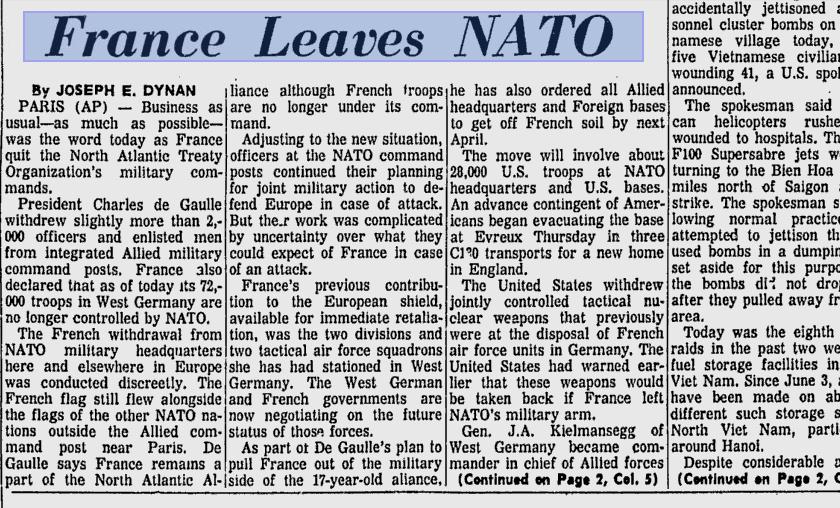
In Europe, a commitment is for life (unless you're France)

Give the French credit, they have an amazing ability to convince others that whatever the French position is, is also the 'pro-European' position.

At times, this can become laughable. Like today for example, when a UK journalist asked French President François Hollande to comment on David Cameron's hints at the 'repatriation' of EU powers. 

Hollande's answer,
To repatriate? Listen, generally when a country commits it is for life. Therefore, I believe that treaties are meant to be complied with. For the moment, I haven’t heard Mr Cameron asking to get out of certain [EU] competences during a European Council [meeting]. This discussion could take place but Europe is not a Europe in which you can take back competences. 
Right. Contrast and compare to François Hollande, March 2012 (during the presidential campaign),
I will renegotiate the fiscal discipline treaty not just for France, but for Europe as a whole. 
The [fiscal] treaty has been signed, but not ratified. Therefore, there’s some room for negotiation…My determination will be total.
Fair enough, "signed but not ratified" but still, hardly a display of cohérence by the French President. And with regard to France's record on the "when a country commits it is for life" stuff, we can't help but to think of this...


Just saying...

Friday, November 02, 2012

Nick Clegg’s opposition to renegotiation could risk the UK’s EU membership

Following Nick Clegg's Europe speech at Chatham House yesterday, we argued on the Spectator's Coffee House blog,

Nick Clegg this morning fell into the usual ‘all or nothing’ fallacy on Europe. He said: ‘As soon as we start talking about repatriation, we descend into the in-versus-out debate.’ But the Deputy Prime Minister is wrong: the in/out debate is already underway, and rather than seek to defend the unpopular status quo, Nick Clegg should back renegotiation as the best option for those who wish to put the UK’s membership on a stable democratic footing.
But instead of attempting to address the causes for the EU’s unpopularity, the inflated budget, democracy deficit and bureaucracy etc. Nick Clegg sought to channel the debate into his own in/out debate where the problems of ‘out’ justify doing nothing about the problems of ‘in’.
Clegg said that UK can either be a full member of the EU or outside, like Norway and Switzerland. He is right that Norway as a member of the EEA does indeed implement a large proportion of EU law over which it has little influence and that Switzerland does not have full access for its services industries. He also pointed out that with no EU deal ‘firms who currently pay no import tariffs on the goods they send to the continent would be faced with taxes of up to 22 per cent’.  It is actually more like 10 per cent but the point is the same. However, protesting that no one is suggesting joining the EEA or not having a free trade deal with the EU is missing the point. Nick Clegg is presenting a false choice.
There is not one standard EU membership. The UK is not in the Schengen travel area, others are. The UK has a different deal on EU crime and police law than Denmark, which is fully opted out. There are neutral states and those involved in EU defence, there is the euro, the list goes on. But for Clegg there are only two types.
‘There’s the core: where the Eurozone countries are now pulling together more closely… Then there is the ring around that… And the outer circle… The UK is in the inner circle – but the terrain is shifting. The core is tightening – to what degree we don’t yet know.’
Clegg believes we should remain ‘a strong UK, influential in Europe’, but does not define what he wants to influence or convincingly explain why we should be in anything beyond the single market and some absolutely vital cross-border measures. Clegg’s reasoning:
‘What kind of club gives you a full pass, with all the perks, but doesn’t expect you to pay the full membership fee or abide by all the rules?’
This is an odd justification for the EU’s Common Agricultural Policy, Common Fisheries Policy, social and employment regulation, wasteful regional policy and unnecessary loss of democratic control. Are these accepted as some bizarre self-imposed flagellation for daring to desire free trade? If so, why not just accept a rise in the EU budget and get on with it? It’s the ‘subscription’ fee after all.
So what should the UK aim for? In a recent paper we set out that for now the UK benefits from being in the EU’s customs union and single market for good and services but that all other areas should be decided on a case by case basis. Is this pick -and-mix EU possible? Yes. The EU, as Clegg acknowledges, is changing. The eurozone is renegotiating its membership terms, and the treaties will need to be revisited sooner or later. This will present the UK with the opportunity to reform its membership terms and put it on a stable democratic foundation in line with public opinion.

Friday, August 03, 2012

Cameron needs credibility on Europe – here are two things he can do immediately to get it

Over on Conservative Home, we argue
The Coalition has already done some good work on the EU, the ‘referendum lock’ and the recently launched ‘audit’ of the EU’s influence on the UK to name two. However, the constraints of coalition government have tested the loyalties of Conservative MPs, party members and potential voters who wish to see substantial changes to the UK’s EU membership terms. As a result, Europe could damage the electoral coalition the Conservatives need to muster in order to win an outright victory. This is borne out by recent polling by Lord Ashcroft, which shows that 10% of Conservative voters say they would now vote for UKIP. Of course this may not happen, those who say they will vote UKIP may, when it comes to it, vote to keep the Labour party out. But it would be foolish to advocate complacency, not least as this also links to general trust in politicians. So what can be done?
Some talk of deals with UKIP, some talk of promises of a referendum, some talk of the need for a better defined Conservative vision for a post-2015 Government. These proposals all have specific problems and one major problem: Credibility. Would anyone (including in the first instance UKIP-inclined voters) believe them? Increasingly, the answer is no.
For this group of the electorate and party base, the Conservatives’ credibility on Europe has been hit by a series of forced and unforced errors. Whether perceived or real, the overselling of the Lisbon Treaty ‘cast iron’ guarantee, the revelations that before the election David Cameron’s policies may have been framed with Coalition in mind, the CCHQ prohibition on candidates campaigning on Europe, the opting in to EU crime and policing laws, lecturing the French and Germans on the need to create a Fiscal Union and now Cameron ruling out forever leaving the EU, all chip away at his credibility. In short, Cameron could promise to spend every waking moment committed to achieving new, improved EU membership terms, jump over the EU parapet, look back, and see his troops have opted to stay in the trenches.
Fortunately for David Cameron he has two great opportunities to address these concerns and reassure the electorate he means business, two opportunities where he can either act unilaterally or use a veto. Importantly both these opportunities come before the next election.
Firstly, David Cameron should use a quirk of the Lisbon Treaty to activate the 2014 block opt-out and repatriate around 130 EU crime and policing laws, rather than allowing them to fall under the jurisdiction of the European Court of Justice. He should then avoid squandering this gain by resisting pressure from within the coalition to opt back into them piecemeal. He should instead argue for either a better deal, under which the European Court has no jurisdiction in the UK over criminal law, or stay outside permanently.
Secondly, the UK should demand root and branch reform of EU regional policy, repatriating responsibility for regional funding to the UK and other richer member states. Limiting EU-managed regional funds to poorer countries would mean that 23 out of 27 EU countries pay less into the EU budget than at present, saving the UK £4bn net over seven years (in addition to the £8.7bn it currently gets back through the EU regional funds). This is achievable but Cameron must make it clear that he is prepared to veto the next multi-year EU budget, currently up for negotiation, in order to make this demand more credible.
These two measures would achieve several objectives simultaneously – a reduced EU budget contribution, repatriation of two areas of power from Brussels and limiting the powers of the EU judges – an early opportunity to get some ‘balls in the net’. If Cameron takes these two opportunities, this would be a substantial down payment for future electoral credibility which he will need when he promises a wider renegotiation with the EU. Without it, any future manifesto promise may be skilfully crafted but will not sway many voters’ minds.
 

Wednesday, July 18, 2012

Campaign to devolve EU regional policy gathers momentum

Last Friday, the Parliamentary Select Committee for Communities and Local Government's inquiry into the European Regional Development Fund, to which Open Europe submitted both written and oral evidence, published its final reportAmong others, the report recommended that:
“We support the principle of repatriating regional policy funding, provided funding could be protected and ring-fenced over the long-term to ensure that the poorest English regions continued to receive the same level of support they would have received under the current system.” 
 In our recent report on the subject, Open Europe recommended that:
"Limiting EU regional spending to poorer countries [GDP below 90% of the EU average] would be a win-win situation for both Britain and Europe. It would channel more cash to the newest member states and allow the UK to spend exactly the same amount on its regions as it does now, with the option of adding the several billion that it would save from streamlining the structural funds. It would also eliminate a range of additional costs and allow the Government to radically improve the targeting of funds towards poorer areas and to viable projects.” 
We are therefore delighted that MPs accepted the central tenet of our recommendations, especially as Open Europe was the only organisation profoundly critical of the status quo to submit evidence. However, we consider that there is a realistic prospect of the government being able to secure this reform in 2014 – and that the government should be prepared to veto the next MFF, currently up for negotiation, in order to make this demand more credible – whereas the Committee sees this as an objective for 2020 and beyond.

Just to briefly recap the arguments why the reform would be a win-win for the UK and Europe:
  • While it can generate added value in individual cases, involving all member states in EU regional spending, irrespective of their relative wealth, is economically irrational. In richer member states, the structural funds mostly serve to redistribute income within the same regions. As the Commission itself has admitted, this exercise creates “considerable administrative and opportunity costs”;
  • Over the 2007-2013 EU budgetary period, the UK is contributing roughly £29.5bn to the funds, and getting back around £8.7bn. Of the 37 regions in Britain under the EU’s classification system, 35 are net contributors to the structural funds, with only West Wales and Cornwall net beneficiaries. Some relatively poor areas lose out substantially; for example, the West Midlands, which has the lowest disposable income per capita in the UK, pays £3.55 to the structural funds for every £1 it gets back;
  • Limiting the structural funds to poorer countries would result in 23 out of 27 EU countries paying less into the EU budget than at present. - all new EU member states would be better off. The UK would save around £4bn net over seven years in addition to the £8.7bn it currently gets back through the structural funds. This option could therefore attract strong political support in many capitals, especially given the current need for governments to make savings;
  • Domestically, it could enjoy cross-party support given that it was originally a policy championed by the previous Labour government, and areas represented by Labour MPs stand to be the biggest winners under this reform. 
All in all, the campaign to reform EU regional policy is gathering momentum...

Thursday, December 08, 2011

30 MPs and Lords back our proposal for "emergency brake" on financial services

In a letter to the Telegraph today 30 MPs and Lords back Open Europe’s recommendations that David Cameron seek, at the very least, a new Single Market protocol or an “emergency brake” on EU financial services laws at this week’s EU summit.

Here it is in full:

SIR – European Union proposals pose a grave threat to Britain’s financial services industry, which employs nearly two million people, accounts for 10 per cent of GDP, and generates over £50 billion in tax receipts annually.

Although there have undoubtedly been regulatory failures in recent years, future policy should primarily be decided by Britain, not the EU.

There are nearly 50 proposals under consideration by the EU. The most troubling include a unilateral, EU-wide financial transactions tax which would inflict enormous damage on Britain’s economic interests, a ban on some short-selling and a European Central Bank proposal that transactions on euro-denominated financial products are only cleared in the eurozone.

From 2014, Britain will have only 12 per cent of the votes in the Council of Ministers and 10 per cent in the European Parliament, yet it accounts for 36 per cent of the EU’s wholesale finance industry and enjoys a 61 per cent share of the EU’s net exports of international transactions in financial services.

It is imperative that the Government fights our corner by arguing either for a new EU protocol or a Britain-specific legal safeguard. Without strong action, the present drift seriously threatens both British jobs and Exchequer revenues.

Andrea Leadsom MP
Chris Heaton-Harris MP
George Eustice MP
Desmond Swayne MP
Sajid Javid MP
Nicholas Soames MP
Ben Gummer MP
Margot James MP
Nadhim Zahawi MP
Harriett Baldwin MP
Karen Bradley MP
James Gray MP
Amber Rudd MP
Anne-Marie Morris MP
Bernard Jenkin MP
Dominic Raab MP
Lord Trimble
Steve Brine MP
Lord Risby
Mike Weatherley MP
Geoffrey Clifton-Brown MP
Mark Garnier MP
Esther McVey MP
Caroline Dinenage MP
Andrew Bridgen MP
Michael Fallon MP
Matthew Hancock MP
David Ruffley MP
Lord Flight
Viscount Trenchard

London SW1

Significantly, the letter is signed by Cameron and George Osborne's Parliamentary Private Secretaries, Desmond Swayne MP and Sajid Javid MP, potentially a sign that the Government is sympathetic to the idea of UK veto over financial services.

There's a long way to go until close of play on Friday night when the dust will settle for a short while on this week's summit (there will be more like it before too long) but there are some encouraging signs that the Government is starting to get the message.

Tuesday, October 25, 2011

Rebels in need of a cause?

As you are undoubtedly aware by now, last night 79 Conservative MPs defied a three line whip to vote for a referendum on the EU. There have been Tory euro rebellions before, and no doubt there will be again – but this one was different. Not only did it take in nearly half of all Tory backbenchers, but it also included many of the 2010 intake untainted by the Tory euro wars of old. This new group are not against the EU in its entirety but wish to see some form of EU reform where powers are returned to the member states. Much can be said about yesterday's vote - and we'll return to this issue when the dust has settled and tempers have cooled down.

Leaving aside the issues of Cameron's party management skills, backbench powers and residual discontent over the Coalition (pretty big issues in domestic politics for sure), yesterday's debate, whilst good in part, did suffer from a certain lack of clarity and definition.

We know that many MPs are unhappy about the status quo in Europe - that was clear from the interventions. But moving beyond discontent, what sort of Europe are MPs/should MPs be arguing for? David Cameron said that he agreed with the rebels as to their ends but not their means – yet scratch the surface and there are a variety of opinions, some informed, and some less so. Some MPs talk of repatriating powers, others of a free trade agreement, and some of a Norway-style arrangement as if these were mutually interchangeable. In fairness Tory MP Nadim Zahawi made exactly the same point during his speech yesterday. There is also disagreement as to what the UK's negotiating position ought to be; some believe the eurozone crisis has given the UK a golden opportunity to demand reform, while others take a more cautious line.

But - and this is where the debate is likely to head next - there's growing agreement across the political spectrum that the move toward eurozone fiscal union creates a new situation for the UK and one the UK needs to respond to in a strategic manner. It is unclear when or if there will be a new treaty, but when the time comes the UK will need to know what to ask for. In other words, we need to calmly and rationally weigh up the UK’s membership of the EU and decide what our priorities should be.

Strategies should include:

What does the UK need to safeguard from an unsympathetic eurozone voting caucus? What should be decided at the national level only? How can safeguards and carve-outs be made watertight and legally binding, given the EU's history of circumventing such measures (think Charter of Fundamental Rights)? What does the UK do if there's a new eurozone-only Treaty, stripping the UK of its veto over the next step of European integration, but leaving it exposed to the secondary effects?

These questions need answering, and the government needs to draw up a plan to make sure the UK's priorities get pushed through. It is important that the UK ascertains who its potential allies are, what its negotiating levers are, and when to use these to maximum effect. Encouragingly, it looks like this process might already be under way, as the government announced this afternoon that a review of which powers could be returned from Brussels to Westminster is in its early stages, with Europe Minister David Lidington saying that he “would welcome constructive suggestions from the Opposition as well as any part of this House as that work is carried forward."

If last night’s vote increases the sense of urgency in the need to come up with such a properly thought-out strategic plan then it will have served some good.

If not then it will be just another chapter in Conservative Party’s internal politics.