• Facebook
  • Facebook
  • Facebook
  • Facebook

Search This Blog

Visit our new website.

Thursday, September 15, 2011

In public

Apparently, the Dutch Parliament has given the country's Finance Minister Jan Kees de Jager until Friday to outline possible scenarios for how to deal with Greece, including the impact on the Netherlands should the Greek government default on its debt.

This comes hot on the heels of leaks in the Dutch media, claiming that the Dutch Finance Ministry now considers a Greek default "unavoidable". According to the leaked documents, the Dutch government is now instead planning for how to manage a Greek default in an orderly manner. The reports were immediately denied by the Finance Ministry). The other night, Dutch TV programme Nieuwsuur (the Dutch equivalent to BBC Newsnight) featured an interview with de Jager (picture), who said (our emphasis):
"as Finance Minister I need to assume in public that Greece is complying with its obligations, but for us it is important that we continue to insist that Greece sticks to the agreement and if they don't, then we'll have to indicate that we cannot contribute our share."
As the reported highlighted, note the use of "in public" (suggesting that "in private" he thinks otherwise). Hardly an earth-shattering revelation given the state of the Greek economy, but still interesting to see him being so candid about it. He also seamed to suggest that leaks of this kind could serve to put additional pressure on Greece.

A the risk of a Greek default, he said:
"There is indeed a large risk, and it can be that Greece forces us to do that. However, this kind of pressure can push Greece to take yet another step. And that's what we're assuming for now."

Wednesday, September 14, 2011

The Evolution of Greek Debt


A light-hearted illustration (if that is possible in these grim times) of how the problem of Greek debt has grown in size over the last two years (hat-tip: Forum Ordnungspolitik)...

Tuesday, September 13, 2011

Follow our event 'EU aid: what is it for?' online

Tonight we will be holding a joint event with the ODI on EU external aid, following our report on the subject earlier in the year, "EU external aid: who is it for?".

The speakers are:

Baroness Glenys Kinnock, Opposition Spokesperson for the Department of International Development in the House of Lords

Chris Heaton-Harris MP, Member of Parliament for Daventry

Simon Maxwell CBE, Senior Research Associate, Overseas Development Institute

Stephen Booth, Research Director, Open Europe

Chair: Liz Ford, Deputy Editor of the Guardian's Global development website.

The attendance list is now full but if you wish to watch the event online, it will be streamed live here from 6.30pm:
http://www.odi.org.uk/events/details.asp?id=2684&title=eu-aid

Raus Aus Dem Euro!

We've just learned from FAZ that about one hundred protesters from the so-called Party of Reason and the Free Voters movement rallied outside the ECB headquarters in Frankfurt today. All Germans, they were equipped with blue-on-white placards conveying two very simple messages: Raus aus dem Euro (Out of the euro) and Nein zur Schuldenunion (No to debt union). The paper notes that the majority were people in their mid-thirties and mid-forties, arriving straight from their offices (see picture).

Nothing to do with the thousands of Spanish indignados for the moment, but it's the first time a protest has taken place outside the ECB buildings, and it may well not be the last...

Max Hastings: "I was wrong" about the EU

In today's Daily Mail, Max Hastings makes a self-described recantation of his formerly "pro-European" stance:

"After much agonising and hesitation, I adopt the conclusion that many of you probably reached years ago: that the EU in its present form has become a disaster, which threatens the future of its major members, unless its terms and powers are drastically recast."
His argument for the change of heart is powerful - although we would argue that pointing out the failings of the EU doesn't mean that Hastings can no longer describe himself as "pro-European", just that he is now a "pro-European" of a different sort.

He cites a long list of burdensome EU regulations, such as the Temporary Agency Workers Directive and the Resale Rights Directive, which are holding back the UK and other EU members from competing with the world's emerging economies:
"At a time when we face a historic challenge from Asia, the EU makes it almost impossible to adopt measures essential to strengthening its members’ competitiveness, above all the relaxation of employment law. This has become, for practical purposes, unemployment law."He lists other failures too. The lack of a meaningful foreign policy, the corruption of the European Parliament and, of course, the failed Single Currency, whose perceived success, in Hasting's words, "was an illusion created by smoke, mirrors, prodigious subsidy and reckless borrowing."
For Hastings, "membership of the EU in its present form has become a blight, imposing unacceptable social, cultural, commercial and industrial burdens and constraints" but the option of outright withdrawal is rejected, which he suggests would quickly lead to "lonely isolation":
"I realise that quitting Europe would engage us in a crisis that would sap the entire energy and attentions of any British government for years.

But it has become essential to repatriate powers from Brussels. This is not in furtherance of isolationism, but of the economic imperative to strengthen our competitive position in the world and repair our social fabric."
It's well worth a read in full.

Member states shoot across Commission's bow in budget talks

It's unclear whether European Commission is embarrassed by yesterday's rejection, by eight member states, of its 2014-2020 budget proposal (also known as the MFF). But it was certainly sent a stiff message by the biggest net contributors.

After talks in Brussels, the UK's Europe Minister David Lidington and his counterparts from Austria, Denmark, Germany, Finland, France, Italy, the Netherlands and Sweden issued a statement warning:
"We need to make the best use of the European budget to create better conditions for growth and make Europe more competitive. We need to spend better, not to spend more."
They added,
"The Commission proposal is too high. The increases of spending over the next MFF are significantly in excess of what is needed for a stabilisation of the European budget. The new Multi-Annual Financial Framework (MFF) should not lead to an increase in national contributions to the EU budget."
According to the Treasury's calculations, the Commission's proposal would see annual cash contributions to the budget increase by 11% (based on this year's contribution) - figures that the Commission disputes. The UK's demands for a cash freeze were not discussed at yesterday's meeting, according to Reuters. However, the fact that these countries have signalled their intent to resist inflation-busting increases so early in the negotiation process is indeed encouraging.

Yes, the Commission doesn't have the easiest job, trying to find the balance between net contributors and net recipients, in addition to the European Parliament. And yes, the European Commission has been burnt in previous budget negotiations by tabling an initial proposal that was too far away from one or more of the negotiating parties' starting positions. And also, to be fair, it has made a bit of an effort by proposing a cut to staff numbers in the EU institutions. That's something.

But, in the eyes of the public, the Commission still looks completely out of touch when it repeatedly talks about its "justified requests" for more money since the EU budget is for "growth and jobs" (oh yes, that hugely successful job-creation scheme known as the Common Agricultural Policy).

The vital question remains however whether this burgeoning coalition of member states can come up with a concrete budget proposal of their own, which they can all agree on.

Monday, September 12, 2011

Angela Merkel's office lights up

The German Association of Young Entrepreneurs or Bundesverband Junger Unternehmer has started a campaign against the current methods being employed to 'save the euro'.

As a means of showing their discontent, they have projected the words “Euro Rettung: So nicht!”, meaning "Euro Rescue: not like that!" on the facade of Angela Merkel’s Chancellery.

Europe: It's so hot right now

There was a time when "Europe" was an issue that drew the occasional news story. And although EU issues still don't get nearly enough attention in British and European media, it has now reached a stage where it is literally impossible not to give this issue (which in fact, is a whole range of different issues) some serious attention.

And there are several story lines unfolding in parallel:
  • Osborne went on record over the weekend, saying that a new EU treaty to fix the eurozone is now "on the cards". According to the Telegraph, a proposal will be tabled in the autumn which would see negotiations over the Treaty commence as early as December. This is clearly a moving target - and we shouldn't draw hasty conclusions. But potential talks over a new EU treaty so soon is clearly big news.
  • It comes as a group of 90+ MPs will meet tonight in Westminster, as part of a new initiative to help the Government come up with constructive ideas for how to re-order the UK's relationship with Europe. In an interview with Saturday's Times, Foreign Secretary William Hague appeared to semi-endorse the group, saying: "I was talking to some of them about it last night…It’s certainly not career suicide. I’m always pleased by good, healthy, democratic debate. They’re not approaching it in a confrontational spirit. They will be welcome in this office to discuss it.”
  • Osborne also said over the weekend that Hague was drawing up a list of demands for powers to be repatriated to Britain in return for treaty change. To us, it seems increasingly as though the UK government has made a policy shift over recent weeks, and is now openly acknowledging that the aim is to bring some powers back should a new EU Treaty be up for negotiation.
Meanwhile in the eurozone:
  • ECB Chief Economist Jürgen Stark resigned from the ECB’s Executive Board on Friday “for personal reasons” – although the move is almost certainly linked to disagreements over the ECB’s on-going purchases of weaker eurozone countries’ bonds. As Handelsblatt notes, his resignation has made it clear that "Germany's stability culture has not managed to prevail within the ECB. The Central Bank is increasingly becoming an instrument of politicians."
  • Ambrose notes in the Telegraph, this move marks "a German vote of no confidence in EMU management." The decision has thrown global markets into fresh turmoil.
  • German media report that officials at the German Finance Ministry are looking into the consequences of not lending Greece more money. Two scenarios are being discussed, according to Der Spiegel: Greece going through a hard default but remaining in the eurozone; or going through a hard default and leaving the single currency.
  • In a further sign of the tensions within Germany, the junior coalition partner to Angela Merkel, the FDP, are planning to organise an internal referendum on the future of the European Stability Mechanism (ESM), the eurozone’s post-2013 permanent bailout fund. The article notes that 3,400 signatures – about 5% of FDP members – are needed to call this referendum. If one-third of party members take part in the vote, the result becomes official party policy.
  • In an interview with Greek TV channel Mega, Greek Deputy Finance Minister Filippos Sachinidis has warned that Greece will run out of liquidity next month, if the next tranche of the first EU/IMF bailout is not paid out.
And elsewhere: Slovakian President Ivan Gasparovic has admitted that the Slovakian government may collapse as a result of disagreements over changes to the EFSF, the eurozone’s temporary bailout mechanism.

There's clearly no such thing as a quiet EU news week any more.

Go local

Today we publish a report, written by ex-head of Policy Exchange Anthony Browne and our Director Mats Persson, suggesting a fresh EU strategy for the UK government - European localism. In yesterday's Sunday Times, we trailed the piece, arguing:
"closer union cannot continue for ever. In some ways the EU is already more centralised than a country — individual American states have more freedom over sales tax than do EU members. And what was right 50 years ago is not necessarily right now. When challenges change, so should institutions.

The euro crisis has tested to destruction the principle of ever closer union — its momentum required Greece to join the euro when it was not ready, directly leading to turmoil. As the crisis has unfolded, the debate has moved to an existential question: what kind of Europe do Europeans want?"

We go on to say:

"Popular support for the EU has plummeted even in the countries that were once most supportive and national parliaments have grown restive because their powers are being usurped. The euro crisis is also forcing Europe to develop a more variable approach to co-operation, with countries integrating at different speeds.

The EU is ripe for change and this presents Britain with an opportunity to push forward its own strategy — which we call European localism. Since it joined in 1973 Britain has never shared the strategic vision of ever closer union, but nor has it had an alternative strategy of its own. As a result it has remained disengaged from Brussels, focusing on defensive tactics limiting the perceived damage of European legislation, rather than trying to steer the direction of the EU. This is an unsatisfactory position."

But, we argue, in the wake of the crisis,

"Britain can position itself as the champion of European localism, taking the principles and rhetoric of localism widely endorsed at a national level and applying them at a European level. The same arguments apply: if you devolve where possible and centralise only where necessary, you get better democratic engagement, more flexibility and better policy making."

As we note in our press release, in terms of concrete proposals, this would include:
  • Parliament should be given the right to approve the UK appointment of judges to the European Court of Justice, to hear their views on European integration, just as Congress approves presidential appointments to the Supreme Court in the US;
  • The Government should consider taking the European Commission to the European Court of Justice for breaches of subsidiarity, the legal principle underpinning localism that is now enshrined as a founding principle of the EU in the Lisbon Treaty;
  • The role of national parliaments should be strengthened by a new “red card” mechanism, whereby if two thirds – or in particularly sensitive areas, half – of national parliaments express concerns about EU legislation or European Court of Justice rulings, then the EU would have to abandon legislation or overturn the ruling;
  • The UK Parliament should work with other national parliaments to set up an “Inter-parliamentary Task Force on Localism”, acting independently from EU institutions, to ensure that the EU does not involve itself in issues that should be left to national governments;
  • A new mechanism should be introduced enabling member states to repatriate powers over certain policy areas, even if all 27 countries do not want to do so, resulting in a variable, more democratic Europe where powers can flow both to and from Brussels;
  • The Government should use its legal rights under the Lisbon Treaty to unilaterally repatriate up to 90 Justice and Home Affairs laws, and should prioritise other areas where it wants to repatriate powers;
  • The Government should subject all significant EU proposals to a robust subsidiarity test, and should hold the European Commission to account for rejecting parliament’s complaints about breaches of the subsidiarity principle;
  • The Government should lobby for a new European Subsidiarity Court, to uphold breaches of subsidiarity;
  • The Foreign Office should set up a ‘European Localism Unit’ to drive the localism agenda across Whitehall departments affected by the EU;
  • Form a ‘localism bloc’ of like-minded EU nations, starting with a conference in London.
As we conclude in the Sunday Times piece, This "is a strategy that should command wide cross-party support in Britain and enable us at last to engage fully in the EU."

Thursday, September 08, 2011

The Karlsruhe factor II

In case you missed it, here's our reponse to yesterday's ruling by the German Consitutional Court (for those of you up for the challenge, the full ruling can be found in German here):

Open Europe has today responded to the German Constitutional Court ruling against the claims that the eurozone bailouts are illegal. As expected, the Court ruled that the eurozone bailouts are compatible with German Basic Law, since, according to the Court, they do not provide an excessive burden on the German budget, do not constitute a significant transfer of power away from the Bundestag nor impact negatively on the euro’s purchasing power, as had been suggested by the claimants. However, the Court also gave the Bundestag’s Budget Committee an effective veto over future activation of the eurozone’s bailout fund, the EFSF, and reinforced German constitutional restrictions on the introduction of Eurobonds.

Open Europe Economic Analyst Raoul Ruparel said,

“Giving the Bundestag’s Budget Committee the final say over the use of the bailout fund is welcome from a democratic point of view, but will add another element of uncertainty to the eurozone crisis. However, so far the Budget Committee has consistently taken the government line on the bailout, albeit reluctantly, and it remains to be seen whether it dares to exercise its new power. The calls for the whole Bundestag to have a greater say in the dispersion of financial aid are, therefore, likely to continue.”

“The ruling also seems to further entrench the German government position that Eurobonds are a no-go, by warning that Germany should not assume other countries’ liabilities. However, the wording used by the Court also seems to suggest that joint debt in the eurozone could be constitutionally allowed if it involved a stronger German say over other member states’ fiscal policies. This could set Europe up for a major clash of national democracies in future, should Eurobonds be deemed necessary to hold the Single Currency together in the long term.”

“Controversially, the Court did not give an opinion on the legality of the ECB’s bond purchase programme – despite the potential implications this programme has on price stability and the ECB’s independence. This unsettling question is likely to resurface in future.”

What did the Court say?

Although finding the complaints non-substantive, Chief Justice Andreas Voßkuhle stressed that the verdict “should not be misinterpreted as a constitutional blank-cheque for further aid-packages”.

The Court also ruled that, in order to conform to the constitution, “the Federal Government is in principle obliged to always obtain prior approval by the [Bundestag] Budget Committee before giving guarantees.” This gives the committee a significant role in the approval of any future use of the EFSF, the eurozone’s bailout fund, a marked change from the current situation where it can only give a non-binding opinion on the issue.

Additionally, the Court also flagged up some red lines over any future mutualisation of debt. The Court’s press release states that, “The Bundestag, as the legislature, is also prohibited from establishing permanent mechanisms under the law of international agreements which result in an assumption of liability for other states’ voluntary decisions, especially if they have consequences whose impact is difficult to calculate.” This seems to suggest that any move towards Eurobonds would be unconstitutional, even with agreement from the Bundestag. However, the phrasing of the statement does also hint that if Germany were to have a greater say over the fiscal policies of other states, where it had assumed a liability, then in fact, it may not be unconstitutional. The full implications of the ruling, however, still remain unclear.

To read Open Europe’s preview briefing on the ruling – which reflects the content of the actual verdict, click here.

Tuesday, September 06, 2011

What kind of fiscal integration, Mr Osborne?

This just in from PA:
George Osborne today repeated his call for greater fiscal integration among eurozone countries battling the ongoing debt crisis.

The Chancellor urged governments in the single currency nations to follow the "remorseless logic" of further financial fusion.

He said: "The financial crisis in the eurozone is extremely serious.
Fortunately Britain is not in the euro; unfortunately however, we are not immune to the instability on our doorstep.

"The euro area must implement its policy commitments to address the crisis."

Mr Osborne added: "The euro area should follow the remorseless logic of monetary union with greater fiscal integration.

"We must ensure we are not part of that integration and our national interests are protected and promoted at all points."

Conservative David Nuttall (Bury North) called on ministers to press for eurozone countries to be allowed to ditch the currency without sacrificing membership of the European Union.

But the Chancellor stressed the euro was "here to stay" and said there was "no immediate prospect of major treaty renegotiation".

Speaking at Treasury questions in the Commons, he claimed Labour remained committed in principle to taking the UK into the single currency.
Of course, we see what's going on here. A British Chancellor worried about a highly fragile recovery at home, wants to avoid an immediate meltdown in the eurozone - something which would send the UK economy back to recession. Understandable in one way.

And yet, at the same time, not. Because if he supports fiscal integration on the basis that it'll fix the eurozone, and therefore aid the UK's recovery, surely it follows that he should specify what kind of fiscal integration he has in mind. There's fiscal union and there's fiscal union. Half-hearted fiscal integration that doesn't solve any of the underlying economic problems in the eurozone, but still leads to a pretty nasty political fallout (we all know the political cost of bailouts and collective borrowing by now), must signify the worst of all worlds for the UK.

For example, as we've argued before, it is far from clear that the watered down mix between eurobonds and national bonds that currently is being discussed will actually end the crisis. Such an arrangement would discourage fiscal discipline while possibly even increasing overall borrowing costs for indebted economies, as the national share of the bonds would face alarmingly high rates. There's also the massive question of implementation and how eurobonds could be applied without imploding the existing bond market.

Some clarity on this please...

Monday, September 05, 2011

What will the German Constitutional Court ruling mean for the eurozone crisis?

We've put out a briefing today, looking at the upcoming German Constitutional Court ruling on the eurozone bailouts. The ruling is due on 7 September and whichever way it goes, it's likely to have an interesting impact on the future of the eurozone crisis. (See here for the full briefing).

In the briefing we suggest:
The Court will almost certainly find the complaints non-substantive – and therefore approve the bailouts – probably citing what it sees as the need to balance different legally protected interests, e.g. economic and monetary stability on the one hand, and property (owners of money) and democratic rights on the other. However, while the Court clearly is subject to political influences, it is also susceptible to public opinion, and will want to guard its own reputation. Similar to the line it has taken in past rulings on the Maastricht Treaty (1993), the euro itself (1998) and the Lisbon Treaty (2009), the Court might try to avoid sounding too positive on the bailouts by laying down further conditions as quid pro quo for nodding through the new measures
We continue, saying:
What could make the ruling political dynamite is if the Court lays down specific constitutional red lines, on, for example, joint debt liabilities, an upper ceiling on any future rescue package - asking for additional safeguards for the ESM for example - or on the relationship between the bailouts and Germany’s constitutionally rooted debt-brake. Any such limitations would further complicate moves towards a eurozone fiscal union, including the widely discussed pooling of debt and risk through Eurobonds. It’s also interesting to see whether the Court will address the reduced interest rates under the second Greek bailout (from over 5% for Greece, Ireland and Portugal under their original bailout deals, to around 3.5% now), since this increases the moral hazard of the loans and decreases the returns from them.
The briefing concludes that:
Giving Parliament a stronger say over EFSF/ESM would further restrict the manoeuvring room of EU politicians to swiftly bail out struggling governments and banks during market turmoil. While injecting more parliamentary democracy is clearly desirable, it will make the EFSF even more inflexible, in turn increasing market uncertainty, as EU leaders could see their hands tied in a crisis situation. One likely side-effect of this would be that the ECB has to take on the role of lender of last resort again (a role it is keen to avoid), as the EFSF would simply be too unresponsive to shoulder that responsibility. That would raise further questions over the political independence of the ECB and its primary mandate of price stability (rather than guarantor of the euro).
These challenges are also unlikely to be the last of their kind, with the debate over the legality of the bailouts and the ECB's bond buying heating up in Germany and elsewhere.

Another day, another poll

While the eurozone crisis rumbles on, the mis-match between what the eurozone needs to survive (probably a full-blown fiscal union) and what citizens accept, is growing ever more conspicuous.

Therefore, we were a bit surprised when the we read the following headline in Friday's Die Welt: "Die Deutschen wollen mehr Europa" (Germans want more Europe). This was apparently the most eye-catching finding in a new opinion poll carried out by DeutschlandTREND for German TV station ARD. Some in the twittospehere and elsewhere interpreted this as endorsement by German citizens for more powers being transferred to the EU institutions.

Really?

As it turns out, the question didn't even mention the EU. Instead, respondents were asked whether they supported “more common policy making in Europe over the next few years” ("mehr gemeinsame Politik in Europa"), which can mean a whole range of things, including more inter-governmental cooperation for example. On this question , 64% answered "yes". It's still an interesting finding, but clearly not one that can be taken as a strong indicator of German public support for the transferral of more power to EU's institutions.

(We're not suggesting that there's anything sinister about the Die Welt's write-up of the poll - just a normal case of seeking to spice up a headline. Not like when the European Commission tried to have us believe that just because a majority of respondents to a Eurobarometer poll said that "stronger coordination of economic and financial policies among all EU member states" would be effective or fairly effective to combat the ongoing crisis, that therefore meant that a majority of EU citizens favoured "stronger European economic governance").

However, the DeutschlandTREND poll provides a number of other very interesting findings, which which seem to suggest that, if the eurozone moves towards fiscal union, it will probably do so with German citizens kicking and screaming. According to the poll, only 35% of Germans would accept even “limited” versions of Eurobonds, while 55% oppose them.


As in previous polls, the bailouts aren't popular either: 66% of Germans are opposed to the Bundestag approving an extended bailout fund:


At the same time, 53% of respondents say they oppose a “United States of Europe”, with only 42% in favour, which clearly qualifies the conclusion that Germans are in favour of "more Europe".

However, the most conspicuous expression of changing public sentiments over recent weeks comes from Finland. A poll out last week shows that 47% of Finns think the euro has done more good than harm. When that same question was asked in a Eurobarometer poll only one year ago, 71% said the euro had done more good than harm. Meanwhile, 49% of Finns are opposed to the Greek bailout, with 34% supporting it. It's hard to find a clearer illustration of the political cost of the bailouts and the eurozone crisis.

If it wasn't for that annoying thing called democracy...

Friday, September 02, 2011

The New Battle For Libya

The curtain has been drawn over the Paris conference on Libya. Now that the time for photo-ops and ritual calls for "reconciliation and forgiveness" has passed, another 'battle for Libya' is under way, with all the main countries participating in the military operations elbowing their way towards the front of the queue for profitable energy deals with the new Libyan government.

In this regard, France is undoubtedly the early front runner. Most people in Paris have seen the fall of the Gaddafi regime as 'Sarkozy's victory'. The same people now think that France has the right to claim preferential treatment from Libya's National Transition Council (NTC). French left daily Libération - definitely not Sarko's favourite reading - yesterday suggested that France had started to pursue its chacun pour soi (every man for himself) strategy well before the end of the military operations. The paper published a letter sent by the NTC to the cabinet of the Emir of Qatar in April, explaining that the NTC had committed to granting Paris priority access to 35% of Libya's crude oil in return for France's "full and permanent support."

As usually happens in these kind of situations, the NTC immediately denied the existence of the letter. French Foreign Minister, the seasoned Alain Juppé (see picture), also said that he didn't know about the letter, but then unequivocally added,
"The NTC has said very publicly that, in the reconstruction effort, it would give preferential treatment to those who supported them...That seems quite logical and fair."
In other words, the French have been quick off the mark this time, given that a delegation of French companies will go on an official trade mission to Libya later this month. However, Foreign Secretary William Hague has guaranteed that the UK - which bore most of the military burden together with France - "will not be left behind."

Also, quite significantly, David Cameron told the BBC's Today programme this morning,
"I think there is a big danger today of people in the West taking too much credit for themselves. Frankly, this is a Libyan triumph. This is the Libyan people who have rid themselves of a dictator."
A veiled criticism of Sarkozy?

Let us not forget about Italy, which was - in all fairness - a bit reluctant on waging war on Libya, with Prime Minister Silvio Berlusconi memorably saying, back in February, that he didn't want to "disturb" his friend Gaddafi. Berlusconi might have his head elsewhere these days, but Italian companies seem very focused on how best to safeguard their privileged position in Libya. Indeed, some might argue that Italian companies' priority access to Libyan oil depended heavily on the personal friendship between Il Cavaliere and the Colonel. However, as Paolo Scaroni, CEO of Italian oil giant ENI, recently made clear to the FT:
"It is not a problem of who is the prime minister, it is about the special relation between the countries, which has lasted for decades. It is in everyone’s interest to maintain it this way...[ENI will] find itself in the usual position of strength, just like in the last 20 years.”
And what about Germany? Well, the Libyan campaign will almost certainly not become one of the most memorable pages in the history of German foreign policy. However, Germany may not have pulled out of the race yet. In fact (hat-tip to Italian journalist Marco Zatterin and his Straneuropa blog), it looks like German EU Energy Commissioner Günther Oettinger is considering proposing that in future all oil and gas agreements reached by EU member states with third countries be rubber-stamped in Brussels (a roundabout way of getting a veto on any preferential deals between Libya and EU member states). One could easily imagine a good deal of lobbying from Berlin behind these plans, although the article notes that Oettinger might eventually backtrack and leave the proposal in a drawer of his desk next Wednesday, not least to avoid exposing the Commission to a barrage of criticisms from other member states.

This is where we are at. The starting gun has just been fired and the situation already looks extremely interesting. Needless to say, this new - more subtle - battle for Libya is set to deal another blow to the 'single voice' of EU foreign policy, just as the military campaign did. However, there's something people in Brussels could actually rejoice over. European Council President Herman Van Rompuy, Commission President José Manuel Barroso and EU Foreign Minister Baroness Catherine Ashton were all invited to attend the Paris conference - which in itself is an achievement...

Thursday, September 01, 2011

Regling goes loopy


This Greco-Finnish collateral deal is turning out to be quite the thorn in the side of eurozone leaders. As with all such problems, it has begun to attract all manners of solutions. One of the more interesting and outlandish ones was covered by Handelsblatt yesterday, reportedly put forward by none other than Klaus Regling, Head of the European Financial Stability Facility.

According to the German daily (although without citing sources) Regling has suggested to eurozone Finance ministers that Greece partly nationalise its banking sector and then use these bank shares as collateral with Finland in exchange for the Finnish share of the bailout loans. Sounds simple enough, although it has one slight snag – the collateral offered would be worthless in the event that the Greek state failed to repay the bailout loans.

It’s been noted that there is a significant sovereign-bank loop going on in Greece. Greek banks have almost solely survived on using Greek bonds and state backed bank debt to obtain loans from the ECB. If the state fails to repay its bailout loans, which would mean Greece had defaulted, these huge amounts of state debt and guarantees which help support the banking sector would unwind and the banking sector would collapse. Not to mention the fact that it would already have been partly nationalised and so would be directly state backed to some extent. (There's also the small issue of the banks being recapitalised with bailout funds and possibly by the EFSF in the future - presenting even more of a conflict).

The long and short of it is, Greek state defaults, Greek banks go under, therefore their shares are worthless as collateral.

Seems obvious enough but the reports suggest this plan will be the starting point for the discussions at 16 September meeting of eurozone finance ministers, at which a deal is expected to be finalised. If the plan does follow this proposal in some form it will be the mother of all sovereign-bank loops, with eurozone governments propping up Greece with a bailout, which is propping up Greek banks, the shares of which are being used as collateral to prop up the bailout.

In any case, we’re sure Finland is smart enough to figure all this out (and more) for themselves making this proposal, as with so many others, look dead on arrival.

Wednesday, August 31, 2011

Juppé's Polemic

In an interview with today's FAZ, French Foreign Minister Alain Juppé made the following, rather striking statement:
“The dissolution of the eurozone is not acceptable, because it would also be the dissolution of Europe. If that happens, then everything is possible. Young people seem to believe that peace is guaranteed for all time…But if we look around in Europe there is new populism and nationalism. We cannot play with that.”
This threat to peace is, of course, the justification for doing "whatever is necessary to ensure the cohesion of the eurozone."

Does Juppé really believe that people are still willing to buy into this transparent scare-tactic? He has simply turned the logic of current events on its head and confused cause with effect.

After all, the rise of populist parties, which Juppé cites as a threat to European peace no less, has been a response to the attempts to preserve the eurozone at all costs, with many of them using opposition to the bailouts to their electoral advantage.

The True Finns are perhaps the most prominent example of this strategy, which has both pushed them to the top of opinion polls and enabled them to influence the Finnish government from the outside. The argument over Greek collateral in return for Finnish bailout loans is a case in point. The protests against EU-backed austerity measures on the streets of Athens are another manifestation - the EU flag's 12 peaceful stars distorted by Greek protesters into a golden swastika should be enough to make us think twice. This tense situation is particularly damaging for Germany, which is now increasingly being seen as Europe's bully, reawakening some pretty unpleasant stereotypes.

The rise of anti-euro parties point to a situation in which the politics of the eurozone could become explosive. Juppé's polemic, and the mindset that gave birth to it, only makes such a scenario more likely. Shutting down or ignoring peaceful means of registering legitimate protest is the surest way to push people to extremes (though, just to be clear, populist parties around Europe are more diverse in their make-up and origin than is often understood, i.e. the True Finns and FPÖ are not the same). If voters' message is ignored, what options do they have left to register their opposition to and fears about the eurozone elite's consensus?

Former ECB board member Otmar Issing made the point in the FT earlier this month that:
"Any attempt to 'save' monetary union via agreements which transfer sovereignty to a European level, where violations of fundamental treaties have become a regular event, lacks any logic. In the end it will only further alienate the people from Europe itself...

...This type of political union would not survive. Its collapse would be brought by resistance from the people. In the past cries of 'no taxation without representation' have brought war. This time the consequence would be to threaten the collapse of the most successful project of economic integration in the history of mankind."
Similarly, in the FT this week, the standard-bearer of the German anti-bailout movement, Hans-Olaf Henkel, argued,
"Instead of uniting Europe, the euro increases friction. Students in Athens, the unemployed in Lisbon and protesters in Madrid not only complain about national austerity measures, they protest against Angela Merkel, the German chancellor. Moreover, the euro widens the rift between countries with the euro and those without."
Now, talk of the eurozone crisis bringing down the entire EU with it is clearly premature at this stage and, putting it in these terms, on either side of the debate, risks upping the stakes so far as to make the argument self-fulfilling.

However, with the fiscal union versus dismantling of the eurozone choice on the horizon (however distant) the politics of this issue are only going to get more fraught until politicians start addressing the genuine concerns of their citizens. Juppé's remarks are unlikely to help.


Losing Faith In The Commission?

Today's Le Monde has a juicy example of one of the upcoming policy priorities in the European Commission's in-tray. A study* has apparently been submitted to the Commission recommending the introduction of EU-wide standards to reduce the amount of energy consumed by...household electric coffee machines (we kid you not).

The article notes that Barroso & Co. will make a decision on this delicate matter over the next few months. The Commission could either opt for introducing a new regulation or choose to negotiate with producers on a voluntary basis.

We recently noted that the euro crisis, and particularly France and Germany's response to it, has sidelined the European Commission in favour of national governments. Le Monde's front page editorial applies this theme to the coffee machine/energy issue. It concludes,
"That's how things go in a Europe of which the Commission is no longer the engine. But let's reassure ourselves, the aforementioned Commission finds something to do. These days, it bustles about regulating the energy consumption of our electric coffee machines. Our filter and espresso machines are too voracious of kilowatts; we need - we're told - to introduce a new rule as a matter of urgency. Some days, being a European is a matter of faith."

* Update 16:10: Here is a link to the study mentioned by the article. It looks like a huge research project...


Tuesday, August 30, 2011

Playing With Fire

Before we start:

For our Italian-speaking readers, you can listen to our interview with the European Council on Foreign Relations on the situation in Italy and its potential implications for the future of the single currency.

Now straight to the point:

Two weeks ago, the Italian government unveiled its second austerity package in less than a month. It was immediately clear that not too many people were happy about the new measures, and not just among opposition parties. Unsurprisingly then, Italian Prime Minister Silvio Berlusconi met with key members of his own party and Lega Nord in his well-known villa in Arcore yesterday evening to try and hammer out a more satisfactory deal. Leave the final savings of €45.5bn for 2012-2013 untouched was the only rule, all the rest was negotiable.

In the end then, the result was, as one might expect, a rejigged package which has very little in common with the initial set of measures. For starters, the 'solidarity contribution' - an extra levy on high incomes, the introduction of which made Berlusconi's heart "drip with blood" (his imagery not ours), and even triggered a strike of Serie A footballers last weekend - has been scrapped, together with the almost €4bn it was expected to raise over the next three years. Lega Nord got it its way on cuts to transfers to local administrations, which in the new draft are reduced by around €2bn.

Crucially, it looks as if the Italian government is a bit confused on what to do to cover for these adjustments, which are clearly driven by political rather than economic reasons. Officials from the Italian Finance Ministry have warned that, at the moment, there's a 'hole' of at least €4.2bn in the package adopted yesterday compared to the previous version. Where will this money exactly come from? Well, the mooted VAT increase has been ruled out - Italian Finance Minister Giulio Tremonti was never too keen on it. Other, more ambitious proposals to abolish all Italian provinces and halve the number of parliamentarians are indeed impressive on paper, but they both require amendments to the Italian Constitution - i.e. several months of discussions in the Italian parliament and a two-thirds majority in both chambers if a referendum is to be avoided. In other words, neither of them could guarantee savings in the short term.

The government maintains that a new intervention on pensions plus stricter controls against tax evasion will be enough, but given the Italian government's history in tackling tax evasion we're sure you'll forgive us our misgivings in this case.

The draft package was presented to the Budget Committees of both houses of the Italian parliament this morning and will be discussed by the Italian Senate from next Monday. It's still unclear whether the opposition will be allowed to submit its own amendments - something which would likely make the debate even longer.

The general impression is that Italy's ruling coalition is playing with fire. As we argued here, if the Italian government fails to get serious on this, it may have to plan for a future outside of the eurozone. Unfortunately, so far, Italian governing politicians seem more focused on trying not to disappoint their electorates rather than grasping the gravity of the situation (the fact that they are only the latest in the long line of politicians to do so in this eurozone crisis does little to help their standing). Italy's problems are structural, and the markets won't forgive the Italian government for failing to address them indefinitely.

An un-makeable eurobond, Part II

In yesterday's FT we had the following letter, responding to the idea of the UK issuing eurobonds - as suggested last week by Chris Giles, a columnist for the paper:

Sir, Chris Giles’ argument that “Britain should bite the bullet and back a eurobond” (Comment, August 25) is thought-provoking but politically and economically flawed. Total eurobond issuance would probably be in the region of £1,000bn-£2,000bn a year, depending on the proportion of national issuance retained – a £34bn UK share as suggested by Mr Giles would hardly be enough to give Britain substantial influence over the eurozone under his “pay to play” logic. Due to this small share, the UK’s participation would not do much to boost the rating of eurobonds either; nor would it act as an effective inflation deterrent.

In order to have the suggested effects, the UK’s share would have to be far larger, which in turn could increase its debt to gross domestic product and its own borrowing cost, while also exposing the UK to unacceptable exchange rate risks. In addition, even if it can be achieved legally and politically, it is far from clear that the half-hearted mix between eurobonds and national bonds that currently is being discussed will actually end the crisis. Such an arrangement would discourage fiscal discipline while possibly even increasing overall borrowing costs for indebted economies, as the national share of the bonds would face alarmingly high rates if eurobonds were implemented on existing debt.

Friday, August 26, 2011

Pushing the limit

In the early hours of this morning, Spain's ruling Socialist party, PSOE, and the conservative opposition, PP party, brokered a deal on amending the constitution to include limits on public deficit and debt. An idea that was pushed by Germany and France just last week.

The very fact that the opposing PSOE and PP have managed to agree to something as big as a constitutional change in the space of just a few days is indicative of the depth of the economic problems facing this peripheral member state. The speed of the deal also demonstrates that Spain is committed to dealing with the economic crisis head on.

Despite widespread reports yesterday that the PSOE had "serious" divisions over the amendment, the deal looks to have been reached with substantial political support. All autonomous communities, except Andalucia, said they would support the amendment yesterday, despite entrenched economic problems and a joint deficit of more than €13bn. This isn't necessarily a surprise considering that the PP now hold the lion's share of autonomous communities' seats, and as leader Rajoy likes to point out, the PP has been calling for a deficit limit for quite a while.

The constitutional amendment will not fix limits itself, but will be accompanied by a law limiting the structural deficit at 0.4% of GDP from 2020 (the 0.4% limit breaks down into 0.26% for the central government and 0.14% for Spain's regional governments). This is far stricter than the mooted 3%, which was rumoured to be the target level over the past week (in line with the original Growth and Stability Pact). The amendment also comes with a rather interesting get-out-clause, as it allows deficit limits to be overridden in cases of natural disaster, economic recession or other exceptional circumstances.

This undoubtedly gives any future government significant scope to suspend the limit, as long as it can count on an absolute majority in the Spanish Parliament. Add in the fact that the specific levels which the limits are set at are enshrined in law rather than in the constitution directly (making them much easier to amend), and the proposal begins to look more like a gesture to Germany and the ECB than a substantive shift.

While political support for the measure has been strong, it's certainly not universal. Many have argued that a constitutional change shouldn't be made in such a small period of time and without the consent of the people. It's only the second amendment made to the constitution since it was written in 1978 after the fall of Francisco Franco's dictatorship.

Spanish unions and the United Left coalition yesterday threatened to mobilise calls for a referendum and said they would put the constitutional change at the heart of their election campaigns. If twitter is anything to go by, this could be a popular move. Following the announcement on Tuesday, the public turned to twitter to call for a referendum as #yoquierovotar (i want a vote) trended. The next day the second biggest left-wing daily Público led the calls for a referendum (pictured above).

Despite this, neither PSOE nor PP have even publicly contemplated the idea of a referendum. Now that a formal proposal has been made, Parliament will vote next Friday, and it will go to the Senate the week after. In both chambers it needs a three-fifths majority.

Even though introducing the debt and deficit limit is a positive move and should gain Spain some leeway with the markets, it doesn't change the fact that the problems that led Spain to this point were not ones of massive public debt or deficit but a huge real estate bubble, excessive private sector debt (both leading to banking sector troubles) and a decade of lost competitiveness.

Thursday, August 25, 2011

An un-makeable bond?

In today's FT columnist Chris Giles suggests that Britain should not only back eurobonds - but also issue some of them itself.

He argues:
"There is much less difference between the British position and Germany’s than the chancellor cares to admit. For someone who believes eurobonds are a necessary feature of a rescue plan for the whole of Europe’s economy, there is an easy option to help remove blockages to their creation – offer to take part."
And how would this work? Simple, says Giles:

"Mr Osborne could pledge the UK issues as many eurobonds as it issues index-linked gilts over the next five years. In 2010-11 that would have meant issuing about £34bn, about a fifth of the deficit. It would lend Britain’s triple A credit rating to roughly six times this amount of eurobonds issued by other countries.

...To limit the risk Britain has to stump up for Italian debts, the eurobonds should have a dedicated tax stream as collateral, as suggested by Barclays Capital, which would apply even if a country defaulted."

And the quid pro quo?

In return for this generous offer, Mr Osborne could demand a voice in European fiscal consolidation efforts and that the eurozone goes further in issuing joint sovereign debt.

"Such a suggestion will leave as many in the Conservative party spluttering, but the logic of Britain issuing part of its sovereign debt in eurobonds is compelling", notes Giles.

Really, only the Conservative party? Credit to the columnist for coming up with something thought-provoking, but this idea is politically and economically flawed.

For the UK:

- Total Eurobond issuance would likely be in the region of £1-2 trillion per year, depending on the proportion of national issuance retained - a £34bn UK share, as Giles suggests, would hardly be enough to give Britain substantial influence over the eurozone, under Giles ‘pay to play’ logic. It's clear in the eurozone that the biggest guarantor (Germany) gets the final say in many matters, why the UK would get a influential role without putting up the necessary gurantees is far from clear and seems a massive assumption on Giles' part.

- Giles also suggests that the UK's Triple-A rating could boost that of eurobonds as a whole. But again, given the small issuance on the part of the UK and therefore its small share of guarantees this seems unlikely. As the EFSF and other Eurobond proposals show the ultimate rating of these instruments will be determined by the share of guarantees provided by higher rated countries. Adding the small share of the Triple-A rated UK into the mix won't make much of a difference.

- Economically, at a time of uncertainty, it would be illogical for the UK to expose itself to the exchange rate risk that comes with borrowing in euros – on any scale - effectively linking part of its debt to the ECB’s monetary policy. This is because part of the UK's debt would be determined in euros, the value of which is ultimately impacted by the ECB's decisions and the overall health of the eurozone economy. This may settle after eurobonds, but given the lack of clarity in this plan it is far from certain. In any case, the suggested benefits of issuing in euros is likely to be minimal at best.

- Similarly, the idea that these share of eurobonds would act as an inflation deterrent for the UK or an guarantee against inflation for investors seems overblown given the overwhelming amount of issuance still in pounds sterling.

For the eurozone:

- Apart from the huge legal and political hoops (i.e. national democracy), it's a heroic assumption that eurobonds would actually solve the current eurozone crisis - at least in the form they're currently being discussed. As Alvaro Nadal of the Spanish Partido Popular, on path to win the national elections there in October, recently told an Open Europe event, Eurobonds would be “suicide” for Spain as they discourage fiscal discipline while possibly even increasing overall borrowing costs, as the national share of the bonds pick up the slack. (We've detailed this problem and many more with eurobonds generally here).

As with most of the eurobond ideas out there, this one is undermined by taking the half-measure approach and failing to fully reconcile the economic and political shortcomings. More time and print space should be given to workable proposals, which so far have been few and far between.

Wednesday, August 24, 2011

Collateral Thinking

The eurozone's embarrassing collateral-for-loans spat continues, with member states disagreeing over whether Finland should be allowed to get collateral from Greece in return for giving Athens fresh loans. Who should guarantee the guarantees remains the thorny question.

To re-cap:
Under a special deal with Greece, agreed on the sidelines of the 21st July summit, Finland would get collateral of some form, in a bid to appease taxpayers at home. The exact nature of the collateral wasn't agreed, and as it turned out, the creditor countries had very different interpretations of the exact meaning of the deal. It was almost as if they hadn't thought it through properly (shock horror!)...

Unfortunately for the Finns, the deal between Athens and Helsinki now has to be ratified by all eurozone governments. The reason is simple: since the collateral that Greece will post with Finland will probably come from the bailout funds (Athens is a bit short of cash) it will be other eurozone countries that actually underwrite the collateral that Finland has demanded. Hardly surprising, not everyone is happy - Austria, the Netherlands, Slovakia, Slovenia and also Germany have all rejected the collateral agreement, calling it unfair.

This has left the eurozone in yet another tricky situation. If everyone asks for collateral, the second Greek bailout will go down the tube, as Greece won't be left with enough cash. But if the Finnish deal isn't approved, Helsinki has threatened not to participate in the bailout - or it may be forced to go back on its word to taxpayers, in turn leading to a political backlash at home.

So now what? Here's the latest from the five main protagonists.

Finland

With the anti-euro "True Finns" party (which continue to lead in the polls) breathing down its neck, the Finnish government is sticking to its guns, with Prime Minister Jyrki Katainen unequivocally answering "yes" when asked if Finland would pull out altogether of the second Greek bailout if it were denied the requested collateral, adding,
"It is our parliament's decision that we demand it as a condition for us joining in."
Finnish government representatives have repeated the “no collateral, no loans” mantra - at least when speaking to a home audience (internationally, the tone has been more accommodating). And with the Finnish Presidential elections coming up - in January 2012 - no candidate is keen on explaining to voters why the government has 'sold out' to Europe (sounds familiar?). That would be a gift for the True Finns.

However, the Finnish are also pragmatists and derailing international agreements doesn't come naturally to them. As Katainen has pointed out,
"Of course the Finland-Greece collateral deal cannot block the [bailout] package, but in any case we demand that collateral."
In fact, in recent days, he has stressed that he's flexible on the nature of the collateral (gold, cash, land, etc). But there needs to be some sort of collateral nonetheless, begging the question whether the eurozone can reach a minimalist deal that will allow Katainen to save face.

Netherlands

In a letter to the Dutch Parliament, Dutch Finance Minister Jan Kees de Jager insisted that the Greco-Finnish agreement needs to be ratified by all eurozone member states and the IMF - signalling that it would veto it:
"Finland has unilaterally announced the bilateral agreement. Because of that, the incorrect image has emerged that there would be a legal agreement between Finland and Greece...To execute the current proposal is unworkable."
The Dutch Social-Democrats, whose support is needed for the second Greek bailout to go through the Dutch Parliament, added,
"It can't be the case that the Finns obtain guarantees at the expense of the Netherlands. That's not acceptable and if it comes that far, the Netherlands should veto it."
Austria

And there's not much love from Vienna either. The Austrians don't necessarily consider collateral a precondition for lending more money to Athens, but if Helsinki obtains it, then everyone should get it. Austrian Finance Minister Maria Fekter said,
"It's not a viable option when Finland makes a deal with Greece to receive 20% collateral and all the other euro countries should pay."
Last week, Austria put forward an alternative plan, under which the amount of collateral would be inversely proportional to each country’s private banking sector exposure to Greece. Countries (including Austria) whose banks have little exposure to Greek debt would be allowed to get collateral from Greece, while countries whose banks are heavily exposed (Germany and France spring to mind) would not get any collateral at all. A bit cheeky, but not entirely unreasonable.

Slovakia

Slovakian Finance Minister Ivan Miklos - clearly not a fan of the eurozone bailouts in the first place - has made it clear that he considers it
"unacceptable for any country to not have the collateral if other countries have it. Because if this is a loan, and that is what everyone is calling it, the debtor should have no problem offering collateral for the loan."
Incidentally, Prime Minister Iveta Radičová said on Monday that Slovakia will be the "last country" to ratify changes to the EFSF - the eurozone's temporary bailout fund - and to agree to the establishment of its permanent successor, the ESM. The Freedom and Solidarity (SaS) party - a junior partner in the Coaliton government - doesn't support expansion of the EFSF. Negotiations between the parties are ongoing. Speaker of the Slovakian Parliament and SaS leader Richard Sulík said,
"I'm not aware of any reason why Slovakia ought to rush to be the first to put itself in a position that's not good for us. Let the rest of the EU reach agreement or not, we'll follow up with discussion then."
Germany

German Labour Minister Ursula von der Leyden - who is also a prominent leader of German Chancellor Angela Merkel's CDU party (see picture) - broke ranks yesterday when she suggested that Greece should post either gold or stakes in state-owned companies as collateral in return for further loans. However, her proposal was quickly dismissed by the German government. Also, in a meeting with CDU MPs, Merkel voiced her opposition to the Greco-Finnish agreement, reportedly saying,
"It can't be that one country gets extra collateral."
So, in short, eurozone leaders have landed themselves in a right old mess. You have to wonder why no one saw this coming on July 21st.

Tuesday, August 23, 2011

EU've just been Ashtonised!

An interesting op-ed in Le Monde from Bastien Nivet of the Paris-based IRIS think-tank notes,
"A new notion is beginning to dominate the debate on the international action of the European Union: the Ashtonisation of the EU. Inspired by the surname of [EU Foreign Minister] Catherine Ashton, this notion describes a skillful mix of lack of anticipation, reactivity and diplomatic coherence, of absence of strategic ambitions and leadership by the EU, and of the abandonment of a timid europeanisation of stakes in foreign, security and defence policy to the benefit of the re-appropriation of this process by some member states."
This is certainly an unfortunate neologism, but, as Nivet points out, this "Ashtonisation" is also a result of member states realising that the EU architecture is too unwieldy:
“Paris is about to succeed in the incredible challenge of reducing the ambitions and the interests of the European Security and Defence Policy at a pace and with an effectiveness that not even the most eurosceptic Britons would have dreamed of…Paris now seems to have come to a decision: what is ambitious will be done with the Britons outside of the EU framework, what is not will be done with them as well, within the EU framework.”
Monsieur Nivet concludes his piece with a warning: a number of factors are combining to make the EU an “Ashtonised actor, which doesn’t keep up with the global strategic changes under way.”

Ashtonishing!


Berlusconi's choice

Over on EUobserver we look at Italy - and what the country now needs to do in order to secure a future inside the eurozone.

We note,
Following recent market panic, the European Central Bank’s (ECB) decision to step in and buy Italian bonds has given Rome some breathing space. Market fears were driven by a frightfully simple prospect: if Italy, the EU’s fourth largest economy, goes, so does the euro.

To avoid the worst, Italy now has one, possibly final, chance to push for radical economic reform and break its chronic growth problem. Failing this, Silvio Berlusconi & Co. may have to plan for a future outside the single currency.

....The current period of relief may prove short-lived since the ECB’s lifeline comes with a likely cut-off date. Italy is simply too big to bail. With its gigantic €1.8 trillion public debt, neither the ECB nor foreign governments can guarantee Italy’s finances in the long-term.

We note that, in order for Italy to get out of the woods, several things need to happen: Berlusconi has to go, the centre-right parties need to form a credible coalition (as a left-leaning coalition is likely to block vital pro-growth reforms), the regions need to accept cuts and reforms - and, most importantly, we note that,

Freeing up the labour market is essential: Radical reform of the labour market should be the top priority for any Italian government. Firing and hiring simply has to become far easier, which in turn lowers barriers to entering the job market. In addition, the tax burden on businesses should be reduced, particularly on SMEs where Italy’s economic strength lies. At the end of the day, Italy cannot live on austerity alone. It’s these kinds of reforms that will win investors’ confidence.

We conclude,
Will all these reforms take place? We shall see. But both Italy and Europe need to be fully aware of the consequences of Rome failing to deliver deep-rooted and necessary change. It’s time to finally bite the bullet or Berlusconi may soon have to add yet another, less than flattering point of note to his CV: bringing down the eurozone.
Read the full piece here.

Monday, August 22, 2011

Joining the Euro? Not in my lifetime

Last week we asked in passing when Swedish PM Frederik Reinfeldt would drop his support for Sweden joining the euro. Well, it turns out that he may not have to, as the main opposition party - the Social Democrats - have made that decision for him. Tommy Waidelich, formerly a pro-euro advocate in the 2003 referendum and current economic spokesperson for the Swedish Social Democrats, has made Swedish euro membership a distant dream (or nightmare).

In an interview with Europaportalen he clarifies his new position and that of his party, whose official line in the 2003 vote was also Yes to the euro. Waidelich says:
"[Swedish euro membership] is not on the agenda for the foreseeable future – during my lifetime, as long as I make the decisions."
Not in his lifetime? This is a clear shift, which probably means that the prospect of Sweden joining the euro has gone from lukewarm, to cold, to completely dead in the water. Swedish Finance Minister Anders Borg hasn't exactly been enthusiastic about euro membership either of late. In a recent interview, he said,
"In this type of crisis it is an advantage that the exchange rate and the krona can absorb part of the blow. This will help both the forestry industry and other sectors of the economy, as well as the job situation. It is clear that this is a big blow to the confidence of euro cooperation. I would still vote yes, but during the current circumstances it is an advantage for Sweden to be outside the euro.”
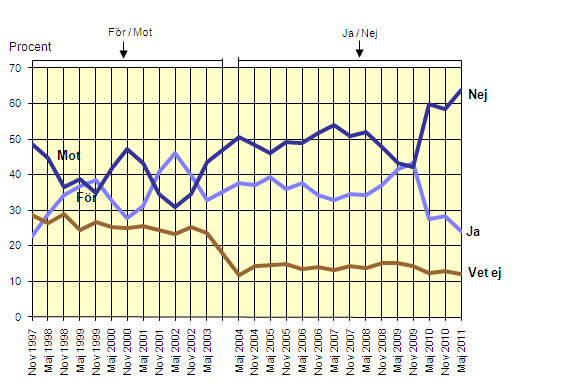
More widely, the development signals a triumph for the common sense of the Swedish people over the short-sightedness of the country's political elite on this particular issue (though there were several notable exceptions, and the centre-right govenrment in Sweden is generally very sensible on economic matters). In the 2003 referendum campaign, all the main parties apart from the tiny Greens and Left party, were in favour of Sweden joining, yet in the referendum, 55.9% of the electorate voted against, vs. 42% in favour. There were, of course, the usual scare stories about how Sweden would be sent back to the stone age and left isolated if it did not join (mixed with some more rational arguments relating to the removal of exchange rate risk for example - which are still valid). But the public's common sense - bondförnuftet - won the day.

With a 4.5% growth rate and lower borrowing costs than Germany, very few Swedes seem to have regrets - apart from a handful of politicians, and provincial leader writers for papers such as Göteborgs-Posten and Dagens Nyheter (the Japanese holdouts after World War II spring to mind- the soldiers, if you recall, who were found on various remote islands in the pacific decades later, still fighting, either unaware of, or unwilling to accept, that the war had ended).


In a recent opinion poll, 64% of Swedes said they would vote no the euro - with only 24% in favour. See the graph illustrating the recent surge in opposition to the euro (Click to enlarge. Nej=No, Ja=Yes, Vet ej=Don't know).

Game over in other words.


"Europe" won't leave the Coalition alone

The weekend's papers saw several interesting articles on the Coalition's Europe policy in the wake of the eurozone crisis.

Here's Tory MP Dominic Raab, hitting the nail on its head in the Sunday Times:
"This fluid geopolitical landscape opens opportunities for a third choice for Britain — between integration and withdrawal. And it is popular. YouGov found 50% want to halt or reverse integration; it would win over many of the 37% who favour withdrawal.

What would such a plan look like? Britain should ditch its ideological baggage in favour of a pragmatic euro-realism. Take the free movement of goods, services, capital and people — a potent force for good, promoting business growth and jobs. The single market is not perfect. Some aspects won’t get better unless the UK negotiates at the table to liberalise services and curtail state aid and agricultural subsidies. There is no economic reason why Britain could not opt out wholesale of the EU social and employment regulations, which cost our economy an estimated £148 billion between 1998 and 2008. Likewise, Britain could insist on immigration controls on prospective members such as Turkey.

The crossroads ahead offers Britain a unique opportunity to come up with a positive blueprint for our relationship with Europe."

Meanwhile, the Sunday Telegraph looked at the formation of a new group of Tory MPs, which is gaining traction, due to the initiative of Chris Heaton-Harris, George Eustice and Andrea Leadsom (amongst others) aimed at reversing European integration. In his Sunday Telegraph column, Tim Montgomerie made this very astute observation:

"...there are two good reasons why [Tory MPs] shouldn’t be in a rush to renegotiate the relationship with Brussels. First, any deal that happens soon will have to be signed off by Nick Clegg. The Liberal Democrats are Britain’s most Europhile party, and they won’t allow a big departure from the status quo. Renegotiation will be more substantial if it happens at the end of the parliament, and David Cameron can turn the terms of a deal into an election issue. Second, there is no plan for renegotiation. Tory Eurosceptics are large in number, but there’s a People’s Front of Judea quality to their organisation."

We hasten to add that, in general, Tory Eurosceptics also need to develop a better understanding of exactly how fluid and fast-moving the situation in Europe is - and of the various forces at work - if they want to achieve a strategic vision of how to capitalise on the shifting politics. Sounds obvious, but Europe can no longer be reduced to some sort of black-and-white struggle between 'federalists' and 'eurosceptics' (it probably never could but even less so now), nor a sceptical Britain vs. the Rest.

Looking at the Franco-German deal last week, we note over on Guardian Comment is Free that,
"aside from the disappointing content, the latest Sarko-Merkel political charge is very interesting for wider reasons – particularly for the UK. Alas, it has been widely misunderstood in Britain and beyond. First, it is not part of some sort of German grand plan to again become the dominant force in Europe – no one in Germany is interested in "colonising" countries in any form."
We go on to argue - and this is important:
"Second, the Franco-German proposal is not a step towards "EU federalism" per se. In fact, the letter circulated by the two leaders envisages a limited role for the European commission in the eurozone's economic governance, with the eurogroup's 17 members instead meeting separately.

In Brussels speak, this is known as intergovernmentalism, often described as the opposite to federalism...Why does this matter? Because British reflexes tend to favour intergovernmentalism modelled around decisions made by sovereign states rather than the Brussels-based institutions. Far from counteracting British thinking, this Franco-German proposal seems to reinforce it."

There is another reason, we note,
"why the agreement seems in line with what many Brits would instinctively argue for: European variable geometry. Responding to the opposition this proposal generated in many capitals, German foreign minister Guido Westerwelle said in private (according to Financial Times Deutschland) that any member states that don't implement the Franco-German plans "shouldn't be allowed to stop the rest" from doing so, adding that "there should be more differentiated co-operation", presumably both in the EU and eurozone.

This is an acknowledgement that, in order for it to work, the EU simply needs to be broken down into smaller units. It's the type of flexible approach to European co-operation which many in the UK would feel most comfortable with – and also a reminder to those who argue a two-speed Europe is defined by euro membership alone (with Britain in the slow lane) that such a division is simplistic.

If the EU, in the wake of this crisis, is heading towards a more intergovernmental, variable approach to European co-operation – sometimes merging policies and institutions, at others keeping them separate, as national democratic preferences dictate – this could well be in Britain's interest."

This is not an endorsement of the content of the Franco-German deal (which we hopefully have made abundantly clear) nor an endorsement of the greater role envisioned for Council President Herman Van Rompuy. It's merely a reflection on the fact that, when European policy strikes at the heart of national democracy (the eurozone crisis has now fully entered the domain of taxation and spending as opposed to regulations, complex treaties or judicial cooperation), intergovernmentalism is still king.

Although we shouldn't read too much into it, the subtext of the Franco-German summit may prove to be a turning point.