• Facebook
  • Facebook
  • Facebook
  • Facebook

Search This Blog

Visit our new website.
Showing posts with label German public opinion. Show all posts

Monday, August 11, 2014

Is Germany emerging as the biggest obstacle to a liberal EU-US trade deal?

If you read our press summary, you will have noticed that the debate around the US-EU free trade deal (TTIP) is really picking up in Germany, with even the euro-critical AfD coming out against key elements of the deal ahead of the European elections.

Of all the mainstream newspapers in Europe, Süddeutsche Zeitung is the one that has devoted the most time and effort into covering the on-going negotiations over TTIP, and it has also published a number of comment pieces - both for and against.

In an opinion piece today, the paper's Economics correspondent Alexander Hagelücken argues that the debate around the EU-US free trade agreement (TTIP) has become “schizophrenic” amid mounting public opposition (as highlighted by the cartoon above). However, he argues that:
"European governments can escape the impasse by making it clear that they want to expand free trade via the TTIP principle while at the same time meeting the legitimate concerns of their citizens who do not want increased prosperity at the cost of losing environmental and health standards. GM foods? Only after passing the European approval procedure and with clear labeling. Investor lawsuits against environmental legislation such as Vattenfall’s legal challenge against the nuclear phase-out? Not before secret tribunals, but only in the ordinary courts."
He concludes that:
"Yes, such a path would not lead to unfettered capitalism with a neoliberal flavour but free trade with constraints. In other words, it would be the kind of social market economy which has given the [German] Federal Republic decades of prosperity after World War II, while tensions decreasing rather than increasing tensions between the social classes.” 
German public opinion will be a crucial factor in determining the success or failure of the TTIP negotiations. As with everything else these days, we suspect, on TTIP, as goes Germany, so goes Europe. 

Friday, August 08, 2014

German public opinion hardens against Putin but business community still reluctant

An Infratest Dimap poll for Welt/ARD published today showed that 70%  of Germans are in favour of the EU's response to the crisis, with 80% thinking that Russia bears the biggest responsibility for the break-down in relations between Russia and the West, and with a slim majority (49% vs 46%) in favour tightening sanctions further, even if it has a negative impact on the German economy and jobs.

Being as ever nervous about meddling too much in world affairs, there's been a considerable shift in the German media and public-opinion regarding Russia. In March, after the annexation of Crimea, only 38% supported economic sanctions. By May this had risen to 50%. Now it's at 70%. The volte-face can be explained in part by some industry bodies publicly announcing that they would be able to weather such sanctions and the public outcry over the MH17 tragedy.

As has been noted by others, Angela Merkel was absolutely instrumental in breaking the deadlock over the sanctions, by showing willingness for Germany to bear a large chunk of the costs. This probably wouldn't have been possible absent the shift in public opinion (incidentally also illustrating how the "as Germany goes, so goes Europe" rule now increasingly also applies to foreign policy).

However, there's still plenty of opposition from within Germany. Business continue to warn against loss of jobs and profits. And today, Gabor Steingart, Editor-in-chief of Germany's financial daily Handelsblatt, laments "The folly of the West," for entering into "the politics of escalation" with Russia, on the front page of his paper today, writing:
"With its politics of escalation, Europe is missing a realistic [end] goal... Even the aim to bring Russia to its knees through economic pressure and political isolation, has not been properly thought through." 
"Even if this were to work: What good will that do? How can one expect to live alongside a demeaned people in the European house, when their elected-leader is treated like pariah, and their citizens may be committed to soup-kitchens in the coming winter?"
As Steingart sees it:  
"German journalism has switched from level-headed to agitated in a matter of weeks. The spectrum of opinions has narrowed to that of a sniper's scope... Headlines betray an aggressive tone that is usually characteristic of football hooligans."
There is clearly a growing gap in the German media, politics and public between those who want to go in harder on Putin, and those who favour Germany's 'Ostpolitik' tradition of bridge-building with the Kremlin. In turn, this reflects that on-going, grinding and drawn-out debate about Germany's role in Europe and the wider world, in which all kinds of German instincts clash.

Wednesday, March 19, 2014

Where are the real fault lines in the EU?

Ipsos Mori has this week published an interesting poll on public attitudes* in ten EU member states. Across the ten countries as a whole relatively few people want to leave the EU outright (18% on average), but the single most popular option is staying in the EU but reducing its powers (34%).

Just over a third want to see either the EU’s powers strengthened further (19%), or even a long-term policy of working towards a single European government (18%) - click to enlarge the charts.


Broken down by country, the British (68%), along with the Swedes and Dutch (69% and 68% respectively) are most in favour of leaving or reducing the EU’s powers:


The research suggests that, on average, two in three (68%) think things across the EU are moving in the wrong direction. People from the Netherlands, Sweden, Belgium and Britain are in line with the average, but those in the Mediterranean countries are the most pessimistic.


France, is the most pessimistic of the countries polled, whch seems to have a lot to do with the state of the country's economy. People in France, Italy and Spain are all particularly negative about the EU’s impact on the economy (74%, 74%, and 68% respectively are critical), and many feel that their economy has been damaged by the demands of austerity (75%, 70%, and 75% respectively).

The UK political debate on Europe may be a few years ahead of many other countries (perhaps with the exception of the Netherlands), but at the level of the individual, there are many people disenchanted with the European project. Many countries are deeply split but, on average, there is clearly an appetitie for the EU to do less. Most interesting though is the striking fault line in the eurozone. Francois Hollande has had precious little influence on EU policy since his election as president, but the question is, how long before the French public's disenchantment is reperesented by its politicians?

If you think the UK is the awkward partner, imagine if French politicians actually started telling Chancellor Merkel what their people think about Europe.

* It should be noted that the poll is not representative of the entire electorate in Belgium, France, Great Britain, Germany, Hungary, Italy, Poland, Spain and Sweden (where 16-64 year olds were interviewed), while the Dutch panel is representative of voters. Why they chose not to poll people over 65 is unclear and in our view is likely to skew the results somewhat (in different directions for different countries).

Friday, February 28, 2014

Merkel sagt 'Jein': German reactions to Merkel's speech

Merkel's big speech yesterday was being trailed in the UK media almost a week in advance while the German media only began to cover it the day before. Its fair to say it didn't completely dominate the news in Germany yesterday - not with the conclusion of the trial of former German President Christian Wulff - but it nonetheless attracted a lot of coverage, comment and analysis. Here is our round-up of key German responses:


In terms of the speech itself, German media and commentators broadly picked out Merkel's call for the UK to stay in and help shape the EU, although N-TV went with “Merkel leaves Cameron hanging”. Today's headlines and comment pieces make for interesting reading; FAZ headlined their write-up with ‘Chancellor Jein' - Jein, for those who haven't worked it out already is a combination of Ja & Nein. Süddeutsche Zeitung goes with “Merkel’s lecture in Europe realism” adding that “she didn't close doors but remained vague”. Die Welt says “Merkel meets the Queen and resists Cameron”.

In terms of the comment pieces, Handelsblatt's EU correspondent Ruth Berschens argues that:
“The UK and Germany share a staggering amount of common ground... the list of common interest has now even been extended by a very important point: both Germany and the UK want to readjust the institutional structure of the EU... [However] even if the Chancellor wanted to she could not give Cameron a special status [for the UK in the EU]... Merkel has offered a limited EU treaty change for the Eurozone and that the EU Commission will voluntarily commit to stay out of specific policy areas. Now the ball is in the British court.”
Die Welt columnist Alan Posener writes in the Guardian that:
“Cameron will get his treaty changes sooner or later. In return, he should learn to walk the European walk and talk the talk – as Merkel does, while pushing a German agenda.” 
In a separate comment piece in Die Welt, Posener argues that a more integrated eurozone but with the possibility of other powers flowing back to member states would
“not create a Europe of ‘two-speeds’, but a freer Europe of differences and choices. Those who want more integration should be able to go down that path; those who prefer a looser European ‘dress’ should not have to leave the EU for that”.        
Süddeutsche Zeitung’s Foreign Affairs editor Stefan Kornelius points out that:
“Those, like the British Premier David Cameron, who hope for a herculean reform effort of the EU, including comprehensive treaty change, do not understand the EU. Europe moves cautiously, step by step, fittingly like the German Chancellor, with or without crutches.” 
He adds that Merkel’s speech understandably left a lot of questions unanswered such as
“What are the concrete plans for the strengthening of the economic and monetary union? Should governments agree on a common economic policy or does this competence go to the [European] Commission? Above all in terms of the Commission: which of Cameron’s complaints about Brussels are justified? Where do competences have to be checked and be trimmed back?”
In conclusion the broad response of the German media is much as we argued yesterday - Merkel did not give much away but left the door open to reform.

Monday, November 11, 2013

Business leaders and entrepreneurs across Northern Europe add weight to EU reform agenda

When a group of business people who, amongst them, have helped to lead companies that employ around one million people, say something, it's a good idea to listen.

In an unprecedented joint initiative, leading business men and women from across Northern Europe used a letter to the Sunday Times and op-ed articles published in today's Frankfurter Allgemeine Zeitung and Dagens Industri to call on EU leaders to grasp the nettle and embrace reform.

The list of signatories, who have all signed in a personal capacity, includes household names and is particularly significant because many have not spoken out on the issue of 'Europe' before. They include Karl-Johan Persson, the CEO of Swedish retail giant H&M, Dr. h.c. August Oetker, Chairman of renowned German food producer, Dr. Oetker, Douglas Flint CBE, Group Chairman of HSBC Holdings, Joanna Shields, Chief Executive of Tech City, and Sir John Peace, Chairman of Standard Chartered Bank.

The business leaders and entrepreneurs who have signed up to this initiative come from businesses in different sectors of the economy and, uniquely, this initiative, coordinated by Open Europe, cuts across borders.

As you can see below, this has already caused quite a splash in Sweden, with the front page of the financial daily Dagens Industri carrying the headline "Come on, EU!":


In Germany, six business men and women including Dr h.c. August Oetker, Chairman of the Oetker Group – one of Europe’s largest family-owned businesses – and Marie-Christine Ostermann, former head of the German Association of Young Entrepreneurs, wrote an article arguing that, "The EU does not have to move towards 'ever closer union,' but needs to become ever more open and flexible":


In a letter to the Sunday Times, 52 British executives and entrepreneurs demand a “bold reform agenda” focused on trade and transparency:


This joint initiative shows that there is a market across much of Europe for an EU reform agenda centred on making the EU more business-friendly, internationally competitive and democratically accountable. However, the only way to do that is to make the arguments heard across Europe and put so much pressure on politicians that it cannot be ignored.

This is the first step in pushing a robust reform agenda ahead of the European elections next year and beyond, and we will be encouraging plenty more entrepreneurs across Europe to sign up to this initiative. So watch this space!

Friday, October 18, 2013

UK-German push for EU reform gathers pace as German SMEs call for return of powers from Brussels

Today's FAZ reports on a letter to German MPs from the German Association of Family Businesses (Die Familienunternehmer) which calls for “a fundamental re-calibration of the EU Treaties”. Crucially, this would entail a correction of the distribution of competencies, which in plain English (and German) would mean the possibility of some powers flowing back to member states from Brussels. The letter argues:
“A key element for the sustainable improvement of the situation [in the EU] is the principle of liability. The future of Europe cannot be jeopardised through the progressive pooling of debts with foreseeable cuts to the German budget or the disempowerment of national parliaments in favour of centralisation in Brussels.”
Given the economic and cultural importance of family run businesses/SMEs - the organisation's website notes that there are 180,000 such businesses in Germany employing around 8 million people - this is an important development and the first time a German business group has made such a demand. While it is important not to get carried away - some of the Association's previous calls, such as pushing for MPs to vote down the ESM, fell on deaf ears - it comes at a time when the concept of adjusting the balance of powers between the EU and member states is slowly gaining traction in Germany. Not that long ago the mere suggestion would have been shot down instantly, now even Chancellor Merkel has hinted that it could be a possibility.

As our recent joint opinion poll with Open Europe Berlin demonstrated, there is substantial support among the German public for the return of certain powers.

Source: YouGov Deutschland for Open Europe and Open Europe Berlin

Of course for Germany to support such transfers they must apply to the EU as a whole, which is why British proposals to give national parliaments a greater role in the EU policy-making process could gain support in Berlin, as could proposals to streamline EU legislation. The Sunday Telegraph recently reported that the UK’s CBI is working closely with its German counterpart, the BDI, in order to push through business friendly reforms in the EU which could include the repeal of some EU social and employment laws as well further liberalisation in areas including telecommunications and services.

The momentum for EU reform is definitely growing, and in an encouraging sign of UK-German co-operation (which we advocated before it became fashionable), Conservative MP Alok Sharma and German CDU MP Ralph Brinkhaus argue in a joint piece on the Spectator’s Coffee House blog that “There’s a historic opportunity for Britain and Germany to lead the work of improving the structures of the European Union, together with other like-minded countries. There are areas of common ground for discussion on budget discipline, free trade and efficiency in the public sector to name but a few."

We couldn't agree more.

Tuesday, October 15, 2013

Open Europe Berlin: One year on

With the first anniversary of the founding of our sister organisation, Open Europe Berlin, fast approaching, it seems an appropriate time to look back at its achievements over its first year. Following an impressive launch in Berlin featuring a keynote speech by former ECB Chief Economist Ottmar Issing, under the expert guidance of its Director, Professor Dr Michael Wohlgemuth, and Deputy-Director, Nora Hesse, OEB has been making waves on the German EU policy scene and beyond. Its influence is sizeable and growing continuously.

Just last week, leading German daily, Die Welt, described OEB as having a growing influence on the German media, and commended it, in particular, for its success in using social media to contribute cutting-edge research and market-orientated concepts to the debate about the future direction of the EU. The piece notes that OEB research and proposals have "even received responses from the European Commission."  In the past 12 months, OEB has become a fixture in both the German and international press, and for many, OEB became the go-to source for information, analysis and comment in the run-up to the German elections, including internationally broadcast interviews with the BBC and Reuters (see here for a compilation of OE and OEB's best #btw13 hits).

OEB research is already proving to be a leading source of analysis on key European issues including EU regulatory policy; banking union; the EU budget and the EU’s current democratic deficit. Research and media commentary aside, it has also managed to secure interviews with important German figures, including the renowned German economist Hans Werner-Sinn, and Bernd Lucke, leader of the anti-euro Alternative für Deutschland party, whose rapid rise has commanded attention around the world. The OEB blog is also a regular source of interesting information and comment, including guest posts from esteemed figures such as former FDP MP Frank Schäffler, Barenberg Chief Economist Holger Schmieding and Charles B. Blankart, an advisor to German Economy Ministry.

Fundamentally, however, Open Europe Berlin has, and will, continue to play an important role in helping to understand the role of Germany in the future of Europe. And as we have been arguing for quite some time, there is great scope for cooperation between the UK and Germany to agree on strategic and systemic changes to the way the EU operates. How this dynamic plays out, will, no doubt, have an important role in shaping the future of the European Union and both countries' places within it.

Friday, October 04, 2013

Handelsblatt asks, "Where is the inflation?"

That’s today’s front page of German daily Handelsblatt, with the headline asking “Where is the inflation?”

A stark reminder of what remains a key issue in German (and therefore European) politics. We could barely ever imagine such a front page in the UK, particularly when annual inflation is running at only 1.6% (August 2013).

Inside the paper there is a ten page section discussing the issue. Essentially, Handelsblatt is questioning why, when there has been such significant money printing and low interest rates in the eurozone, is there yet to be inflation. This is put in context with a comparison to the hyperinflation of the 1920’s Weimer Republic, another reminder that this episode in the country’s history continues remains firmly embedded in the German psyche.

The discussion itself is obviously hugely technical, but the paper’s explanations for why inflation is (yet) to show up is quite telling about the debate in Germany.

  • Central banks only measure consumer prices – the paper essentially suggests that the usual metric of inflation, the Consumer Price Index (CPI), does not fully capture the real inflation rate since it does not include things such as asset prices and house prices.
  • The increased money supply is not feeding through to the real economy – the suggestion here is that, although money supply is being increased significantly, it is not feeding through to the real economy because banks are not lending out and because people and companies are saving more. It could also be down to the fact that banks, companies and the government are deleveraging (paying off debts and reducing their size) in order to become more stable in the wake of the crisis. For these reasons, the money created has stayed within the financial system rather than leaking to the wider economy and hitting inflation – at least not yet.
  • Still too early to fully judge the impact of the ECB’s policies – this seems to be linked to the argument above but the paper suggests that the low interest rates and other non-standard measures which the ECB has undertaken (such as unlimited long term loans) are yet to have their full impact. The suggestion seems to be that, as the economy recovers, the true impact of the policies will become clear.
  • So, what will happen? The paper concludes that these policies are likely to have some impact and that inflation will show up at some point.
Although this is clearly just the view of one paper, the tone and line of argument here is quite telling.

Clearly, there is still concern that inflation will show up and even that it may already have and be going unnoticed. This fits with recent concerns raised by the Bundesbank that low interest rates and loose monetary policy can pump up financial bubbles and set the scene for the next crisis.

This debate is here to stay in Germany and Europe. As the ECB considers further long term lending operations (LTROs), how to deal with actions of other central banks and the large divergence in growth between Germany and some struggling countries, it could come to the fore once again. 

Friday, September 20, 2013

The top 10 'spiciest' moments of the German elections

How do we put this delicately...the Germans aren't exactly known for their sense of humour. Equally neither are politicians, other than attracting derisory chuckles at their attempts to seem cool or in touch with the common man. Combine the two and result is often enough to drive large swathes of people to watch the handwork of their decorator dry slowly. 

This round of German elections has been little different, not least because Angela Merkel has actively employed the tactic of trying to bore people into voting for her (see cartoon below). We haven't seen so many references to 'Safe Hands' since David Seaman's auto biography.

Fortunately, there have been a some spicier moments (though we refrain from call them "highlights"), here are the top 10:


The FDP, neo-nazis and a cream cheese discover they have something in common

An awkward moment for the FDP when someone spotted that a stock image of an all-German family used in one of their televised ads also featured in a campaign video for the far-right/neo-Nazi NPD party. Bizarrely, the same family also featured in an advert for a Finnish cream cheese. Unfortunately for the FDP, the moment has not proved as embarassing as being seen as a photocopy of the CDU.


The necklace that won the #tvduel

We all know Germans love gold but this takes the nugget. The only TV debate between Angela Merkel and Peer Steinbrück was considered so dull that it prompted many to proclaim Merkel's fetching patriotic necklace the real winner of the debate, and it quickly gained its own Twitter account with over 8,700 followers to date.

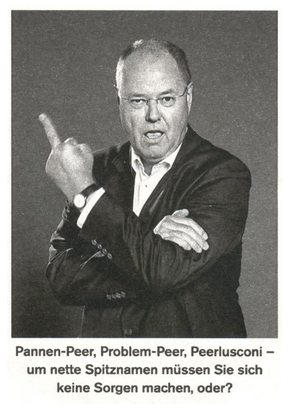
Peer's 'Stinkefinger'

After losing his only televised debate to a necklace, Peer felt the need to take drastic action. But what to do? Well, apparently, if your words aren't working, go 'wordless'. Peer Steinbrück signed up for a 'wordless interview' with Süddeutsche Magazin which ended up receiving widespread coverage in Germany and abroad after he responded to a question by unapologetically flipping the bird. Unfortunately, rather than inspiring the electorate they simply replied in kind...


Lucke's Greek toga party

If you thought Peer's wordless interview was bizarre, wait until you see this. AfD leader (and serious German professor) Bernd Lucke held an interview with German channel Tele 5 on why Greece should leave the euro, during most of which he wore a Greek flag as a toga. He then proceeded to sing a duet with the host, of the AfD's official song to the backing music of Take That's 'Back for good' (a song which Lucke had apparently never heard before). On top of all of this, as some of the papers noted, one of the producers of the show is Greek and proceeded to periodically alter Lucke's voice so that he sounded like Mickey Mouse. A truly bizarre election interview, which is well worth watching even if you don't speak German.

Don't mess with the Currywurst

While pushing for the humane treatment of animals, the Green party ironically managed to shoot themselves in the foot. In an almost inexplicable move, they proposed forcing all public canteens to make one day a week vegetarian day. Unsurprisingly, the suggestion did not go down well in a country famous for loving its meat. “How dare the Greens tell us what to eat!” thundered Germany’s mass circulation Bild newspaper, the day after the proposal was floated. What next? Banning nudism, autobahns or the Hoff...? You simply don't mess with the Currywurst or the Schweinshaxe. The Greens have recently slipped a couple of points in the polls - clearly no coincidence...

Beating the kids at their own game 

The new anti-euro party Alternative für Deutschland was widely derided as a party for old, white and grumpy men or alternatively as the 'Professor party' (if only it was true some would say). The contrast with the young, swinging and tech savvy Pirate party could hardly be greater. However, the AfD has proved it is no slouch when it comes to online campaigning with one of its election campaign videos getting over a million hits, while a Pirate video has received only just over 10,000 views.

Die Partei's whole election campaign


The brilliantly named Partei für Arbeit, Rechtsstaat, Tierschutz, Elitenförderung und basisdemokratische Initiative (Party for Work, Rule-of-Law, Protection of Animals, Advancement of Elites, and Grassroots-Democratic Initiative) - shortened to Die Partei - is a German satirical party akin to the UK's Monster Raving Loony Party, but much funnier. Set up by Martin Sonneborn, editor of the satirical Titanic magazine, its campaign pledges include razing the City of London to the ground and putting Angela Merkel on trial in a cage. Die Partei also released an election video on 'family policy' featuring (pixelated) scenes from an adult film with a soundtrack of "moaning and groaning, accompanied by light-hearted background music".

The hypnotic Chancellor 

We're not sure if it is her or her necklace, but Merkel has certainly lulled the electorate into a state of tepid contentedness. This cartoon perfectly captures the excitement of the CDU's election campaign. Merkel: "You are going to sleep. Everything is good. You are going out to vote..."


A rough ride for AfD

In their misguided attempts to stop the AfD expressing its alleged intolerant views the members of the Green youth decided to physically halt AfD activists from their right to freedom of speech and expression, with no sense of irony. Green with envy of the AfD's media coverage perhaps? In any case, as reported by Spiegel, this is likely to help the anti-euro party's chances, rather then hurt them.

Merkel drones on...

Just when the scandal surrounding the government's bungled purchase of the multi-million euro 'Euro Hawk' surveillance drone was beginning to fade, a CDU event with Angela Merkel and Defence Minister de Maizière in Dresden was interrupted by a miniature drone operated by remote control. The Pirate party claimed responsibility, saying that "The goal was to make Chancellor Merkel and Defence Minister de Maizière realise what it's like to be subjected to drone observation". Judging by the results above maybe they should just make her watch their election video...

David Hasselhof singing on the Berlin wall

Oh, sorry, that was in 1989...maybe it just seems like yesterday since we watch it on a daily basis...

Monday, September 02, 2013

Merkel's necklace aside, who won yesterday's German election debate?

Some 17 million Germans – and, we dare to say, a record number of keen international analysts - tuned in yesterday to watch the first and last televised debate between Angela Merkel and SPD contender Peer Steinbrück, ahead of the country’s elections on 22 September.

The debate only briefly touched on the Eurozone crisis and EU policy, with Steinbrück criticising Merkel’s policy over Greece in particular. Though some Anglo-Saxon commentators have written this up as the SPD candidate “criticising austerity” , in fact, he was more criticising the pace of austerity and its balance with more 'growth orientated' policies – not austerity itself.

As we've argued before, you just don’t criticise Sparpolitik in Germany – next to plagiarism, this is the best way to end a mainstream political career. Steinbrück did, however, criticise the pace and scale of Merkel’s austerity policies, again repeating his calls for an as yet very vague new “Marshal Plan” for Europe. “There must be budget consolidation”, he said, but must not be “a deadly dose”. Merkel hit back, saying that if, as Steinbrück claims, the need for a third Greek bailout is a sign of her Eurozone policies failing, why did he and his party vote in favour of all the bailouts so far?

So who won the debate?

The view in the German media and commentariat seems to be pretty unanimous that though the debate itself was pretty much a draw, it involved a bit of a boost for Steinbrück – which wasn't entirely unexpected, given that the man started from an exceptionally low base.
Snap post-debate polls also suggested a draw, with one putting Steinbrück in the lead (49% to 44%), and two others putting Merkel ahead (40% to 33% and 44% to 43% respectively). A fourth poll put both candidates on 50%.

However, Steinbrück did see a boost to his head-to-head ratings. An ARD poll (see below) has a massive swing in favour of Steinbrück on the question: who would you vote for if the Chancellor could be elected directly?


AnFG Wahlen poll for ZDF shows a much smaller swing for Steinbruck – but still a clear swing.


However, the real winner of the debate, according to many, was Merkel's fetching patriotic necklace, which has now has its own twitter account with over 6,000 followers.

Friday, August 09, 2013

German election update: Would the SPD rather stay in opposition than become Merkel's "lackeys" again?

Given that August is traditionally been a slow news month, we thought we'd revive an old Open Europe tradition - German poll Fridays (we know you're excited!). Its worth remembering we are only 6 weeks away from elections in Germany which will to a large extent determine developments in the eurozone and in the push for EU reform. So where are we at? Well the polls have been remarkably stable for the past few months with minimal fluctuations:

Source: Forsa (other polls display a similar trend)
While the result above would deliver a small majority for Angela Merkel's current conservative/liberal coalition, a couple of percentage points could deprive them of that. However, an alternative coalition of SDP/Greens would also be unlikely to have sufficient seats to govern, and a potential Rot-Rot-Grün (SPD-Greens-Linke) coalition has been ruled out by both sides as unappealing and unworkable.

Here's another consideration: what if the CDU/CSU/FDP coalition wins but ends up with a very narrow majority, meaning the government may not be able to pass contentious eurozone related legislation without support from the opposition due to rebels in its own ranks?

Both these factors increase the likelihood of another CDU/CSU and SPD 'grand coalition', like under Merkel's first Chancellorship between 2005 and 2009.  Although that government - in which the SPD's current Chancellor Peer Steinbrück served as Finance Minister - is credited with successfully navigating through the initial economic crisis, the SDP's poll ratings have never recovered, while Merkel's CDU has gone from strength to strength.

As a result, Steinbrück has ruled out another grand coalition, claiming that:
"The SPD's inclination to enter into a Grand Coalition is pretty much zero. Why should we once again be Merkel’s lackeys?"
Of course the fact that Steinbrück himself would not serve under Merkel again does not preclude a grand coalition with someone else from the party serving as Merkel's deputy. However, antipathy to this idea is widespread throughout the SPD, due to fears it would be unable to implement many of its policies and sink even lower in the polls (although ironically the party has also accused Merkel of stealing all its best policies for the CDU).

This is hardly a story of unrequited love - the CDU/CSU are also not keen on the idea, believing that such a coalition would be unstable as the SPD would be waiting for the appropriate time to bring down the government with the votes of the other left-wing parties before calling new elections, with Merkel unlikely to stand a fourth time, and with other credible CDU 'spitzenkandidaten' thin on the ground.

Either way, if the polls remain stable over the next few weeks and are an accurate reflection of the final results, we could be in for some interesting coalition talks.

As usual, we recommend you follow us on Twitter @OpenEurope, @pswidlicki, @NinaDSchick and @matsJpersson for all the updates from Berlin over the coming weeks.

Thursday, June 20, 2013

AfD surges ahead... in the social media popularity stakes

An online force to be reckoned with
An interesting story in Die Welt caught our eye this morning on the success of Germany's new anti-euro party Alternative für Deutschland in the online campaign.

While the party's support in the polls has stabilised on around 3% (not enough to secure seats in the Bundestag), it is surging ahead every day in the social media popularity stakes. With over 36,000 'likes' on Facebook, the party has long since overtaken the FPD, the CDU/CSU, Die Linke and the Greens, and is now only around 2,000 behind the SPD. The party is however unlikely to overtake the Pirate Party which (unsurprisingly) is Germany's most popular political party in the online world with 78,000 'likes'.

In practical terms this is not hugely meaningful unless the party can translate this into actual votes in September. It does however suggest that early perceptions of AfD as a party dominated by stuffy, middle-aged male academics could be some way off the mark.

Friday, June 14, 2013

Deliberations begin as hearings draw to a close in Karlsruhe

The hearing at the German Constitutional Court into claims against the ECB's crisis policies is now over. Day one saw verbal jousting between the two men to the left (Bundesbank President Jens Weidmann and ECB Executive Board Member Jörg Asmussen) which we covered on our live blog. Day two of the hearing was a bit more cagey and less political but possibly more revealing in terms of the Court's thinking.

Constitutional Court Judge Peter Müller kicked off by reiterating the strict rules of the game:
“it is clearly defined in which china shop the elephant of monetary policy is not allowed – monetary state financing.” 
Clemens Fuest, Research Director at the Oxford University Centre for Business Taxation, shrugged his shoulders and replied:
“If OMT is ECB’s commitment to buy state bonds to a non-defined extent, than I wouldn’t know how to prevent the contact with the china shop”  
Being slightly more direct (as might be expected), Head of the Ifo Institute Hans-Werner Sinn said that the ECB engages in “regional fiscal policy” and that the Central Bank’s OMT programme is basically “a free insurance for investors when a state goes bankrupt”.

It's clear the Court remains concerned that the ECB could overstep its mandate. President of the Court Andreas Vosskuhle suggested that the current conditions attached to the OMT, the ECB’s bond-buying programme, are on a “very abstract level” but if correctly applied “could be a good middle way…of distinguishing between monetary and fiscal policy”.

A rather diplomatic construction but conditionality is a key issue here, as we’ve pointed out. The fundamental problem is that since there is no legal documentation and the OMT has never been tapped, it is very challenging for the court to judge how strictly the conditions will be applied. They could make a value judgement over whether they trust the ESM and eurozone politicians to fully implement the conditions but this could well be beyond the scope of the legal judgements the Court is allowed to make.

As Süddeutsche Zeitung's Markus Zydra points out, there is significant ambiguity around one of Asmussen's key points - that the OMT is practically limited since it can only purchase short term bonds. This is especially true given ECB President Mario Draghi's (and other's) previous remarks that there are no ex-ante limits to the OMT. Chief economists of DZ Bank Stefan Bielmeier put it nicely saying, “there is a dual rhetoric of the ECB…[they] tell everybody what they want to hear” - exactly as we noted here.

A running theme of the coverage following day two has been the signfiicant time given to those arguing against the ECB. ECB proponents reportedly told Handelsblatt “we feel like at an away game”, given the level of opposition support. The paper even goes so far as to question the neutrality of the court's referees given the line-up of known ECB critics it had called to provide evidence at the hearing (e.g. Hans-Werner Sinn, Kai Konrad, Harald Uhlig, Franz-Christoph Zeitler, Clemens Fuest).

How the Court will rule remains to be seen. It's clear they have some serious concerns about the policies but are struggling given the hypothetical nature of the case - the OMT remains undefined and unused, so any claims against it rely on second-guessing its implementation. Ultimately, it could be a question of whether they take the ECB at its word or not. Approval of policies but with some extra constraints remains the most likely outcome.

A final ruling is due for September although many involved expect a delay until after the German Federal Elections on 22 September. In the meantime, there are already those calling for a re-match in Luxembourg.

Tuesday, June 11, 2013

German Constitutional Court live blog: One of the most important cases in the Court's history?

The German Constitutional Court in Karlsruhe
The German Constitutional Court’s (GCC) hearings into the legality of the ECB’s actions to combat the eurozone crisis – and specifically the OMT bond buying programme – kicked off this morning. (See here for the background). In a front page leader, FAZ describes the case as one of the “most important” in the court’s history.

Public opinion in Germany is mixed, with a Forsa poll for Handelsblatt finding that 48% of Germans hope that the Court will put a stop to the OMT, while 31% believe that the complaint against the ECB is unjustified. As we noted in our flash anaylsis on the topic yesterday, the GCC can't actually stop the ECB. At worst, it could remove Germany from the ECB's bond buying programme and probably, therefore, from the eurozone itself. (A poorly phrased poll question, then, but a very telling result nonetheless).

With Schäuble, the German Finance Minister, and the ECB's positions already well known (that OMT is within the Central bank's mandate), we can safely say that the highlight of the day will come  from the opposing side, in testimony of Bundesbank President Jens Weidmann. In terms of their specific grievances, it will be the first time we will hear a detailed, public explanation of where the Bundesbank stands on this issue, while the tone of Weidmann's comments will also be interesting. Will there be any more Faust references we wonder?

Check our twitter feed for live updates from Karlsruhe throughout the day. We will also continue to update this blog as things develop.

17:45

Bundesbank President Jens Weidmann has now had his say - and again his points were very much as expected (his full statement is here but only in German for now).
  • Warned that ECB OMT blurs the line between monetary and fiscal policy - this makes it more difficult to achieve price stability and spreads solvency risks amongst eurozone countries, but does so without any parliamentary or democratic approval.
  • Pushed for a narrow interpretation of a central bank's primary mandate, with a complete focus on price stability.
  • Suggested that the OMT does represent potential losses for taxpayers, arguing that if the ECB took on significant amounts of risky debt, it may face large a loss which it cannot absorb and may require aid from member states.
  • Argued that even secondary market purchases can overturn the force of market discipline and undermine fiscal autonomy.
  • Issued a warning over the interpretation of the real-risk premiums for bonds, which he suggested was very subjective and dependent on future policies.
  • Accepted that the inflation outlook in the eurozone fits with price stability at the moment, but still expressed serious concern about comprising the ECB’s focus on this.
It seems to us that, of the two sides, Weidmann had the tougher case to make. Ultimately, as much of the above shows, he is forced to consider hypothetical scenarios and potential worst cases. These are undoubtedly risks that should be highlighted, but it does leave one feeling that his argument is slightly less clear cut than Asmussen’s.

Having heard the key testimony of both sides, we still expect the court to side with the ECB, but with some caveats (although how strict they will be is very much up in the air). Of course, this could still develop more tomorrow. 

16:20

Asmussen has now concluded his testimony and subsequent Q&A, and the ECB has also helpfully put a transcript on their website. Here are the key points he made:
  • the OMT will have the ability to sell bonds as well as buy them, and it will not take them off the market permanently, unlike its forerunner the SMP (in fact Asmussen repeatedly highlighted the differences between the two);
  • the OMT is pari passu (equal to) other creditors,
  • the OMT seeks only to reduce unwarranted interest rate spikes and is not aimed at harmonising financing conditions of member states,
  • the ECB would react if a country were to try to game the system by converting all its bond issues to a short maturity (of up to three years), but that in any case markets themselves would "see through and deny" such attempts,
  • the only risks associated with the programme stem from countries operating "un-sound" policies, but that those states that fail to comply with the OMT's conditionality could be faced with the prospect of having to leave the eurozone.
The comments were more or less as expected. However, there are a couple of interesting points. First, the fact that the bonds purchased under the OMT will be judged at market value suggests that, if they are purchased and then decline in value, the ECB could be facing losses on its balance sheet. A tricky technical and political issue. Second, the point about 'un-sound' policies leaves us feeling slightly uneasy. Its clear that even with an ESM bailout programme, implementation may not be up-to-scratch. Meanwhile, it also highlights the clear link that would be established between ECB policies and the fiscal (and other) policy of national governments. This surely raises questions about the ECB's independence.

Asmussen also admitted that the policy did have de-facto practical limits given that it will only purchase short term debt, as reported over the weekend.

15:10

Handeslblatt
reports that Philip Rösler, the German Minister for Trade and Vice Chancellor is coming under increasing pressure from his own FDP party to take a stand against the ECB, following the Handelsblatt/Forsa poll showing that almost 50% of Germans hope that Karlsruhe will stop the ECB’s OMT programme (despite this actual course of action not being possible, see blog intro above on this).

Frank
Schäffler, the financial expert of the FDP parliamentary group, told Handelsblatt Online that "Working towards a market-economy is widespread among the followers of the FDP. Liberals know that prosperity cannot be printed from the ECB.

The irony of clinging on to central bank independence, while using political pressure to change the course of the ECB is not lost on us - nor on Rösler it seems, who said: “We must not allow this course toward stability to be broken up through the the attempt to exert influence on the European Central Bank.”

13:55


These comments from ECB Executive Board member Yves Mersch seem to confirm our feelings that the ECB is trying to have it both ways over its refusal to publish the OMT documentation (see 13:30):
13:40

Germany's new anti-euro party Alternative für Deutschland has just put out a press release citing Professor Joachim Starbatty - one of the original plaintiffs in the case and now one of AfD's top candidates in September's elections - warning that under the OMT, German taxpayers will be responsible for liabilities that are "no longer the responsibility of any government or parliament". The party is clearly hoping the publicity around the hearings will boost its poll ratings.

13:30

Asmussen is clearly channelling Draghi in his comments below. The ECB's continuing refusal to simply publish the legal documents relating to the OMT is at best strange and at worst downright obstructive. It does beg the question: what are they trying to hide? Maybe nothing, but at the very least it seems they are trying to have the best of both worlds. By refusing to reveal the exact terms and conditions, the ECB can try to address German concerns over the extent of the OMT (as we have seen them doing in the run up to this case) while also being able to continuously reassure markets that the scheme is in fact "unlimited".

Such a balancing act is tough to pull off and may add to confusion if it breaks down. Some transparency would be welcomed. It needs to happen at some point, who's to say it would be better revealing the legal documentation just when the OMT is being tapped, surely by definition that would be a period of crisis?

13:05

The ECB's Jörg Asmussen is up now making the point that the ECB would actually adopt a legal ordinance before any bonds were purchased:

11:15

German Finance Minister Wolfgang Schäuble has spoken, and as expected, he backed the ECB:

Monday, June 10, 2013

ECB gears up for German Constitutional Court scrutiny

This is set to be an important week for the ECB and therefore the eurozone.

As we noted in a flash analysis this morning, the German Constitutional Court (GCC) will hold a hearing on the 11 and 12 June focusing on whether the ECB’s policies have infringed either its own or the Bundesbank’s mandate, and if these have created fiscal risks without democratic approval.

The focus of the case will be the OMT, the ECB’s flagship bond buying programme, the announcement of which is widely seen to have played an important role in easing the eurozone crisis.

Why is the case important?
  1. Highlights the tensions at the heart at the eurozone: the case is a microcosm of the wider debate as to whether Germany is willing and able (in terms of legal constraints) to do what is seen as necessary to save the eurozone. It also puts pay to the idea that once the German government has a fresh mandate following September’s election, there will be a swift move towards more eurozone integration – these legal questions will remain and will continue to crop up.
  2. Pits the ECB against the Bundesbank: linked to the point above but this is also a very awkward division within the eurozone architecture, as personified by the confrontation of the ECB's Jörg Asmussen on one hand and Bundesbank President Jens Weidmann on the other. The Bundesbank will likely have to keep implementing ECB policies despite it now being well known that it fundamentally disagrees with them. 
  3. Further constraints on crisis policies: in the end, the GCC will likely rule in favour of the ECB. However, as with previous rulings, it could set out red lines and restrictions to protect the German Constitution – this could throw a new element of risk into the crisis.
  4. Increased transparency on ECB actions: this is something which we, and others, have been calling for for some time. One benefit of the case is that it has increased scrutiny on the OMT with the ECB now admitting it may be forced to published the legal documents which will layout the practical functioning of the OMT. This could generally be beneficial, although if markets do not like what they hear then it could actually contribute to market jitters.
With this final point in mind, there was an interesting story in FAZ over the weekend, which suggested that the OMT is not in fact as “unlimited” as had first been thought. Indeed, FAZ claimed that it is limited to €524bn, since the ECB will only be allowed to purchase debt with maturity between one and three years.

This constraint was always known, as we noted when the programme was announced. The cap essentially arises because this is the total amount of debt from Italy, Spain, Ireland and Portugal (i.e. those countries most likely to access OMT). The cap doesn’t seem to be hard and fast then, since countries could simply issue more short term debt. However, this does come with its own risks (another point we raised at the time), and the ECB has suggested it would look to prevent such an approach, although it hasn't said how.

Handelsblatt goes even further, suggesting that there is an internal rule which limits the ownership of bonds by the ECB to 50% of the given market, suggesting this means the cap is even lower at €260bn.

But even if the cap isn't quite what it’s cracked up to be, it’s very interesting that the ECB itself is selling it to the GCC as a limit. Clearly, there is some concern about the outcome on its part.

Despite a definitive ruling not expected until the end of the summer at the earliest, and more likely after the September elections, there could well be plenty of interesting revelations and disputes aired over the next few days, which we will of course be covering in detail.

Monday, June 03, 2013

The future of the eurozone: Will it be the lawyers who have the last laugh?


Update 18:00 The new German anti euro party Alternative für Deutschland have put out a press release claiming that di Fabio's report is a "body blow for the euro rescuers" and that he is corroborating AfD's stance that the ECB's bond buying constituting illegal state financing.

******************************************

We have frequently pointed out the significant role played by the German Constitutional Court in the eurozone crisis, including before it came to be in vogue. The Court is due to hold hearings next week into the ECB’s handling of the eurozone crisis, specifically whether the legality of the new OMT bond-buying programme. In an interesting development ahead of the hearings, Udo Di Fabio – a prominent legal scholar and former German Constitutional Court judge has warned that if the Court rules that the ECB has violated its ban on state financing, in the most extreme case, the Court could then commit the German Parliament and Government to withdrawing from the euro.

This is the key quote from his report:
"If the rulings of the Constitutional Court were unsuccessful in influencing the federal acting bodies, it [the GCC] would have to make an extreme-case ruling that the further participation of Germany in such a system would be constitutionally untenable."
This is admittedly an unlikely scenario – we expect the Court to approve the measure albeit with some additional conditionality and carefully expressed warnings for the ECB not to go too far – this has been standard procedure in the big EU/eurozone cases recently. Ultimately, despite the legal ambiguity surrounding the ECB and the wider handling of the eurozone crisis, the Court is mindful of the fact that it does not operate in a political vacuum. Di Fabio’s warning does however highlight that compliance of the German legal establishment cannot be taken for granted indefinitely.

Monday, May 13, 2013

Splits in Germany (and beyond) over banking union?

It’s been a week of 'splits' over Europe and it looks like another one may be emerging – although this time in Germany.

German Finance Minister Wolfgang Schäuble had an article in the FT arguing:
"While today’s EU treaties provide adequate foundation for the new supervisor and for a single resolution mechanism, they do not suffice to anchor beyond doubt a new and strong central resolution authority.

We should not make promises we cannot keep. The overly optimistic predictions about a single supervisor starting work as early as January 2013 cost the EU credibility.

A two-step approach could start with a resolution mechanism based on a network of national authorities as soon as the new supervisor is operational, the resolution directive has been adopted and the Basel III capital requirements are in place.

A banking union of sorts can thus be had without revising the treaties, including a single supervisor; harmonised rules on capital requirements, resolution and deposit guarantees; a resolution mechanism based on effective co-ordination between national authorities; and effective fiscal backstops, also including the European Stability Mechanism as last resort."
Essentially, pointing out that a full centralised banking union is some time away, post EU treaty change. This potentially has implications for the UK, as much of Schäuble's solution, with the exception of the common eurozone supervision, would apply to all 27 members - the question for non-eurozone countries, including the UK, is how they will be affected by the 'second stage' of his solution. On the other hand, treaty change, as we've noted before would potentially enable the UK to put forward its own amendments.

However, German ECB Executive Board Member Jörg Asmussen espoused a different view in comments to the German press this afternoon:
"It is the aim [of the banking union] to make the Eurozone more robust against banking crises with an orderly, cross-border resolution of systemically relevant banks without leaving the burden on the taxpayer or the central bank."

"We think this is best ensured by a common resolution regime, a joint resolution fund that is financed by banks' contributions and a common resolution scheme…The entire tool kit should be available along with the Single Supervisory Mechanism."
So, much stronger on the need for a clear centralised authority as soon as possible, preferably when the ECB takes on its supervisory role at the start of next year. This also seems to imply then that such a move could be done without changing the EU treaties.

To be honest this is not an entirely new position, it is something other members of the ECB have previously called for. Nevertheless, it represents a fairly significant split between two leading political voices in Germany over what is now the key policy for reforming the eurozone.

It's also worth noting that at a press conference earlier today the Spanish and Portuguese leaders both put forward a similar argument to that of Asmussen on the need for an immediate 'full' banking union. Meanwhile, Eurogroup Head Jeroen Dijsselbloem said that the issue of treaty change could be dealt with "later on" but admitted that "understandable questions" were being asked on this front.

We, as with all those following the crisis, wait with bated breath for German Chancellor Angela Merkel to declare which side she comes down on. So far she has managed to dodge taking any big eurozone decisions ahead September's election in Germany, but with key discussion on banking union coming up next month its not clear whether she can continue to do so on this one.

Friday, May 03, 2013

Alarm für die SPD: German voters not impressed by the party's approach to the eurozone crisis

We thought we’d revive an old Open Europe tradition today – Friday afternoons = German polling time. And we certainly have some interesting news to bring you from a new ARD Deutschlandtrend poll published yesterday.

First off the parties – no huge variance here compared to other recent polls: CDU/CSU on 40%, SPD on 26%, Greens on 15%, Die Linke on 7% and FDP on 4%. Angela Merkel’s lead here looks solid, the question is will the FDP make it over the 5% threshold?

As we’ve noted before, if the FDP fails to re-enter the Bundestag, it is likely to be in significant part because of the performance of the new German anti-euro party Alternative für Deutschland which appears to have settled in recent polls on 3% (having hit a high of 5% a couple of weeks ago). Interestingly however, 37% said that it would be good if AfD won seats in parliament compared with 58% who said it would be bad; a significant pool of potential support.

The poll also has some worrying news for the SPD in particular – 70% of respondents said that the party had not really made it clear how it intended to solve the eurozone crisis or to differentiate its own policies from those of the government. This is something we’ve flagged up before – rhetoric aside, the SPD’s eurozone policy is broadly the same as that of the coalition’s. The question is, if the party is tempted to go for greater differentiation in this area, would it take a tougher stance (like it did on Cypriot banks) or a softer stance (e.g. on some form of debt-pooling or a dedicated ‘growth fund’).

The poll also confirms the SPD Chancellor candidate Peer Steinbrück's dreadful head-to-head record against Merkel - despite a small improvement in his ratings he still trails her by 28% to 59%.

Finally, 76% of respondents said they expected the euro to survive the crisis, although 29% said they want the return of the Deutschmark. 58% said that the government ought to do “everything possible” to ensure that this happens which is interestingly vague – does it mean greater EU-wide fiscal supervision or a more activist ECB? We suspect that if the latter were offered as a specific policy option it would not gain such high support.