• Facebook
  • Facebook
  • Facebook
  • Facebook

Search This Blog

Visit our new website.
Showing posts with label referendum. Show all posts

Saturday, September 27, 2014

Catalan President calls non-binding independence vote: legal battle with Madrid looms

The signature of Catalan President Mas on today's decree
The die is cast in Barcelona. Catalan President Artur Mas has just signed the decree calling an independence vote on 9 November.

The Spanish government will hold an emergency cabinet meeting on Monday, once Prime Minister Mariano Rajoy is back from his state visit to China, to officially announce that it will lodge a legal challenge at the Spanish Constitutional Court.

The immediate effect of the move will be that the decree signed by Mas today will be suspended until the Constitutional Court issues its ruling. However, Catalonia's pro-independence parties are expected to keep campaigning while waiting for the verdict.

It is important to bear in mind that, based on a separate Catalan law that came into effect this morning, the legal status of the 9 November vote is 'non-referendum consultation' (consulta no referendaria). This means the vote would not be binding.

The Catalan government believes this should provide a sufficient safeguard against legal challenges from Madrid, but is clearly also taking a gamble: even if non-binding, the outcome of an independence vote would be politically very difficult to ignore.

A legal battle is most certainly ahead, and we will keep monitoring the situation very closely. If you want more background on Catalonia, you can read our previous blog posts (see here and here).

Monday, September 22, 2014

Yesterday Scotland, tomorrow the EU? Are there lessons for the 'In' and 'Out' camps?

Staying or leaving?
If David Cameron wins the May election he has promised an In/Out EU referendum by 2017. Even if he does not it is still probable there will be one at some point. National referendums are rare in the UK so with the Scottish vote we have a rare glimpse of what the EU referendum campaigns could look like. What should the nascent In/Out camps take away from it?

In trying to understand the motivations of the Scottish voters Lord
Ashcroft's poll, conducted after the vote, sheds some interesting light. Voters made up their minds late in the day - 52% of voters made their mind up this year with 18% in the last month. The main issues driving independence voters were disaffection from Westminster and concerns about the NHS. Uncertainties over the pound and pensions drove the No side. 70% of Yes voters said they agreed with "The principle that all decisions about Scotland should be taken in Scotland" while No voters also felt the risks of independence were to great and conflicted with their attachment to the UK.

So are these findings and the Yes/No campaign relevant to a UK referendum on EU membership? here are some key issues:


Scottish Yes/No
EU In/Out
The need for a clearly thought out alternative to the status quo
The Scottish 'Yes' campaign came unstuck on some key elements of their proposition. Notably confusion over the £ and EU membership. The difficulty ‘Yes’ had with these key policies dogged their campaign
The nascent EU ‘Out’ campaign has a similar problem as there is no settled view. What relationship will the UK have with the EU after exit? Will it be the EEA, a new free trade agreement, what will access to the Single Market be etc and what are the political trade-offs. 
Harnessing optimism
The 'Yes' campaign was good at harnessing the ‘future’ and ‘change’ as a campaign weapon. The ‘No’ side failed to put forward a comparable future vision for the UK focusing instead on the risks of independence leading them to be portrayed as ‘negative'.
It will be difficult for the ‘In’ campaign to portray an optimistic vision of an EU future, given the likelihood of ongoing problems in the Eurozone – it will probably stick to pointing out what it sees as the risks of leaving.

It remains unclear whether the ‘Out’ campaign will be able to manage to transform itself from campaigning against the EU’s negative record to wholeheartedly putting forward its own positive vision.
Who leads the campaigns matters - can they claim to be the anti-establishment?
In Scotland the ‘Yes’ campaign was united, had message discipline and was led by the First Minister of Scotland. This gave it the credibility of office and the ability to set the scene while remaining an outsider/underdog in relation to Westminster at the same time.

By contrast the ‘No’ campaign was cross-party, divided and although ‘backed’ by the UK government was simultaneously seen as 'the Establishment' while being in opposition in Scotland.

It is unclear who the ‘In’ and ‘Out campaigns will be led by. However, on the basis that David Cameron is content with his renegotiation, the ‘In’ will have the advantage of the head of government and all the main party leaders.This could leave the ‘Out’ campaign run by UKIP and a number of backbench MPs.

Although the ‘Out’ side would have the advantage of being ‘anti-establishment’ there would be a large imbalance in credibility and official resources that could tell in the campaign.

Foreign interventions helpful /

unhelpful?
The ‘Yes’ campaign had to endure a series of interventions against them from UK allies and others including the USA, Australia, Germany, Spain, NATO and the EU.  
While foreign interventions in the EU referendum are inevitable some will be more effective than others. While UKIP will not lose any sleep over an admonition by Mr Juncker, Germany or France, they may suffer some damage if Commonwealth allies or the US express a desire for the UK to stay in the EU.
Business interventions - do they matter?
'Yes' had to put up with major Scottish and UK companies threatening to relocate out of Scotland in the event of independence. To counter it Yes managed to organise some pro-independence business voices but the overwhelming balance of the warnings weighed on the campaign.
‘Out’ like ‘Yes’ is likely to have to endure a slew of major companies questioning the case for exit, particularly larger businesses. This too will be countered by pro-exit business voices. Without the currency issue to worry about, the business question will be about what market access the UK would have to the single market (see alternative to the status quo section above).
Emotional appeal of staying / leaving?
While 'Yes' managed to mobilise significant emotional appeal for independence the residual emotional appeal of the United Kingdom was also considerable.
The emotional appeal of the EU institutions in the UK is close to zero. While it is clear that the emotional desire to leave the EU is felt strongly by confirmed 'Outists', it is less clear what role political identity will play among the undecideds.
Devo Max / EU Devo Max - key to the middle ground voter?
While the campaign started as a polarised Yes/No campaign it quickly switched in the last week into a No+Devo Max v. separation. This managed to win over some of the wavering middle ground to No. For that to work the credibility of the offer being delivered was key.
The In/Out campaign will start from the basis that ‘EU Devo-Max’ has either been achieved or has failed. This will have a huge repercussion on the campaign. If the negotiation is still on-going and is in the form of a last minute ‘EU Vow’ it is unlikely the credibility of those offering it will be enough to swing the result.
Turnout and the undecided voters - Age groups voting
The Yes/No campaign had a very high turnout and a high level of voters who made their mind up in the last month.

Older people tended to support the UK and younger people independence. As turnout was universally high the normal higher turnout among older voters probably did not tell.

An In/Out referendum is likely to have a lower turnout and a higher level of undecideds, making the last month and weeks of the campaign key.

Older voters are more likely to vote for 'Out' and younger for 'In'. However, with a lower turnout older voters are more likely to make their voice heard.

Wild card issues
The Yes/No campaign spent a lot of time discussing the supposed ‘privatisation’ of the NHS - a policy area already devolved to Edinburgh.
Immigration aside, the dry nature of EU policy could mean the In/Out campaign comes to focus on unpredictable issues.
Rogue polls - who might they help?
The close nature of the polls probably drove turnout and drove ‘shy unionists’ who may have taken the result for granted to vote.
Polling is also very likely to be a large driver of the 'In' / 'Out' campaigns but it is unclear who this might benefit.

Thursday, September 18, 2014

Scotland votes, Catalonia waits: Will there soon be another independence referendum in Europe?

FC Barcelona supporters waving Scottish flags at Camp Nou
The world is watching Scotland today, and the Catalans will watch closer than most.

Spanish news sites are featuring pictures of FC Barcelona supporters waving Scottish flags during their team's Champions League game yesterday, and it is widely reported that delegations from the Catalan (and Basque) nationalist parties have travelled to Scotland to follow the latest developments on the ground.

This is because the debate around Catalonia's independence referendum is approaching its own moment of truth:
  • Catalonia's ruling parties agreed long ago that the independence referendum (carefully described as la consulta, the consultation) would take place on 9 November. However, the Catalan government has yet to officially call such a referendum. 
  • The Spanish government maintains the referendum is unconstitutional (and as we explained here, the Spanish Constitution is actually on Prime Minister Mariano Rajoy's side).
  • The Catalan government will tomorrow try to get around the legal obstacles by asking the Catalan parliament to adopt a new law on 'non-referendum consultations' (consultas no referendarias). Catalan President Artur Mas is then expected to convene one of these consultations for 9 November. However, the legal status of the result of such a consultation is unclear at the moment.     
  • Reports in the Spanish press suggest the Spanish government has everything ready to launch a legal challenge against la consulta at the Spanish Constitutional Court, as soon as it is officially announced.
  • If the Spanish Constitutional Court were to strike down the referendum (which is what Rajoy expects), the 'Plan B' of Artur Mas would be to resign and call early regional elections - and then present the election results as a referendum on Catalonia's future. Recent polls suggest the strongly pro-independence Catalan Republican Left (Esquerra Republicana de Catalunya, ERC) would come out as the largest party, albeit short of an absolute majority. For Rajoy, having to deal with ERC instead of Mas would be like jumping out of the frying pan and into the fire.
Are the Scottish and the Catalan cases similar?

There are similarities between Catalonia and Scotland. Both are proud regions with long histories of independence movements, and both have also been embedded in decentralised systems. Also with respect to the consequences of leaving there are similarities, not least the prospect of joining the EU and the difficulties that could potentially arise.

However, there are at least two fundamental differences:
  • The Spanish government has never considered accepting the outcome of an independence referendum in Catalonia. On the contrary, it is determined to use all the legal instruments at its disposal to stop the referendum taking place. Spanish Foreign Minister José Manuel García-Margallo has not even ruled out making use of Article 155 of the Spanish Constitution - which gives the central government the power to "adopt the necessary measures" to force a regional government to comply with its constitutional obligations. In practice, despite the planned date for the referendum being less than two months away, the Catalans still don't know whether - and in what form - it will actually happen.
  • Constitutional reform and greater devolution of powers to Spanish regions as an alternative to independence has so far not been discussed properly, mainly because the Spanish and Catalan governments have never really engaged in negotiations. 
Will there be a 'contagion effect'?

Pro-independence Catalans would no doubt get a boost in case of a 'Yes' victory in the Scottish referendum, whilst, naturally, Madrid would love to see the 'No' camp win. Irrespective of the outcome in Scotland, the status quo doesn't seem to be an option anymore for Catalonia. Just think of the 500,000 to 1.8 million people, depending on the estimates, who took to the streets last week to celebrate La Diada, Catalonia's National Day.
Sooner rather than later, the Spanish and Catalan governments will need to give up posturing and start talking to each other. At that point, reforming the Spanish Constitution to give regions greater power to set and collect taxes may well appear as a valid alternative. The Scottish episode, whichever way the referendum goes, may ultimately serve to accelerate further devolution in Spain.

Tuesday, September 09, 2014

Braveheart: Aspiration or reality? Alex Salmond claims Scotland could join the EU in 18 months

Aspiration or reality?
Alex Salmond has today claimed that an independent Scotland's (iScotland) EU membership terms could "be finalised in 18 months" i.e by March 2016. There is an obvious political reason for wishing to play down the disruption caused by Scotland leaving the United Kingdom - Alex would not want to scare the Scottish horses - but even by the standards of political rhetoric this is quite a claim. Here is how it might or might not work.

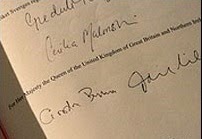
Gordon Brown's is the only 
Scottish signature on the EU Treaties


We have explained before that an independent Scotland would have to rejoin the EU. For although Scotland is within the EU it is the UK that is the signatory to the Treaties - above the most recent UK signatory (Gordon Brown's) it clearly states "United Kingdom". (If in doubt see the definitive legal opinion supplied to the Scottish Government by Former EU legal Counsel Jean-Claude Piris here). So it is clear that an iScotland would have to join  (not even re-join) the EU. So how long would that take?

Well a lot more than 18 months if history is a guide. We have set it out before here but in brief Scotland would need to apply for EU membership, be independent to apply and then complete 35 chapters of accession negotiations. Once the Commission has cleared Scotland through that phase, Scotland would still need the unanimous approval of all 28 EU states (inc rUK) and the European Parliament's approval. This leaves a lot of unanswered questions. We have set some of them out here and again here but here is a recap of the more serious problems:

All in 18 Months?
  1. Gain an opt-out from the Euro + Schengen border controls: All EU accession negotiations are based on accepting the full treaties. In iScotland's case Alex Salmond will come to the table asking for a UK-style opt-out from the euro, justice and policing laws and Schengen and the a share of the current UK rebate. These are all in the main body of the treaties. Without them iScotland would have passport controls on the English border, have to comply with rules governing the eurozone and be signed up to a growing body of EU criminal laws. Some EU members will object or want something in return.
  2. Avoid a Spanish veto: Spain (and a number of other states listed in our table here) have an 'in principle' objection to secession. As Scotland would require their agreement to join this is a real problem, while not unsolvable has the potential to complicate matters. 
  3. End negotiations with rUK: If Scotland were to opt to become independent it would enter into a long and fraught negotiation with rUK over the mountain of UK debt, assets, oil, currency, defence, passports and a whole range of other complicated issues. While this is going on the rUK will have want and be entitled to ensure that its negotiations with Scotland take precedence over iScotland's negotiations with the EU.
So could this all be done in 18 months of the referendum? Well as with so much of the independence debate, the reality is that all we have at this point are lots of 'known unknowns' and it is fair to say that if Scotland does vote for independence there will be a large item in Alex Salmond's inbox labelled EU membership...

Thursday, August 28, 2014

Douglas Carswell defects to UKIP: A Clacton by election could change the general election result

Douglas Carswell was until this morning the Conservative MP for Clacton on the Essex coast. He has now resigned from the Conservative party, joined UKIP, and says he will resign his seat in order to contest it as a UKIP candidate in the resulting by-election.

His resignation is not a total surprise as it follows a long period as a critic of the Conservative Party's direction and of David Cameron in particular. Carswell's criticisms are not limited to the Conservatives and not limited to Europe - he has developed a critique of British politics generally -  but Europe is among his key complaints.

In his resignation speech Carswell questioned David Cameron's commitment to EU reform accusing him of aiming to do the bear minimum necessary in order to secure an 'in' vote, while Carswell's view of a satisfactory renegotiation seems more akin to associate membership. He says this is a classic example the political class not being straight with the electorate and his reason to quit. The Conservative leadership for their part will feel aggrieved that having set out a 2017 referendum on EU membership they are rewarded with Carswell's 'ingratitude' - recriminations will run and run.

Carswell prides himself on having a large following locally and Clacton itself, it has been argued, is  the "number one most demographically favourable seat in the country for UKIP" according to Goodwin and Ford's Revolt on the Right. He therefore has a fighting chance of winning the seat. So what could happen?

Firstly, it is unclear whether the Conservatives will allow the by election to go ahead - they have to approve the writ being moved and could argue that with an election already scheduled the people of Clacton can wait until May 2015. However, if it is called, the stakes could not be higher.

For the Conservatives to hope to win the 2015 general election they need to minimise the UKIP vote. The best way to do this is the classic 'squeeze'. In a first past the post election they will say there is no point voting for a third placed party - i.e UKIP. This will be very effective. However Carswell's by-election could change voter's calculations - and set a hugely important electoral precedent one way or another:
  • If Carswell wins, UKIP can then tell voters everywhere that voting UKIP gives a genuine change of producing an MP. This could be catastrophic for the Conservatives and may deprive them of a number of seats, to other parties mostly, but conceivably to UKIP as well.
  • If Carswell loses, the result will be equally disastrous for UKIP. The Conservatives can use it to show that even in one of UKIP's best constituencies with one of their biggest names they can not win a seat - so why waste your vote in May 2015 will be the refrain.
UKIP does not just take votes from the Conservatives, they also gain a lot of their support from Labour, non-voters and even the Lib Dems. However, Carswell by taking on his former party will polarise the debate again into Conservatives/UKIP, something perhaps both parties may wish to avoid. This could be a foretaste of 2015.

In any case, a Labour victory would most likely mean that the In/Out EU referendum Cameron has promised won't happen, as Ed Miliband looks determined to stick to his promise not to offer a straight vote. It would be a tremendous irony if Carswell's defection - Carswell, remember, having campaigned tirelessly for an EU referendum and more direct democracy - would in the end deny the UK public an EU referendum and more direct democracy.

Thursday, June 26, 2014

The Juncker row: Will Cameron now be forced to say he's willing to recommend 'Out' in a referendum?

Could he merrily wave the EU goodbye?
There has been much said about David Cameron's supposed "threat" to leave the EU, reportedly delivered to Angela Merkel in a discussion over whether Juncker should become President of the EU Commission.

There are good reasons to doubt the specifics of the report, because the source probably had ulterior motives: to damage David Cameron's campaign to dislodge Juncker. The theory being, the prospect of a Prime Minister "making" a threat would so upset EU sensibilities nobody would dare stand with Cameron's campaign.

Having said that the story does have two elements of truth to it.

Firstly, all polling shows that EU reform is the decisive factor in determining whether Britons would vote to stay in the EU. David Cameron could easily have pointed out that Juncker's appointment - an obvious example of non-reform - would damage the chances of an 'In' vote. But is that a threat - or a fact? Possibly, if David Cameron was the only person planning to vote in his planned  referendum, but he is not. So, if it is a threat, it is a collective one from the British people.

Secondly, David Cameron has studiously avoided saying he could ever campaign for an 'out' vote - and been criticised for it in the UK. However, with Juncker's appointment, this is becoming a much more difficult position to sustain. If this continues, i.e. if the EU actively goes the wrong way, there would be a lot people in the UK saying it's not credible for him to say he would still recommend 'In'.  (Open Europe's Christopher Howarth set out some reason's earlier here.)

The outcome of the Juncker saga may be that Cameron has no choice but to say he's willing to recommend "Out". But hey, the nature of the referendum is that it won't be his choice anyway.

If Juncker is appointed as President of the EU Commission David Cameron will be one step closer to advocating an ‘out’ vote

Open Europe's Christopher Howarth wrote the following article on Conservative Home

Imagine you woke up in a state where the head of the civil service was elected – but not by you. Imagine a state where the top governmental positions were settled in deals in meetings to which your elected representatives were not invited. Imagine that this system had been introduced without your approval. Well, you may soon be living in it if Jean-Claude Juncker becomes President of the European Commission.

So what should David Cameron do? His options are limited; the UK lost the veto on this appointment under the terms of the Nice Treaty in 2001. He can vote against, but cannot prevent himself being outvoted.

This is a major problem on two levels. First, by appointing Juncker EU member states have conceded the precedent that the European Parliament is now responsible for selecting the Commission President. This will politicise the Commission, and make it subject to perennial Brussels political deals between MEP factions. Juncker’s route to power has been paved by a series of such contradictory deals cut firstly with the Christian Democrat EPP; then the Socialist S&D; then, reportedly, the Socialist Prime Minister of Italy and French President – and allegedly the German mass circulation Bild newspaper. Needless to say, this bears no relation to the results of the recent European Elections and is a straightforward power grab. It is a cession of power not authorised or even discussed in the UK Parliament.

Beyond the principle and the person, Juncker’s appointment presents a strategic headache for David Cameron and his Europe policy. The assumed policy is to provide enough tangible evidence that the EU can reform to allow Cameron to advocate an ‘In’ vote in his promised 2017 referendum. In doing so, he has bet the farm (or the UK’s EU membership) on his belief that other member states, notably Germany, will wish to bail him out. Juncker’s appointment is a clear message that he cannot always rely on his fellow leaders to see him through when they come under their own domestic pressure.

So what should Cameron do? He could take being outvoted on the chin, hope for some consolation prize and pray that, next time, EU leaders will help him to deliver change. This is a risky approach. An alternative would be to send a direct message to his fellow leaders that he is not just in favour of EU reform but also believes that it is fundamental to the UK’s continued membership. Cameron could say that if the EU continues in the manner of Juncker’s appointment he will have no choice but to advocate an Out vote.

This would be interpreted as a threat, and be greeted by a wall of hostility in Brussels – but it would have the benefit of being true. It is not an idle threat. Cameron’s plan to base his referendum on the potential for EU reform was the right one, and one from which he cannot back down. Nor can he back the UK’s membership come what may. If he tried to pull the Harold Wilson trick of presenting a few concessions as a major triumph, he will be found out. After over 40 years of EU membership, a cynical British public will not be fooled. Remembering that Cameron was unable to block Juncker will not help in this regard. Cameron has to succeed in EU reform if he is to advocate an ‘in’ vote – it is time others in the EU began to realise that and act accordingly, or it may be Out by default.

Tuesday, May 27, 2014

Martin Callanan for EU Commissioner?


Commissioner Callanan?
The most high profile UK casualty of last week’s European Elections, other than Nick Clegg obviously, was Martin Callanan, the leader of the Conservatives’ European Conservative and Reformist Group (ECR) in the European Parliament. He lost the sole Conservative seat in the North-East of England. This has caused people in Conservative circles, including the influential Conservative Home website, to float the idea that he would be the ideal candidate for the UK’s European Commissioner. Is this true and if so could it happen?

The decision of who will be the next UK Commissioner is ultimately in the gift of David Cameron who has let drop a few hints already. Firstly, we had a job description leaked in a
Number 10 memo that said they were looking for a “political heavyweight who speaks another language”. But there were other considerations. Avoiding a by-election, being a ‘eurosceptic’ but not offending Nick Clegg, and above all someone who could communicate the EU reform and referendum policy to the public and Conservative party alike.Some candidates have some of these qualities. The widely tipped Andrew Lansley has cabinet experience and is a big “big beast” in the Conservative Party but does not tick all the boxes, although in Lansley’s case his Cambridgeshire seat is considered safe from UKIP in a by-election, which would be an additional plus.

Callanan is new to the shortlist and is probably not a bookies' favourite. But he is a popular figure in the Conservative party, particularly among its grass roots, and well known in Brussels where leading the ECR group has given him the knowledge of building alliances and the power-broking needed for the job. In this role he has been through EU budget battles, fisheries reform, negotiating the car CO2 package as well as ensuring the ECR group's survival. Meanwhile, and crucially in many Conservatives' eyes, he has not “gone native”. Added to that, Callanan’s background in the North-East is a perfect counterfoil to Nigel Farage’s appeal to disgruntled former Conservative voters outside London. We do not know if he wants the job but he could well be suited for the tricky role of balancing an economic portfolio, pushing a Conservative reform agenda and credibly selling this in the UK.


So does Callanan tick all the boxes? Well he is not yet a household name in the UK, but running a European Parliament group is valued more highly elsewhere in Europe than in the UK – after all, Martin Schulz, the Socialist EP group leader was a serious candidate for the top job of EU Commission President prior to the elections.


Would Nick agree? Since the election result was a disaster for Nick Clegg it might be safe to assume that his ability to block a candidate is reduced, potentially removing one more obstacle.


Will he get it? Most likely not. As the press has already been reporting (including the FT), the post will probably go to Lansley.

Friday, February 14, 2014

#DEvote? Majority of Germans want to restrict migration

The Swiss referendum #CHvote to cap the number of EU migrants has sparked strong reactions across Europe. But would other European people vote differently if they were to be asked?

An Infratest dimap poll for Deutsche Welle from Wednesday suggests that a relative majority of Germans would like to restrict immigration as well. 48% say they are in favour of capping migration, while 46% are not. A very close call.  Note though, that the question was about "immigration" in general rather than "EU migration".

When broken down by party affiliation breakdown, it's clear where these views are most concentrated: 84% of Alternative für Deutschland's  supporters say they want a cap on migration. 51% of Angela Merkel's CDU/CSU say the same. Meanwhile, the Greens are least keen, with only 29% supporting the cap.
Courtesy of Deutsche Welle
In France, the picture might be even more distinct. A TNS Sofres/Le Monde poll recently showed that 34% of French “agree with the ideas” of Marine Le Pen’s Front National. Greens MEP Danile Cohn-Bendit estimates that 60% of French would vote in favour of limiting immigration.

Monday, February 10, 2014

Europe responds to the Swiss referendum - and it ain't pretty

We suspect the reverberations from the decision in the Swiss referendum to cap the number of EU migrants might be felt for some time (we look at what the long term implications could be for the UK here). The Swiss case is interesting because unlike the debate on migrants from Central and Eastern Europe in the UK, Germany and the Netherlands, it primarily affects citizens of the wealthier member states, primarily Germany, France and Italy. Here are some immediate reactions from around Europe.

The tone from the Berlin has been quite tough with Steffan Seibert, Merkel's spokesperson commenting that:
"The government takes note of the result and respects it but it is also the case, in our view, that it throws up considerable problems... It's in our interest to keep EU-Swiss relations as close as possible."
Foreign Minister Frank-Walter Steinmeier (SPD) added that "I believe that with this result Switzerland has harmed itself". He also dusted off the classic line so beloved of his predecessor in the post:
"there can be no cherry-picking when it comes to the EU
The new FDP leader Christian Linder echoed this sentiment arguing that "The Swiss are taking from the European buffet only that what they want" (which is kind of the point of a buffet). Interestingly however he added that he was "open-minded" about having more referenda in Germany.

Meanwhile Alternative für Deutschland leader Bernd Lucke didn't explicitly argue for capping EU migration although he struck a different tone compared with the established German parties, arguing that:
"Irrespective of the result of the Swiss referendum we can also achieve in Germany an immigration law which is based on qualifications and he ability to integrate while preventing benefits migration... If necessary we could have such referendums [in Germany]."
The least diplomatic response came from Ralf Stegner, leader of the SPD faction in Schleswig-Holstein who took to twitter to describe the Swiss as "crazy".
The response in France has also been quite tough with Foreign Minister Laurent Fabius arguing that:
“This is bad news for Europe and the Swiss, because Switzerland will be penalised from withdrawing into itself... There’s a so-called ‘guillotine clause’ establishing that if one of the elements [of the Swiss-EU bilateral deal] is put into question – in this case, the free movement of workers – everything falls down. Therefore, this means we’ll have to renegotiate […] This means we’re going to reconsider our relations with Switzerland.”
Former French PM Fillon (UMP) was commented that:
“It would be totally incomprehensible if Switzerland put a barrier to the access of cross-border workers… On the other hand, that [Switzerland] wants to reduce the overall number of foreigners on its territory is a perfectly natural demand.”
Italy's Foreign Minister Emma Bonino said that:
“The impact [of the Swiss referendum] is undoubtedly very worrying, with regard to both Italy and the other agreements with the EU.” 
Matteo Salvini, the leader of Lega Nord, said:
“Hurrah for Switzerland’s democratic referendum. We’ll propose one in Italy, too.”
However, his fellow party member Roberto Cota – the governor of Piedmont – voiced concern over the future of cross-border workers from his region, claiming that:
“Respect is needed, because we’re talking about honest and regular workers. Together with [Roberto] Maroni [the governor of Lombardy, another senior Lega Nord member] we’ll request a meeting with [Italian Prime Minister Enrico] Letta on this issue as soon as possible.”
UK Foreign Secretary William Hague was quite restrained, commenting that he did not want to prejudge the results of the negotiations, adding that:
"We will be mindful of the position of 40,000 British nationals who work in Switzerland".
Irish foreign minister Eamon Gilmore warned that “We are seeing signs of the rise of the far-right in Europe” while the Luxembourgian foreign minister Jean Asselborn has been the most outspoken, claiming that the vote has put the Swiss in “good company” with people such as Marine Le Pen, the leader of the French Front National.

There have also been some strong responses coming out of Brussels with EU Commission spokeswoman Pia Ahrenkilde-Hansen commenting that:
"The message is clear today: free movement of people is a sacred right for the EU... This will clearly have implications for the rest of the agreements [with Switzerland]."
EU Justice Commissioner Viviane Reding, never knowingly understated, argued that "the single market is not a Swiss cheese. You cannot have a single market with holes in it" which is a silly statement given that the Swiss trading relationship actually is a bit like a Swiss cheese, with patchy market access in services, for example.

The response from MEPs is also interesting as they might have a say in the negotiations (although this is a bit of a grey area). While EP President Martin Schulz was relatively restrained, other senior MEPs were quick to stick the boot in.
So a lot of posturing. These negotiations will be very, very interesting...

EU immigration: Why Ukip should pay close attention to what happens next in Switzerland

Our Director Mats Persson writes on his Telegraph blog:
In a referendum yesterday, the Swiss voted by a narrow margin in favour of restricting immigration from the EU. Switzerland is not an EU member but via around 100 agreements, Switzerland is partly integrated into the EU, including in the contentious area of free movement of workers.
Ukip’s Nigel Farage has been quick to stick the boot in, calling the vote "wonderful news for national sovereignty and freedom lovers throughout Europe." Equally predictable, Vivanne Reding – Vice President of the EU Commission – said that while "we respect the democratic vote of the Swiss people… The single market is not a Swiss cheese. You cannot have a single market with holes in it."

Which is a silly statement. One of the basic flaws with the Swiss trading relationship with the EU is precisely that it suffers from holes, including patchy market access in areas such as services, making it a sub-optimal model for the UK to follow. But Reding’s comments still highlight what an important test case this will be of the feasibility of the pick and mix relationship with the EU from outside, which the UK might have to adopt should it leave the EU.

Here it gets tricky. The Swiss-EU agreement on free movement was part of a bundle of agreements known as Bilaterals I, which also covered six other areas including market access for various Swiss exporters and firms, from trade in agricultural products to civil aviation. Crucially, it contains a "guillotine clause: which says that that the contents – including the market access – can only take effect together: if one of the agreements is terminated, the others would also cease to have effect. This sets Bern up for very difficult talks with Brussels. If the EU wants to play hardball, it could scrap the entire agreement.

There are a huge number of issues captured in the Swiss vote: support for immigration in Europe, the risk for an open economy in erecting new barriers to the world (think labour costs), how the EU responds to referendum results and much more. However, for the UK the implications are clear. If this escalates into other areas of Swiss-EU trade, including restricted market access, many in the UK will argue that a “pick and mix” deal with the EU will be hard to pull off. If, on the other hand, Switzerland was able to renegotiate its relationship to impose some form of restrictions on EU migration, however minor, those who favour UK exit would no doubt see it as a politically palatable precedent.

The Swiss referendum question doesn't specify what shape the immigration quotas would take, but only instructs the Swiss Parliament to draft legislation addressing the issue within the next three years. Much can still happen. However, no matter what, the EU will most certainly negotiate any revised deal with one eye firmly fixed on London, worrying about giving the Brits ideas. And for anyone with even the slightest interest in Britain’s future place in Europe, this is a key one to watch.

Friday, February 07, 2014

Switzerland's free movement referendum could provide key test of what life outside the EU is like

On Sunday the Swiss electorate will be asked to vote in a referendum on whether to impose migration quotas on European Union and European Economic Area nationals – a system the country currently uses for non-EU/EEA migrants. The referendum question doesn't specify how large or what shape the quotas would take, but would instruct the Swiss Parliament to draft legislation addressing the immigration issue within the next three years.

Ahead of Sunday’s vote, it is looking very tight with 43% expected to vote in favour of the quotas and 50% against, according to a recent poll by GFS.Bern. If the referendum result goes in favour of introducing quotas, not only would it potentially end free movement between Switzerland and the EU as we currently know it, there could be much wider ramifications for the Swiss-EU relationship that would provide a landmark test case.

The Swiss-EU agreement on free movement was part of a bundle of agreements known as ‘Bilaterals I’, which covered six other areas including the Mutual Recognition Agreement, which simplifies the admission of Swiss products in to the EU market, trade in agricultural products and civil aviation (other aspects of Swiss-EU relations are governed by a 1972 free trade agreement and there is also a Bilaterals II – in total there are 20 main and 100 subsidiary agreements in place). Crucially, Bilaterals I contains a ‘guillotine clause’ stipulating that the contents can only take effect together: if one of the agreements were not to be prolonged or terminated, the others would also cease to have effect.

Nothing will happen immediately on Monday morning, irrespective of the referendum result, because if the Swiss government is mandated to impose quotas it would have to decide what form this would take. Nevertheless, it would set up a very difficult negotiation with Brussels, which, if it wants to play hardball, could scrap the entirety of the rest of the agreement.

Now, it is not difficult to see why this could have consequences beyond Switzerland's relations with the EU (some would argue, it will also be another test of how the EU responds to referendum results). But, should the row escalate and other aspects of Switzerland's trade cooperation with the EU be cut off, many would argue that it illustrates that a pick and mix UK relationship with the EU from outside (particularly a carve out from EU immigration that UKIP would favour) would be difficult or impossible to pull off. If, on the other hand, Switzerland was able to renegotiate its relationship to impose some form of restriction on EU migration, however minor, this would give those who favour UK exit an important precedent to point to.

For this reason, we suspect the EU will take a very hard line with the Swiss government if the Swiss people vote for quotas on Sunday.

Thursday, June 13, 2013

Have the EU Referendum Bill's chances just improved?

Labour won't be there on 5 July
We have heard today that the Labour Party have decided not to turn up and vote on 5 July on the Conservative-sponsored Private Members Bill on an EU referendum. As we have written before, the Referendum Bill faces many hurdles before it has a chance of becoming law but if Labour abstain on 5 July it does help its chances. So what are its chances now - here is a recap.

1st Reading  - 19 June - We will get the name of the Bill but not necessarily the final text. At this stage there is no vote as all that happens is the Bill is lodged before Parliament.

2nd Reading - 5 July  - 100+ Conservative MPs are needed to turn up on the Friday to secure the closure of the debate. This is followed by a vote on the Bill itself - which now, without Labour opposition, will presumably pass.

Committee Stage. A lot might depend on who chairs the Committee and whether anyone tries to bog it down but it is still possible the Bill will survive the Committee and get to report stage.

Report stage. At report stage any MP can table amendments. If the Labour Party wish to derail the Bill this could be their chance. If it passes it would then be voted on at 3rd reading.

3rd Reading. If it has survived to this stage it would be interesting to see what the Labour Party and the Liberal Democrats do next. Do they change their mind and vote against the Bill or risk it passing and heading off to the Lords unopposed? But if the plan is to vote against at 3rd reading why not vote against on 5 July on the principle of the issue? And what of Conservative MPs - will some be tempted to table their own amendments on issues such as timing and the meaning of renegotiation?

As always with matters EU it is likely to become a political football. So will the Bill get to the Lords? On balance, it is still difficult, but its chances have just improved.

Monday, May 20, 2013

The UK electorate is in the market for something more than the false choice of status quo or exit

When it comes to the question of whether the UK ought to stay in the EU there are two key considerations. Is continued membership the best solution from an economic perspective (trade, regulation etc) and also is it democratically sustainable? (Others will also cite 'influence' and geopolitical clout).

Leaving aside the first consideration for now, the second one has long generated a heated debate, not least in the comment section of our blog, with some regular readers pointing out to us that a majority of the UK public wants to leave the EU. End of story.

In his Europe speech, David Cameron warned that support for the EU was “wafer-thin” – which as we highlighted at the time was a long-term trend (albeit exacerbated by the crisis).


Recent polls have shown an ever larger margin in favour of exit, with a widely cited ComRes poll over the weekend showing that 46% would vote to leave, 24% would vote to stay in, with 30% undecided.

However, there is, of course, an important sub-story here. While this and similar polls have been interpreted by some as a mandate for withdrawal, when a supplementary question about restoring “some EU powers” to the UK is posed, the proportions change quite dramatically with 43% (including 48% of Conservative and 20% of UKIP voters) voting to stay in, 24% voting to leave regardless, and 34% undecided. These figures are consistent with the results of similar questions asked in a number of opinion polls in recent times.

In fact, restricting the choice in the EU debate to only In/Out is rather odd. How often does that happen in other areas of public policy? Would a choice between a 100%, all encompassing welfare state or no welfare state at all, for example, be a fair choice put to the British public? Unlikely, as most of the public wants something in between.

That we consistently see such a large swing in opinion from 'Out' under a straight In/Out scenario to 'In' under renegotiated terms shows that one of the clearest trends in UK public opinion is that the UK public wants to see new EU membership terms first, and only then withdrawal if that fails.

As such, for those who cite the issue of democratic legitimacy as their prime motivation, whilst they most certainly have a point, there is no reason not to at least give Cameron a good shot at his strategy of re-negotiation followed by a referendum.

The democratic question is also frequently cited by those who demand an immediate referendum, including the MPs who voted in favour of the amendment to the Queen’s Speech last week. However, buried in the poll data was an interesting finding that ought to provide some food for thought – 20% of voters (including 52% of Conservative voters) said they had more sympathy with David Cameron while 18% sided with backbench MPs. Meanwhile 48% said they did not have more sympathy for either side.

If there was an overwhelming support for an immediate UK exit - as opposed to substantially reducing the EU's powers in Britain - one would have suspected far greater support for the handful Tory backbenchers who are pushing for an early referendum bill. This isn't to say that there is a major trust issue when it comes to Europe, and that some Tory backbenchers didn't make valid points last week, but merely that the public, again, is basically quite content with the basic idea of the UK negotiating new membership terms followed by a public vote.

At the same time though, politicians and officials who think they can fudge this process or procrastinate over addressing the EU's involvement in too many areas of national life ought to be very careful. The electorate's desire to staying the EU is clearly predicated on substantial reforms taking place.

Tuesday, March 12, 2013

Beppe Grillo, the Five-Star Movement and the euro enigma: Episode 2,478

We have noted on this blog before that it would be a bit of a stretch to describe Beppe Grillo's Five-Star Movement as an anti-euro party - mainly because it has yet to adopt an official position on the issue. At the moment, not even the referendum on Italy's membership of the single currency appears in the Five-Star Movement manifesto.

According to an ISPO poll published by Il Corriere della Sera on Sunday, if this referendum were to take place in Italy, 73% of Five-Star Movement voters would opt to stay in the euro - and only 17% would vote for a return to the Lira. An overwhelming majority.

However, Professor Mauro Gallegati (see picture) - one of Beppe Grillo's closest economic advisors - gives a slightly different picture in an interview with French business daily Les Echos today. He says
The [Five-Star] Movement is still split over the euro. There is a good part of supporters who are in favour of an exit from the single currency. Personally, I’m against [euro exit] because I think the cost to the Italian middle class would be prohibitive. 
So to what extent the Five-Star Movement's electorate can be described as anti-euro remains unclear. But the poll and the interview both leave another key question unanswered. What do the Five-Star Movement's 163 MPs and Senators-elect actually think about the euro? This is quite hard to figure out at the moment, given that they are not allowed to speak to the press. But they may have to take a clearer stance sooner rather than later, not least because official talks on the formation of the next Italian government are due to kick off next week.

Follow us on Twitter @OpenEurope or @LondonerVince for the latest from Italy.

Thursday, January 24, 2013

Business backs Cameron's call for a mandate on Europe

A letter in today's Times from some leading UK business people supporting Cameron's approach:

EU reforms must come before any membership referendum

Business faces ever more burdens from Brussels and the single market in Europe has not yet been fully realised

Sir, As business leaders we are passionate about Britain’s prosperity. We agree with the Prime Minister that Britain’s best chance of success is as part of a reformed Europe. We need a new relationship with the EU, backed by democratic mandate.

Business faces ever more burdens from Brussels and the single market in Europe has not yet been fully realised. The euro crisis has created the circumstances for a new EU settlement. This is the moment to push for a more flexible, competitive EU that would bring jobs and growth for all member states. That means completing the Single Market and quashing the culture of red tape.

Now is our chance to reform the EU from within. The Prime Minister is right. This is a European policy that will be good for business and good for jobs in Britain.
The full list of signatories:

John Ayton, Bremont Watch; Sir Anthony Bamford, JCB; Sir John Beckwith, Pacific Investments; Samir Brikho, AMEC; Sir George Buckley, Arle Capital; William Butler-Adams, Brompton Bicycles; Stephen Catlin, Catlin Group; Ian Cheshire, Kingfisher; Andrew Coppel, De Vere Group; Gerald Corbett, Betfair; Mick Davis, Xstrata; Philip Dilley, Arup; Paul Drechsler, Wates Group; Ralph Findlay, Marston’s; Rupert Gavin, Odeon & UCI Cinemas; Ben Gordon, Britvic; Michael Gutman, Westfield Group; Lord Harris, Carpetright; Aidan Heavey, Tullow Oil; Robert Hiscox, Hiscox; Brent Hoberman, made.com; Sebastian James, Dixons Retail; Luke Johnson, Risk Capital Partners; Andrew Law, Caxton Associates; Lord Leach, Open Europe; Alistair McGeorge, New Look; Jon Moulton, Better Capital; Charlie Mullins, Pimlico Plumbers; Jamie Murray Wells, Glasses Direct; John Nelson, Hammerson; Richard Nichols, College Group; Tim Oliver, Hampden Holdings; David Ord, Bristol Port Company; Alan Parker, Brunswick; Sir John Peace, Burberry; Tony Pidgley, Berkeley Group; Sir John Ritblat, Delancey; Nick Robertson, ASOS; SIr Simon Robertson, Rolls-Royce; Xavier Rolet, London Stock Exchange; Sir Stuart Rose, Ocado; Joanna Shields, Tech City Investment Organisation; Michael Spencer, ICAP; Tim Steiner, Ocado; James Townshend, Velcourt Group; Ted Tuppen, Enterprise Inns; Moni Varma, Veetee; Paul Walsh, Diageo; Robert Walters, Robert Walters; Joseph Wan, Harvey Nichols; Tom Wells, Charles Wells Pub Company; Nick Wheeler, Charles Tyrwhitt Shirts; Bob Wigley, Stonehaven; Charles Wigoder, Utility Warehouse; Lord Wolfson, Next