• Facebook
  • Facebook
  • Facebook
  • Facebook

Search This Blog

Visit our new website.
Showing posts with label Alex Salmond. Show all posts

Monday, September 22, 2014

Yesterday Scotland, tomorrow the EU? Are there lessons for the 'In' and 'Out' camps?

Staying or leaving?
If David Cameron wins the May election he has promised an In/Out EU referendum by 2017. Even if he does not it is still probable there will be one at some point. National referendums are rare in the UK so with the Scottish vote we have a rare glimpse of what the EU referendum campaigns could look like. What should the nascent In/Out camps take away from it?

In trying to understand the motivations of the Scottish voters Lord
Ashcroft's poll, conducted after the vote, sheds some interesting light. Voters made up their minds late in the day - 52% of voters made their mind up this year with 18% in the last month. The main issues driving independence voters were disaffection from Westminster and concerns about the NHS. Uncertainties over the pound and pensions drove the No side. 70% of Yes voters said they agreed with "The principle that all decisions about Scotland should be taken in Scotland" while No voters also felt the risks of independence were to great and conflicted with their attachment to the UK.

So are these findings and the Yes/No campaign relevant to a UK referendum on EU membership? here are some key issues:


Scottish Yes/No
EU In/Out
The need for a clearly thought out alternative to the status quo
The Scottish 'Yes' campaign came unstuck on some key elements of their proposition. Notably confusion over the £ and EU membership. The difficulty ‘Yes’ had with these key policies dogged their campaign
The nascent EU ‘Out’ campaign has a similar problem as there is no settled view. What relationship will the UK have with the EU after exit? Will it be the EEA, a new free trade agreement, what will access to the Single Market be etc and what are the political trade-offs. 
Harnessing optimism
The 'Yes' campaign was good at harnessing the ‘future’ and ‘change’ as a campaign weapon. The ‘No’ side failed to put forward a comparable future vision for the UK focusing instead on the risks of independence leading them to be portrayed as ‘negative'.
It will be difficult for the ‘In’ campaign to portray an optimistic vision of an EU future, given the likelihood of ongoing problems in the Eurozone – it will probably stick to pointing out what it sees as the risks of leaving.

It remains unclear whether the ‘Out’ campaign will be able to manage to transform itself from campaigning against the EU’s negative record to wholeheartedly putting forward its own positive vision.
Who leads the campaigns matters - can they claim to be the anti-establishment?
In Scotland the ‘Yes’ campaign was united, had message discipline and was led by the First Minister of Scotland. This gave it the credibility of office and the ability to set the scene while remaining an outsider/underdog in relation to Westminster at the same time.

By contrast the ‘No’ campaign was cross-party, divided and although ‘backed’ by the UK government was simultaneously seen as 'the Establishment' while being in opposition in Scotland.

It is unclear who the ‘In’ and ‘Out campaigns will be led by. However, on the basis that David Cameron is content with his renegotiation, the ‘In’ will have the advantage of the head of government and all the main party leaders.This could leave the ‘Out’ campaign run by UKIP and a number of backbench MPs.

Although the ‘Out’ side would have the advantage of being ‘anti-establishment’ there would be a large imbalance in credibility and official resources that could tell in the campaign.

Foreign interventions helpful /

unhelpful?
The ‘Yes’ campaign had to endure a series of interventions against them from UK allies and others including the USA, Australia, Germany, Spain, NATO and the EU.  
While foreign interventions in the EU referendum are inevitable some will be more effective than others. While UKIP will not lose any sleep over an admonition by Mr Juncker, Germany or France, they may suffer some damage if Commonwealth allies or the US express a desire for the UK to stay in the EU.
Business interventions - do they matter?
'Yes' had to put up with major Scottish and UK companies threatening to relocate out of Scotland in the event of independence. To counter it Yes managed to organise some pro-independence business voices but the overwhelming balance of the warnings weighed on the campaign.
‘Out’ like ‘Yes’ is likely to have to endure a slew of major companies questioning the case for exit, particularly larger businesses. This too will be countered by pro-exit business voices. Without the currency issue to worry about, the business question will be about what market access the UK would have to the single market (see alternative to the status quo section above).
Emotional appeal of staying / leaving?
While 'Yes' managed to mobilise significant emotional appeal for independence the residual emotional appeal of the United Kingdom was also considerable.
The emotional appeal of the EU institutions in the UK is close to zero. While it is clear that the emotional desire to leave the EU is felt strongly by confirmed 'Outists', it is less clear what role political identity will play among the undecideds.
Devo Max / EU Devo Max - key to the middle ground voter?
While the campaign started as a polarised Yes/No campaign it quickly switched in the last week into a No+Devo Max v. separation. This managed to win over some of the wavering middle ground to No. For that to work the credibility of the offer being delivered was key.
The In/Out campaign will start from the basis that ‘EU Devo-Max’ has either been achieved or has failed. This will have a huge repercussion on the campaign. If the negotiation is still on-going and is in the form of a last minute ‘EU Vow’ it is unlikely the credibility of those offering it will be enough to swing the result.
Turnout and the undecided voters - Age groups voting
The Yes/No campaign had a very high turnout and a high level of voters who made their mind up in the last month.

Older people tended to support the UK and younger people independence. As turnout was universally high the normal higher turnout among older voters probably did not tell.

An In/Out referendum is likely to have a lower turnout and a higher level of undecideds, making the last month and weeks of the campaign key.

Older voters are more likely to vote for 'Out' and younger for 'In'. However, with a lower turnout older voters are more likely to make their voice heard.

Wild card issues
The Yes/No campaign spent a lot of time discussing the supposed ‘privatisation’ of the NHS - a policy area already devolved to Edinburgh.
Immigration aside, the dry nature of EU policy could mean the In/Out campaign comes to focus on unpredictable issues.
Rogue polls - who might they help?
The close nature of the polls probably drove turnout and drove ‘shy unionists’ who may have taken the result for granted to vote.
Polling is also very likely to be a large driver of the 'In' / 'Out' campaigns but it is unclear who this might benefit.

Tuesday, September 09, 2014

Braveheart: Aspiration or reality? Alex Salmond claims Scotland could join the EU in 18 months

Aspiration or reality?
Alex Salmond has today claimed that an independent Scotland's (iScotland) EU membership terms could "be finalised in 18 months" i.e by March 2016. There is an obvious political reason for wishing to play down the disruption caused by Scotland leaving the United Kingdom - Alex would not want to scare the Scottish horses - but even by the standards of political rhetoric this is quite a claim. Here is how it might or might not work.

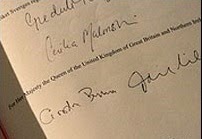
Gordon Brown's is the only 
Scottish signature on the EU Treaties


We have explained before that an independent Scotland would have to rejoin the EU. For although Scotland is within the EU it is the UK that is the signatory to the Treaties - above the most recent UK signatory (Gordon Brown's) it clearly states "United Kingdom". (If in doubt see the definitive legal opinion supplied to the Scottish Government by Former EU legal Counsel Jean-Claude Piris here). So it is clear that an iScotland would have to join  (not even re-join) the EU. So how long would that take?

Well a lot more than 18 months if history is a guide. We have set it out before here but in brief Scotland would need to apply for EU membership, be independent to apply and then complete 35 chapters of accession negotiations. Once the Commission has cleared Scotland through that phase, Scotland would still need the unanimous approval of all 28 EU states (inc rUK) and the European Parliament's approval. This leaves a lot of unanswered questions. We have set some of them out here and again here but here is a recap of the more serious problems:

All in 18 Months?
  1. Gain an opt-out from the Euro + Schengen border controls: All EU accession negotiations are based on accepting the full treaties. In iScotland's case Alex Salmond will come to the table asking for a UK-style opt-out from the euro, justice and policing laws and Schengen and the a share of the current UK rebate. These are all in the main body of the treaties. Without them iScotland would have passport controls on the English border, have to comply with rules governing the eurozone and be signed up to a growing body of EU criminal laws. Some EU members will object or want something in return.
  2. Avoid a Spanish veto: Spain (and a number of other states listed in our table here) have an 'in principle' objection to secession. As Scotland would require their agreement to join this is a real problem, while not unsolvable has the potential to complicate matters. 
  3. End negotiations with rUK: If Scotland were to opt to become independent it would enter into a long and fraught negotiation with rUK over the mountain of UK debt, assets, oil, currency, defence, passports and a whole range of other complicated issues. While this is going on the rUK will have want and be entitled to ensure that its negotiations with Scotland take precedence over iScotland's negotiations with the EU.
So could this all be done in 18 months of the referendum? Well as with so much of the independence debate, the reality is that all we have at this point are lots of 'known unknowns' and it is fair to say that if Scotland does vote for independence there will be a large item in Alex Salmond's inbox labelled EU membership...

Monday, February 17, 2014

If EU law is followed, Scotland will join the EU just before Serbia

Our Director Mats Persson writes on his Telegraph blog:
The UK must be the first country, with the forthcoming Scottish and EU referenda, to simultaneously have an intense political debate about the difficulty or otherwise of both joining and leaving the EU. Traditional assumptions are being bent in all sorts of directions, with senior UK politicians approvingly citing EU Commission President Jose Manuel Barroso for suggesting it would be “very difficult, if not impossible” for an independent Scotland to join the EU.

Like Catalonia in Spain, rightly or wrongly, Alex Salmond’s case rests in part on the argument that "if we leave one club, we can safely join another." It’s an insurance policy against the uncertainty which is a such a killer in any referendum to change the status quo. So is Barroso right?

Iceland’s accession talks with the EU – which were terminated since the Icelanders turned cold on the idea – would, in purely legal terms, come close to those of Scotland. Iceland is part of the European Economic Area, and therefore almost an EU member. Scotland has been an EU member for 40 years. Both would face tricky negotiations, like protecting their fishing industries.

There are basically six steps (by my rough categorisation). Salmond’s biggest problem is that for half of these, each of the 28 EU states, including rUK and Spain, has a veto:

Step 1 – Scotland applies to join the EU: Under EU law, it would have to be an independent country to apply.

Step 2 – The European Commission “screens” Scottish law to see if the country is compatible with EU membership – this won’t be an issue.

Step 3 – EU governments decide whether to approve Scotland’s EU application. All EU states have a veto.

Step 4 – The EU and Scotland begin negotiations over individual EU policy areas. There are now 35 so-called “accession chapters” covering everything from the euro to employment law to the EU budget. Each country has a veto over the decision to both open and then to close every single chapter – ask Turkey how easy that has proven (read: Cyprus and France). It’s in these talks that Salmond would need to deliver on his pledge to get an opt-out from the euro, as well as replicating the UK’s special deals on the EU budget, crime and immigration and passport controls.

Step 5 – When the 35th chapter is agreed, the Accession Treaty with the Scottish terms of entry is drafted.

Step 6 – This Treaty must then be ratified by the Parliaments of each EU country and the European Parliament. If one says no, the deal falls.

Iceland officially applied to the EU in June 2009. In 2013, when the bid was dropped, it had completed about a third of the negotiations. So if the letter of the law is followed, Scotland might join the EU just before Serbia, several years from now.

However, in the EU, political expediency tends to trump the letter of the law. I suspect that, given the stakes, if the Scots do pull the trigger, the EU will engage in the kind of legal acrobatics that it’s proven so good at in order to fast-track an independent Scotland to membership, with or without a euro opt-out (though, as Andrew Lilico has pointed out, there might be a range of practical currency issues).

No matter what, it would be a mess. In truth, we have little idea what’s going to happen if Scotland goes independent. And I suspect that in itself undermines Salmond’s case.