• Facebook
  • Facebook
  • Facebook
  • Facebook

Search This Blog

Visit our new website.
Showing posts with label Ashton. Show all posts

Tuesday, July 15, 2014

Are things heading towards a showdown on the new EU foreign policy chief?

UPDATE (18:20) - The FT's Peter Spiegel and Alex Barker are reporting that Belgium's Karel De Gucht, currently serving as EU Trade Commissioner, could be a late entry into the race for High Representative.

Like former Estonian Prime Minister Andrus Ansip (see below), De Gucht is a member of the liberal ALDE family - that has joined the 'grand coalition' supporting Juncker in the European Parliament and now looks to be asking for something in return.

ORIGINAL BLOG POST (17:07)

EU leaders will meet in Brussels tomorrow to get on with the assignment of the remaining top jobs. Priority will probably be given to the appointment of the EU's new foreign policy chief (aka High Representative for Foreign Affairs and Security Policy).

Italian Foreign Minister Federica Mogherini is still regarded as the frontrunner for the job. However, things may not go as smoothly as initially thought. Sources close to European Commission President-elect Jean-Claude Juncker have told Italian news agency ANSA that "ten-eleven [EU] countries" are currently against Mogherini's appointment.

The sources didn't name any names, but it is understood that Eastern EU member states are particularly reluctant, since they believe Italy did not take a hard enough stance against Russia during the Ukraine crisis.

The Lisbon Treaty establishes that, similarly to the European Commission President, the High Representative is appointed by EU leaders under qualified majority. And Italian Europe Minister Sandro Gozi has made clear Italy is prepared to go to a vote. He said:
"[The appointment of] Juncker is part of an agreement whereby the High Representative goes to the socialists." 
"Juncker has been designated by [qualified] majority. No-one ever raised objections [against Mogherini] with us. If there were any, that would mean the High Representative will also be designated by majority."
Therefore, things may be heading towards another showdown. This time, though, the outcome of the vote could be a lot more uncertain. A group of ten or eleven countries (very likely to include Poland, a qualified majority heavyweight) would have good chances of success in forming a 'blocking minority' to reject Mogherini's appointment. That would be a blow for Italian Prime Minister Matteo Renzi, who seems to be investing a good deal of political capital trying to secure a post that he considers as of great prestige. But it could also shift the balance in the distribution of the other top jobs - notably the Presidency of the European Council.

Mogherini is from a centre-left party. This means her appointment would make it less likely for Danish Prime Minister Helle Thorning-Schmidt, another centre-left politician, to succeed to Herman Van Rompuy as European Council President. However, this argument could no longer be valid if the new High Representative were to come from a centre-right party.

This would be the case with Bulgaria's Kristalina Georgieva, who looks to be gaining momentum as an alternative to Mogherini, although, as our dove-hawk axis showed, Bulgaria has so far also been quite soft on Russia.

Another option could be to offer the post of European Council President to someone from an Eastern European country in order to assuage opposition to Mogherini. Polish Prime Minister Donald Tusk could be an option, although with Polish domestic politics in a precarious state he may prefer to stay put. In that case, former Estonian Prime Minister Andrus Ansip - who has already been nominated as Estonia's next EU Commissioner - could be one to watch. Ansip's Estonian Reform Party belongs to the liberal ALDE group, that has joined the 'grand coalition' supporting Juncker in the European Parliament and would presumably be keen to get something substantial in return.  

In other words, a few surprises may come out of tomorrow's European Council. Stay tuned.

Friday, August 30, 2013

Europe reacts to David Cameron's defeat on Syria

Europe has reacted with surprise - and a degree of shock - to David Cameron's defeat in the House of Commons, which has de facto ruled out British participation in any potential military operation in Syria, at least for now. Here is a first round-up.

In an interview with Le Monde, French President François Hollande commented the outcome of the vote as follows,
Each country is sovereign [and can decide] to take part in a [military] operation or not. This is valid for the UK as well as for France.
Hollande suggests France could go ahead with or without the UK, and says,
If the [UN] Security Council is unable to act, a coalition will be formed. It will have to be the largest possible…It will have the support of the Europeans. But there are only few countries that have the capacity to inflict a sanction through the appropriate means. France is one of them. It’s ready [to act]. It will decide its position in close contact with its allies.
An editorial in Le Monde carries the headline, "The Commons vote against...Tony Blair", and notes,
It's the trauma of the Iraqi episode…that explains the 'no' of the British parliament to a [military] action in Syria. It's not David Cameron…who has been defeated. Rather, he pays for Tony Blair – as Mr Cameron himself acknowledged during the debate. 
As regards the international implications of yesterday's vote, the article goes on,
Washington has indicated that the decision of the UK – the privileged ally, the one of the 'special relationship' – would not stop the US intervening. But [the UK’s decision] can’t not embarrass Paris – even though, officially, France’s position remains that it is impossible not to react to the use of chemical weapons.
Germany's Die Welt has a comment piece entitled, "Cameron experiences his greatest humiliation". The article notes,
The refusal of the British House of Commons to participate in a military strike against Syria has left Cameron badly damaged - and with him the 'special relationship' with the United States.
Die Welt's chief correspondent Michael Strümer stresses how, once again, when it comes to 'hard power' the EU disappears. He writes,
While all eyes are on Washington, New York, Moscow, and on Damascus, Ankara, Cairo and Jerusalem, awkward silence reigns in Brussels…In the corridors of powerlessness in Brussels you can sense frustration and little momentum.
Christian Zaschke of Süddeutsche Zeitung describes the vote as,
A political slap in the face of historic proportions” for the Prime Minister, adding that it will define his tenure…On the international stage, [Britain] will be taken less seriously.
In Denmark, the only other EU country that has signalled it might take part in a strike, political leaders have this morning signalled that the country remains committed - although Foreign Minister Villy Søvndal also warned that the UK vote "calls for reflection".

When asked about the vote, Polish Foreign Minister Radoslaw Sikorski dodged the question, replying that it is important to have confidence in the UN inspectors' evidence. Sikorski also suggested that a possible solution could be for Russia to secure the Syrian regime's chemical weapons stockpiles - as the majority of them dates from Soviet times.
 
In Spain, an article in El País under the headline, "A blow to Cameron", argues that, as a result of the vote,
The British Prime Minister sees his authority seriously dwindled and, in an unprecedented event in the country’s modern history, has lost control over foreign policy.
Italian political commentator Gianni Riotta notes in La Stampa,
Paradoxically, Hollande, a French Socialist, seems to be the ‘hawk number one’. After securing a very prudent pension reform, he’s now trying to use strength against an ex colony inherited by the Turks to titillate the nation’s imperial pride – although Cameron’s defeat will lead him to take a milder stance.
We will keep updating the blog with any other interesting reactions throughout the day.

Monday, August 19, 2013

What the Egyptian crisis tells us about the (in)effectiveness of EU aid

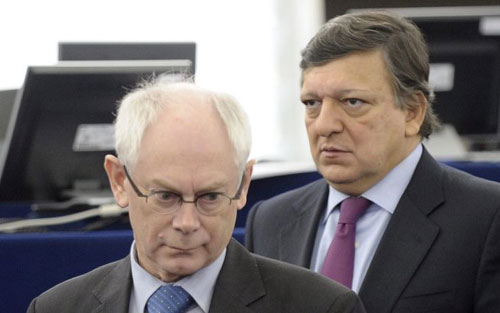
As the crisis in Egypt continues to intensify by the day, European Council President Herman Van Rompuy and Commission President José Manuel Barroso warned in a joint statement yesterday that the EU would "urgently review in the coming days its relations with Egypt" - including the new aid package worth around €5 billion that was pledged to Cairo last year.

EU member states' ambassadors are holding talks today, followed by a meeting of EU foreign ministers on Wednesday. For the moment, though, Egypt's new military-backed government does not seem very impressed by threats coming from Brussels. As Foreign Minister Nabil Fahmy put it,
"I want to determine what is useful and what is not and what aid is being used to pressure Egypt and whether this aid has good intentions and credibility. We are not looking to replace one friend with another but we will look out to the world and continue to establish relations with other countries so we have options."
There is plenty of political posturing in Mr Fahmy's words, but this kind of reaction inevitably raises questions over how the EU has handled its relations with Northern African countries over the past few years, particularly via the European Neighbourhood Policy (ENP). 

In a report we published in May 2011, we stressed how, in the name of 'stability', the EU had consistently increased funding allocations for countries like Egypt and Tunisia, despite the European Commission itself noting limited progress on human rights and democratic reform over the years. In particular, we argued that the Commission's reliance on so-called 'budget support' - whereby EU aid money is given directly to neighbouring countries' governments and then directed towards specific projects by the latter - was clearly problematic, given the lack of transparency on how these funds were used.

The European Court of Auditors recently made a similar criticism in a tough report on EU aid to Egypt, where it suggested that the European Commission had been "too flexible" in assessing whether the Egyptian authorities were actually meeting the conditions for granting 'budget support'. The Court noted that,
"The Commission and EEAS [the EU's diplomatic service headed by Baroness Catherine Ashton] have not been able to manage EU support to improve governance in Egypt effectively. This was partly due to the difficult conditions they have faced in Egypt but also to shortcomings in the way the Commission and EEAS have managed their cooperation with Egypt."
The recent events in Egypt add one further element of concern. Despite its generous funding (Egypt was initially allocated approximately €1 billion for the period 2007-13, around 60% of which via 'budget support'), the EU seems to have failed to gain any significant leverage on the Egyptian establishment. Calls to stop the violence have been ignored - and the threat to stop the disbursement of aid has so far been openly snubbed.

This is of course a complex political situation and the circumstances are difficult, but given that the ENP is a very political aid instrument (seen by the EU as a tool to exercise its 'soft power'), it is getting increasingly difficult to see what value it has added in the case of Egypt.