• Facebook
  • Facebook
  • Facebook
  • Facebook

Search This Blog

Visit our new website.
Showing posts with label Piratenpartei. Show all posts

Friday, September 20, 2013

The top 10 'spiciest' moments of the German elections

How do we put this delicately...the Germans aren't exactly known for their sense of humour. Equally neither are politicians, other than attracting derisory chuckles at their attempts to seem cool or in touch with the common man. Combine the two and result is often enough to drive large swathes of people to watch the handwork of their decorator dry slowly. 

This round of German elections has been little different, not least because Angela Merkel has actively employed the tactic of trying to bore people into voting for her (see cartoon below). We haven't seen so many references to 'Safe Hands' since David Seaman's auto biography.

Fortunately, there have been a some spicier moments (though we refrain from call them "highlights"), here are the top 10:


The FDP, neo-nazis and a cream cheese discover they have something in common

An awkward moment for the FDP when someone spotted that a stock image of an all-German family used in one of their televised ads also featured in a campaign video for the far-right/neo-Nazi NPD party. Bizarrely, the same family also featured in an advert for a Finnish cream cheese. Unfortunately for the FDP, the moment has not proved as embarassing as being seen as a photocopy of the CDU.


The necklace that won the #tvduel

We all know Germans love gold but this takes the nugget. The only TV debate between Angela Merkel and Peer Steinbrück was considered so dull that it prompted many to proclaim Merkel's fetching patriotic necklace the real winner of the debate, and it quickly gained its own Twitter account with over 8,700 followers to date.

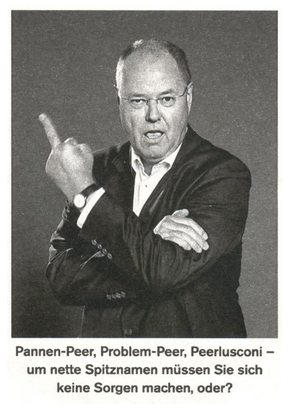
Peer's 'Stinkefinger'

After losing his only televised debate to a necklace, Peer felt the need to take drastic action. But what to do? Well, apparently, if your words aren't working, go 'wordless'. Peer Steinbrück signed up for a 'wordless interview' with Süddeutsche Magazin which ended up receiving widespread coverage in Germany and abroad after he responded to a question by unapologetically flipping the bird. Unfortunately, rather than inspiring the electorate they simply replied in kind...


Lucke's Greek toga party

If you thought Peer's wordless interview was bizarre, wait until you see this. AfD leader (and serious German professor) Bernd Lucke held an interview with German channel Tele 5 on why Greece should leave the euro, during most of which he wore a Greek flag as a toga. He then proceeded to sing a duet with the host, of the AfD's official song to the backing music of Take That's 'Back for good' (a song which Lucke had apparently never heard before). On top of all of this, as some of the papers noted, one of the producers of the show is Greek and proceeded to periodically alter Lucke's voice so that he sounded like Mickey Mouse. A truly bizarre election interview, which is well worth watching even if you don't speak German.

Don't mess with the Currywurst

While pushing for the humane treatment of animals, the Green party ironically managed to shoot themselves in the foot. In an almost inexplicable move, they proposed forcing all public canteens to make one day a week vegetarian day. Unsurprisingly, the suggestion did not go down well in a country famous for loving its meat. “How dare the Greens tell us what to eat!” thundered Germany’s mass circulation Bild newspaper, the day after the proposal was floated. What next? Banning nudism, autobahns or the Hoff...? You simply don't mess with the Currywurst or the Schweinshaxe. The Greens have recently slipped a couple of points in the polls - clearly no coincidence...

Beating the kids at their own game 

The new anti-euro party Alternative für Deutschland was widely derided as a party for old, white and grumpy men or alternatively as the 'Professor party' (if only it was true some would say). The contrast with the young, swinging and tech savvy Pirate party could hardly be greater. However, the AfD has proved it is no slouch when it comes to online campaigning with one of its election campaign videos getting over a million hits, while a Pirate video has received only just over 10,000 views.

Die Partei's whole election campaign


The brilliantly named Partei für Arbeit, Rechtsstaat, Tierschutz, Elitenförderung und basisdemokratische Initiative (Party for Work, Rule-of-Law, Protection of Animals, Advancement of Elites, and Grassroots-Democratic Initiative) - shortened to Die Partei - is a German satirical party akin to the UK's Monster Raving Loony Party, but much funnier. Set up by Martin Sonneborn, editor of the satirical Titanic magazine, its campaign pledges include razing the City of London to the ground and putting Angela Merkel on trial in a cage. Die Partei also released an election video on 'family policy' featuring (pixelated) scenes from an adult film with a soundtrack of "moaning and groaning, accompanied by light-hearted background music".

The hypnotic Chancellor 

We're not sure if it is her or her necklace, but Merkel has certainly lulled the electorate into a state of tepid contentedness. This cartoon perfectly captures the excitement of the CDU's election campaign. Merkel: "You are going to sleep. Everything is good. You are going out to vote..."


A rough ride for AfD

In their misguided attempts to stop the AfD expressing its alleged intolerant views the members of the Green youth decided to physically halt AfD activists from their right to freedom of speech and expression, with no sense of irony. Green with envy of the AfD's media coverage perhaps? In any case, as reported by Spiegel, this is likely to help the anti-euro party's chances, rather then hurt them.

Merkel drones on...

Just when the scandal surrounding the government's bungled purchase of the multi-million euro 'Euro Hawk' surveillance drone was beginning to fade, a CDU event with Angela Merkel and Defence Minister de Maizière in Dresden was interrupted by a miniature drone operated by remote control. The Pirate party claimed responsibility, saying that "The goal was to make Chancellor Merkel and Defence Minister de Maizière realise what it's like to be subjected to drone observation". Judging by the results above maybe they should just make her watch their election video...

David Hasselhof singing on the Berlin wall

Oh, sorry, that was in 1989...maybe it just seems like yesterday since we watch it on a daily basis...

Wednesday, May 23, 2012

Pirates of Westfalen

A slightly amusing story in yesterday’s Bild caught our attention this morning concerning a growing row over the seating arrangements in the Nordrhein-Westfalen regional parliament (Landtag) which has to be re-thought following the recent elections. Namely the far-Left Die Linke were wiped out, while the pirate party continued its recent hot streak and won seats in NRW for the very first time with 7.8% of the vote. The other parties want a straight swap with the pirates taking over Die Linke’s old seats on the far left of the chamber, but the Pirates are outraged by this proposal, demanding instead to be sat in the middle, between the governing and remaining opposition parties.

Ostensibly of no great significance, this spat does however illustrate a wider point in German politics: the difficulty for the country's political structure to come to terms with alternatives to the traditional parties. Although, to be fair, classifying and categorising the pirate party, particularly using the traditional left-right labels, isn't easy. For example, polling has shown that it has garnered support from across the political spectrum from the Christian Democrats through to Die Linke. Unsurprisingly, this is reflected in their manifesto, which combines strongly libertarian aspects (e.g. on civil liberties) with more traditionally social-democratic policies (e.g. on universal child care). While there are some interesting parallels with UKIP (e.g. on drug policy), overall the Pirates are pro-EU membership, in particular aspects such as free movement. However, as we have pointed out before, they have been highly critical of the eurozone bailouts, and this could have been a significant factor in their recent rise.

One to watch is whether the Pirates could see a surge in support by vocally oppose the introduction of eurobonds or greater ECB intervention, particularly if Merkel starts to give ground on those issues. So far she is standing firm, but Merkel does have form for crossing red lines...

Monday, March 26, 2012

Is this party over?

Yesterday's elections in the German region of Saarland saw a somewhat unexpected surge for Angela Merkel's CDU party, which won 35.2% of the votes, ahead of the Social Democrats (SPD) on 30.6% and the far-left Die Linke on 16.1%.

As Torsten Krauel comments in Die Welt, despite expectations of an SPD victory, “The CDU held its own. Angela Merkel will appreciate this when it comes to the formulation of further conceivable eurozone rescue packages”.

But perhaps equally significantly, Merkel’s junior coalition partner at the national level, the FDP, won only 1.2% of votes - a massive drop of 8% compared with the previous elections. In fact, the FDP only just beat the neo-Nazi NPD party by 267 votes.

This also means that in all the regional elections that have taken place over the last two years, the FDP has only managed to get re-elected its heartland of Baden-Württemberg, and even then they just about scraped in with 5.3% of the vote. Despite its history as a party of government (it has often played the role of kingmaker for either the SPD or CDU/CSU), it is literally being wiped off the map, having completely failed to re-invent itself.

As the party stares into the abyss, former party leader and one-time golden boy of German politics Guido Westerwelle (in our view increasingly marginalised as Foreign Minister) organises conferences looking at the prospects for fundamentally re-shaping the EU's constitutional architecture after the crisis, which although undeniably important in the longer term, can hardly be deemed to be a priority for voters concerned about the 'here-and-now' of the eurozone crisis and Germany's role in the bailouts.

Meanwhile, Germany’s young and swinging Pirate Party, which has been critical of the bailouts, came fourth with 7.4%, meaning it has secured seats in Saarland’s regional parliament for the first time. It also won seats in last year's regional election in Berlin and looks competitive in polls ahead of the impending elections in Nordrhein-Westfalen, Germany's most populous state. The Pirates are also contributing to a wider cultural change in German politics, for example pushing mainstream politicians to become more social media-savy, e.g. by joining Twitter, which the Pirates have utilised to great effect.

So as the FDP's star wanes (or more accurately comes crashing down to earth), the Pirates are definitely the ones to keep an eye on...

Tuesday, October 25, 2011

A German eurosceptic party on the horizon?

There is a curious mismatch in the German EU debate between public opinion and party politics. Poll after poll shows that a clear majority of Germans oppose further bailouts and eurobonds, and yet the two main opposition parties that have backed eurobonds in principle, the Greens and SPD, are currently way ahead in the polls (Combined they are on 42% to Merkel's CDU/CSU on 31% .

While there are some obvious initial explanatory factors such as Germany's unambiguous commitment to Europe and the fact that German elections (there are a number of state elections in addition to national ones) have been dominated by personalities and local issues. Nonetheless, an opinion poll is FOCUS earlier this month suggested that 37% of Germans would consider voting for a "euro-critical" party, which begs the question whether there is a vacuum in German politics just waiting to be filled.

We're yet to be entirely convinced. The FDP, Germany's liberal party, had a brief and half-hearted flirtation with a more critical EU stance during the recent Berlin regional elections, and scored a disastrous 1.8%, although the impression we got was that the FDP leadership really wasn't all that keen on the flirtation in the first place.

On the other hand, the German political scene is fluid, which is why the rise of the German Pirate Party (Piratenpartei) is particularly interesting. The Pirate Party is tapping into to the German debate on an unregulated internet, civil liberties and privacy. Like its Swedish counterpart, the party targets a younger, more or less tech-savvy demographic, using the same social media and IT tools that it wants to 'set free'. A recent opinion poll put the Pirate Party at a full 10%.

Last week German finance paper Handelsblatt published an interview with the party's economics spokesperson Matthias Schrade (pictured here in a sharp suit as opposed to traditional pirate garb), an indication that the party was starting to be taken more seriously. This is what Schrade had to say about the eurozone crisis:
"I believe that we cannot avoid building a core-Europe with countries such as Germany, Austria, France, Benelux with the euro as their currency. We need a zone that is economically homogenous and not one that is completely drifting apart. We would then get a more stable monetary union than the one we have today. It would of course be open to other countries providing they have made reforms and stabilised their economic system.”
When Schrade was asked whether he thinks this means Greece should leave the eurozone, his reply was: “not just Greece”.

So a break-up of the euro in other words. The regional Piratenpartei in North Rhine-Westphalia called for referenda on bail-outs and have argued for an Icelandic style solution to the eurozone crisis rather than the current bailout strategy. The Swedish Pirate Party ran on a clear eurosceptic platform in the European elections in 2009, in which they managed to get 7.1% of the vote by opposing the EU's Data Retention Directive and various other international data sharing measures, as well as the Lisbon Treaty. Could such a strategy work in Germany, if the Piratenpartei was to capitalise on the anti-bailout mood as well?

Possibly.

The Piratenpartei is less of a political party and more of a movement, and as such it may be difficult for it to come to an internal agreement on such a huge issues like the future of the EU and euro, not least because its supporters are scattered all over the political spectrum. However, what is abundantly clear is that the rise of the Piratenpartei shows that Germans are ready for something new (and incidentally marks a conspicuous failure by the FDP to reinvent itself).

In any event, with an increasingly assertive Bundestag, and with voters starting to show signs of seeking political alternatives, German domestic politics is becoming more interesting by the day.