• Facebook
  • Facebook
  • Facebook
  • Facebook

Search This Blog

Visit our new website.
Showing posts with label Bild Zeitung. Show all posts

Thursday, June 19, 2014

Is Bild having second thoughts about Juncker?

If Angela Merkel had privately hoped to quietly ditch Jean-Claude Juncker after the European election, it all started to go wrong when Axel Springer, the media group that owns Bild, Germany's and Europe's biggest selling paper, added its substantial weight to the pro-Juncker/pro-spitzenkandidaten campaign. This severely restricted Merkel's room for manoeuvre.

While Bild's editorial line has not changed explicitly, today's coverage of the issue is notably less enthusiastic. The paper's Brussels correspondent Dirk Hoeren asks "Will the Juncker deal be a dirty one?", with his piece claiming that France and Italy have made their support for Juncker conditional on a relaxation of EU budgetary rules (unlike Cameron who has taken a principled stance).

In a separate op-ed entitled “Merkel’s dilemma”, Bild’s deputy editor in chief Béla Anda argues:
“that the Southern Europeans will make their vote for Juncker dependent on an agreement on their debt policies shows the shabby extent the haggling over the EU’s chief post has reached.”
“If Merkel supports the election of a euro-softener to the post of Commission President, she will have backed the wrong horse.”
“Jean-Claude Juncker should be warned and be made aware that he must not be a chief at the mercy of Southern Europe.”
If you believe in tight observance of budget rules, as most Germans do, the last thing you want is to have a Commission President, appointed on a 'pan-European democratic mandate', who supports relaxing German-inspired rules on budgetary stability and the introduction of eurobonds.

While Juncker might need French and Italian support, ultimately he is the EPP candidate and Merkel is likely to bring her influence to bear. But imagine if 'centre-left' parties with a more avowedly Socialist spitzenkandidat were to win in future. How would Germany respond then, particularly the 'centre-right'? Would it be a case of yes to pan-European democracy, but only if the 'right' candidate wins? It seems like some people are starting to wake up to this prospect.

Wednesday, June 04, 2014

Der Spiegel not all pro-Juncker: 'He is no friend of the Germans'

Germany's Spiegel (magazine and online news agency), has been vocal in its criticism of David Cameron for
his objection to Jean-Claude Juncker as the next Commission President, on the premise that he is blocking the democractic choice in Europe.

Spiegel's editing director, Nikolaus Blome wrote a piece for today's FT arguing that:
To many member countries, backing Mr Juncker has become a strong symbol for promoting democracy and transparency in Europe. The British government would be ill-advised to laugh at this sentiment.
However, scratch beneath the surface, and you will find that even in Germany, Juncker's is a troublesome prospect. Spiegel columnist and editor, Jan Fleischauer, today argues that, "Juncker is no friend of the Germans".

Fleischauer continues:
Or better said, Juncker is only a friend of the Germans, so long as they continue to pay for the debts of their neighbours without grumbling too loudly about it..[He] is one of those people who dream of making the monetary union a debt union.
Fleischauer points out that at the the height of the eurocrisis, when the German government was hesitating before providing more bailout money, Juncker said:
This is part of the problem, to behave as though Germany is the only virtuous country in the world that has to foot the bill for all other countries. This is highly offensive to the others.
When the German goverment insisted on stricter budgetary discipline in peripheral countries, Juncker's interjection was:
Why exactly does Germany constantly allow itself the luxury of formulating domestic policy in all euro-related questions? Why does Germany treat the eurozone as a subsidiary?
And on eurobonds, which Germans have pretty much ruled out, Juncker said:
This approach, building taboo-zones in Europe, and not engaging with the ideas of others, is a very un-European way of doing European business. Germany is thinking a bit simplistically there.
Fleischauer then challenges the premise that Juncker is the 'democratic' choice, arguing that his bid for Commission President was "fraudulent" from the very start. He adds: 
What one could call a rigged game anywhere else, is called democracy in Brussels: First, one makes citizens believe they can vote on something, that in reality, is in the remit of the heads of [national] governments. When [government heads] subsequently insist on their right to ignore the self-nomination of the candidates, then it is painted as neglecting the vote of people.
Fleischauer concludes that, “The only person who can come between [Juncker and the Commission Presidency] is the German Chancellor…One can only hope that [Merkel] says no to Juncker.”

Meanwhile, Bild, Europe's largest tabloid that actively came out in favour of Juncker's presidency, strikes a more nuanced tone today, writing that Merkel didn’t agree on the concept of ‘Spitzenkandidaten’ “from the start,” because she knew “there would be “no agreement” in the Council. The piece adds that Merkel could ultimately “live” with Juncker in the post, because:
 The head of the Commission dances to the tune of the heads of the member states: not vice versa.
Interesting stuff then, showing that even in Germany, neither Juncker nor the process of his selection are universally endorsed.

German media turn on Cameron over Juncker - but what are they arguing for?

We pointed out on Friday that a powerful coalition between media and politicians was forming in Germany in support of Jean-Claude Juncker becoming the next Commission President and the Spitzenkandidaten experiment more generally. More worryingly for Cameron, he has emerged as the pantomime villain of the piece due to his opposition to both.

What's interesting though is that German commentators seem to argue more against Cameron than in favour of Juncker - who, we suspect, most of them realise that the idea of Juncker as the saviour of European democracy isn't entirely intellectually sound. A widely reported pre-election opinion poll for Bild showing that only 7% of Germans actually knew Juncker was a candidate, is no longer cited.  Here is a round-up of some of the key pieces from the past few days:

On Friday, the big news was the endorsement of Juncker by Axel Springer (the parent company of Bild and Welt). In a piece headlined “Juncker has to become President", the group's chairman Mathias Döpfner wrote:
“Are the results of the elections in Europe the sovereign decision of the citizens that politicians ought to implement? Or are they a form of non-binding suggestion that in the backrooms of powers can be interpreted and then gladly twisted into something opposite?”
"The issue is clear: Europeans want Juncker as the EU president. Schulz got the second-best result. A third [candidate], who didn't stand for election, can't be allowed to get the job. Otherwise that would make a farce out of democracy. You may get away with something like that in the DDR or in far-right banana republics. But not in the EU. Otherwise it will abolish itself."
In another comment piece on Saturday titled “Merkel must keep her word”, regular Bild columnist Ernst Elitz - who has often been critical of EU over-reach argued that :
“Before the elections it was clear: The Commission President will be decided by the voters and the EU Parliament. Afterwards some national leaders don’t want to hear about it anymore.”
On Monday, Handelsblatt’s Brussels correspondent Thomas Ludwig argued that:
“Whoever listens to the Brits in the debate about the personnel for Europe’s top posts is allowing the notorious spoil sport to take charge of the game... “It is impudence that the British Prime Minster David Cameron called the vote of the people an ‘unnecessary restriction’ for the political manoeuvring in the personnel poker. What kind of democracy understanding is that!”
Die Welt's Brussels correspondent Florian Eder - another German journalist and commentator who is often sensitive to the need for EU reform - also had a piece on Monday in which he argued that:
"It would in any case be a risky move [for member states to put forward an alternative candidate] which would delight the strengthened anti-Europeans that David Cameron and Francois Hollande want to keep at bay. The sceptics could already by the first vote get that which they could never achieve alone: a hamstrung, institutionally paralysed EU. Is that supposed to make sense?" 
"the European Council is by no means set against Juncker. Many of its members, including social democrats, have come out in support of the Luxembourger. That was how it had been agreed: the election winner would become Commission President. Cameron is voting against this as he blames his defeat at the European elections on the EU, which should show consideration towards him and his party interests... whoever blocks Juncker is duping the voters who believed in a political promise."
German magazine Spiegel went the furthest, with its English-language version publishing an editorial yesterday entitled "Decision Time: Britain must now decide if it will stay in Europe", which argued that:
“The EU cannot allow itself to be blackmailed by the British for another three years and refuse to give the people of Europe what was assured to them before the election - that they could use their vote to determine the next president of the European Commission. If the EU doesn't fulfill that promise, it will lose all credibility and acceptance… Britain is important to be sure. But the choice between a more democratic EU and Britain's continued membership is clear. Europe must choose democracy.”
There are a others who take a more nuanced tone. For example FAZ’s Brussels correspondent, Werner Mussler, points out that:
“The future of democracy in the EU does not depend on whether [the European Commission President] is called Jean-Claude Juncker, Martin Schulz or something else.” 

Friday, May 30, 2014

Belated Ascension Day for Juncker?

Since Tuesday's European Council, at which Angela Merkel pointedly played down Jean-Claude Juncker's prospects of becoming the next European Commission President, she has come under a phenomenal amount of pressure domestically from a wide ranging coalition spanning senior members of her own party, her coalition partner the SPD, the opposition Green party, Germany's most popular tabloid Bild Zeitung and Jürgen Habermas.

This pressure was most likely responsible for her change of tone earlier this afternoon when she said that:
"I am conducting all the discussions in the spirit that Jean-Claude Juncker should be the President of the European Commission."
Even if this is not tantamount to saying "Juncker will be the next Commission President", it is still a clear departure from her position on Tuesday when she said that:
“The agenda [of the next European Commission] can be handled by [Juncker], but also by many others...At the end, there will be a fairly broad tableau of names on the table.”
The SPD has been quick to respond, with the party's General Secretary Yasmin Fahimi claiming that:
"It is good that the public pressure on Merkel forced her to correct her stance. Anything else would have been cheating the voters."
So is it a done deal? No - a lot can still happen before the next Commission President is announced; despite the lofty talk about 'EU democracy', Juncker's eventual ascension or otherwise will still come down to cynical horse-trading between member states - if there is a wider national advantage (such as securing a key Commission portfolio) to be had by supporting an alternative candidate, some member states may jump at the chance. 

However, it cannot be denied that Juncker's prospects look healthier than they did this morning, leaving Cameron in a vulnerable position. We do not know exactly how many other member states share his reservations about Juncker but the risk is that some could now peel away, thereby massively reducing the chances of forming a blocking minority. 

The question for the UK is now whether to accept the damage that a Juncker led Commission would entail and seek other policy and personnel concessions or to invest significant political capital in blocking his accession. Given how big this issue has become both in of itself but also as a proxy for the battle of visions in Europe, Cameron must get something very substantial.

Anything short of the single market portfolio for the next UK Commissioner probably wouldn't cut it. 

Friday, May 23, 2014

Hey Herr Schulz - what happened to your pan-European values?

UPDATE 12:50

Just to make clear, as Bojan Pancevski of the Sunday Times points out, it’s not that Schulz is playing the German card per se that we’re critical of – clearly Germany is within its right to pursue its interests like everyone else. It’s that Schulz has built his entire career and campaign on the notion that the nationalist interest is a dated (and indeed dangerous) concept.

--------------------

This is really odd - and painfully revealing.

In today's Bild - Germany's and Europe's biggest tabloid, which is up there with UK tabloids on the hit list of  Brussels spokespeople (Bild once urged the Greeks to sell their islands) - the Socialist's Spitzenkandidaten Martin Schulz has taken out an advert that comes conspicuosly close to pandering to nationalist instincts.


The ad reads:
Only if you vote for Martin Schulz and the SPD can a German become the President of the EU Commission.
The thing is, Schulz has built his career on bashing those who come even close to playing the 'nationalist' card in Europe - targets have included David Cameron and indeed Angela Merkel herself - claiming he hopes “national identities [will] melt away" and that the “The Nation State has reached its limit.” In today's Le Figaro he said he campaigns against "nationalism adorned with all virtues." And in a recent interview with Der Spiegel, Herr Schulz claimed that "nationality plays no role for me."


By all means, don't your let 'pan-European democratic values' stand in the way of scoring some desperate, last-minute points in a tabloid...

Wednesday, February 05, 2014

BILD up in arms about Greek bailouts once again


This is the front page of Germany’s (and Europe’s) largest  newspaper Bild. The headline reads:
“Greeks richer than us! ...But [the German] government plans new billions of aid.”
Now this is not exactly a surprising or rare occurrence – we have pointed out the tabloid's concern with the bailouts and other eurozone crisis actions before.

The story is based on the ECB wealth survey published last year. But as as we detailed on the blog at the time, the survey is actually quite misleading since it is based on old data and distorted by the much higher home ownership in peripheral Europe than in Germany. It also misses the point that tapping into such ‘wealth’ would be incredibly difficult.

In any case, with Greece continuing to struggle, even while the rest of the eurozone posts some positive results, the chances are that further assistance will be needed at some point. This remains a tricky proposition in Germany (and Greece, given the strings attached, we might add).

Wednesday, February 27, 2013

Bild ups the ante: Will Italy's political clowns destroy the euro?

Yesterday Bild's online edition asked will the Italians destroy or euro? Today the same headline appears in the print edition, complete with a mock up of as Grillo and Berlusconi as clowns.

However, its not just the tabloid press that are using this analogy - Peer Steinbrück, the SPD's chancellor candidate, yesterday told a rally that "I am appalled that two clowns have won", going on to warn that the result would likely increase problems within the eurozone.

The North - South tensions in the eurozone are unlikely to easy anytime soon...

Tuesday, February 26, 2013

Bild asks "Will the Italians destroy our euro"?


As always Bild Zeitung cuts to the chase. Its headline on the Italian Elections in today's edition reads "Grand Confusion! Italians elect government of chaos". For good measure, the online version adds "Will they now destroy our euro"? The "our" in that sentence won't go down well in all corners of Europe...

Of course the situation is very much developing, but this has the potential to make the relationship between Rome and Berlin far more complicated, and further entrench the eurozone North-South stalemate (as we noted in our pre-election briefing). The subsequent response of the German media and public opinion will be very interesting.

Monday, December 03, 2012

Fact-checking Commissioner Lewandowski (Spin alert!)

When the Commission talks about the EU budget, it's always worth taking their "facts" with a pinch of salt - they have a record of spinning the figures pretty shamelessly.  

The issue of the EU budget is refusing to go away – the torturous discussions over the 2014 – 2020 financial framework have only been deferred, while the European Parliament and member states are still at war over the 2012 and 2013 annual budgets. However, rather than working on constructive proposals to trim expenditure, EU Budget Commissioner Janusz Lewandowski (pictured) seems to be conducting a PR campaign in favour of greater EU spending.

And you guessed it, he's being generous with the truth. 

In an interview with Bild, he made a few points that were either highly contestable or outright factually incorrect. Here is our quick fisk of some of his arguments:
Bild: Why is the Commission not making any savings?
Lewandowski: That is not quite true. With regard to 2013 our proposal is consistent in real terms, which means we are only seeking an adjustment in line with inflation. 
Lewandowski is being disingenuous – the latest draft for the 2013 budget forward by the Commission foresees a 6.7% increase in spending, well above inflation. The real terms freeze refers to the ‘commitments’ section of the budget, not the actual cash contributed by member states.
Lewandowski: Many German states such as Brandenburg, Schleswig-Holstein and Saxony are dependent on EU funding. 
Well, "dependent" is an interesting choice of words. For richer member states, the structural funds involve recycling cash. As we have shown, there's no good reason for the EU’s continued involvement in the regional policy of wealthier member states such as the UK and Germany. In fact, there's no conclusive evidence that the structural funds offer the best comparative use of public money considering their contradictory criteria, and their deadweight, opportunity, and administrative costs.

But Lewandowski also shows poor understanding of the redistribution flows within Germany - and the relative wealth of German länder. If by "dependent" he means "net recipient", he is correct that Brandenburg and Saxony (both formerly in the DDR) are net recipients of EU structural funds. However, Schleswig-Holstein is definitely a net contributor, and a big one at that. According to recent research published by Open Europe’s German sister organisation, Open Europe Berlin, Schleswig-Holstein pays €3.80 into the structural funds (via general taxation) for every €1 it gets back. If Lewandowski wanted to prove our point that the structural funds suffer from irrational redistribution patterns, he did a good job. But such a poor grasp of the basics is worrying from the Budgetary Commissioner.
Bild: All member countries have to save - why not the EU?
Lewandowski: It is misleading to use national austerity programmes to justify cuts to the EU budget. The EU budget is far too small to significantly affect the deficits [in national budgets]. It accounts for only 1% of EU GDP. 
Leaving aside the boring and completely arbitrary debate about the EU budget ‘only’ being 1% of EU-wide GDP, Lewandowski is on shaky ground when asserting that contributions to the EU budget only have a negligible impact on national deficit targets. For example, France is seeking to reduce its budget deficit by €33bn next year (a mix of cuts and tax increases) whereas its contribution to the 2013 annual budget is set to be €21.8bn - hardly insignificant. 

Lewandowski also ignores the symbolic impact of the EU demanding higher contributions at a time of national austerity – one of the factors contributing to citizens’ widespread disillusionment with the EU. 

So not Lewandowski's finest hour. If he is stuck for inspiration we would recommend he takes a look at our ‘alternative EU budget’ for 2012 which cut EU spending by €41bn (almost 30%) while also re-focussing the remaining spending far more effectively on boosting jobs and growth.

Thursday, September 27, 2012

Germans vs Inflation: the battle continues

In our daily review of UK and continental press, we spotted an interesting consumer analysis survey referenced on the front page of Bild yesterday. The survey - conducted by Axel Springer AG and the Bauer Media Group - found that Germans were conservative and prudent in terms of their finances with 67.9% of respondents possessing a savings book, 57.2% setting aside a specific sum every month, with only 33.8% having a credit card.

In contrast, in 2010, 64% of the UK’s adult population had a credit card – almost double that of Germany’s. This could possibly help to explain how the German and UK debates on the eurozone pass each other by so often, especially when it comes to the role of the ECB. The view from Berlin is that the ECB ought to remain as the guardian of price stability and not engage in activist monetary policies such as bond-buying, while the view from London, Washington and indeed other European capitals is that Draghi’s recent actions mark a decisive turning point in the crisis, and that it is good that he has been able to overcome German resistance – as argued by David Laws at an Open Europe fringe event at the Lib Dem conference.

Incidentally, former ECB chief economist Otmar Issing has an interview in yesterday’s Die Welt in which he warns against the social and economic damage of unchecked inflation:
“Many people come up to me on the street. Savers are deeply insecure and they have every reason to be. [The ECB’s] monetary policy has reached its limits [it] risks losing its credibility.” 
"There is no immediate risk of inflation. However I have my doubts that the ECB will stop its immense liquidity at the correct time. If this fails, prices will rise. I do not anticipate hyperinflation. However, even an inflation rate of 4 to 5% disposes savers and creates social problems… The social partnership between employers and unions, everything depends on a reliable monetary policy. Inflation is the most anti-social policy.” 
“[Pumping more liquidity into the system] is a dangerous argument. In putting out a fire, it is also the case that more water is not always better per se. Ultimately it could turn out that the damage caused by the water exceeds the actual fire damage.” 
Speaking to the German Industry Federation (BDI) yesterday, ECB President Mario Draghi defended the ECB’s new bond-buying programme, and in an apparent swipe at German fears of inflation, that in times of crisis “we cannot always look to the past for answers”. While Bundesbank chief Jens Weidmann may have been isolated in voting against the OMT programme, he retains the backing of a huge swathe of German public opinion which is deeply rooted in the country’s culture of savings and financial prudence.

This battle is not over by any stretch of the imagination.

Friday, September 07, 2012

Draghi: Germany's new bogeyman?

As a follow up to our previous blog outlining the unprecendented level of anger in Germany to the ECB's decision to purchase government bonds,  we have picked out a couple of the headlines in the German press today:

Die Welt's front page went with: "Slippery slope: ECB buys government bonds indefinitely"

The rest of the paper was also full of articles with rather more provocative headlines.

The ever entertaining Bild went for: "Blank cheque for debt-states? Has Draghi killed the euro?"

What is striking is that this must be one of the most unified media backlashes against a policy decision (certainly by a central banker!) in recent history. We wonder how things will progress once large bond purchases actually begin or if the ECB were ever to face losses.

Friday, August 03, 2012

The day after Draghi: Contrasting views from Spain and Germany

The day after the monthly meeting of the ECB's Governing Council and Mario Draghi's subsequent press conference - during which he said that the ECB is willing to intervene on the debt markets again but will hold fire for the moment - we've summed up a few media reactions from Spain and Geremany, opposite sides of the debate on what the ECB's role in the crisis should be. The discrepancy between what the Spanish and German press have made of Draghi's words is fascinating.

An article in El País with the headline, “Draghi pushes Spain towards another bailout” argues that:
"With a single shot, Draghi has shifted all the pressure onto [eurozone] countries verging on intervention. That is, onto Spain. Therefore, Mariano Rajoy’s government finds itself in the thorny condition of someone who has to choose between requesting a bailout – the second, after the one for [Spanish] banks less than two months ago – or burn in the markets."
A similar headline in Spain’s main business daily Expansión reads, "Europe pushes Spain towards a soft bailout”. Interestingly, the paper notes,
"Make no mistake. Neither is Draghi the first high-ranking European official to show Spain the way to the [eurozone] bailout funds, nor did the [Spanish] government realise yesterday that this is what it is being asked to do."
In fact, the article goes on, other top European politicians, from EU Competition Commissioner Joaquín Almunia and Eurogroup Chairman Jean-Claude Juncker, made similar remarks over the past few weeks.

An opinion piece in another Spanish business daily, El Economista, carries the headline, “ECB to Spain: Seek a bailout”. The article says,
“The ECB is now an inoperative institution, the guardian of an ancient orthodoxy. At the moment, the ECB doesn’t want to be the solution…but is part of the problem…Spain will predictably see itself obliged to ask for a bailout. Sooner or later, the fearsome Troika (ECB, IMF and European Commission) will take the helm of our economy and our [public] accounts.”
Bernardo de Miguel, Brussels correspondent for Spanish business daily Cinco Días, writes on his blog that Draghi has made Italy and Spain a Godfather-style “offer they can’t refuse”, adding,
"Madrid and Rome have few options at their disposal, apart from Draghi’s offer, if they want to avoid a full bailout."
Meanwhile, over in Germany, the media have focused more heavily on the implications for German taxpayers and the fraught relations between Draghi and Bundesbank President Jens Weidmann.

Mass circulation Bild, referring to the lack of concrete details announced yesterday, carries the headline, “Could…Would…Should…What does Draghi’s euro wishy-washy mean for our money?” Still, the good news for Draghi is that as long as the ECB’s ‘monetary floodgates’ remain closed, Bild have said he can keep his Pickelhaube.

Writing in Die Welt, Sebastian Jost is less complimentary towards Draghi, accusing him of “taunting” the Bundesbank. Jost argues that:
"ECB Chief Mario Draghi obviously feels comfortable in his role of the euro-saviour. However, not yet able to offer money, he had to make do with strong words and hidden side-swipes."
An article on Handelsblatt’s frontpage asks, “How long can [Bundesbank President Jens] Weidmann hold out in isolation?”, arguing that:
“At the ECB headquarters in Frankfurt, the warnings from Germany are hardly being heard, and they clearly have no influence on decision-making.”
However, Draghi could console himself by reading FT Deutschland’s leader, entitled “Draghi’s wise plan”, which interestingly argues that:
"It would have been good not to interfere with the psychological impact of Draghi's announcement. But once again opposition came from Germany, from the head of the Bundesbank, Jens Weidmann, apparently the only one who voted against Draghi's plan in the Governing Council… It is indeed unwise to break the ranks of the Governing Council in this situation. Weidmann is fanning mistrust where he should be fostering confidence."
Two countries, two completely different roles in the eurozone crisis, two completely different interpretations of the same words. Meanwhile, European stock markets seem to have recovered from yesterday's losses. The interest rate on Spain's ten-year bonds has also decreased, after peaking at over 7.4% this morning.

The situation looks increasingly like another eurozone 'game of chicken'. On the one hand, Draghi yesterday effectively urged eurozone governments (primarily Spain, but also Italy) to show their hands first -  that is, if they think they need help to bring their borrowing costs down they should request EFSF assistance. But at his press conference less than two hours ago, Spanish Prime Minister Mariano Rajoy insisted that he first wants to see what the ECB's announced "non-standard monetary policy measures" actually involve, adding that, as regards the possibility of Madrid asking the eurozone bailout funds to buy Spanish bonds,
"I haven't made any decision. I will do what suits the general interest of Spaniards."
Who will blink first?

Thursday, August 02, 2012

Take your pick Mario: Bond-buying or the Pickelhaube!

Mario Draghi's head-wear selection could soon be smaller after Bild threatened to take back the authentic 'Pickelhaube' - the famous 19th Century Prussian military helmet - they bestowed upon him a few months ago to remind him of strict budgetary oversight and economic stability (see photo). Draghi responded by saying he was honoured, and that "Germany served as an example in the crisis".

However, with more investors and politicians looking towards the ECB for salvation, Draghi has indicated that he is prepared to accept a more activist role for the ECB, pledging that, "Within our mandate, the ECB is willing to do whatever it takes to preserve the euro and, believe me, it will be enough".

This has been widely interpreted as an announcement that the ECB will re-start buying government bonds to reduce Spain and Italy's unsustainable borrowing costs. Today's Süddeutsche reported that Draghi is working on a ‘dual strategy’ whereby the eurozone’s new permanent bailout fund, the ESM, would – following an official request from an affected country – buy bonds on the primary market, while the ECB would intervene on the secondary market (similar to the 'concerted action' described by Le Monde last week, which we discussed here).

Way too much for Bild, which today has a headline reading, “No more German money for bankrupt euro states, Herr Draghi!”, adding "or else we will take our Pickelhaube back!"

Will this threat be enough to make Draghi think twice?

Monday, July 23, 2012

Eurozone crisis meets German pensions

It was just a matter of time: The front page of today's Bild warns about the effect the crisis will have on millions of Germans’ pensions.

Under the headline “Euro crisis shrinks pensions”, Bild reports that the occupational pensions of 17 million Germans are threatened by a combination of the low interest rates on the government bonds of the remaining creditworthy nations – which pension funds heavily invest in – and by the low rate of interest (0.75%) set by the ECB in an attempt to stimulate the economy, which it is feared will lead to inflation in the longer term.

In turn, the paper claims, this will erode the value of pension payments, citing calculations by Professor Stefan Homburg from the University of Hannover which show that given an inflation rate of 5%, a €1,000 pension payment would only be worth €614 in ten years’ time (although at OE we think that, given current policies, such an inflation rate is someway off).

Although there is clearly an element of scaremongering here, this is the kind of stuff that brings the crisis to life for people, and angry retirees are not a constituency that any government is advised to take lightly. It also highlights the ever-present tensions between different interest rate needs of the 17 euro economies. Sooner or later, there will be significant pressure from within Germany on the ECB to raise rates, possibly leading to a political tug of war between member states' representatives - this seems inevitable at some point if Germany continues to outgrow other parts of the eurozone so significantly. It also shows that perversely, the record low interest rates on German sovereign debt are not wholly a positive factor for German citizens.

At the end of the day, the outcome of this crisis may be decided in large parts by its impact – be it tangible or perceived – felt by German citizens in their everyday lives.

Thursday, July 12, 2012

The Karlsruhe factor, Part IV

Throughout the eurozone crisis, we have often highlighted the gap between the kind of ‘shock and awe’ decisions expected by financial markets, and what national democracies are able to deliver. Nowhere has this been more evident than in the on-going constitutional tug-of-war between the German government and the country’s Constitutional Court (see here, here and here for background). The latest chapter concerns a series of legal challenges against the ESM and fiscal treaty, on the basis that they violate the sovereign budgetary rights of the German Parliament.

The stakes are very high given that the Court could, in theory, strike down the best part of Merkel and Schäuble’s efforts over the past year. It is unlikely that the Court will do so given the ramifications, but at Tuesday’s public hearing, the judges (pictured in their traditional red robes) indicated that they would take their time before issuing a ruling; up to three months to decide on whether to issue a temporary injunction pending a full decision on constitutional compatibility early next year.

This delay is most unwelcome news for Merkel who is desperate to reassure financial markets and other political leaders that Germany is serious about the eurozone rescue, which is why she expended a lot of political capital in pushing the two treaties as a package measure through the German parliament in record quick time, and was angry that after all that German President Joachim Gauck refused to give his assent after the Court asked him to allow them time to consider their legality.

The problem is that the Court was specifically designed – by the British and the Americans no less - to counteract the concentration of power and rash decision making by other federal institutions, a sort of systemic circuit breaker. It is for this reason it is tucked away in sleepy Karlsruhe, the opposite end of the country to Berlin and previously Bonn.

The question of urgency vs caution has led to deep divisions not only within the German government but also the wider political and constitutional establishment. Ahead of the proceedings, Justice Minister Sabine Leutheusser-Schnarrenberger (FDP) said that:
“Government and politicians should stay out of this completely. The Constitutional Court does not need any advice... Judges are also aware of the importance that their decision will have on the economy.”
However, addressing the Court directly, Finance Minister Wolfgang Schäuble warned that:
“A considerable postponement of the ESM… could cause considerable further uncertainty on markets beyond Germany and a substantial loss of trust in the eurozone's ability to make necessary decisions in an appropriate timeframe”.
Meanwhile the Guardian reports that Chancellor Angela Merkel allegedly told a private meeting of her CDU party that the Court was “pushing the limits” of her patience, while Martin Schulz, the President of the European Parliament complained that some of the Court’s verdicts are "characterized by great ignorance”. Conversely, Bundesbank President Jens Wiedmann, also giving evidence, warned that “a quick ratification is no guarantee that the crisis will not escalate further".

The graphic below shows how Germany’s major political figures have found themselves at odds over the Court ruling, with figures from all parties adopting a range of positions on the issue:


The German media on the other hand have presented a broadly united front, with Die Welt noting that the Court’s eventual ruling will determine “How far European integration can go without damaging the democratic substance of Germany”. A leader in German tabloid Bild argues that “It is totally right that the constitutional judges take more time – after all, the question is whether Germany is overburdening itself financially. That would be a lot worse than short term turbulences on the financial markets”, while in centre-left broadsheet Süddeutsche Zeitung, Heribert Prantl argues that:
“Karlsruhe has to find the ways and means by which Europe can continue to be built without breaking the foundations of the constitutional settlement. The success of this search is existentially vital for Germany and the EU. It is more important than the fleeting applause of the so-called markets in return for a quick decision.”
While the Court, even in the opinion of some of the litigants, is not expected to torpedo the eurozone rescue at this stage (although they take a slightly more pessimistic view over on FT Alphaville), the red lines of the existing constitutional settlement are looming ahead, with most forms of debt pooling that many have called for - such as Eurobonds or a banking union - lying on the opposite side. As the debate over the future of the eurozone will continue to rumble on, expect further tension in the broadly consensual model of German politics between further European integration on one hand and preserving the current constitutional settlement on the other.

Thursday, June 28, 2012

"Yes to Europe means no to debt pooling"

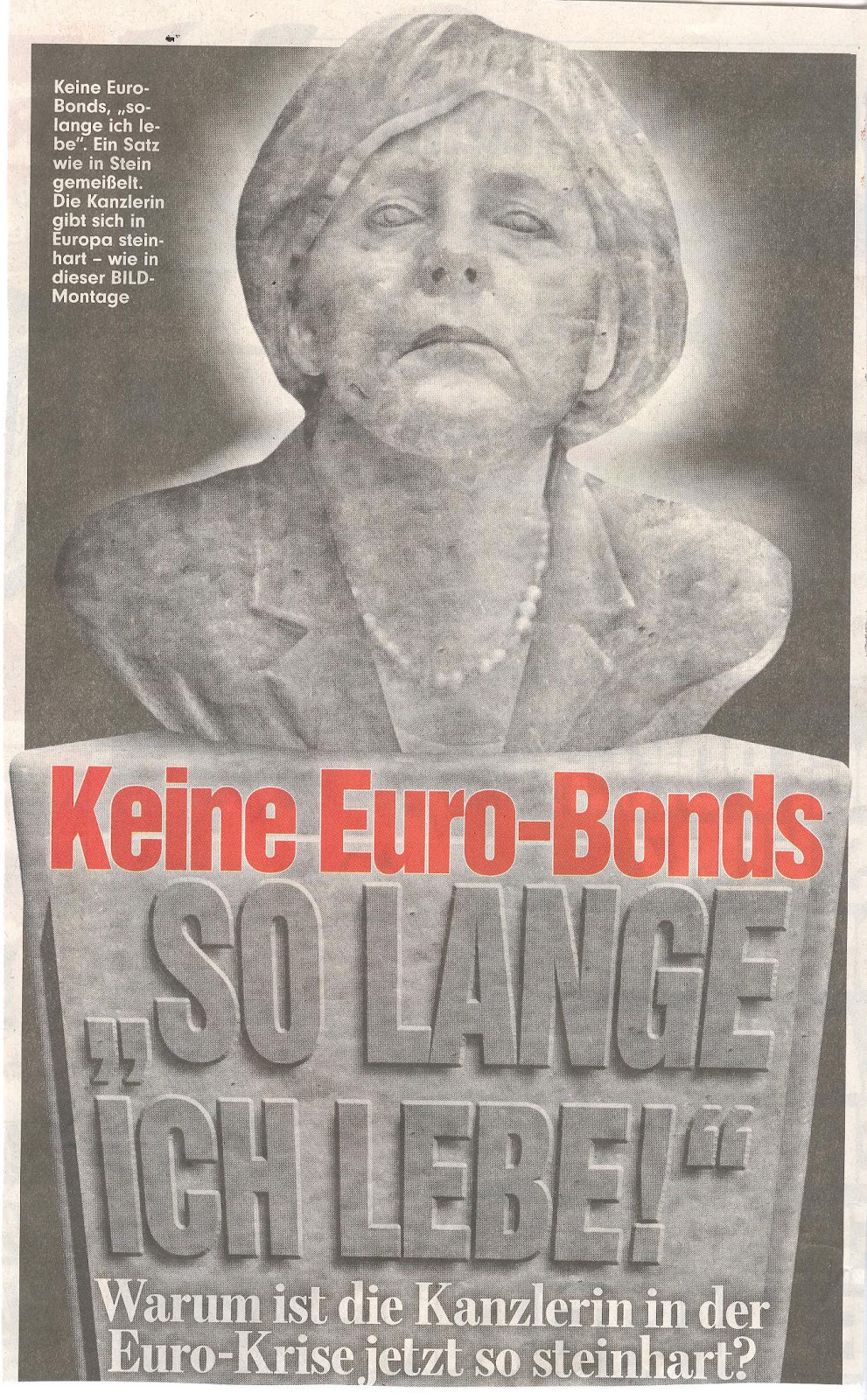
As so often in the crisis, German tabloid Bild has captured a hugely complex debate - on the possible pooling of present and future liabilities among eurozone members - with a snappy illustration, depicting Merkel's 'rock solid' resistance to the idea after she said that "there will be no shared total debt liability for as long as I live".

Merkel's stance is warmly endorsed by former Handelsblatt editor Gabor Steingart who in a front page op-ed, under the headline “Nein! No! Non!", compares Merkel to a lioness and argues that her firm denouncement of debt pooling was the "best moment" of her Chancellorship, adding that “this is the Merkel that one wishes to see more often”. He adds that:
“Now she has to explain to our friends at the summit that that it helps no one if Germany passes the fruits of its labour around liberally. It is actually the other way around: ‘Yes’ to Europe means ‘No’ to Barroso's ideas. The replacement of the main components of the market economy – work and effort – with consumption and credit has led us to where we are today… Europe needs to roll up its sleeves and not a parasitic philosophy, where everyone aspires to the wealth of their neighbours.”
That's pretty strong.
 

However, for its part Bild does also cheekily notes other 'famous last words', such as DDR leader Erich Honecker's assertion that the Berlin Wall would stand for 100 years or former Libyan leader Muammar Gaddafi's claim that his people loved him.

But still, a good illustration of how far away Germany still is from nodding through grand schemes for debt pooling. 

Wednesday, May 23, 2012

Pirates of Westfalen

A slightly amusing story in yesterday’s Bild caught our attention this morning concerning a growing row over the seating arrangements in the Nordrhein-Westfalen regional parliament (Landtag) which has to be re-thought following the recent elections. Namely the far-Left Die Linke were wiped out, while the pirate party continued its recent hot streak and won seats in NRW for the very first time with 7.8% of the vote. The other parties want a straight swap with the pirates taking over Die Linke’s old seats on the far left of the chamber, but the Pirates are outraged by this proposal, demanding instead to be sat in the middle, between the governing and remaining opposition parties.

Ostensibly of no great significance, this spat does however illustrate a wider point in German politics: the difficulty for the country's political structure to come to terms with alternatives to the traditional parties. Although, to be fair, classifying and categorising the pirate party, particularly using the traditional left-right labels, isn't easy. For example, polling has shown that it has garnered support from across the political spectrum from the Christian Democrats through to Die Linke. Unsurprisingly, this is reflected in their manifesto, which combines strongly libertarian aspects (e.g. on civil liberties) with more traditionally social-democratic policies (e.g. on universal child care). While there are some interesting parallels with UKIP (e.g. on drug policy), overall the Pirates are pro-EU membership, in particular aspects such as free movement. However, as we have pointed out before, they have been highly critical of the eurozone bailouts, and this could have been a significant factor in their recent rise.

One to watch is whether the Pirates could see a surge in support by vocally oppose the introduction of eurobonds or greater ECB intervention, particularly if Merkel starts to give ground on those issues. So far she is standing firm, but Merkel does have form for crossing red lines...

Friday, May 11, 2012

German inflation backlash alert (it took about 12 hours)

Well, it didn't take long. You may have thought that yesterday's comments from people allegedly close to Bundesbank President Jens Weidmann to the effect that Germany could live with the shocking inflation rate of 2-3% were in any way a sign that Germany was about to cave in on its resistance to anything that resembles high inflation. Well the front page of Bild Zeitung - the gold standard of European tabloids (pun intended) - says it all:


The “Bundesbank is going soft on the euro”, adding that:
“Over the next few years prices in Germany will rise much faster than before. Our venerable Bundesbank, the sacred guardian of price stability, will do nothing about this since it considers it to be ‘manageable’”.
And in case the 13 million or so Bild readers didn't get the message, page 2 features a giant picture of a one trillion DM banknote from the Weimar era:


An op-ed by the paper's chief editor Nikolas Blome argues that:
“[inflation] will above all hit workers, employees and pensioners. Precisely those who kept a cool head and ploughed on through the crisis. This is unfair. It gnaws at our trust in money and our major institutions, in politics and central banks… since Germans have bitterly experienced it themselves they know that high inflation ultimately breaks down every society”. 
It wasn't only Bild though. The man himself, Weidmann, moved swiftly to deny the reports, claiming in an interview with Süddeutsche that this was an “absurd discussion”. He clarified that keeping inflation below 2% in the eurozone as a whole meant that “in some cases” German inflation would be higher, but that “we will ensure [in the ECB’s governing council] that inflation in Germany will not run out of control. Citizens can rely on the vigilance of the Bundesbank”.

This is one national core belief you don't mess with.

Thursday, March 15, 2012

So will German taxpayers have to fork out for Messi and Ronaldo?

So the eurozone crisis has made it to the one place where it is guaranteed to hit home - the sports pages. The main page of the sports section in yesterday's Bild ran with the headline, "Will German taxpayers eventually have to fork out for Messi and Ronaldo?"

The fear, said Bild, is that the Spanish government is about to authorise a 'debt amnesty' for Spain's professional football clubs - including Barcelona and Real Madrid. A "crazy idea", said the paper, as forfeiting money owed to the Spanish government by various football clubs, could further increase the country's already pretty scary deficit. This should worry readers of the sports section, the paper continued, as should Spain hit the iceberg and be forced to seek a Greece-style rescue package, then German taxpayers would effectively, albeit indirectly, be bailing out Barça and Real.

Far-fetched? Most certainly, but the story caught our attention for four reasons:
  • Over at Open Europe, we have developed a slight obsession with Bild (the best barometer of German public opinion)
  • That Germany's largest-selling newspaper includes, in its sports section, a line on the recent discussions over Spain's deficit targets shows that the euro crisis is now as much of a household issue as they come

  • If Madrid was to cancel all or part of the money that Spanish football clubs owe it, that could actually leave a hole in Spain's public finances, given the size of the balance sheets of some of these clubs (which are notoriously over-leveraged).
  • Closer to home (which at OE includes Newcastle, Wisla Krakow and Napoli), the move could, shock horror, also give Spanish football clubs an additional advantage over European clubs
As expected, after a bit of fact-checking and cross-checking with the Spanish press, it turns out that Bild's story is largely a matter of 'lost in translation'. Here's what we've got:
  • Following a parliamentary question by Caridad García, an MP from the Izquierda Unida (United Left) party, the Spanish government has recently revealed that Spain's professional football clubs owe an impressive €759 million to the country's Tax Agency - of which almost €490 million is owed by clubs in the Primera División (the Spanish Premier League).

  • Asked how the Spanish government was planning to address the issue, Sports Minister Miguel Cardenal said that a plan is currently being put together to "make this debt disappear (hacer desaparecer esta deuda, in Spanish) within a reasonable time frame". Now, we suspect that this is where misunderstanding arose.

  • Though subject to dispute, Don Miguel may simply have meant that, in a way or another, football clubs will have to pay their debt quickly, or face sanctions, such as loss of points in the league table, forced relegation, and so forth. During the same interview, he made clear that "football clubs' debt will be paid by football clubs". Again this morning, he insisted that "no debt will be forgiven" for Spanish football clubs.
In other words, Bayern Munich and Borussia Dortmund's fans can sleep peacefully. They are not going to foot the bill for The Flea and CR7's multi-million wages...

Monday, February 27, 2012

STOP! Bild pumps up pressure on German MPs ahead of vote on second Greek bailout


With the debate ahead of the Bundestag vote on approving the second bailout package for Greece due to get underway in 30 min or so (as ever we will be covering the event live on our twitter page @openeurope), Germany's biggest selling tabloid, Bild Zeitung, has upped the ante calling on MPs to vote against the package.

Under the brilliantly simple headline "STOP" (see picture above), Bild writes:
"Once again, it's payday in the Bundestag. €130 billion are meant to save Greece from ruin. Bild appeals to all MPs, do not proceed with this folly!"
The entire page 2 of the paper then features a range of interviews with economists, such as the German Guru Hans-Werner Sinn, explaining why Greece is a "bottomless pit" and why it "can't stand on its own two feet even with this bailout". The Chief Economist of Deutsche Bank, Thomas Mayer, says that a euro exit should not be "taboo" anymore.

It's pretty strong stuff.

Remember, as we've pointed out before, Bild is a huge paper - by far the best selling paper in Germany (far bigger than the Sun for example) and according to some measures, the paper with the widest circulation outside Japan.

In other words, it has a lot of political clout and serves as an important barometer of public opinion, which you mess with it at your peril. A poll in Bild Am Sonntag also showed that 62% of Germans are against the second Greek bailout (up from 53% in September).

But how many MPs, not including those who were already going to vote against, will be swayed? Given that the opposition SDP and Green party will back the government there is virtually no chance of the bailout being rejected, so the issue is how many coalition MPs will rebel, and whether it will be more than the 15 who voted against the expansion of the EFSF back in September.

If Merkel is unable to rely solely on her MPs to pass through the bailout, it will have serious repercussions for the continued viability of the government...