• Facebook
  • Facebook
  • Facebook
  • Facebook

Search This Blog

Visit our new website.
Showing posts with label restructuring. Show all posts

Monday, June 24, 2013

Bank bail-in plans: is France becoming nervous about being left alone with Germany?

As we have pointed out repeatedly, those who think that the eurozone is one German election away from a full banking and fiscal union (which includes a surprising number of British eurosceptics) should have another look around Europe.

As we noted last week, the latest draft of the bank recovery and resolution directive left plenty of questions unanswered.

[Background - this is the proposal which looks to establish a clear and standardised pecking order for losses in the instance of a bank failure. It is not the full 'banking union' proposal, which involves some form of combined backstop. Despite being first suggested as far back as 2010 and with a proposal put forward last summer which was largely ignored, this has become an important piece of legislation since the Cypriot crisis.]

That EU finance ministers failed to reach an agreement after 18 hours of talks on Friday is therefore not entirely surprising. What is perhaps slightly more surprising is the dividing lines and in particular which countries found themselves arguing the same side.

We highlighted before where each country broadly stands on this issue. This does not seem to have changed much, although the focus of the discussions has. Previously, much of the emphasis was on ‘depositor preference’ – i.e. when and to what extent uninsured depositors would face losses during a bank bail-in. Not exactly surprising given the Cyprus debacle.

A broad consensus seems to be emerging around a structure which protects insured depositors completely and gives added seniority to those uninsured deposits held by individuals and small and medium size enterprises. With the pecking order broadly settled, focus has shifted to the level of flexibility allowed within the structure, in particular whether bail-ins should be automatic or whether there should be sizeable national discretion to decide on which format to use.

This debate has seen the EU split into two broad groups: 
  • One led by France, the UK and other non-eurozone countries, arguing for greater flexibility and national discretion – although presumably for different reasons, the UK because it fears its financial sector is larger and more varied than many in the eurozone and France because it is keen to keep open the option of a bank bailout due to fears automatic bail-ins could increase funding costs (souveraineté). 
  • The second group is led by Germany and the Netherlands, both of whom are keen to limit flexibility to allow for a standard framework across the eurozone and also partly because they fear governments will put domestic political needs above those of the single currency as a whole. This is a trust issue as these countries' taxpayers may one day have to stand behind the continent's banks.
Ignoring the technical details for a bit, the wider political dynamic at work here is fascinating. France is actually on the side of the non-eurozone countries. This is bending assumptions as it's usually France that is the keenest on doing stuff at the level of 17 rather than 27, as Paris is proportionally stronger in that smaller constellation. Germany, on the other hand, prefers 27 to 17, for the opposite reason.

There seems to be good reason to expect some greater flexibility for non-eurozone countries, with the idea reportedly gaining support towards the end of negotiations.

Now, we don't want to read too much into this but first, this dynamic suggests that France could actually find itself isolated within the eurozone (we're looking forward to that FT headline). Secondly, as we have mentioned in the past, perhaps this is another indication of how Paris - who used to see the euro as a way to lock in Germany - is actually getting quite nervous about losing the UK as a balancing force in the EU.

As ever in Europe, there's always that political sub-story worth keeping an eye on.

Friday, March 15, 2013

The €7bn Cypriot question

Eurozone finance ministers are currently meeting to try to sort out Cyprus - the country that accounts for 0.2% of eurozone GDP but has still managed to throw a spanner in the eurozone works. Ahead of the meeting, we published a flash analysis on the state of the Cypriot bailout. Hint: it's none too pretty.

The summary of the analysis is:
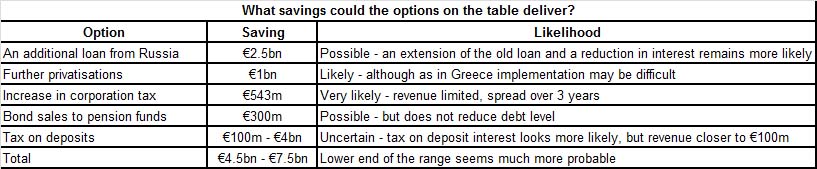
Though progress has been made, eurozone finance ministers are unlikely to reach a final deal on the Cypriot bailout at their meeting this evening. Even if they do, any deal is likely to be another fudge, shying away from more radical options such as significant bank restructurings or depositor write downs. Amid political resistance in Germany and elsewhere to another bailout, eurozone leaders will seek to shrink the size of the €17bn bailout by up to €7bn. However, we estimate that even in a best case scenario, only around €4.5bn could realistically be cut, due to practical and political constraints. This will leave Cypriot debt to GDP at 130% - a level that remains wholly unsustainable. In turn, this makes further financial assistance for Cyprus likely, reminiscent of developments in Greece.

Fundamentally, the row over Cyprus – which accounts for only 0.2% of Eurozone GDP – illustrates that firstly, three years into the eurozone crisis, the block still has no effective tools to restructure debt and repair banks amid the complicated politics of the eurozone. Secondly, the stand-off between the creditors in the eurozone north and the austerity-fatigued south could well be hardening.
There are a few reasons why we believe the Cypriot bailout is unlikely to end particularly positively for the eurozone. Firstly, the usual methods of cutting the debt burden and/or taxpayer contribution such as bank or sovereign debt restructuring are very tricky to enforce in Cyprus (see table below, click to enlarge):


Secondly, the alternative options on the table simply do not deliver enough savings (at least not without the risk of significant contagion which politicians are likely to shy away from):


That leaves us with a very familiar solution: another fudge.

In terms of what to expect from tonight's meeting, well, probably no conclusive deal for a start. At best an agreement on some of the options above. The audit of Cypriot anti-money laundering regulations is just beginning and the final result will likely play a role in determining the level of conditions Germany applies to the bailout. (As the WSJ noted recently, the institution running the audit has previously ranked Cyprus above Germany in terms of its rules on money laundering, so exactly how much the result will help remains unclear).

See here for the full piece.

Monday, February 25, 2013

Do the Cypriot elections pave a clear path to a Cypriot bailout?

How big of a problem can a country accounting for 0.2% of eurozone GDP possibly be? Well, potentially pretty big it seems.

As expected Nicos Anastasiades, the centre right candidate, was yesterday elected President of Cyprus winning 57.5% of the vote in the runoff election – the highest vote share in 30 years. Anastasiades, along with other eurozone leaders, has said he is keen to move quickly towards finalising the Cypriot bailout which was first requested in June 2012 – meaning it has been in the pipeline for 8 months. Usually the fresh election of a reform minded government with a large majority paves a clear path for a bailout. While, it is true that the previous communist President Demetris Christofias has been an obstacle to finalising a bailout by refusing to countenance any privatisations, the path to a bailout is still littered with hurdles.

The first hurdle is the banking sector which needs a massive recap of €10bn (50% of GDP). Over the past decade it has swelled to seven times the size of Cypriot GDP, mostly off the back of a huge inflow of foreign (mainly Russian) money attracted by the low tax rate and reported lax financial regulation. Unfortunately, despite requiring a significant restructuring and overhaul, for which taxpayers should not foot the bill, there is a very limited amount of bank debt to ‘bail-in’ (circa €3bn against €128bn of assets). This leaves few options. One is writing down depositors, although the threat of contagion and the unprecedented nature of this means it remains someway off for now.

The second issue is fiscal. Cypriot debt has been increasing rapidly, already standing at around 84% of GDP. Adding the burden of a €17bn bailout would take it to 140% - far from sustainable. However, restructuring the sovereign debt is not much easier than the bank debt. Around half is issued under UK law, meaning the Cypriot parliament cannot simply pass a law restructuring it (as Greece did). The other half is predominantly held by shaky Cypriot banks making any write down counterproductive as these banks would simply need an even larger recapitalisation. The rest takes the form of official loans to EU countries and institutions – unlikely to take losses, as Greece has proven.

The confluence of the above problems ultimately makes this a very tricky political decision. The Cypriot bailout and the presence of large Russian deposits and lax financial regulation (in Germany’s view at least) is now becoming a topic in the upcoming German elections. As we noted in today’s press summary, a DPA poll over the weekend showed that 63% of Germans are opposed to a Cypriot bailout whereas only 16% are in favour. The SPD has also made this a point on which to differentiate themselves from the governing CDU. On the other hand the politics in Cyprus are also tricky. Many in the country are expecting a show of solidarity from the eurozone given that half of the bank recap needs are a result of Cyprus wilfully taking part in the Greek debt restructuring. And is Cyprus really systemically important, given its tiny size? Many would say it is not, however, as the problems above highlight there is substantial potential for contagion, not least because any radical solution would challenge the view that Greece is “unique and exceptional”.

Taken together, this represents a minefield of issues to negotiate when formulating the Cypriot bailout. Unfortunately, the technical and legal challenges balanced with the fragile turnaround in the eurozone mean that at this point in time it looks likely that eurozone taxpayers will be forced to foot the bill once again – albeit with very strict conditions and a significant financial overhaul. Potentially the most worrying thing about this bailout is how familiar the problems all seem. The banking issues are similar to those in Ireland and Spain, the fiscal challenges to those in Greece and the political ones, well, to everywhere. One thing that the Cyprus issue makes abundantly clear is that the eurozone lacks any new tools to overcome these very familiar problems. Of all the issues mentioned above, that may be the most ominous for the future of the euro.

Thursday, November 29, 2012

Greek banks and the Greek bond buyback

Yesterday we put out a flash analysis looking at the latest Greek deal and the prospect of Greek bond buyback. One of the many issues with the deal (and the buyback in particular) which we raised was that Greek banks will find it difficult to participate without needing extra capital.

However, Greek Finance Mininster Yannis Stournaras also said yesterday (in a timely statement):

The debt buyback "doesn't mean new capital for banks, given that they have recorded these bonds at lower prices than those that will be offered."
His suggestion then, is that the Greek banks have already marked their bonds to market prices on their books, meaning that they can sell them at the low prices involved in the bond buyback without needing new capital. This may make their participation more likely, but there are plenty of other reasons why we still see it as difficult and unpredictable. (We also still question why foreign holders will be involved, particularly previous hold outs and those who are holding to maturity, see our full analysis here).

Firstly, as Kathimerini reported today, the banks themselves are not keen to be involved in the buy back. Many feel that they have already done their part in terms of taking part almost ubiquitously in the first debt restructuring. If they were to take part in the buyback, they could seek adjustments in the terms of the recapitalisation and reform – something which the EU/IMF/ECB troika is unlikely to accept.

Secondly, taking part in such a scheme would need significant approval within the banks and other financial firms. This means board level and possibly wider shareholder approval. As the restructuring earlier this year showed, this takes time, with the process dragging for months. Given the 13 December deadline to have a bond buyback plan in place (i.e. to have a firm idea of who will take part, to make sure it is worthwhile) it is not clear how many bondholders will be in place to participate.

Thirdly, and possibly most importantly, is that the banks need their holdings of bonds (around €22bn) to gain liquidity from the Emergency Liquidity Assistance (ELA) through the Greek Central Bank (GCB). Looking at the GCB balance sheet, it seems broadly that Greek banks posted €247bn in collateral to gain €123bn in liquidity, an average haircut of 50%. Given that many of these assets will be loans or securities, sovereign debt (even Greek) is unlikely to be judged any more harshly than the average. So, if the banks sold these assets for a 65% write down (as suggested) they could purchase new assets (maybe other sovereign debt) but would be able to buy less of it (as not many other assets priced at a 65% discount) meaning they would not be able to gain as much liquidity under the ELA as with current Greek bonds.

Essentially, this could harm the Greek banks liquidity position which would further constrain their lending ability and possibly prompt further deposit flight – both of which would hurt the fragile Greek economy.

All in all then, this process could still be counterproductive for Greek banks even if they do not book new losses directly and they still could be hesitant to take part voluntarily. However, that is not to say that the political pressure applied behind the scenes will not be enough to force them to voluntarily join. Ultimately, it simply highlights that this policy may deliver a small benefit with some negative side effects but is at best a way of skirting the real issue of whether the eurozone can stomach permanent fiscal transfers to Greece. This will come to the fore again soon.

Monday, October 29, 2012

Revising the Greek bailout: Two more years of extend and pretend?

Open Europe published a new flash analysis on Friday, which looks at the prospects of a revision to the Greek bailout. It now looks almost certain that Greece will receive a two year extension to its fiscal consolidation and reform programme. However, questions remain over how much it will cost and how it will be funded. Open Europe estimates that the extension would cost a minimum of €28.5bn, if Greece meets all its targets. Meanwhile, none of the options for providing the funding looks politically or economically palatable.

The €28.5bn comes from: an extra €14bn due to slower deficit reduction, an extra €12bn from reducded privatisation receipts and an further €2.5bn from increased government arrears (unpaid bills).

We examine six key options for filling this gap:
1. A reduction in interest rates - which looks very likely but could only deliver €2bn - €3bn.

2. Increased short term debt issuance and more austerity - this looks possible and could deliver anywhere between €15bn - €20bn.

3. Extending length of loans to Greece - unlikely, it could raise €9.1bn in the short term, but on net it would give zero reduction.

4. ECB forgoing interest and/or profit on its Greek bonds - looks very unlikely, but could yield €1.15bn - €2.3bn (interest rate cut) and/or €14.25bn (forgoing profit).

5. Bond buybacks - again very unlikely, but it would mark a much larger step than simply covering the funding gap, as it could deliver €45.65bn overall and €17.15bn after the two year extension is paid for.

6. Write-down original eurozone bilateral loans -  this would be a huge step and could provide €26bn to €52bn but looks very unlikely to be approved, especially as it would support in national parliaments. 
Overall then, its hard to see how the gap will be filled without some larger decision being taken over the future of Greece in the eurozone. To read the full note, click here.

Friday, August 31, 2012

So Bankia is still a viable bank...?

Spain announced its plans for cleaning up its banking sector earlier. With the full legislation only just released, we are still looking through it and will bring you the pertinent points in due course. But there was also another interesting development with regards to the ailing lender BFA-Bankia.

The Spanish government announced this afternoon that BFA-Bankia will receive an "immediate capital injection" from Spain's bank restructuring fund (FROB). Nonetheless, Spain has decided not to request the early disbursement of part of its €100bn bank bailout package. This is despite the fact that €30bn had been set aside for emergencies, as the Eurogroup noted in a statement issued earlier this afternoon. The funds will therefore be paid out in advance by the FROB and will be eventually incorporated into the Spanish bank bailout when it is fully dispersed.

This raises a couple of interesting questions. Firstly, why is Spain so keen to avoid tapping the €30bn kept in reserve? The money is there for just such an occasion, and in fact it was fairly obvious that this exact situation would arise. What's more, the money will be folded into the bailout anyway. Therefore, we can only imagine that the Spanish government is keen to avoid some kind of negative stigma – although this seems slightly strange since the bailout is already confirmed. It is worth keeping in mind the constraints of the EFSF vs. ESM funding (which we covered here), so it is possible that Spain and the eurozone have decided they want to wait until the ESM is fully operational before tapping the funds.

Reading the press release, it is also clear that this is a restructuring of BFA-Bankia, meaning it is still viewed as a viable bank. This seems almost outrageous for a few reasons:
• Bad loans held by Bankia jumped by 44% (to 11%) in the past six months alone
• The group just posted a loss of €4.45bn, compared to a slight profit a year ago
• In the past six months the banking group has lost a staggering €37.6bn in client funds, a massive 28% fall. 
It’s been clear to most for some time that Bankia is no longer viable. The latest government plans for dealing with the banking sector provide for an “orderly resolution” of unviable banks and a template for splitting up its assets and winding down the institution. It is not entirely clear why this is not being applied here, although protecting retail investors could be part of it. In the end, though, investing further public funds into a failing institution will do everyone more harm than good.

Friday, May 04, 2012

Greek elections unlikely to yield any answers

The Greek elections are almost upon us. Much of the attention (including ours) has been focused on the French election, possibly rightly given the potential impact on the Franco-German axis and the austerity approach to the eurozone crisis. The lack of attention may be down to Greece-fatigue following the intense start to the year with the Greek restructuring, or the fact that with a bailout and strict programme in place the room for flexibility with the new government is severely limited. That said, the Greek elections have the potential to be almost as important.

Despite the well documented rise of fringe parties and the strong talk from New Democracy (ND), a coalition between Pasok and ND looks to be the most likely outcome. Combined the parties may gain around 35% - 40% of the vote. The largest party (likely to be ND) gets an extra 50 seats under Greek electoral rules, meaning that the coalition would be the largest combined group in the Parliament and may just scrape a majority. This position will be aided by the fact that all the other parties are fairly disparate and unlikely to form any cohesive opposition.

However, even if this coalition is formed there numerous ways in which it could play out:

1)      Stable coalition – ND and Pasok manage to gain and hold a majority in the Parliament. They set about attempting to implement the EU/IMF bailout package. May be some talk of renegotiating elements of the package, particularly to boost growth. If anyone is to have success on this front it would be this coalition as it has at least some experience and knowledge of negotiating with EU/IMF.

Impact on the eurozone: This added stability would likely be positive for markets and the eurozone in the short term. Ultimately, it will not make much difference since Greek debt still looks unsustainable and implementing the necessary reforms will be a massive challenge on the ground even if they are pushed through parliament. There is less chance of external financing being cut off anytime soon, since the government will at least try to adhere to the programme.

2)      Coalition breaks up, new elections where ND wins a majority – The coalition fails to gain a full majority in Parliament (possibly due to Pasok defections after the deal is struck) or fails after a very short time due to lack of cohesion between parties (especially if ND leader Antonis Samaras feels he could gain a full majority in new elections). Elections delay implementation of EU/IMF package but once ND government comes into power the implementation continues, although calls for growth policies will grow louder.

Impact on the eurozone: Ultimately, depends on how long the coalition lasts and the policies which ND uses in the new election to gain a majority (potentially shift further right if there is growing disillusionment with the EU/IMF austerity).  ND unlikely to push for euro exit or full renegotiation of EU/IMF package so that adds certainty, but the inherent problems with the package (mentioned above and covered in detail here) still hold true. The turnover between elections could be important. Any delay in implementing the package will not go down well with the EU or IMF and could reduce its effectiveness even further.

3)      Coalition breaks up, new elections fail to deliver suitable replacement leading to an election cycle – Coalition breaks down as mentioned above, but this time the new elections fail to deliver a clear winner, possibly with an even greater move towards the far left and far right parties. This would likely trigger a series of unstable coalitions and probably more elections. Once this cycle has begun it will be hard to break, particularly with Greece’s economic situation seemingly only getting worse.  

Impact on the eurozone: This would be the worst of all outcomes. The EU/IMF package would fall by the wayside due to lack of willingness or a government to implement it. If a cycle of elections does take hold it could feed anti-euro sentiment, although anger has, for now, been largely directed at the austerity bailout rather than euro membership more generally. This would eventually result in funding being cut off and Greece probably having to exit the eurozone. This is unless such a threat galvanises the population to vote a single party supporting the euro into power.

Overall, a ND-Pasok coalition looks likely but it will probably be far from stable. It is definitely hard to see it serving a full term. The most likely outcomes (1 and 2 above) may deliver some short term certainty but problems loom large for Greece over the medium to long term. The EU/IMF package still looks unachievable for Greece and will not solve its debt sustainability problems, while there is surely a tipping point where the Greek population withdraws its support for the euro more. At the moment this is still some way off. These elections will certainly not deliver a definitive answer to long term issues in Greece and there is still a chance that an uncertain outcome could worsen Greece’s situation.

Tuesday, April 03, 2012

Not so bullish now? The short term prospects for Spain inside the eurozone

In a new briefing, Open Europe assesses the state of the Spanish economy in light of recent budget proposals, announced by the Spanish government in full today. Spain is not the “next Greece” - it remains a serious and diverse economy, with relatively good administration and infrastructure. However, the increasing exposure of its banks to potentially toxic loans, the difficulty in curbing Spanish regions' spending and the risk of reforms not taking effect quickly enough, all raise serious questions as to whether the Spanish economy will make it through without some sort of external help.

Key Points
• Given its size, the fate of the Spanish economy will also largely decide the fate of the euro. €80bn of €396bn (1/5) in loans that Spanish banks have made to the bust construction and real estate sectors are considered ‘doubtful’ and potentially toxic, meaning at serious risk of default, with the banks only holding €50bn in reserves to cover potential losses. Already dropping, house prices could potentially fall another 35%, meaning that Spanish banks will almost certainly face hefty losses as more households default on their mortgages.
• In such a scenario, the Spanish state is unlikely to be able to afford to recapitalise its banks, meaning that the eurozone’s permanent bailout fund (the ESM) would have to step in, shifting the cost to eurozone taxpayers.
• As domestic banks are currently the main buyers of Spanish government debt, this could also lead to major funding problems for Spain. The chances of a self-fulfilling bond run on Spanish debt would increase massively in this scenario, threatening to push the whole country into a full bailout.
• Containing spending in the Spanish regions is also key to Spain rebalancing its books. The level of unpaid debt on the balance sheets of local and regional governments has risen by €10bn (38%) since the start of the crisis (now topping €36bn). This will likely be paid off by the central government, increasing the country’s debt and deficit.
• Spain’s various reforms, particularly to the labour market, are welcome, but are themselves not enough to stop a bond run, as it will take time before they bite. The country’s long- term unemployment has now reached 9% of the economically active population, and youth unemployment reached 50.5% last month. This is threatening the long term productivity of the economy and whether Spanish society can sustain this level is unknown.
A Spanish bailout is far from a forgone conclusion, but more work needs to be done to avoid one. Open Europe recommends:
• Spanish banks double their provisions against souring loans and commit to thorough stress tests.
• Strengthen labour market reforms, particularly to relieve the welfare burden on state finances, including: end wage and pension indexation to inflation, reduce size and duration of benefits, limit collective bargaining, reduce redundancy costs and improve the business climate.
However, these reforms will only stand the test of time if they enjoy political buy-in across Spanish society and are seen as democratically legitimate, rather than being imposed from outside.

To read the report in full, please click here,
http://www.openeurope.org.uk/Content/Documents/Pdfs/Spain2012.pdf

Tuesday, March 13, 2012

Greece take II - it's official

Reuters has just released the latest EU/IMF/ECB troika report – the first to fully account for the bond swap and its impact on Greek debt. We’ll provide a fuller run down once we’ve had more time to trawl through the 195 page report (we have to give the troika some kudos for the turnaround on this one), but for now we’ll just flag up a few headline figures. We also couldn't resist comparing the new Troika estimates to our previous estimates of how Greece's debt will change following the bailout, which we published a couple of weeks ago. We would lie if we said we weren't pretty much spot on.

Greece's debt-to-GDP after PSI

Open Europe's estimates: 161%
New Troika report: 160%

Amount of money needed to recapitlise Greek banks

Open Europe estimates: €50bn
New Troika report: €48.8bn

Cost of private sector involvement (PSI)


Open Europe estimates: €86bn
New Troika report: €78bn

(The discrepancy between the OE and Troika estimates primarily seems to be a consequence of the Troika report not including the near €6bn to pay off accrued interest, which doesn’t get lumped into the ‘cost of PSI’ but may fall into other funding costs). In any case still doesn’t seem like great value for money.

Other interesting figures include:
  • Total EU/IMF assistance in 2012: €112bn (most yet for a single year)
  • Average revenue from privatisation: €4.4bn (despite the plan barely getting going)
  • Amount Greece needs to raise on the market in 2015: €7.6bn (despite new Greek bonds trading with the highest yields in the eurozone)
In addition, the graph below is pretty revealing. Given the optimistic privatisation targets and the optimistic growth projections the bold turquoise and dotted orange line give us some significant cause for concern to say the least.

Friday, March 09, 2012

A small step forward, but the Greek restructuring deal could prove to be a pyrrhic victory

Open Europe has responded to the agreement between the Greek government and its private creditors which laid out how much and under what format the country’s massive €360bn debt burden should be written down. The deal involved private sector bondholders agreeing to a 53.5% nominal write-down, while so-called Collective Action Clauses (CACs) will be used meaning that Greece is now technically in a state of default – precisely what EU leaders have spent two years trying to avoid. While marking a small step forward, Open Europe notes that the deal is unlikely to save Greece, and that the country is still on course for a full default in three years’ time, if not sooner.

In our response we note:
“With the use of CACs Greece has entered a coercive restructuring or default – something which Greece and the eurozone have spent two years trying to avoid. While the financial markets can handle the triggering of CDS that this will entail, at some point serious questions need to be asked over the amount of time and money which policymakers have wasted on what has ultimately amounted to a failed policy. Instead, Greece should have undergone a full restructuring combined with a series of pro-growth measures.”

“There will be plenty of optimism in the corridors of power around the eurozone today, some of it justified – Greece has avoided a chaotic and unpredictable meltdown. However, this deal could end up being a Pyrrhic victory: the debt relief for Greece is far too small which means that another default could be around the corner, while the austerity targets are wholly unrealistic and kill off growth prospects. Furthermore, Greece’s debt will end up being almost completely owned by eurozone taxpayers and by exempting official taxpayer-backed institutions from the write-down, the deal has created a distorted, two-tier bond market.”
See here for the full response.

Update 17:00: Based on our figures and projections, the Telegraph has produced a handy graphic showing the break-down of the restructuring, the details of the write-down and where the money from the second bailout will end up. View it here.

Wednesday, March 07, 2012

A credible Greek threat?

The Greek Public Debt Management Agency put out an interesting press release (PR) yesterday. We won’t go over all of it, since it’s been heavily covered in the press, but it did raise one interesting point:
“The Republic’s representative noted that Greece’s economic programme does not contemplate the availability of funds to make payments to private sector creditors that decline to participate in PSI.”
This is widely being seen as a warning to those who hold Greek bonds governed by foreign law and who therefore may be more inclined to hold out due to the extra protection offered under foreign law (they are also subject to higher CAC threshold, meaning CACs are harder to use). Greece essentially says that any bondholder who doesn’t take write downs will be defaulted on (except the ECB).

So, is this a credible threat?

Well, firstly we won’t find out until 11 April since that is the settlement date for foreign law bonds under the restructuring plan.

But more importantly it raises the question of whether Greece could be setting itself up for a second default, at least in technical terms. Let us explain:

Greece will certainly be judged to be in default by the rating agencies after CACs are triggered, but once the bond swap is completed and new bonds are issued it should come out of this rating fairly quickly. Yet, a month later it could again trigger CACs on foreign law bonds. Even worse, it could just leave these bonds and default on them through non-payment as and when payments are due (this could run long into the future). If this constituted another default it would have a negative impact on funding for Greek banks and the stability of the economy - so would be something to avoid.

Ultimately, it comes down to whether the new Greek bonds have ‘cross-default clauses’ in them – which means if Greece defaults on other bonds it will default on these too. From what we can see, the new bonds do not have general cross-default clauses (despite earlier versions of the plan including them), only ones which apply to the new group of bonds which exist after the restructuring.

This makes the threat to default on the remaining foreign law bonds much more credible. It would still be an extreme course of action, but one which looks increasingly attractive given the extra debt relief it could deliver (which Greece will need).

This is something which bondholders would do well to keep in mind if they are planning to try and get paid out in full.

Tuesday, March 06, 2012

IIF on a disorderly Greek default

A leaked document from the Institute of International Finance (IIF) has been doing the rounds recently and has some rather alarming statistics regarding the cost of a disorderly Greek default in it (see here for full doc). The document is well worth a read if not just because it sheds some valuable light on the thinking inside an institution which, up until the few months ago, very few people had any knowledge of.

As far as we’re aware the doc was first released by Athens News (we’ve done an interview with them presenting our thoughts which we will post in due course), but for now see our initial thoughts on the claims that a disorderly Greek default could cost as much as €1 trillion:

- The IIF does have a vested interest in seeing the current plan succeed and has played a substantial role in negotiating it, which should be kept in mind when reading their analysis of the ‘alternative’ of a disorderly default.

- As our latest report on Greece highlights, the current plan for Greece does not actually decrease the prospect of a disorderly default. It offers little real debt reduction and simply transfers the debt from private to public sector (making any future default more costly for taxpayers). If anything then, the warnings in the IIF report could also be a read as the potential consequences of the current path of action which risks shifting the cost of a disorderly default further onto taxpayers – the consequences of which could be hugely problematic for Europe and the global economy.

- A disorderly default is the worst case and would be incredibly painful for Greece and the eurozone, however, to present it as the only alternative to the current plan is misleading. This is a diametric choice engineered by the EU/IMF/ECB and even the IIF. There is still the option of a managed restructuring offering a greater write down with a simpler process and therefore better value for money than the current plan.

- The document mentions the social cost of a disorderly default, which would be very high, but the IIF and the troika continue to ignore or just accept the social costs of the current plan. The massive austerity threatens to create a downward spiral in the economy, while the riots show a glimpse of the tensions simmering underneath the surface in Greek society.

- There is much discussion of contagion but there has been little thought given to the potential knock on effects of the current plan, from aspects such as the legal gymnastics to protect the ECB to the lack of a comprehensive solution.

Does this document, then, simply constitute scaremongering on the part of the IIF?

That may be going a bit far, but as we point out above there are certainly caveats to consider when examining their estimates. The key point is that the current plan simply kicks the chances of disorderly default further down the road, beyond the end of this year at best. However, at that point, the potential for dire consequences of a disorderly default set out in the IIF report, will not have gone away.

Friday, March 02, 2012

Despite a mundane EU summit, plenty of challenges remain in Greece

Just a quick post on the developments at what must be seen as the most mundane (if not pointless) EU summit on eurozone issues for some time. Reports today suggest that the eurozone will withhold part of the bailout funds for Greece, only paying out the part required to ensure that the voluntary Greek restructuring can go ahead.

This was mostly expected and as we have noted previously, as well as in our report released yesterday, the amount that needs to be paid out is sizeable. The eurozone estimates it at €58.5bn, while we have suggested it could be closer to €86bn.

The main reason for this difference arises from the expected level of recapitalisation for Greek banks. The eurozone returns to previous estimates of around €23bn to aid the banks, despite widespread reports that this could reach €40bn - €50bn as admitted by the leaked EU/IMF/ECB debt sustainability analysis. For our part, we estimate that the bank capital needs could fall between €36bn - €46bn (depending on how they incorporated the write downs onto their balance sheets) to meet the European Banking Authority’s 9% capital requirements.

It is likely that Greek banks will need at least €50bn in the longer term, so it may be that the eurozone is keen to limit the immediate capital pay-out to the minimum necessary to stabilise the banks. This may be prudent on one hand, since it reduces the amount which needs to be raised to push the restructuring through and is less politically divisive. However, running the banks so close to the edge in an economy as uncertain as Greece’s could be asking for trouble.

The final point worth considering on the Greek banks is the issue of collective action clauses (CACs – see here for background). It looks increasingly likely that they will need to be used to get the necessary participation in the Greek restructuring (notice at this point we finally drop the ‘voluntary’ qualifier, as in no way could that still be claimed to be the case). This would leave Greek banks in a tricky situation. Under this scenario the rating agencies would likely leave Greece in a ‘default’ rating longer than expected, meaning that Greek banks will be locked out of borrowing from the ECB for some time (funds which they need to survive). The main way to keep Greek banks alive would be to transfer their funding to the Greek Central Banks Emergency Liquidity Assistance (ELA) as we discussed here.

This is far from ideal, since the ELA is opaque and secretive, but ultimately it may be necessary and unavoidable. Triggering CACs at this stage may be one of the few ways to actually deliver the debt relief which Greece needs. It presents many challenges and unknowns but it still seems better than pursuing a path which seems to be fundamentally flawed.

Friday, February 17, 2012

Decoding the ECB bond swap

As Die Welt reported yesterday, it now looks as if the ECB will swap it’s circa €55bn (nominal) holdings of Greek debt into newly issued Greek bonds provided by the Greek state. Below we attempt to summarise what this actually means. It’s a bit techie – so bear with us.

There are basically three options for Greece: a debt write-down that creditors agree to voluntarily, coercive restructuring (where Athens uses contract-based provisions to not pay back its creditors) or disorderly default (all hell breaks loose). Today’s deal has reduced the risk of the latter while increasing the chance/risk of the first two. However, it still hasn’t answered the question whether the ECB will actually itself take losses – or participate in some form – in a Greek restructuring.

Why is the ECB swapping its current holdings of Greek bonds for new ones?

Under this arrangement, the new bonds will be distinguished from the old ones in some way (possibly through different serial numbers) allowing Greece to pass legislation which retroactively imposes collective action clauses (CACs) on the rest of Greek debt held outside of the ECB. (This is sort of like the government hiking the tax rate today and then trying to claim 10 years of back tax at this higher rate). While a number of bondholders could agree to take write downs voluntarily, the remaining ones could be forced to do under these CACs. But the ECB is now safe. This matters tremendously since, if Greece went for a coercive restructuring without any special protection for the ECB, the institution could be faced with major losses and huge dents to its credibility – since it continually denied that it was taking too much risk since it saw a Greek default as impossible. The Eurozone and Germany in particular is keen to avoid this (see here for a whole range of political reasons why).

Open Europe take: While we have sympathy with the ECB for trying to avoid losses, this is a rather strange move (and a result of their flawed policy approach we might add). The preferential treatment it now has on Greek debt, suggests that the ECB’s wider holdings of eurozone debt from its bond purchase programme (around €220bn) are senior to eurozone debt held elsewhere. This could create uncertainty in the bond markets of the southern eurozone states, as bonds held by private creditors are much more likely to be next in line for a write down. More importantly, it also opens the ECB up to legal challenges, since some bond contracts will have clauses protecting them against subordination (negative pledge clauses). Importantly this worrying precedence is reported to be the reason why Bundesbank President Jens Weidmann objected to the move, further highlighting the fundamental disagreements within the ECB itself.

Doesn’t this increase the prospect of a voluntary restructuring?

The swap seems to have gone down well with markets. The perception is that private creditors – those that still hold out – will be much more likely to now accept voluntary losses, which – finally – can bring a conclusion to what has seemed like endless talks between creditors and the Greek government.

Open Europe take: The risk of a disorderly default on the 20 March has radically decreased, which must be considered a good thing. The Greek threat of forcing a coercive default using CACs is now much more credible (it can be done with fewer legal complications) which should force private sector bondholders to pull their finger out since they could face far greater losses under a coercive restructuring. At the same time, Greece now actually has the tools to push through a coercive restructuring (via the CACs) and a larger write-down, meaning that this option is still very much a possibility. So perhaps the markets are getting ahead of themselves.

Does this provide any additional debt relief for Greece?

No. There has been some confusion over this point. Currently the swap is 1:1 meaning the ECB will not take any losses or provide any monetary benefit to Greece. The ECB does seem to have agreed to distribute its ‘profits’ (revenues from the interest payments) on the new holdings so that they can be used to aid Greece.

Open Europe take: As we have noted before, the official sector will take losses in Greece, now or in the future (better now). The ECB should not take direct losses but forgoing the difference between the purchase and nominal price of its holdings of Greek debt would be beneficial. On a side note this episode highlights the lack of transparency surrounding the ECB's actions in the eurozone crisis. Despite purchasing the bonds at a discount the ECB holds the bonds at nominal value on its balance sheet, therefore selling them at purchase price means the ECB would still book a loss on paper. This is not an argument against the ECB providing some debt relief to Greece in of itself (by selling the bonds at purchase price), but more that the ECB does not correctly display risk on its balance sheet and did not create enough safeguards against such an event when it first decided to purchase eurozone government debt.

Furthermore, the concept of redistributing ECB ‘profits’ is flawed. The ECB already pays out any profits it makes to eurozone member states. It is then up to them to use the money how they see fit – it is a political decision, meaning the ECB’s comments about profits being used to aid Greece in this sense are more or less irrelevant.

Is this the end of the discussion with the ECB and Greece then?

Not quite. Once the switch to the new bonds has occurred there could still be scope for the ECB to offload them and sacrifice the difference between the purchase price and nominal value of their Greek holdings. The voluntary restructuring will move ahead and if it does not provide enough debt relief the pressure on the ECB to provide some additional relief will increase again.

Open Europe take: As we note above, Greece will probably need help from the ECB at some point. The Greek negotiating position is now significantly weakened since the ECB has greater protection. The ball is firmly in the ECB’s court – not exactly desirable given the opacity and stubbornness which it has presented so far in the eurozone crisis.

Thursday, February 16, 2012

The second Greek bailout: Ten unanswered questions

We put out a briefing note today outlining the ten questions and issues that still need to be resolved in the coming weeks in order for Greece to avoid a full and disorderly default on March 20.

The briefing argues that, realistically, only a few of these issues are likely to be fully resolved before the deadline meaning that Greece’s future in the euro will come down to one question: whether Germany and other Triple A countries will deem this to be enough political cover to approve the second Greek bailout package.

In particular, the briefing argues that recent analyses of Greece’s woes have underplayed the importance of the problems posed by the large amount of funding which needs to be released to ensure the voluntary Greek restructuring can work – almost €94bn – as well as the massive time constraints presented by issues such as getting parliamentary approval for the bailout deal in Germany and Finland. While the eurozone also continues to ignore or side-line questions over the whether a 120% debt-to-GDP ratio in 2020 would be sustainable and if, given the recent riots, Greece has come close to the social and political level of austerity which it can credibly enforce.

The briefing concludes that, ultimately, there’s no way Greece can actually ever fully meet the conditions laid down by the EU and IMF – particularly if they keep piling on new demands. The scale of the cuts goes far beyond any fiscal consolidation – successful or failed – that any country has gone through in living memory. The question is instead one of how long the eurozone’s charade of unrealistic conditions in return for more bailout cash can continue. Specifically, will Germany and other Triple-A countries accept half-baked solutions to the big unanswered questions that still haunt the efforts to save Greece?

To read the full briefing click here.

Wednesday, February 15, 2012

More delays in Greece may not be an option...

Following another postponed meeting of eurozone finance ministers, there have been reports that the eurozone could try to delay the second Greek bailout package (possibly until after the elections in April) or just pushed ahead with part of it (the voluntary restructuring of Greek debt).

As reported by the FT and the WSJ in the past day or two, a draft of the latest bailout agreement has been circulating, however we believe that some of the issues which the drafts raises have been underplayed - particularly those that impact the chance of delaying or breaking up the bailout.

The draft lays out how some of the bailout funds will be used:
Bond sweeteners - €30bn
Funds to buy back bonds from the Eurosystem - €35bn
Funds to pay off interest - €5.7bn
Bank recapitalisation - €23bn
Total - €93.7bn (out of the €130bn bailout)
This is money needed to make the PSI successful and allow the voluntary restructuring to be completed. Firstly, this highlights that the claims by the eurozone that they could simply push ahead with the PSI without fully approving the second bailout seem to be incredibly misleading. Without this money in place there would be a huge amount of uncertainty on the part of bondholders, particularly Greek banks who would need new capital injections to survive. However, to disperse this substantial amount of money would need full approval from the eurozone and some national parliaments. Given that it is widely accepted that the PSI needs to be put into motion this week if Greece is to avoid a disorderly default on 20 March getting this money released could be a huge stumbling block.

Secondly, where would this money come from? The draft stipulates that the EFSF will issue debt to raise these funds (since it currently only has guarantees), however, it is has not pre-funded any of these commitments and suddenly flooding a subdued market with over €90bn in (possibly non-triple-A) EFSF bonds is not an effective funding strategy. There is no telling how the market will react or at what cost the EFSF will be able to borrow. The urgency of the situation feeds the uncertainty here and could be catastrophic for Greece.

Lastly, with new provisions such as €35bn for bond buy backs, will €130bn be enough to fund Greece for three years? We questioned whether this was even enough originally, now it seems even more unlikely.

The chance of getting approval for and raising this amount of funds in the time necessary (a week or two max) seems unrealistic. But it is also unlikely that eurozone finance ministers will delay the PSI further, simply because they cannot afford to. The eurozone has once again backed itself into a corner and things are likely to get worse before they get better.