• Facebook
  • Facebook
  • Facebook
  • Facebook

Search This Blog

Visit our new website.
Showing posts with label sovereign debt. Show all posts

Friday, November 14, 2014

As the Ukrainian ceasefire falters what next on sanctions?

UK PM Cameron warns Russia of sanctions ahead of G20
Over the past few days we have seen the situation in Ukraine begin to escalate once again. Both NATO and the Organisation of Security and Co-operation in Europe (OSCE) have said that they have witnessed significant military movements in Eastern Ukraine, most likely from Russian troops. By almost all accounts the ceasefire only continues to exist on paper (although we have pointed out before why both sides might be willing to continue to pretend it is more than that).

Why has the situation suddenly escalated?
In all honesty, it’s not entirely clear how significantly the situation has escalated on the ground in Ukraine, given that there have been continuous reports of fighting since the ceasefire was struck. It could be more a case of attention shifting back to Ukraine ahead of the G20 and EU meetings. That said, Russia continues to push the boundaries with military exercises. Furthermore, the elections (both in Ukraine and the separatist regions) have increased tensions, while Russia is reportedly keen to help further establish the newly elected separatist leaders.

As might be expected, these reports have once again triggered the discussion on whether the US and EU should increase sanctions on Russia. As we reported in our press summary today, numerous leaders have come out warning of the potential increase in sanctions – surprisingly this also includes representatives of Hungary and Slovakia, though both countries remain a bit divided on sanctions.

While there is lots of talk of further sanctions we would not get ahead of ourselves. Crucially, German Chancellor Angela Merkel has already played down the chance of this in the near future as we reported in our press summary earlier in the week. EU officials have also suggested any agreement is unlikely at Monday’s meeting of EU foreign ministers, although a discussion will be had at the meeting of EU leaders in mid-December.

What could be on the table if sanctions are escalated?

We’ve discussed many times before the options for sanctions but below are a reminder of the potential options if they wanted to take the next step up from the current sanctions.
Expanding list of individuals subject to asset freezes and travel bans: This is a virtual certainty and should be agreed at Monday’s meeting. Specifically the newly elected officials for the pro-Russian separatists will be targeted. More broadly, those involved with the elections in the region could be targeted. It’s not yet clear if there will be a broader discussion about adding further people or oligarchs close to Russian President Vladimir Putin to the list (we have pointed out the potential legal concerns on these sorts of sanctions here).
There are a few other options which the EU could consider (many of which we have discussed before):
  • Ban purchases of new Russian sovereign debt – this was reportedly toyed with before but considered too harsh a step. As we noted before, this would probably be manageable for Russia given its fairly low government debt level but it would add another difficulty at a time when the economy and state budget is coming under severe pressure.
  • Broaden scope of technological sanctions – this would involve expanding the list of banned tech exports to Russia, currently very focused on oil exploration. It could also include expanding the ban of services which European firms can provide to Russia, which again is currently focused on oil exploration.
  • Extend financial sanctions – similar to the above, this would involve broadening the existing financial sanctions from just state owned firms to Russian firms more generally, most likely still only in specific sectors such as financial and defence. This would be legally difficult since the ties to the state would become even more indirect and justification would need to be watertight.
  • Broaden scope of financial sanctions – related to the above, rather than expanding the number or type of firms subject to the sanctions, the EU could broaden the scope of the sanctions. This could, for example, mean cutting off all euro funding from certain state owned firms, no matter what the maturity or the type of loan (there are probably a few incremental steps or variations between this and where we are now).
  • Remove Russia from the SWIFT system – This remains very unlikely and for some very practical reasons. SWIFT is independent and private. Removing Russian financial firms from this system would mean having heavy direct sanctions on them which forces SWIFT (in acts of compliance) to shut them off from the system. This is one of the key reasons it has never really been discussed at the top level as a realistic option so far.
For his part Putin continues to demand a removal of sanctions but if they were ramped up it is likely he would be willing to retaliate with his own sanctions, some of which we looked at here.

In terms of the broader picture it’s clear that sanctions, combined with the falling oil price, are hurting the Russian economy. However, they do not yet look to have impacted Putin’s approach or course of action. As we warned before, the lack of a clear goal or strategy for the sanctions as well as in terms of what Europe actually wants in terms of a future relationship with Ukraine and Russia could well hamper the approach. The EU would do well to discuss this, not least because the continuing downward spiral of the Ukrainian economy will likely (as we warned some months ago) lead to further bailout requests.

Tuesday, September 02, 2014

What further sanctions is the EU considering against Russia?

Given the recent escalation in Eastern Ukraine and the increasingly obvious Russian influence in the rebel forces, the EU looks set to impose further economic and financial sanctions on Russia.

EU ambassadors met yesterday to begin discussing the options and will meet again tomorrow in an attempt to finalise a package to send to EU leaders. They are expected to reach a decision by Friday.

Before we look at the options on the table, we should note that such agreement is not a forgone conclusion. As we have been pointed out repeatedly, there are significant divisions within the EU around sanctions. Slovakian Prime Minister Robert Fico  recently even threatened to veto another round of sanctions if they hurt the Slovakian economy. In short, many EU leaders seem to be becoming increasingly anxious about the economic impact of sanctions and the inevitable Russian retaliation – just see the concern around the Russian ban on EU fruit and veg.

All that being said, with the UK, Germany and France seemingly in favour of further sanctions – and pressure on Italy’s Foreign Minister Federica Mogherini to take a hard line ahead of taking up the role of EU High Representative for Foreign Affairs – the big states seem largely to be backing further action and willing to take on a larger share of the economic burden.

With all that in mind, here are the options that are being touted:
  • Expanding targeted sanctions: This looks a done deal with further entities and persons involved in Crimea and Eastern Ukraine being subject to asset freezes and travel bans. The focus has tended to be on smaller firms and regime members directly involved. The measures would have a larger impact if Europe decided to sanction a higher profile firm (such as a state-owned bank), or a big name oligarch with ties to the regime.
  • Expanding stage three sanctions: This seems the most likely option, with extensions made to the existing sanctions on finance, defence and energy sectors. This could take many forms but the main ones under discussion are – expanding the restrictions on financing for state-owned banks to any maturity above 30 days (currently 90 days), and expanding the list of banned energy tech exports and dual use goods to Russia.

    Other proposals under consideration include, banning a larger number of firms in these sectors from issuing debt in Europe and/or listing on European exchanges – initially this would be focused on state owned firms (of which there are many in Russia). The range in these sanctions remains large, so the impact is hard to judge. For the most part they will be focused on limiting medium to long term financing for state-owned firms. This will have a grinding impact on the economy, but as we have noted before, the Russian state does have resources at its disposal to aid firms hit by these measures.
  • Banning syndicated loans to certain Russian entities: This remains a vague option, but could have a substantial impact since many Russian firms are reliant on external loans. For example, the private sector (excluding financial firms) have $142.5bn in outstanding external loans, a key source of financing for them. Given some European banks large exposure to Russia, any movement into this area of sanctions would likely be tentative and limited to very select entities (state-owned banks perhaps), under very specific terms.


  • Ban on new purchases of Russian sovereign debt: this would see European entities banned from purchasing any newly-issued Russian sovereign debt. It would be quite a bold measure, and fears remain that Russia, a big investor in European sovereign debt, would retaliate in kind, something struggling eurozone countries would not want to see. In terms of impact, as the graphs above and below show, while Russia does have a sizeable amount of government debt to roll over in the coming year, the amount which is held externally is fairly limited. That said, this could well increase borrowing costs and reduce liquidity in Russia’s sovereign-debt market at a time when its economy is struggling and the state is being forced to take on an even larger role.  


One option which doesn’t yet seem to be on the table is one which the UK has reportedly called for – banning Russia from the SWIFT network. This is not surprising, since it would be a big step and could almost amount to freezing out Russia’s financial sector from Europe – a move which the EU is clearly not ready or willing to make. We will analyse this in a future blog post.

One consideration that seems to be glaringly absent from these discussions is the consideration of how effective the sanctions have been so far. To be fair, Dutch Prime Minister Mark Rutte did call for such consideration ahead of last week’s EU summit. There are already reports of them having some economic impact (both on Russia and Europe), but clearly they have not caused a change in course or approach from Russia or in Eastern Ukraine. Europe would do well to consider why this is the case in order to fully judge and best optimise any future sanctions.

Furthermore, as we have noted countless times before, the end goal and medium to long term strategy of such sanctions and the wider approach to Russia and Ukraine remains unclear. Given that this crisis has already been going for 6 months, and shows little sign of abatin,g some longer term thinking would be welcome.

Monday, May 12, 2014

Have borrowing costs in the eurozone periphery come down too far, too fast?

Over on his Forbes blog, Open Europe’s Raoul Ruparel asks: is there a bond bubble in peripheral Europe? The thurst of his answer is that, while there are good explanations for why costs have come down so far and so fast, they could certaintly have side effects, not least because people misinterpret the reasons for the move. The full post is here, but below are the key points:
What is driving this and is it a bubble?
There are three key factors at work here:
  1. ECB President Mario Draghi’s promise to do “whatever it takes” to protect the euro combined with the unlimited bond buying policy of Outright Monetary Transactions (OMT) has driven borrowing costs down since mid-2012. This effect has been amplified by the expectations of further ECB easing, particularly some form of Quantitative Easing (QE), which would bring yields down even more.
  2. There has been some success in terms of eurozone reform, particularly with the successful end to the Irish and Portuguese bailouts as well as these countries’ return to the markets, along with Greece. The eventual agreement on banking union and other aspects of trying to correct the structural flaws in the euro (although I believe it is far short of what is needed) has also contributed to the positive sentiment.
  3. Possibly the most important factor though is the very low inflation in the eurozone (and even deflation in some countries). Over the past six months this has pulled the borrowing costs across the eurozone down.
This final point is driven home by looking at the rough and ready version of the ‘real yield’ on ten year debt in Europe (10yr yield minus HICP inflation). As the graph below highlights*, when this is done the UK actually borrows at a real rate which is 2% below Ireland’s.


Could this present a problem? (Hint: Yes)
While the process of collapsing bond yields in peripheral Europe is explainable it does still present some serious causes for concern.
  • The huge demand for peripheral bonds does seem to have gone too far with respect to the economic fundamentals of these countries. Debt levels have continued to rise – exacerbated by low inflation – while many countries are barely posting any economic growth.
  • More concerning though is that this creates very perverse incentives. Many governments can already be seen professing the success of their policies, citing falling borrowing costs and buoyant financial markets. In reality, these are much more down to the ECB and inflation effects mentioned above.
  • The risk is that complacency seeps in (some of which can already be seen) and that the reform process in these countries stalls. Italy and France are prime examples of this. While the European Commission does have additional powers now to encourage further reform, when push comes to shove there is little it can do to force reform on an unwilling political class and population, particularly one with low borrowing costs.
  • As detailed here, the banking union looks insufficient to break the sovereign banking loop in the eurozone. The efforts to improve the structure of the eurozone have slowed, the risk is they will grind to a halt until the threat of a crisis returns.
  • The performance also looks strange relative to countries such as the US and UK which have always borrowed in their own currency for which they are solely responsible and have clear fiscal and central bank backing. Even with the changes to the euro structure and the ECB promises it’s hard to say that, in another crisis, the same issue wouldn’t arise with regards to a comprehensive lender of last resort (let’s not forget, the OMT comes with plenty of conditions and is limited in scope). Even though accounting for the inflation impact, the difference in risk between peripheral eurozone countries and the likes of the US and UK does seem to be being underestimated.
Ultimately, the crisis highlighted that too much price convergence without economic convergence and reform in the eurozone can actually be a bad thing, with resulting perverse incentives and negative outcomes. While the price action in peripheral bonds might not yet count as a ‘bubble’, investors and politicians would do well to remember these lessons when interpreting the record low borrowing costs.

Wednesday, April 23, 2014

The ECB gives Portugal a helping hand with its return to the markets

Portugal this morning followed the lead set by Ireland and Greece and issued new debt for the first time since its bailout in 2011.

Portugal managed to sell €750m of 10 year bonds at an average borrowing cost of 3.58% and with demand totalling €2.6bn (3.47 times the desired amount). This is a successful return, albeit not quite as large as Greece’s or Ireland’s issuance.

Again, many people will be asking why a country with uncertain funding conditions over the coming years saw such solid demand for its debt, even before it exited its bailout. As with Greece, we would say many of the factors are more to do with the state of the broader market than specific to Portugal:
  • The issue remains small with a decent yield – there will always be demand for this kind of risk and return.
  • This is particularly true in the current market where interest rates are at record lows and there is a dearth of safe assets which still yield a decent profit.
  • The ECB and the eurozone have shown their commitment to keeping the eurozone together and have shown a renewed aversion to private sector write downs on sovereign debt. This combination provides insurance to investors that, even if the Portuguese economy struggles, the rest of the eurozone will ensure that it continues to pay its debts.
  • Of course, all that said, the reforms which Portugal have instituted and which have helped boost exports will play some role in encouraging investors.
One specific point to note though is that, on top of the general support given by the ECB mentioned above, it also gave Portugal a more direct helping hand.

Die Welt reported on this issue today, terming it a “trick”. In reality, the ECB has altered its collateral rules so that, when Portugal exits its bailout, its government bonds will still be eligible as collateral for its lending operations. The change was snuck through as part of a package of changes in ECB/2014/10 ‘amending guidelines for ECB/2011/10’ last month.

The ECB’s line seems to be that this was simply a move to bring all the ratings from different agencies into line for collateral, so they correspond to the correct level in the other agencies. This is a fair point, but the timing seems more than coincidental, especially since these rules have been in place since 2011.

The thinking is that, without this change, demand for Portuguese debt would have been limited since it couldn’t be used to gain liquidity from the ECB (we explained here why ratings are still important for just this reason). As such, the ECB looks to have given Portugal a helping hand.

We have written before about concerns over the ECB’s independence during the crisis, particularly in relation to adjusting its technical rules to aid struggling countries. This seems pretty close to falling into that category and highlights that, even though the crisis has eased somewhat, the ECB still finds itself treading some difficult boundaries with regards to its independence.

All that said, this remains a positive, if small, first step for Portugal. Questions remain about whether it will be able to fully fund itself without a credit line from the EU/IMF and whether export growth will be enough to offset the collapse in domestic demand and investment.

Is the eurozone crisis over? The Germans think not…

There was an interesting poll in today’s FAZ conducted by INSA for Bild on whether Germans believe that eurozone crisis is over or not.

The results were pretty comprehensive with 81% saying that they do not believe the crisis is over compared to 7% who do.

Furthermore, 34% of Germans believe that Greece is on the road to recovery compared with 39% who believe the country has not done enough to reform its economy. Clearly they remain very unconvinced by the efforts of the Greeks.

In the same vein, Eurostat this morning put out its first estimate of the debt and deficit figures for the end of 2013. As might be expected they don’t make particularly pretty reading. As the graph below highlights, the debt levels in many EU countries have continued to increase and by substantial amounts in Cyprus, Greece and Slovenia – all due to bank bailouts/recapitalisations.


With debt levels continuing to rise and the long term structure of the eurozone still developing it remains premature to cast the crisis as over - at least the Germans seem to think so.

Thursday, April 10, 2014

Greece exits the wilderness and returns to the markets

It has been labelled by some as the “amazing comeback”. Greece has this morning sold €3 billion of five-year bonds at an interest rate of 4.95% - and the demand exceeded €20 billion.

To be fair, the turnaround in investor sentiment with regards to Greek debt is pretty astonishing and the demand for the first Greek bond issue has outstripped even the most optimistic forecasts. As the newswires pointed out this morning, it increased quite significantly overnight:

But this outcome has left a few people scratching their heads and wondering what this means for Greece and the eurozone – both of which continue to struggle when judged on a broader set of data indicators. Below, we try to address some of these questions in a reader-friendly Q&A.

Why has demand been so strong?

There are a couple of reasons for this, and they have little to do with Greece.
  • The bond auction remains small, and the yield fairly decent relative to other peripheral economies and 'junk' or high yield bonds of similar length. And there will always be investors looking for a better return. After all, even in the immediate aftermath of the Greek debt restructuring there were plenty of investors willing to take a punt on the newly formed bonds in the secondary market – and many of them ended up with good returns.
  • This links to a broader problem in Europe, and even in developed economies – the shortage of safe assets and the lack of yield. Given the rock-bottom interest rates and dwindling inflation, the level of return available on many financial instruments is not what it used to be, and investors are keen to find new avenues to boost their gains.
But isn’t there a huge amount of risk involved?

Actually, given the structure of the deal and the environment involved, maybe not as much as one would expect (click on the graph to enlarge).

  • Firstly, the bonds will be issued under English law. This will stop them being restructured in a similar fashion to the previous Greek bonds, meaning that the investors have significantly stronger legal protection.
  • Secondly, the maturity of the debt is quite short, especially relative to the very long term (20+ years) maturity on the loans from the eurozone. This ensures that payment of these bonds falls well before Greece needs to start paying off its official loans – as the graph above highlights.
  • Thirdly, the ECB’s promise to purchase government bonds if the crisis escalates again still stands. Furthermore, this has been combined with greater support from the eurozone for Greece and a new aversion to write downs of sovereign debt. 
  • All of this means the likelihood of losses on Greek private sector debt has been significantly reduced. It has not been eliminated, but if any write-down were to be forthcoming it would most likely be losses on official sector loans, not least because they now make up 66% of Greek debt.
This has almost come out of nowhere in the past week or two: why such a rush?
  • The first, obvious reason is Greece’s need for further funding. The issue of a funding gap this year and over the coming years (estimated to be around €20bn up to 2016) has been well covered. This bond issue, combined with some new fiscal measures and probably the leftover capital in the Greek bank bailout fund, will help fill most of that fiscal gap over the next couple of years. It also potentially paves the way for further debt issues.
  • However, there are deeper political reasons. As shown by yesterday’s anti-austerity strikes, this morning's bombing outside the Bank of Greece and the dwindling majority of the government in parliament (which now stands at only two seats), there still is a significant amount of political uncertainty around. The government seems to harbour hopes that this return to the markets will galvanise its support, and act as a symbol of the turnaround it has helped to create.
  • Furthermore, with the European elections around the corner and the opposition SYRIZA party looking set to do well, the government seems to believe that this issue could somewhat also boost their support at the polls.
But how much of a turnaround does this really signify for Greece?

While it’s certainly a positive, the macro level data for Greece remains worrying. As the charts below show (courtesy of Natixis), unemployment remains very high. In particular, youth and long-term unemployment are both stubbornly high, and threaten to become a drag on the economy in the longer term. While business activity has stopped its decline, the hope of a swift recovery is yet to be based on clear evidence. There is a long way to go in the structural reform programme, as highlighted by the 329 reforms recommended by the OECD.


More broadly, Greece’s long term strategy for competing and growing in the eurozone remains unclear, and it has zero room to absorb further economic shocks. Citi - forever bearish on Greece - took it upon themselves to be the buzzkill amongst all this optimisim with the chart below (via FT Alphaville). Ultimately, it remains a small symbolic step, especially given the size of the bond issue.

 Will Greece get to spend this money as it wishes?

That seems hopeful at best. While Greece may have a little more flexibility compared to when the funding comes from official loans, of which almost every penny is clearly assigned, there will be little wiggle room. As even those countries outside bailout programmes have found, the oversight at the eurozone level is now quite significant. Greece’s budget still has to be agreed in tandem with the EU/IMF/ECB Troika, and little flexibility is likely to be allowed, especially since there is already an outstanding funding gap which needs to be filled.

Tuesday, February 25, 2014

The European Commission's new economic forecasts: Fragile recovery continues, but problems remain

The latest Commission economic forecasts are out and the theme of a broad but still fragile recovery (combined with some gentle self-congratulations on the success of the current approach) has been continued. For the most part the forecasts are not hugely different from the Autumn 2013 ones, which we covered here.

We won’t do a country by country run down again, since little has changed. But we pick up on a few general themes below.

Inflation forecast cut
A metric which everyone is watching at the moment is inflation. As we have discussed before, March has been pegged as a key meeting for the ECB and is expected to be a defining choice over whether the bank takes more action to tackle inflation. The EC has cut its forecast for inflation from 1.5% to 1.1% for this year while last year’s has been revised to 1.3% from 1.5%. Despite the language being quite strong on inflation remaining low and subdued, these forecasts aren’t far from the ECB’s own and are unlikely to push them one way or another when it comes to taking further action. The graph also highlights that the view of core inflation (without energy or food prices) been on a slow decline for some time but is expected to melt upwards over the coming years. Again this fits with current ECB thinking rather than bucking against it.

Spain and Italy – diverging forecasts, but plenty of common problems
One of the more surprising points is that Spain has got the most substantial upgrade of all the big eurozone countries – with its 2014 growth forecast raised from +0.5% to +1%. At the same time Italy is the only big eurozone country whose growth forecast for this year has been revised downwards – from +0.7% to +0.6%. Similarly, on the unemployment side (while Spain remains in a much worse position) the forecast has improved somewhat for Spain and worsened for Italy. In any case, both continue to struggle with their large debt loads (more below), although new Italian Prime Minister Matteo Renzi might take the less than optimistic forecast as an important reminder of the reforms he needs to pursue, not unlike the ones Spain has undertaken…

Debt remains a problem in the eurozone
By 2015, seven eurozone countries are forecast to have public debt levels above 100% of GDP – Belgium, Ireland, Cyprus, Greece, Spain, Italy and Portugal. As the report warns, this debt overhang could become a drag on medium term growth, particularly when combined with other factors such as the knock on effects of years of depressed investment, high unemployment and falling productivity.

Borrowing costs for SMEs have come down but remain divergent in eurozone
As the graph highlights, there has been some improvement over the past few months. That said, borrowing costs for firms in France and Germany remain substantially below those in the periphery countries. Given the importance for SMEs, particularly in Italy and Spain, it is difficult to see a strong pick-up in economic activity or employment until SMEs can fund themselves effectively at reasonable rates.

Transition from export driven growth to a more balanced recovery
The EC suggests that the recovery is and will become more broadly balanced. As we have warned, particularly with regards to Portugal, becoming overly reliant on exports can be dangerous as it’s not clear that there will be sufficient demand to pull the economy out of its slump. That said, the Commission doesn’t entirely provide convincing ground for the significant turnaround in domestic demand and investment which is expected. With firms and households still weighed down by significant amounts of debt in much of the periphery and borrowing costs remaining high, it’s not yet clear that this can take place as quickly as is hoped. As the graph below shows, the turnaround needed is substantial.

Labour market continues to lag behind
Even if you buy into other parts of the recovery, it’s clear it hasn’t yet come close to improving the serious unemployment problem in much of Europe. Divergence is also expected to remain with many of the peripheral countries having incredibly high unemployment for the foreseeable future (well beyond the timeline of these forecasts).

And finally, seriously, what’s wrong with Finland? This data marks another bad day for the Finnish government, with the Finnish economy forecast to grow by only 0.2% this year, the slowest level behind Cyprus (-4.8%) and Slovenia (-0.1%), both embroiled in the eurozone crisis.

Friday, August 02, 2013

IMF takes a more critical line on Greece

The IMF  released its latest review of the Greek bailout on Wednesday. As might be expected it was a bit more critical than the version released by the European Commission and ECB a couple of days ago.

As also might be expected the press has focused on the fact that the report reveals an €11bn funding gap for Greece between 2014 and 2016 (higher than that suggested by the eurozone). The report also calls for the eurozone to consider further debt relief for Greece. Neither of these revelations is brand new, with both having been included in the leaked version of the Troika report a few weeks ago.

There are a couple of other interesting points in the 207 page report, including some concrete forecasts on the shares of Greek debt.


These amounts are pretty much as we predicted back in March 2012, where we forecast that by 2015 around 76% of Greek debt could be held by the IMF and eurozone (NB – it’s not clear how the ECB and national central banks holdings of debt [circa €40bn] are classified in the IMF figures. If they fall under private sector here, then the holdings by official creditors may well be higher in reality).

In any case, these amounts drive home that the real question facing Greece and the eurozone (after the German elections) is whether to write down these ‘official creditors’ or not – known as ‘official sector involvement’ (OSI). There will likely be a push to extend the loans further and cut their interest rates but, as the funding gap highlights, there are immediate liquidity and solvency questions facing Greece.

Other interesting points in the report include:
  • The IMF warning of further social unrest: “The risk of political instability remains acute, especially in light of high unemployment and on-going social hardship. Further ambitious fiscal adjustment is needed for public sector debt to decline steadily, which exacerbates the possibility of social stress and political resistance.”
  • Arrears clearance seems to be behind schedule with only €1.4bn of the targeted €4.5bn being paid off. However, Kathimerini reports that this has now been increased to €4bn according to Greek government data.
  • Greece only just manages to quality for IMF assistance, with the IMF saying, “The program continues to satisfy the substantive criteria for exceptional access but with little to no margin.” The explanation involves a few stretches on the debt sustainability front, with the fund arguing, “The risk of international systemic spill overs in case of a permanent interruption of the program remains high and justifies exceptional access.” This raises an interesting question of whether, with the OMT and talk of a eurozone turnaround, the spill over effects are still significant enough to justify such IMF action?
  • The comments by Paulo Nogueira Batista, the Latin American representative on the IMF board, who slammed the overly optimistic assumptions in the debt sustainability analysis and suggested the programme was flawed. He has since backtracked from his comments, while the Brazilian government has issued its support for the bailout programme. Nevertheless, the outburst is a timely reminder of the on-going disputes behind the scenes in the IMF, between the US/Europe and the emerging market countries.

Wednesday, July 24, 2013

Debt problems in Europe extend beyond the headline figures

On Monday, Eurostat released its latest figures on public debt to GDP, which soared to a record of 92.2% in the eurozone in the first quarter of this year. Of all the eurozone members, only Germany and Estonia were able to reduce their debt levels in the first three months of 2013, while in total five eurozone members had debt-to-GDP over 100%.

High government debt is obviously a well-covered issue and a well-known problem in the eurozone. However, the debt problems extend well beyond this simple figure - we've touched on this previously, when looking at the level of financial sector debt and the need for a eurozone banking union. Another potentially interesting aspect of the debt problems relates to what is known as 'implicit debt'. This is an estimate of the future debt which states will accrue including contingent liabilities such as pension payments and welfare payments (many of which are, at this point, unfunded). 

In that vein, we thought it would be worth looking back at an interesting study produced by German think tank Stiftung Marktwirtschaft in coordination with academics at the University of Freiburg at the end of 2012. They've had a go at calculating the level of 'implicit debt' in the EU and what it means for debt sustainability. The results are laid out in the table below.


('Implicit debt' is calculated using data on future GDP growth as well as on the long-run change in age-dependent expenditure, using the European Commission’s reports on ageing, all done assuming no policy changes and put into 'present value' terms).


As with any such calculations, there are numerous assumptions and we must be wary of drawing grand conclusions, but the results provide some interesting points nonetheless. At the bottom of the debt sustainability ladder, we see the usual suspects such as Greece, Cyprus, Spain and Ireland (raising some questions about how effectively it is really recovering from its crisis). Slovenia, a country which we warned may be in line for a bailout, also finds itself in trouble by this metric. Surprisingly, Luxembourg fares very badly; the authors suggest this is down to its "generous" pension system which has not been overhauled to deal with future demographic developments.

It may also surprise many that Italy ends up top of the table. The authors suggest that this is due to the fact that the country "expects only a small rise in age-dependent expenditures as a proportion of GDP." Italy admittedly made quite an effort already in reforming its pension system (in the 1990s and more recently under Mario Monti's technocratic government) but this outcome does seem fairly optimistic, not least because it is reliant on Italy maintaining a long term growth level of close to 2% per year.

All that said, another study, by Société Générale, on the topic of "unfunded liabilities" relating to pension and welfare costs, places Italy's at 364% debt of GDP suggesting it is better off than France (549%) or Germany (418%). Similarly, by the SocGen method, Spain would only have a burden of 244% to GDP, showing that a lot depends on the precise calculation and what is included. Perhaps a bit worryingly, the UK is doing worse than most eurozone countries in both calculations.

According to Johan Van Overtveldt, the editor-in-chief of Belgian magazine Trends who flagged up these results, "These figures are taken very seriously by the ECB". With regards to Italy, he warns that "an increased interest rate or a continuing recession (or a combination of the two) can quickly and drastically overturn this positive image".

In any case, these figures provide some added depth to the on-going debt issues in Europe and debatedly provide a slightly more complete picture than the simple headline debt to GDP figures. As we have noted before, though, this is simply one aspect of the varied and complex eurozone crisis which extends beyond just government debt to the banking sector and international competitiveness (to name but a few areas).

Thursday, May 09, 2013

When ideology meets economic reality (Part III): Opposition to the FTT grows at the heart of Europe

As we noted recently with the exclusive release of  internal documents on the Financial Transaction Tax (FTT), even amongst those who are championing the proposal, there are a huge number of concerns. Well, those concerns are growing by the week, it seems. The last few days have seen several new interventions. 

First, there is a report from the Deutscher Aktieninstitute (DAI), an organisation representing German listed companies and investors, which warns that the FTT will cost German companies up to €1.5 billion per year. Blue-chip companies, including Siemens and Bayer, say they will face tens of millions of euros of additional cost from the tax due transactions they make to hedge currency and other risks.

What makes this intervention to significant is that we're talking wholesome, exporting German businesses - in the German public mind the very opposite to ‘speculative’ finance. As DAI chief-executive Christine Bortenlaenger put it, the tax is “a direct strike against the export-oriented German economy”.

This comes not long after the important intervention by Bundesbank President Jens Weidmann where he warned, as we did a few days before, that the FTT could impact monetary policy. With the German elections only a few months away, these concerns will be hard to dismiss.

Secondly, the Dutch Central Bank has issued a warning that the tax will cost the Netherlands a minimum of €500m, half of which will be paid by its large pension fund sector. This is all despite the country not taking part in the FTT directly. Dutch Finance Minister Jeroen Dijsselbloem hinted that the country is looking for a change in the way that the tax is structured so that it does not impact those not directly taking part.

Lastly, Financial News notes that MEPs – who have generally been the most stringent defenders of the tax – may be changing their minds somewhat. Over 100 amendments have been submitted to the current FTT proposal in the European Parliament. Changes include exemptions for pension funds and repo markets as well as calls for a more extensive cost benefit analysis of the impact of the tax  (though the EP doesn't have a binding vote on the FTT, it's still politically signifcant).

This cacophony of voices are strengthened by the fact that many of the concerns raised fall on the same points again and again – the impact on repo markets, the cost to pension funds, the knock on costs for retail borrowers and the reduction in lending to the real economy.

As we have long expected, there seems to be a growing feeling that the FTT will need to be watered down or altered in places if it is to come into force and not have a huge negative impact. The populist rhetoric of the tax seems to be finally butting up against the economic and financial realities which many long warned about.

Thursday, April 18, 2013

Is the IMF turning bearish on Spain?

It’s been a busy week for the IMF, releasing their latest iterations of the World Economic Outlook, Global Financial Stability Report and the Fiscal Monitor. We’ve been poring over the reports and will continue to do so (see here for some initial thoughts on the WEO). One forecast in particular caught our eye – Spain's.

The IMF seems to have turned significantly more pessimistic on the prospect of a Spanish recovery. The charts below provide a comparison with the previous WEO forecasts (highlighting how these forecasts tend to be overly optimistic) - which very much confirms what we have noted before about the real risks in Spain.


The latest projections for the Spanish deficit (the dark blue line in the above chart) definitely represent a break from previous forecasts. In particular, the forecast for 2014 is 2.3% of GDP higher than in October. The IMF says this is:
“Reflecting the worse unemployment outlook and the lack of specified medium-term measures.”
Translation: the government does not have the necessary budget cuts and reforms in place to meet its desired deficit path – step it up Rajoy.

Such an increase manifests itself in the debt level projections as well. Worryingly, these no longer peak in 2015/16 and level off thereafter. Instead, Spanish debt to GDP is forecast to reach 111% in 2018 and looks set to keep growing rather than peaking and levelling off.


Effectively, this graph also highlights how the forecasts have progressed as the crisis in Spain has evolved from from financial, to a sovereign liquidity crisis and now into a sovereign solvency one. As the IMF notes, sustaining this will be tough:
“[Countries such as Spain] would need to maintain large primary surpluses over the medium term. In the absence of entitlement reforms, projected increases in age-related spending mean that additional measures will still be needed over time, however, to keep the primary surplus constant.”
Translation: Spain needs to run large primary surpluses for a long time, but in the face of increasing welfare and pension spending, this will need to come from a series of additional and painful cuts.

So the IMF does not paint a pretty picture for Spain. Longer and deeper recession, larger deficits at a time when it needs to be moving to surplus and increasing debt, in turn raising questions about the country's solvency. Let’s not forget, that’s before bringing the bust banking sector into the discussion. Plenty for Rajoy to get on with then…

Update 16:20 18/04/13:
Christine Lagarde has reportedly suggested that Spain should be allowed to ease its austerity programme. Lagarde argues that, although Spain needs fiscal consolidation, it does not need to be front loaded. Such an argument is not going to sit well with the eurozone and will increase the tensions within the Troika (some of which were outlined in this FT article earlier today). As the graph below shows such an approach may not fit well with the IMF own growth forecasts. Even with a 7% deficit, growth next year in Spain will be 0.7% according to the IMF. How much more would need to be spent to get to a respectable 1.5% GDP growth? Double the deficit?


Maybe not something this extreme but with debt already heading towards an unsustainble path it's not clear that there is much scope for further spending, while markets may put pressure back onto Spain once again. This raises the prospect of a further bailout or transfers from other eurozone states, but as we pointed out at length yesterday, Lagarde is talking about something very different than removing austerity in that case.

Thursday, March 21, 2013

The Cyprus Solidarity Fund and bank restructuring - what's the latest?

Is this Plan B or Plan C? We’ve lost track. Maybe Plan B+.

Anyway, it seems that the Cypriot parliament is currently discussing the proposal for a ‘solidarity fund’ which the cabinet has reportedly unanimously approved. This idea originated yesterday and was rejected by the troika overnight – we assume (hope) that this version of the fund contains some additional proposals to smooth over the previous disagreements.

What is the solidarity fund and what does it include (click to enlarge)?


The solidarity fund is essentially an investment fund or sovereign wealth fund which will pool a series of assets to help provide the €5.8bn in cash required by the Cypriot government to agree the bailout.

This is a broad list (we have assessed many of the measures already) and not all of them are likely to be included.

Now, clearly, some of these assets are liquid and can provide a cash flow, while others are not. It has been suggested that this fund will be used to purchase government debt in order to fully monetise the assets and boost government coffers. This seems strange to us since it would only succeed in worsening Cyprus’ debt level. It is also very likely to be rejected by the Troika for just that reason.

We also don’t necessarily see the benefit of extending the Russian loan. It helps from a cash flow sense, interest payments are cut by 2.5% and repayment is delayed by five years. But in the end Cyprus will end up paying €160m more. The Troika usually frowns on this type of approach.

CDU MP Hans Michelbach has also raised questions over the fund and specifically suggested it falls around €1bn short of providing the €5.8bn needed.

Laiki bank restructuring

The Cypriot Central Bank just announced that the second largest bank in Cyprus, Laiki Bank (or Cyprus Popular Bank), will be restructured and separated into a good and bad bank. This had been rumoured throughout the afternoon and sparked long queues at cash machines particularly Laiki ones, while the protests outside the Cypriot parliament have swelled with nervous Laiki bank workers and customers. The level of withdrawals has also been restricted to €260, while (somewhat ironically) the Central Bank has confirmed all depositors up to €100,000 will be guaranteed - no word on those above (see below).

This seems a reasonable move and could save between €1bn and €2bn on bank recap costs but problems abound. The cost of financing and winding down the bad bank will be large, who will finance it? Some reports suggest it could be the uninsured depositors – this may work but is likely to cause outcry amongst foreign investors and some Cypriot businesses.

The bill on bank restructuring is in front of the parliament now, along with a bill on the solidarity fund and a bill which includes some form of capital controls. It seems that the restructuring bill and the capital controls bill has support from the eurozone, but it is not clear that the solidarity fund does or the plans to fund the bank recap (as @SpiegelPeter notes).

The eurogroup will hold a call on this proposal at 6pm GMT, with a statement due after.

It is not clear if a vote will take place on it tonight in the Cypriot parliament, but we imagine they will at least need to wait for approval of the eurogroup.

Friday, March 15, 2013

The €7bn Cypriot question

Eurozone finance ministers are currently meeting to try to sort out Cyprus - the country that accounts for 0.2% of eurozone GDP but has still managed to throw a spanner in the eurozone works. Ahead of the meeting, we published a flash analysis on the state of the Cypriot bailout. Hint: it's none too pretty.

The summary of the analysis is:
Though progress has been made, eurozone finance ministers are unlikely to reach a final deal on the Cypriot bailout at their meeting this evening. Even if they do, any deal is likely to be another fudge, shying away from more radical options such as significant bank restructurings or depositor write downs. Amid political resistance in Germany and elsewhere to another bailout, eurozone leaders will seek to shrink the size of the €17bn bailout by up to €7bn. However, we estimate that even in a best case scenario, only around €4.5bn could realistically be cut, due to practical and political constraints. This will leave Cypriot debt to GDP at 130% - a level that remains wholly unsustainable. In turn, this makes further financial assistance for Cyprus likely, reminiscent of developments in Greece.

Fundamentally, the row over Cyprus – which accounts for only 0.2% of Eurozone GDP – illustrates that firstly, three years into the eurozone crisis, the block still has no effective tools to restructure debt and repair banks amid the complicated politics of the eurozone. Secondly, the stand-off between the creditors in the eurozone north and the austerity-fatigued south could well be hardening.
There are a few reasons why we believe the Cypriot bailout is unlikely to end particularly positively for the eurozone. Firstly, the usual methods of cutting the debt burden and/or taxpayer contribution such as bank or sovereign debt restructuring are very tricky to enforce in Cyprus (see table below, click to enlarge):


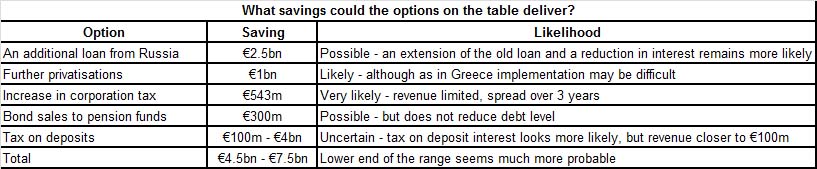
Secondly, the alternative options on the table simply do not deliver enough savings (at least not without the risk of significant contagion which politicians are likely to shy away from):


That leaves us with a very familiar solution: another fudge.

In terms of what to expect from tonight's meeting, well, probably no conclusive deal for a start. At best an agreement on some of the options above. The audit of Cypriot anti-money laundering regulations is just beginning and the final result will likely play a role in determining the level of conditions Germany applies to the bailout. (As the WSJ noted recently, the institution running the audit has previously ranked Cyprus above Germany in terms of its rules on money laundering, so exactly how much the result will help remains unclear).

See here for the full piece.

Wednesday, March 13, 2013

Are Greek banks improving or struggling for liquidity?

Those who followed our analysis of the Greek bond buyback will remember that we warned at length that it could have some adverse effects, one of which would be to hit bank liquidity at a time when Greek banks could least afford it.

In the end Greek banks were pushed to take part by the government but their resistance (despite being reliant on the Greek Central Bank for liquidity and the eurozone for a recapitalisation) was quite telling.

In any case, data is now beginning to emerge which sheds some light on the issue but also provides plenty of questions (as always with Greece data releases are some months behind elsewhere so the latest data available is for January 2013).

Greek bank borrowing from the ECB and the Greek Central Bank (via ELA) has dropped significantly since the bond buyback at the start of December (down €21.3bn since November 2012).

 
Now, normally a sharp drop in borrowing from the ECB and ELA would be a positive thing since it suggests reduced reliance on official funding. However, in this case, we suspect that rather than improving their position, banks are actually struggling to find sufficient assets to post as collateral with the Bank of Greece to gain liquidity.

Other factors do support this argument. The Bank of Greece annual accounts show that the overall collateral pledged for central bank liquidity fell by €11.7bn in the aftermath of the bond buyback, while borrowing from the central banks fell by €7.5bn (data for January is not yet available). Furthermore, with total assets pledged for collateral still totalling €217.1bn or 50% of all bank assets in Greece it is easy to imagine that the banking sector is working under significant collateral constraints.

Are there any other potential explanations?

Well, the first would be that banks repaid their borrowings from the ECB’s Long Term Refinancing Operation (LTRO) in January. This seems very unlikely. The LTROs coincided with a period of extreme turmoil in the Greek banking sector due to the Greek debt restructuring, a period in which Greek banks could not access the ECB. Therefore, it is unlikely that Greek banks borrowed much if anything from the LTRO. Besides, if they did, it seems strange that they would give back a key source of long term funding early.

The second explanation could simply be that confidence has returned somewhat. There is some evidence to support this, not least the return of domestic deposits, which have increased by €12.1bn since November 2012. However, that still leaves a drop in central bank borrowing of €10bn which does not seem to have been filled by other sources of liquidity.

Lastly, the bank recapitalisation is being enacted, which could reduce the Greek bank demands for liquidity, although since it isn’t expected to be completed until end of April it would seem strange if the impact showed up this early on.

Overall then, there seems to be some strong evidence that the Greek bond buyback has hit the liquidity access of Greek banks, albeit not in a catastrophic way. More importantly though it has happened at a time when credit provided to the real economy continues to contract and economic growth remains some way off.

Update 16:30 13/03/13: 
@EfiEfthimiou has flagged up a good point over email. In December 2012 the ECB began accepting Greek government bonds as collateral again, this allowed banks to switch from using the more expensive ELA to standard ECB liquidity. The haircut on collateral may also be lower under standard ECB lending (we can't be certain since ELA terms are secret). This could have allowed the banks to reduce their liquidity needs and the level of collateral posted - another potential explanation then.

Friday, March 01, 2013

How does our prediction on Spanish regions' deficit stand up?

Last July, we put together this 'traffic light table' of Spanish regions, based on how much each region had to cut its deficit by in order to meet the 2012 overall target of 1.5% of GDP (click to enlarge):
The official deficit figures for Spanish regions were published yesterday, so let's see how our table stands up. Unsurprisingly, Spanish regions have missed their overall target, but by a lower than expected margin. The final figure for 2012 is 1.73% of GDP - only 0.23% above the target.

Five regions have missed their individual targets (well, six if you want to include Castilla-La Mancha, which is on 1.53%, but that may be a bit harsh given that they have achieved an adjustment of close to 5.8%). Three of them (Murcia, Comunidad Valenciana and Balearic Islands) are in the 'red' region of our table. The remaining two (Catalonia and Andalusia) top the 'amber' region.

Credit where credit is due (and we're not just talking about the accuracy of our prediction). Some regions have managed to achieve a very substantial deficit reduction to meet their targets. Think of Castilla-La Mancha or Extremadura, for instance, which started from 7.31% and 4.59% respectively. However, the fact that the country's two most populous regions - Andalusia and Catalonia - remain among the most undisciplined despite receiving billions from the Spanish government's dedicated bailout fund is clearly a source of concern for Mariano Rajoy's government. 

Monday, February 25, 2013

Do the Cypriot elections pave a clear path to a Cypriot bailout?

How big of a problem can a country accounting for 0.2% of eurozone GDP possibly be? Well, potentially pretty big it seems.

As expected Nicos Anastasiades, the centre right candidate, was yesterday elected President of Cyprus winning 57.5% of the vote in the runoff election – the highest vote share in 30 years. Anastasiades, along with other eurozone leaders, has said he is keen to move quickly towards finalising the Cypriot bailout which was first requested in June 2012 – meaning it has been in the pipeline for 8 months. Usually the fresh election of a reform minded government with a large majority paves a clear path for a bailout. While, it is true that the previous communist President Demetris Christofias has been an obstacle to finalising a bailout by refusing to countenance any privatisations, the path to a bailout is still littered with hurdles.

The first hurdle is the banking sector which needs a massive recap of €10bn (50% of GDP). Over the past decade it has swelled to seven times the size of Cypriot GDP, mostly off the back of a huge inflow of foreign (mainly Russian) money attracted by the low tax rate and reported lax financial regulation. Unfortunately, despite requiring a significant restructuring and overhaul, for which taxpayers should not foot the bill, there is a very limited amount of bank debt to ‘bail-in’ (circa €3bn against €128bn of assets). This leaves few options. One is writing down depositors, although the threat of contagion and the unprecedented nature of this means it remains someway off for now.

The second issue is fiscal. Cypriot debt has been increasing rapidly, already standing at around 84% of GDP. Adding the burden of a €17bn bailout would take it to 140% - far from sustainable. However, restructuring the sovereign debt is not much easier than the bank debt. Around half is issued under UK law, meaning the Cypriot parliament cannot simply pass a law restructuring it (as Greece did). The other half is predominantly held by shaky Cypriot banks making any write down counterproductive as these banks would simply need an even larger recapitalisation. The rest takes the form of official loans to EU countries and institutions – unlikely to take losses, as Greece has proven.

The confluence of the above problems ultimately makes this a very tricky political decision. The Cypriot bailout and the presence of large Russian deposits and lax financial regulation (in Germany’s view at least) is now becoming a topic in the upcoming German elections. As we noted in today’s press summary, a DPA poll over the weekend showed that 63% of Germans are opposed to a Cypriot bailout whereas only 16% are in favour. The SPD has also made this a point on which to differentiate themselves from the governing CDU. On the other hand the politics in Cyprus are also tricky. Many in the country are expecting a show of solidarity from the eurozone given that half of the bank recap needs are a result of Cyprus wilfully taking part in the Greek debt restructuring. And is Cyprus really systemically important, given its tiny size? Many would say it is not, however, as the problems above highlight there is substantial potential for contagion, not least because any radical solution would challenge the view that Greece is “unique and exceptional”.

Taken together, this represents a minefield of issues to negotiate when formulating the Cypriot bailout. Unfortunately, the technical and legal challenges balanced with the fragile turnaround in the eurozone mean that at this point in time it looks likely that eurozone taxpayers will be forced to foot the bill once again – albeit with very strict conditions and a significant financial overhaul. Potentially the most worrying thing about this bailout is how familiar the problems all seem. The banking issues are similar to those in Ireland and Spain, the fiscal challenges to those in Greece and the political ones, well, to everywhere. One thing that the Cyprus issue makes abundantly clear is that the eurozone lacks any new tools to overcome these very familiar problems. Of all the issues mentioned above, that may be the most ominous for the future of the euro.

Thursday, February 21, 2013

ECB publishes details of SMP purchases

The ECB has just released details on its holdings of government bonds bought under the Securities Markets Programme (SMP) for the first time, see table below (click to enlarge):


To be honest, the figures are much as expected – although the holdings of Greek bonds will have decreased due to a fair amount of the holdings maturing (circa €10bn over the course of the SMP). The holdings of Italian bonds are interesting, given that we knew the ECB purchased almost €145bn of Spanish and Italian bonds, it is possibly a bit surprising that the level of Italian bonds outweighs Spanish so significantly (although it does broadly match the relative size of their debt markets). Still it highlights that necessary intervention to simply keep yields in these countries to below 7% was still very sizeable.

The move is positive for the transparency of the ECB (if a little late). Let us hope this is the start of a trend rather than a one off…

Tuesday, January 08, 2013

Greek bond buyback fallout continues

As we noted in this morning’s press summary, there have been some interesting developments with regards to the Greek banking sector.

Kathimerini reported that, according to unnamed bank officials, the bank recapitalisation may now need to be larger than the scheduled €27.5bn. The reason for this is twofold:


  • First, the level of non-performing loans in Greek banks topped 24% of all loans at the end of 2012. This is a staggering amount. Keep in mind the Spanish banking sector, which has been the focus of so much uncertainty, still has non-performing loans equal to around 11% of all loans. Greece once again is in another league here.
  • Secondly, as we warned at the time, the bond-buyback had a detrimental effect on the Greek banks. Even if they did not take substantial direct losses on the bonds they submitted, they have lost out in terms of future revenue (the interest from the bonds). This is reported to amount to around €1.5bn this year.
As FT Alphaville highlights, this seems a fairly clear-cut case of the negative trade off which we highlighted at length in the run up to buyback.

Needless to say, it is not make or break and the marginal effect of the buyback is still positive, albeit fairly small in the scheme of the Greek crisis. Fortunately, there is an additional €5bn set aside for such ‘unexpected’ increases in the bank bailout, so the additional cost should not disrupt the bailout programme.

We would note as a final point, that this may not be the end of the story (not just because the non-performing loans are likely to increase further) but also because we are yet to find out what impact the bond buyback had on the Greek banks’ ability to access liquidity (an issue we discussed in detail here). Again it may not be make or break, but we suspect it could be a further negative factor for Greece to deal with - something it hardly needs.

Monday, December 10, 2012

The Greek bond buyback: Greek banks are putting up a fight (as we predicted)

As we predicted two weeks ago the Greek bond buyback is turning out to be much trickier than almost everyone else expected, and for exactly the reason we suggested – the Greek banks.

Despite positive declarations throughout last week that the Greek bond buyback would reach its target of €30bn bonds submitted by the Friday deadline, the Greek government has announced that the deadline has now been moved to 12pm Tuesday 11 December.

Throughout the buyback process the Greek banks have made it clear that they want to keep their participation to a minimum and are not keen on the buyback plan generally. The reasons for why have been discussed here and here (potential losses and hit to liquidity). Needless to say, the Greek government has exerted significant political pressure to ensure that the Greek banks do participate fully.

Despite this, Kathimerini reports that the Greek government decided to extend the deal after hedge funds submitted €16bn in bonds (much of which they will make a profit on) while Greek banks submitted around €10bn. This was short of €16bn which the banks were expected to submit, and which they are likely to be pushed into submitting by tomorrow.

As FT Alphaville highlights, this did not go down too well and the press release on the extension contains a (very thinly veiled) threat that those bond holders who do not take part may not end up getting paid back at all. Stelios Papadopoulos, the head of the Public Debt Management Agency, is quoted (in the actual press release) as saying:
“Investors should bear in mind that even if Greece accepts all bonds tendered in the Invitation, it will continue to engage with its official sector creditors in considering further steps to put its debt on a sustainable path. Future measures may not involve an opportunity to exit investments in Designated Securities at the levels offered for this buy back.” 
The buyback still looks likely to be completed, but all of this highlights just how weak Greek banks are - the last thing the Greek economy needs is even weaker domestic banks (and therefore even less lending to the real economy).

Thursday, November 29, 2012

Greek banks and the Greek bond buyback

Yesterday we put out a flash analysis looking at the latest Greek deal and the prospect of Greek bond buyback. One of the many issues with the deal (and the buyback in particular) which we raised was that Greek banks will find it difficult to participate without needing extra capital.

However, Greek Finance Mininster Yannis Stournaras also said yesterday (in a timely statement):

The debt buyback "doesn't mean new capital for banks, given that they have recorded these bonds at lower prices than those that will be offered."
His suggestion then, is that the Greek banks have already marked their bonds to market prices on their books, meaning that they can sell them at the low prices involved in the bond buyback without needing new capital. This may make their participation more likely, but there are plenty of other reasons why we still see it as difficult and unpredictable. (We also still question why foreign holders will be involved, particularly previous hold outs and those who are holding to maturity, see our full analysis here).

Firstly, as Kathimerini reported today, the banks themselves are not keen to be involved in the buy back. Many feel that they have already done their part in terms of taking part almost ubiquitously in the first debt restructuring. If they were to take part in the buyback, they could seek adjustments in the terms of the recapitalisation and reform – something which the EU/IMF/ECB troika is unlikely to accept.

Secondly, taking part in such a scheme would need significant approval within the banks and other financial firms. This means board level and possibly wider shareholder approval. As the restructuring earlier this year showed, this takes time, with the process dragging for months. Given the 13 December deadline to have a bond buyback plan in place (i.e. to have a firm idea of who will take part, to make sure it is worthwhile) it is not clear how many bondholders will be in place to participate.

Thirdly, and possibly most importantly, is that the banks need their holdings of bonds (around €22bn) to gain liquidity from the Emergency Liquidity Assistance (ELA) through the Greek Central Bank (GCB). Looking at the GCB balance sheet, it seems broadly that Greek banks posted €247bn in collateral to gain €123bn in liquidity, an average haircut of 50%. Given that many of these assets will be loans or securities, sovereign debt (even Greek) is unlikely to be judged any more harshly than the average. So, if the banks sold these assets for a 65% write down (as suggested) they could purchase new assets (maybe other sovereign debt) but would be able to buy less of it (as not many other assets priced at a 65% discount) meaning they would not be able to gain as much liquidity under the ELA as with current Greek bonds.

Essentially, this could harm the Greek banks liquidity position which would further constrain their lending ability and possibly prompt further deposit flight – both of which would hurt the fragile Greek economy.

All in all then, this process could still be counterproductive for Greek banks even if they do not book new losses directly and they still could be hesitant to take part voluntarily. However, that is not to say that the political pressure applied behind the scenes will not be enough to force them to voluntarily join. Ultimately, it simply highlights that this policy may deliver a small benefit with some negative side effects but is at best a way of skirting the real issue of whether the eurozone can stomach permanent fiscal transfers to Greece. This will come to the fore again soon.