


The news out of Greece has been improving slightly in the past few months in a welcome change from the trend of bleak economic and political news out of the struggling Eurozone state. However, the next few months could see the country reverting to trend somewhat.
Eurozone finance ministers agreed yesterday to allow Greece a technical extension of 2 months to its bailout which is due to finish at the end of this year. This is to allow the final quarterly review of the bailout to be completed – a necessary step to ensure the reforms are in place which in turn will allow for release of the final cash payment from the Eurozone.
Following the agreement, the Greek government announced that it will hold the first round of its Presidential election on 17 December, moving it up from February.
Together these announcements have crystallised some long standing economic and political risks for Greece going into the New Year. However, there are some key questions which spawn from these decisions and also some further risks which remain unanswered, I outline them below.
How does the Presidential election work and what is the likely outcome?
What questions still need to be answered?
- The President (a largely ceremonial role) is elected by the Greek parliament. In the first or second round the candidate must gain 200 out of 300 votes from MPs. If this is not done then he needs 180 in the third round. If no candidate is found after three rounds, snap general elections are called (these would be around the end of January if they did happen).
- Currently the New Democracy and Pasok coalition holds 155 seats, while the opposition Syriza party has refused to back a joint candidate (a compromise often used in the past) since it is leading in the polls and wants snap elections.
- The government today announced former European Commissioner and Greek Foreign Minister Stavros Dimas as its candidate.
- There is a chance that the government can gain the 180 seats – many of the smaller parties and independent candidates would lose seats to Syriza in a new election and therefore want to avoid having one. Currently, Greek officials put the chance of success at around 50:50 (not exactly inspiring but better than some had expected previously).
Was the government right to move up the vote?
- It remains unclear exactly how the extension of the bailout will play out. It is assumed the two sides will reach an agreement as before, with Greece eventually pushing through tough reforms. This is probable again but not guaranteed – the room for manoeuvre for the government is limited by the threat of elections. There is only so much they can do without harming their vote share further. Furthermore, the coalition partner Pasok is almost wiped out as a political force and therefore is scrambling for some way to boost its presence. This could lead to radical choices with an election looming.
- There has also been little progress on exactly how Greece will fund itself for next year. The Eurozone has said it is supportive of granting Greece an precautionary credit line – but this is complicated by a number of factors, not least that it is not very precautionary since it seems almost guaranteed that Greece will need to tap it.
- Furthermore, the involvement of the IMF remains unclear. Greece harbours significant resentment towards the IMF and wants to move away from their funding, even though they are still due to pay out another €9bn in 2015 and 2016. If they stay, they will need guarantees that Greece will be able to fund itself for 12 months, and if they leave their funding stream will need to be replaced.
Overall, risks are coalescing in Greece once again. The fundamental questions over how to fund Greece in the medium term (as it economy tries to recover) or how it will continue to deal with incorrect interest rates and a too strong currency have never been answered. The government’s plan to move up the election is a risky one but politically probably the correct option. Ultimately, the next few months will be a bumpy ride for Greece, but the wider Eurozone should not be too affected since it has plenty of buffers in place to deal with such a crisis.
- It is a risky play, but I think it was probably the correct decision (at least from a political perspective). The key reason is that the uncertainty around what comes after the current bailout (which now ends in February) takes some power away from Syriza. The government has proven it can negotiate with the EU/IMF/ECB Troika and has a track record of managing crises. Syriza does not. As we have seen in Greece over the past few years, fear of uncertainty and possible increasing the chance of Grexit once again can be an important factor in peoples’ voting and thinking.
- Furthermore, the ideal position for Syriza is that a follow on programme would have been negotiated before the vote on the President and potential elections. This would have provided certainty and a platform which Syriza could try to negotiate a new bailout programme and a restructuring of Greece’s debt.
- One key question which remains unanswered is, what would happen if elections take place and Syriza win? While Syriza claim to support euro membership they want a fundamental change in the way Greece approaches European issues. Notably they want a debt restructuring and a complete overhaul of the programme for reforms and consolidation in Greece which accompanies the bailout (or presumably which would tie into a restructuring). This seems very unlikely to materialise, but it is not clear if they would push for a Greek exit from the euro if their demands are not met or if they would temper their position.
- All that being said, if this doesn’t pan out, then Greece will face elections early next year, in a climate of serious uncertainty with no clear plan to exit the bailout. Then again, this was always the risk and may always have materialised.
Visit our new website.
Showing posts with label bailout. Show all posts
Showing posts with label bailout. Show all posts
Tuesday, December 09, 2014
Was the Greek government right to call a snap Presidential election?
Open Europe's Raoul Ruparel asks this question over on his Forbes blog, concluding it was probably the correct political choice but that plenty of risks remain in the process. Full post below:


Thursday, October 30, 2014
Gas talks stall as Russia pushes for EU guarantees on Ukrainian gas payments

Reuters is reporting that an EU spokesperson has said a deal is "very close" and talks will continue today, as we note below. As we also say below, a deal is still doable and likely, the question remains whether any form of EU payment guarantee will be needed and if this can get sufficient support within the broader EU member states.
***************************************************************
Despite another round of talks between Ukraine, Russia and the EU which ran late into the night yesterday the negotiations seem to have reached somewhat of a stalemate.
Earlier in the year the halting of gas supply between Russia and Ukraine (for Ukraine’s own use at least) was not seen as too big of an issue and it was hoped Ukraine would be able to leverage the combination of economic pain from sanctions and the Russian government’s reliance on commodities exports for funding to secure a relatively favourable deal. However, on the cusp of the harsh Ukrainian winter the power balance has steadily shifted and Russia has continued to hold firm and even broadened its demands.
What has been agreed so far?
Quite significant progress has actually been made compared to the starting point:
- Ukraine has agreed to pay for previous gas supply at a price of $268.5 per thousand cubic metres. This means $1.45bn will be paid by the end of October and $1.65bn ($3.1bn total) by the end of the year. Ukraine’s Naftogaz has set aside $3.2bn in an escrow account to pay for this.
- Going forward Ukraine will prepay on a monthly basis for its gas this winter at a price of $385 per thousand cubic metres. Russia has agreed to pay transit costs.
What are the key sticking points?
There is really only one, but it’s a biggie. While Ukraine has proven that it can afford to pay off its existing debts there is much less certainty about its ability to prepay going forward.
We have noted before the significant downward spiral in the Ukrainian economy. While the fighting has calmed down to an extent, things are still far from normal, not least because the conflict has become frozen in the East with part of the country still de facto cut off.
Ukraine is now totally reliant on external funding from the EU and IMF. As we have seen in the Eurozone crisis the release of such funding is often more complicated than expected and creates a staggered cash flow linked to economic reforms. Such reforms should pick up following the election but remain tricky to implement in a country caught in the proverbial no man’s land in the sanctions war between Russia and the EU.
For these reasons Russia has continued to demand some form of explicit guarantee from the EU that Ukraine will be able to pay for the supplies over the winter – they are expected to cost around $1.6bn, though this could increase if the winter is particularly harsh.
Is a deal likely?
It’s looking difficult as this meeting was earmarked as the most likely one for a deal. Russia seems to be using this arena to flex its muscles given that it believes it has the upper hand. That said, the economic costs of sanctions and a falling oil price are creating problems for the Russian economy, though it’s not always clear whether economic logic is sufficient to alter Russian President Vladimir Putin’s position.
Getting explicit EU support for around $2bn to guarantee prepayment would be difficult. But, so far, the EU has been fairly supportive of Ukraine and may be willing to offer a more tacit agreement to provide further funding rather than outright underwriting of the payments. Furthermore, without a deal there will be a huge temptation for Ukraine to siphon off gas which it is transiting from Russia to Europe. This could cause Russia to halt all gas flow through Russia, something Europe is keen to avoid to say the least.
Talks are set to resume later today according to RIA Novosti. With all this in mind, and the fact that a deal remains in all sides' interests, we would think one could still be struck.
What are the lessons here?
Ultimately, this dispute is teasing out a key question for the EU in the wake of this crisis. It is becoming increasingly clear that Ukraine is economically devastated in the wake of the war and the sanctions. The offer of opening up markets in the EU is unlikely to be sufficient and the EU and IMF will have to face up to the fact that in the short and medium term they will probably have to offer significant amounts of cash to Ukraine to help stabilise its economy, currency and energy supply.
Putin is aware of how politically sensitive this is for the EU – it has just gone through a series of its own bailouts in the Eurozone crisis and now countries are being asked to stump up cash for a country which is not even a member (and is unlikely to be one for the foreseeable future, if ever). As with the sanctions, this narrative is likely to expose dividing lines within the EU and set the tone for the negotiations over the future of Ukraine.
Friday, September 13, 2013
Spotlight on Slovenia

Today and yesterday, eurozone finance ministers have been meeting in Lithuania with aid for Slovenia (as well as Greece, Portugal and Ireland) top of the eurozone’s agenda.
Recap – What problems is Slovenia facing?
- The banking sector is nursing a possible €7.5bn (21% of GDP) capital shortfall. Although Slovenia’s government debt remains very manageable (at 54% of GDP) it could increase quickly due to a toxic combination of collapsing economic growth and spiralling costs of bailing out banks.
- As we noted back in the spring, provisions against this capital shortfall are far below the levels needed and covered at best half of the problematic loans. Since then, the level of bad loans has increased, while little progress has been made on recapitalising banks. The recent bailout of two small banks cost a combined €900m+, and included a bail-in of subordinated debtors. This could set the tone for the approach to the rest of the sector. Worryingly, this is also around the total amount previously estimated for the capital needs of the whole banking sector.
- The European Commission has pushed the independent bank stress test to be expanded to cover the whole banking sector. The results are expected at the start of next month, and could well reveal deeper holes in Slovenia banks. Filling these without external aid will be tricky.
- Non-financial corporations also continue to struggle under a mountain of debt, with a debt-to-equity ratio of around 200%. This will be a significant drag on the economy for some time as firms shrink and deleverage while many could well shutter for good. This of course has further knock on impacts for the level of bad loans at the banks and the level of unemployment.
- Austerity has been limited so far with the government deficit at around 8% of GDP (and possibly set to increase this year). Significant cuts will still have to happen and, as we have been at pains to point out before, the combination of bank deleveraging, fiscal consolidation and struggling domestic demand can create a very painful downward spiral.
- The privatisation programme has failed to get off the ground, with the only sizeable move so far being the €240m sale of retailer Mercator.
- Concerns also remain surrounding the significant amount of cronyism and corruption at play, particularly within state owned firms and within the financial sector. The government has recently moved to crack down on the shadow economy with wider taxes, although whether this will prove successful remains to be seen.
“I think if they stay strictly on course -- and they’ve said that want to do that; they’ve supplied two small banks with capital over the weekend -- then they’ll manage without it…So as long as Slovenia itself says they can manage it, we should encourage them in that.”EU Economic and Monetary Affairs Commissioner Olli Rehn voiced similar sentiments. So far then, Slovenia seems to be happy to go it alone and (possibly with other things on their minds) Germany and others are happy to acquiesce. But with the ECB reportedly increasingly concerned about the state of the banking sector, the upcoming stress test results could be a turning point – assuming of course they are judged credible (far from a given).
If any aid is eventually forthcoming, as we’ve argued before, it seems much more likely to take a similar form to that in Spain than in Cyprus or elsewhere.
Wednesday, July 24, 2013
Open Europe Berlin interviews Prof. Bernd Lucke, leader of Germany's anti-euro party AfD

On the topic of design flaws in the European Monetary Union (EMU)...
Bernd Lucke (BL): The root of all evil is, in my assessment, the fact that the European Treaties did not provide, and do not provide until today, for the possibility to withdraw from the eurozone...Since leaving [the euro] as a last resort was excluded from the outset, the possibility of exerting political pressure on member states was also limited.
[…]
Despite non-sustainable economic development in some countries, the financial markets obviously did not pick up on the large differences [between eurozone countries], which affected the risk of credit default. In turn, the low interest rates 'funded' these developments. Actually, the alarm bells should have been ringing in view of the different developments in country-specific inflation rates, unit labour costs and trade balances. Also, the housing bubbles in Ireland or Spain should have been recognised and counteracted upon by politicians. However, warning systems were not available. It was revealed how ill-conceived the introduction of the euro was, under all aspects.
On the role of the ECB in the crisis...
BL: The ECB is not directly to blame because it was simply a part of the poorly constructed euro system...In the time before the crisis, the ECB could have been blamed at most for not pointing out the dangers associated with different inflation rates in the euro countries...Just a note: an independent central bank is good. But a central bank – like the ECB – that is no longer subject to state or democratic control and has switched to self-preservation mode is extremely dangerous.
On using tools such as the ESM and OMT to stabilise the eurozone...
BL: The ESM is ultimately a giant institutionalised eurobond, and therefore a form of debt mutualisation...What we want as AfD is...the return to the Maastricht criteria, and in particular the re-introduction and strict compliance with the no-bailout clause. No country shall be liable for the debts of other countries...Countries should and would go bankrupt, which would reduce the partly unbearable debt levels.
On how AfD sees a eurozone break-up...
BL: As an ‘immediate measure’, we demand the consequent compliance with the [existing] rules of the European Treaties as well as adding a euro-exit clause to the rules. If necessary, we want to force this right to exit by blocking future ESM loans with a German veto. Without further assistance loans, the crisis countries would decide that it is in their own interests to exit the monetary union. This should happen in an orderly and gradual [manner]. On the legal side, the European treaties need to be changed. We have parliaments and governments for that. And Germany has enough weight to push this through.
Tuesday, July 09, 2013
Athens strikes another bargain in Brussels, but how long will this one last?
As we noted last week on CNBC, a deal was always likely this time round in Greece:
How much will be disbursed and when?
"We've got German elections coming up in September and no one wants to have that talk of how we're going to fund Greece for the next three or four years. So they just want to kick the can down the road until after the elections…They will come to some agreement but it's clear that Greece is well behind track on its programme once again and it's only a matter of time before a new funding gap opens there."One was eventually reached yesterday morning with details filtering out overnight.
How much will be disbursed and when?
- The eurozone will provide €2.5bn this month and €500m in October, while eurozone central banks will provide €1.5bn and €500m at the same time by releasing profits from their holdings of Greek government bonds. This should give Greece enough cash to cover costs and payoff the €2.2bn of government debt maturing in August.
- The IMF will hold a meeting later this month where it is expected to agree to release its next €1.8bn share of the bailout.
- The staggered pay-out of this €6.8bn will allow the eurozone to enforce more conditionality, meaning it could delay the future tranches if Greece does not stick to its reform programme.
- Once this round of funding is complete, Greece will have received around €208bn out of a total €246bn committed.
- The bargain comes with strict conditions on Greece (as always), particularly in terms of civil servant cuts on which Greece seems to have fallen far behind. Greece must put 12,500 civil servants in the labour mobility scheme within the next few weeks (where they receive reduced pay and are sacked within a year if they do not find a new position).
- This must be doubled by the end of the year, while 15,000 must be laid off by the end of 2014.
- Greece must also work to step up reform of the tax system, tackling evasion and improving collection of back taxes. This is obviously easier said than done and has been a target from the beginning, no details yet as to how this time round will be any different.
- Must close the funding gap in the healthcare provider EOPYY which totals around €1bn. Again no details as to how and when exactly this will be closed.
- On top of the ones hinted at above, the key unanswered question remains, how will Greece fund itself once the bailout runs out? The eurozone has already further committed to €11bn in aid (unlikely to be in the form of direct funds) in 2014 and 2015 although it is yet to identify where this will come from. Eurogroup head Jeroen Dijsselbloem dismissed such concerns saying, "If there is a financing gap it will be at the end of 2014, which will allow us plenty of time to deal with it," which provides little comfort given the delays in dealing with other eurozone problems.
- Can the government actually push through all these measures with its slim majority? We expect it will probably be able to (just), but it will be the first real test for the new coalition and will provide a good bellwether of how it will fair in the coming months.
- What is happening to the closed state broadcaster ERT? This remains unclear. This is important not just for political reasons (still has the potential to expose divisions in the coalition) but also since the 2,600 employees could provide a big boost towards meeting the targets for civil servant cuts (the real reason behind the closure in the first place we suspect).
- Another key aspect of the recent funding gap was the reluctance of national central banks to rollover their holdings of Greek bonds (thereby reducing the amount Greece has to pay off). It’s not clear whether this has been done or will be done, although comments from officials this morning suggest it may not yet be finalised.
Thursday, June 27, 2013
Cypriot deposit outflows continue but slow in May
As we reported last month, the outflow of Cypriot deposits has continued apace despite the continuation of capital controls (even once the impact of the bank restructuring is stripped out the outflows have totalled around €3bn for each of the last two months).

Judging from the above graphs (click to enlarge), there seems to have been some improvement in May with the outflow slowing to €1.4bn. This remains a sizeable amount given the continuation of the capital controls.
Of the outflows taking place it seems fairly evenly split between domestic depositors and those from the rest of the world. The outflows also seem to be split fairly evenly across sectors. It’s hard to draw any stark conclusions from this set of data. It seems that both households and firms are continuing to draw down their deposits at a rapid pace and those foreign firms which can withdraw money are still doing so, albeit in small amounts.
The question remains, with Cypriot growth prospects looking so bleak, when and where will this outflow stop?

Judging from the above graphs (click to enlarge), there seems to have been some improvement in May with the outflow slowing to €1.4bn. This remains a sizeable amount given the continuation of the capital controls.
Of the outflows taking place it seems fairly evenly split between domestic depositors and those from the rest of the world. The outflows also seem to be split fairly evenly across sectors. It’s hard to draw any stark conclusions from this set of data. It seems that both households and firms are continuing to draw down their deposits at a rapid pace and those foreign firms which can withdraw money are still doing so, albeit in small amounts.
The question remains, with Cypriot growth prospects looking so bleak, when and where will this outflow stop?
Tuesday, June 18, 2013
Full letter from the Cypriot President to the Troika slamming Cypriot bailout
As we reported last week in our press summary and which the FT is today reporting on (and presenting as a bit of a scoop), Cypriot President Nicos Anastasiades has sent a scathing letter to the EU/IMF/ECB Troika slamming the terms of the Cypriot bail-out/bail-in package and calling for it to potentially be re-examined.
Below we post the letter in full, courtesy of the Cypriot website StockWatch, which published it over a week ago (added emphasis ours):
Below we post the letter in full, courtesy of the Cypriot website StockWatch, which published it over a week ago (added emphasis ours):
I am writing to update you on the economic and banking system developments in Cyprus following the Eurogroup decisions of last March and to request your support regarding a number of very pressing issues which need to be addressed the soonest.
1. The Cypriot economy is adapting to major shocks
The Cypriot economy is adapting to major shocks. Substantial private wealth has been lost and a significant number of Cypriot firms have lost their working capital at the two systemically important financial institutions which were subject to the bail - in. Restrictive measures, including capital controls, are seriously hampering the conduct of business and confidence in the banking system has been shaken. As a result the economy is driven into a deep recession, leading to a further rise in unemployment and making fiscal consolidation all the more difficult.
2. Application of bail-in was implemented without careful preparation
It is my humble submission that the bail-in was implemented without careful preparation. Its form was changed drastically within a week. Originally designed as a general bail-in across the banking system, it eventually became focused on the two distressed banks, the Laiki Bank and the Bank of Cyprus (BOC). There was no clear understanding of how a bail-in was to be implemented, legal issues are being raised and major delays in completing the process are being observed. Moreover, no distinction was made between long-term deposits earning high returns and money flowing through current accounts, such as firms' working capital. This amounted to a significant loss of working capital for businesses. An alternative, Ionger-term, downsizing of the banking system away from publicity and without bank-runs was a credible alternative that would not have produced such a deep recession and loss of confidence in the banking system.
3. Cyprus was forced to pay the cost to ring-fence Greece but no reciprocity has been granted
Another feature of the current solution was that deposits at the branches of Laiki and Bank of Cyprus in Greece were spared from a haircut to prevent contagion. These deposits amounted to €15 billion. The wish to avoid contagion to Greece was also evident in the Eurogroup's insistence that Cypriot banks sell their Greek branches. In addition and as a result of the sale, the Cypriot banks have lost their Greek deferred tax assets. As understandable as ring-fencing may be, this was absent at the time of deciding the Greek PSI in relation to the Greek Government Bonds which cost Cyprus 25% of its GDP (€4.5 billion). The heavy burden placed on Cyprus by the restructuring of Greek debt was not taken into consideration when it was Cyprus' turn to seek help.
4. Imposition of Laiki's ELA liability to Bank of CyprusVery strong stuff indeed. We can't imagine the Troika will take to it too kindly.
The implementation of the sale of the Greek branches of the Cypriot banks, as urged by the Eurogroup, resulted in Laiki selling assets that were pledged against its ELA liability to Piraeus Bank, without Piraeus assuming the corresponding ELA liability. As such, Laiki was left with the related ELA liability but without the aforementioned assets. The ELA liability which was left "unsecured" as a result of the sale amounts to around €3.8 billion and was imposed on Bank of Cyprus as a result of the Eurogroup decision. It is worth reminding that a substantial part (in excess of €4 billion) of Laiki's ELA liability was required in the first place in order to cover deposit outflows experienced by Laiki's Greek branches.
Bank of Cyprus itself has a total ELA liability of around €2 billion. By taking an additional €9 billion from Laiki, which was accumulated over the course of the last year under very questionable circumstances, BOC has substantially increased the vulnerability of its own funding structure, with its cumulative ELA liability reaching a very high €11 billion. BOC was called to pledge its own assets to cover for the collateral shortfall for the €3.8 billion liability carried over by Laiki. Such a high amount of ELA liability hinders BOC's funding sources as the room for obtaining additional ELA is limited. The imposition of Laiki's ELA liability on Bank of Cyprus is the main contributor to the liquidity strain Bank of Cyprus faces.
5. Urgent need for Troika to provide a long-term sustainable and viable solution to the liquidity issues Bank of Cyprus is facing as a result of the Eurogroup decisions
Instead of addressing the issue of severe liquidity strain on Cyprus' mega-systemic bank through a long-term sustainable and viable solution, the Troika partners seem to have chosen the path of maintaining strict capital restrictions. Artificial measures such as capital restrictions may seem to prevent a bank run in the short term but will only aggravate the depositors the longer they persist. Rather than creating confidence in the banking system they are eroding it by the day. Maintaining capital restrictions for a long period will inevitably have devastating effects on the local economy, will also affect the country's international business and will have an adverse impact on GDP. Under such scenarios spill over effects will no doubt register on other local banks through higher non-performing loans as a result of dampened economic activity. In addition, increased deposit withdrawals from other local banks, as fear of lack of liquidity of the only systemic bank will have a domino effect on the entire banking system.
I stress the systemic importance of BOC, not only in terms of the banking system but also for the entire economy. The success of the programme approved by the Eurogroup and the Troika depends upon the emergence of a strong and viable BOC. It is for this reason that I urge you to support a long-term solution to Bank of Cyprus' thin liquidity position. Such a solution will re-instate depositor confidence in the banking system and will allow the full functioning of the economy away from restrictive measures and capital controls. It will also facilitate the attraction of foreign direct investment in Cyprus.
My Finance Minister has alerted the Troika Mission Chiefs in writing on 19 May 2013, in relation to the need to implement a long-term viable solution to Bank of Cyprus' liquidity position. No response has been received yet.
A possible long-term solution could be the conversion of part of Laiki's ELA liability into long term bonds and the transfer of these bonds and corresponding assets into a separate vehicle. Another solution could be the reversal of the Eurogroup decision in relation to the merger of Good Laiki (carrying the €9 billion ELA liability) into Bank of Cyprus. In any case the BOC should exit resolution status without any further delays and should be granted eligible counter-party status by the ECB. Of course more options need to be examined. I should mention that an interim Board and an interim CEO is already in place at BOC and the final asset valuation is progressing according to schedule.
I urge you to review the possibilities in order to determine a viable prospect for Cyprus and its people. The new government of Cyprus, despite its expressed disagreements, has abided by the Eurozone decisions and remains determined to implement the programme fully and effectively. I am personally determined to lead Cyprus out of this dire situation and towards a path of sustainable growth and development. We are also fully committed to re-establishing Cyprus's stance as a credible EU partner. However, at this crucial juncture, we are calling upon you for active and tangible support.
Friday, June 14, 2013
Mervyn King on the solutions to the eurozone crisis

When asked about the solutions to the eurozone crisis, King sums up the options very succinctly and without the usual qualifying statements needed by those directly involved in the crisis:
“I think there are four [solutions]. One is to continue with mass unemployment in the south, in order to depress wages and prices until they’ve become competitive again. The second is to say, ‘Well, we have to get rid of this imbalance in competitiveness, so we need inflation in Germany.’ That seems unattractive, certainly to the Germans.A very concise and accurate summary we’d say. Obviously each option can be tinkered and altered but the broad truth is all there.
“The third is to give up on this question of restoring competitiveness quickly and accept that this is an indefinite transfer union. That requires two things: one is for people in the north to give money to people in the south; the other is for people in the south to accept the conditions imposed on them, which will limit the size of the transfer.
“The fourth is to change the membership. Now, I don’t know what the right answer is, and it will depend on their political objectives, but economics tells you that you have to have one or some combination of these.”
However, we might go so far as to narrow the options down even further. Option one (which is currently being employed) seems unlikely to be politically or socially acceptable – countries such as Greece, Portugal and Cyprus in particular would struggle to regain competitiveness this way. It would also leave the structural flaws of the eurozone untouched, leaving it incredibly vulnerable to future crises.
Option two also seems unlikely to be sufficient, even if it were an option politically. We would say some element of it is probably necessary for the eurozone, but far from sufficient to solve the crisis. It could also create the ‘uncompetitive union’ which Germany fears most, as although internal imbalances in the eurozone may be eased the actual competitiveness of the bloc as a whole would be much worse than previously. There are also questions about how much such an approach would spillover into growth in the struggling eurozone countries - as we discussed in detail here. Again it also does not tackle the institutional flaws.
Therefore that leaves us with options three and four – something we have noted before.
Before the crisis can ever be solved the true choices facing the eurozone need to be realised. Let us hope that this weekend some of the eurozone leaders read King’s interview.
Thursday, May 30, 2013
Cypriot deposit developments
Update 31/05/13 09:40: As we noted below, it seems that the figures do include some of the write-downs of deposits under the bank restructuring (but not all). Apologies for the confusion. As the Central Bank of Cyprus notes the initial write down for Bank of Cyprus depositors is included. This totals around €3.2bn. This means the actual outflow was around €3bn, similar to the previous month.
This is still fairly significant, although we expect much of this may be domestic and due to people and businesses running down their cash reserves. This also likely reduces some of the concerns over the workings of the capital controls. The data does give some feeling for who might be losing from the bank restructuring - US Dollar depositors and foreign NFCs are probably a large share. The concerns over the bank deleveraging and increasing reliance on central bank financing also remain (since they were already well established).
The real test of the deposit flight will come, firstly once the bank restructuring is complete (by end of July) and secondly once the capital controls are removed (who knows when).
*******************************************************************
Yesterday saw the release of the latest data on the state of bank deposits in Cyprus – which always makes for interesting reading.
The headline figures are pretty terrible. Overall deposits declined by €6.346bn (10%) in April, almost double the level seen in March (when the crisis was in full swing) - despite stringent capital controls being in place for the entire month. However, given their importance, these figures deserve delving beyond the headlines.

The charts above (click to enlarge) raise some interesting points:
What does all this mean for Cyprus and the eurozone?
This is still fairly significant, although we expect much of this may be domestic and due to people and businesses running down their cash reserves. This also likely reduces some of the concerns over the workings of the capital controls. The data does give some feeling for who might be losing from the bank restructuring - US Dollar depositors and foreign NFCs are probably a large share. The concerns over the bank deleveraging and increasing reliance on central bank financing also remain (since they were already well established).
The real test of the deposit flight will come, firstly once the bank restructuring is complete (by end of July) and secondly once the capital controls are removed (who knows when).
*******************************************************************
Yesterday saw the release of the latest data on the state of bank deposits in Cyprus – which always makes for interesting reading.
The headline figures are pretty terrible. Overall deposits declined by €6.346bn (10%) in April, almost double the level seen in March (when the crisis was in full swing) - despite stringent capital controls being in place for the entire month. However, given their importance, these figures deserve delving beyond the headlines.

The charts above (click to enlarge) raise some interesting points:
- First, it’s clear that the deposit flight is continuing despite the strict capital controls. This is concerning, since it shows the Cypriot government’s inability to enforce the rules, particularly on the financial sector. It also means that capital controls continue to hamper the functioning of the Cypriot economy, but are failing to stop an outflow of money (though admittedly it could have been much larger without them).
- Second, the outflows are split between domestic residents and those in the rest of the world (ROW). ROW deposits are unlikely to return for some time. Cyprus could hold out hope that domestic residents are just stashing cash due to concerns over the economy and banks, meaning this money may eventually return. Unfortunately, given the bleak outlook this is unlikely to happen anytime soon.
- Third, a surprisingly large amount of the withdrawal (€3.2bn) has come from deposits held in US dollars. This money might also have moved abroad and is unlikely to return, suggesting both domestic and foreign investors are moving money away from Cyprus.
- Lastly, much of the withdrawal has been by non-financial corporations (NFCs) and households. This was perhaps more predictable, but again raises concerns about the future of investment and consumption in the economy. The underlying data shows especially strong withdrawals from ROW households and NFCs which have been a big source of economic growth for Cyprus in recent years. It could also peak concerns over the impact the capital controls are having, as firms and households are forced to eat into their cash reserves (although they still remain at a decent headline level).
What does all this mean for Cyprus and the eurozone?
- Much of it confirms what many people feared in the aftermath of the crisis. In particular, it paints a bleak picture for future growth in Cyprus as money flows out of the economy. It also raises questions over whether such outflows were accounted for in the overly optimistic assumptions about Cypriot growth.
- Another problem will be bank financing. Cypriot banks are locked out of the markets and may well be for some time. With deposits falling they will be forced to access more ECB liquidity and possibly the Emergency Liquidity Assistance (ELA). This is something which the ECB has notoriously been trying to avoid in Cyprus, and more generally. Not least because under any future restructuring/default/euro exit scenario the ECB would face larger losses.
- But it’s also important to remember that there is a limit to how much Cypriot banks can access through these facilities since they require assets to be posted as collateral. Even if they are able to, it is clearly possible that this pressure could force them to increase the already rapid pace of deleveraging. This would undoubtedly further hamper lending to the real economy and in turn economic growth.
- As noted above, from a wider perspective it will increase already pressing concerns over the enforcement of the controls and more generally over regulation of the financial sector in Cyprus.
Tuesday, April 30, 2013
Cypriot parliament narrowly approves bailout deal but plenty of hurdles yet to overcome
The Cypriot parliament has officially approved the bailout deal that the government agreed with its eurozone partners and the IMF. (See here for our previous thoughts on the deal).
A rejection of the deal would probably have led to a Cypriot exit from the eurozone. Given such serious consequences it was an incredibly close run vote with 29 in favour versus 27 against (often for such votes politicians shy away from risky decisions).
We’re yet to get the final breakdown of the votes but here are the early predictions (we will update this with final figures when we have them):

The government is likely to breathe a sigh of relief but it should not view this as the end – it is surely only the end of the beginning at best.
As we have noted at length before, the prospects for Cyprus are bleak. Growth is set to crumble over the next few years, while capital controls remain in place, keeping it at the edge of the eurozone (with close to a separate currency since Cypriot euros are clearly no longer worth the same as euros elsewhere). As recently as last Thursday, the controls were extended for 16 days and despite being eased at points, there is no clear plan for how or when they can be removed (strangely the responsibility for the rules seems to have switched from the Central Bank to the Ministry of Finance while the lengths of the extensions have ranged from 3 days to 16 days at random intervals – not effectively a decisive or clear policy approach).
Despite the vote being approved it is also clear that politics in Cyprus remains fractured. 29 MPs feel strongly in favour of the bailout programme and the associated actions, while 27 MPs were effectively willing to see Cyprus leave the euro rather than implementing the bailout deal. Meanwhile, the rift between the Central Bank and the government shows little signs of abating.
Surely, effective reform and governance will be tough in the future, especially as the anti-austerity feeling amongst the general public rises.
For a taste of this just see the quote from Green MP George Perdikis after the vote:
A rejection of the deal would probably have led to a Cypriot exit from the eurozone. Given such serious consequences it was an incredibly close run vote with 29 in favour versus 27 against (often for such votes politicians shy away from risky decisions).
We’re yet to get the final breakdown of the votes but here are the early predictions (we will update this with final figures when we have them):

The government is likely to breathe a sigh of relief but it should not view this as the end – it is surely only the end of the beginning at best.
As we have noted at length before, the prospects for Cyprus are bleak. Growth is set to crumble over the next few years, while capital controls remain in place, keeping it at the edge of the eurozone (with close to a separate currency since Cypriot euros are clearly no longer worth the same as euros elsewhere). As recently as last Thursday, the controls were extended for 16 days and despite being eased at points, there is no clear plan for how or when they can be removed (strangely the responsibility for the rules seems to have switched from the Central Bank to the Ministry of Finance while the lengths of the extensions have ranged from 3 days to 16 days at random intervals – not effectively a decisive or clear policy approach).
Despite the vote being approved it is also clear that politics in Cyprus remains fractured. 29 MPs feel strongly in favour of the bailout programme and the associated actions, while 27 MPs were effectively willing to see Cyprus leave the euro rather than implementing the bailout deal. Meanwhile, the rift between the Central Bank and the government shows little signs of abating.
Surely, effective reform and governance will be tough in the future, especially as the anti-austerity feeling amongst the general public rises.
For a taste of this just see the quote from Green MP George Perdikis after the vote:
“A 'yes' from Cyprus's parliament is by far the biggest defeat in our 8,000-year history. Its democratically elected representatives have a gun to their head to agree to a deal of enslavement.”The Cypriot government has negotiated a large hurdle but the biggest challenges may yet be to come.
Thursday, April 11, 2013
Who’s next in line in the eurozone crisis? Portugal and Slovenia are the prime candidates
In anticipation of tomorrow's eurozone finance ministers meeting (which will discuss finalising the Cypriot bailout and potentially extending the bailout loans given to Portugal and Ireland) Open Europe has published a new briefing looking at who might be next in the eurozone - our prime candidates are Portugal (for the second time) and Slovenia.
Key points
Both Portugal and Slovenia could need external assistance of some sort.
Portugal


Key points
Both Portugal and Slovenia could need external assistance of some sort.
Portugal
- Domestic demand, government spending and investment are contracting sharply, leaving the country heavily reliant on uncertain export growth to drive the economy.
- By cutting wages and costs at home (internal devaluation), Portugal has in recent years improved its level of competitiveness in the eurozone relative to Germany. However, this trend actually started to reverse sharply in 2012, meaning that the divergence between countries such as Portugal and Germany has begun growing again – exactly the sort of imbalance the eurozone is seeking to close.

- In its austerity efforts, Portugal is now coming up against serious political and constitutional limits. For the second time, the country’s constitutional court has ruled against public sector wage cuts – a key plank in the country’s EU-mandated austerity plan – while the previous political consensus in the parliament for austerity has evaporated.
- In combination, it will be increasingly difficult for Portugal to sell austerity at home and consequently to negotiate its bailout terms with creditor countries abroad.
- Portugal may well need some further financial assistance before long. It is unlikely to take the form of a full second bailout, but could involve use of the ECB’s OMT bond-buying programme, assuming Portugal can return to the markets fully beforehand (even briefly).
- Slovenia is not Cyprus – in fact it is much more like Spain. Its banks are significantly undercapitalised with toxic loans now standing at 18% of GDP. Banks only have provisions to cover less than half the potential losses resulting from these loans.

- At the same time, a heavily indebted private sector is now desperately trying to get debt off its books, which alongside continued austerity and lack of investment, have caused growth to plummet.
- Though a full bailout is unlikely, the country could soon need an EU rescue package worth between €1 billion and €4 billion (between 3% and 11% of GDP) to help restructure the country’s bust and mismanaged banks.
- Such a plan is likely to include losses for shareholder (bail-ins) but, unlike in Cyprus, it may not hit large (uninsured) depositors and there will be no attempt whatsoever at taxing smaller (insured) depositors.
Monday, March 25, 2013
Let the guessing game continue: The Eurogroup's mixed messages on capital controls

The body of the Eurogroup statement said:
“The Eurogroup takes note of the authorities' decision to introduce administrative measures, appropriate in view of the present unique and exceptional situation of Cyprus' financial sector and to allow for a swift reopening of the banks. The Eurogroup stresses that these administrative measures will be temporary, proportionate and non-discriminatory, and subject to strict monitoring in terms of scope and duration in line with the Treaty.”
However, the Annex noted:
“Only uninsured deposits in BoC will remain frozen until recapitalisation has been effected, and may subsequently be subject to appropriate conditions.”
EU Internal Market Commissioner Michel Barnier added earlier today:
“Any measures to restrict or limit freedom of movement may only be enacted exceptionally and temporarily and that is what has been requested by the Cypriot authorities.”
Some pretty mixed messages. The first suggests that “administrative
measures” (which is widely being taken as capital controls or related measures)
will be generally applied. Bruegel suggests that this may not even need to take
the form of full capital controls and could be limited to measures slowing down
the movement of capital. This is contradicted by the second point which suggests
they will only apply to the Bank of Cyprus uninsured depositors. Barnier’s
point is closer to the first point but suggests actual controls will be needed.
FT Alphaville has an interesting run-down of the
different type of capital controls and their implications. Paul Krugman makes
the valid point that, if the trade-off of the single currency is reduced
transaction costs in exchange for an overvalued currency, once capital controls
are introduced, what is the motivation to stay inside? As he notes, wider
points on the EU and access to ECB liquidity apply but it gets to the crux of
the choice facing Cyprus.
As we have suggested, we find it hard to imagine that the
banks could survive long without capital controls, while the economy would
likely take an even bigger hit. As we have mentioned, it would fall on the ECB
to continue to sanction ELA to keep banks afloat during deposit outflows, but
this would amount to a large transfer of risk towards the Cypriot Central Bank
(and therefore the Cypriot state, and therefore the eurozone). Meanwhile,
access to the ELA is limited by the ECB’s view of bank solvency (one they have
shown they may not stretch indefinitely) and assets which can be posted as
collateral.
One thing that is for sure: this lack of clarity
is certainly not helping an already messy situation.
Friday, March 22, 2013
Full circle in Cyprus
Update 13:15 22/03/2013:
Thinking about the plan in more detail, it occurred to us that this may amount to trying to burn the larger depositors twice. As we noted in today's press summary, the plan essentially is to move all the bad assets to a bad bank, along with the large uninsured depositors (€100,000+). These assets would then be wound down or sold off at a large discount with the depositors footing the bill (and taking losses of 20% - 40%). This, along with the merging of Bank of Cyprus and the good bank, is how the recapitalisation costs will be reduced by €2.3bn.
So, the large depositors will take significant losses here and yet may still face a large deposit tax as well? That seems to be pushing the boundaries to us, although it is not impossible. Cyprus would not recover as destination for foreign investment for some time. One way to structure this could be for the tax only to be applied to depositors above €500,000 (as we suggest below) and the bad bank to apply to all uninsured deposits. Obviously, the bad bank scheme also only applies to Laiki bank, but as the second largest Cypriot bank it is still likely to account for a large amount of big deposits.
Still this could see larger depositors taking up to 50% hits in some cases. We can't imagine Moscow would take that one lying down, especially given comments earlier in the week...
****************** Original Post *********************
It now seems we have come all the way back round to the deposit levy as a solution in Cyprus. Overnight, the EU/IMF/ECB Troika rejected the plans for a Cypriot solidarity fund, particularly one based on pension assets and gas reserve revenues (which German Chancellor Angela Merkel specifically spoke out against).

Thinking about the plan in more detail, it occurred to us that this may amount to trying to burn the larger depositors twice. As we noted in today's press summary, the plan essentially is to move all the bad assets to a bad bank, along with the large uninsured depositors (€100,000+). These assets would then be wound down or sold off at a large discount with the depositors footing the bill (and taking losses of 20% - 40%). This, along with the merging of Bank of Cyprus and the good bank, is how the recapitalisation costs will be reduced by €2.3bn.
So, the large depositors will take significant losses here and yet may still face a large deposit tax as well? That seems to be pushing the boundaries to us, although it is not impossible. Cyprus would not recover as destination for foreign investment for some time. One way to structure this could be for the tax only to be applied to depositors above €500,000 (as we suggest below) and the bad bank to apply to all uninsured deposits. Obviously, the bad bank scheme also only applies to Laiki bank, but as the second largest Cypriot bank it is still likely to account for a large amount of big deposits.
Still this could see larger depositors taking up to 50% hits in some cases. We can't imagine Moscow would take that one lying down, especially given comments earlier in the week...
****************** Original Post *********************
It now seems we have come all the way back round to the deposit levy as a solution in Cyprus. Overnight, the EU/IMF/ECB Troika rejected the plans for a Cypriot solidarity fund, particularly one based on pension assets and gas reserve revenues (which German Chancellor Angela Merkel specifically spoke out against).
The bank restructuring plan does seem to be holding water
for now, so this has at least reduced the money Cyprus needs to raise by
€2.3bn. Unfortunately, though, that still leaves €3.5bn to be found. As we noted a week ago,
there are few options for doing it – and it slightly worries us that Cyprus and the
eurozone are only just realising this.
Inevitably, that has led us back to a deposit levy.
Fortunately, with the amount of money needed reduced, a new version can focus on
larger depositors – which is reportedly what was originally proposed by the Troika last week. Barclays has a useful table on the breakdown of
deposits (via @FGoria):

Going from these figures, a 12.2% tax on deposits above
€500,000 would yield the €3.5bn necessary. A 9.46% tax would also be sufficient if
applied to all depositors over €100,000.
Either of these options would probably be acceptable to
the Cypriot parliament. Sources suggest that the Democratic Party (DIKO, Cypriot President Anastasiades's junior coalition
partner) has indicated its support for such proposals, which would bring the government up to 28 votes – so potentially needing only one more.
There are plenty of pitfalls left, but we may get a vote
this evening. That said, noises from the Troika earlier suggested they could
take the weekend to review the bank restructuring deal.
As has been the case for the whole of this week,
uncertainty seems to be the order of the day. One thing we can take away is
that a deal may be inching closer…
Monday, March 18, 2013
While everyone is speculating about contagion to other eurozone countries: What are the Italian and Spanish press actually saying about the Cypriot bailout?
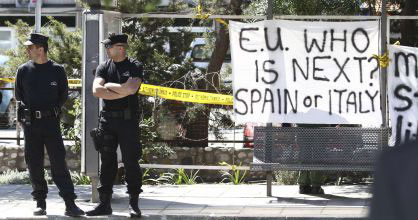
New York Times columnist Paul Krugman went the furthest, arguing that
It’s as if the Europeans are holding up a neon sign, written in Greek and Italian, saying “time to stage a run on your banks!”But for all these speculations, very few analysts have actually bothered to properly assess the mood and immediate reaction in Italy and Spain - whose depositors are meant to be lining up outside banks and cash machines to withdraw all their savings. Surely, the response and tone in the media of these countries on the day following the deal will give a pretty strong indicator as to whether Italian and Spanish depositors will perceive themselves as being 'next in line', or whether, in fact, they consider the Cypriot situation unique.
As Mats Persson argued on his Telegraph blog yesterday,
Fears of deposit-led contagion to other parts of the eurozone should definitely not be be overstated...viewed with a depositor's eyes from Barcelona or Bilbao, Spain may have very little in common with Cyprus.Of course, this is all very hard to predict and if talks about a bailout kicks of in Spain and Italy, will depositors trust what politicians are telling them? But what do governments and pundits actually say in these two countries? Put differently, what did Spanish and Italians depositors actually hear when they woke up to the news that their Cypriot counterparts will now see their savings taxed?
Here's a summary.
Italy
Italy has some relatively fresh memories of a deposit levy: the 0.6% prelievo forzoso from all Italian bank accounts enacted by the government led by Giuliano Amato in 1992, when Italian public finances were facing an "extraordinary emergency". So one would expect the Italian media - and Italians themselves - to make a pretty big deal of the Cypriot bailout.
Not quite. Although Italy's borrowing costs have inevitably been driven up a bit by the news coming from Cyprus, the media is surprisingly relaxed (and certainly no queues outside ATMs). Of the largest Italian papers, only La Repubblica and La Stampa made some room for Cyprus on the front page of today's print edition. Pope Francis and Italy's own political troubles continue to dominate. However, some Italian commentators did flag up the risks involved in the Cypriot bailout for the rest of the eurozone.
Vittorio Da Rold of Il Sole 24 Ore calls the Cypriot bailout "a dangerous precedent which undermines confidence" in the eurozone.
Italian economist Giulio Sapelli put it more bluntly,
Stuff like this can generate bank panic throughout the EU. [European leaders] are crazy.Ferruccio de Bortoli, editor of Il Corriere della Sera, has tweeted that Cyprus's deposit levy "risks creating uncertainty and fears".
Unsurprisingly, the authorities' reaction was targeted at being a lot more reassuring. Giuseppe Vegas, head of Italy's financial markets watchdog Consob, said,
There are no similarities between Cyprus and Italy...The markets are obviously nervous [over Cyprus], but I wouldn't dramatise.Spain
Several Spanish dailies ran with Cyprus as front page story today (see here). The most common reference in the Spanish press is to Argentina's corralito - when Argentinians' accounts were frozen to prevent a bank run in the country at the end of 2001.
As in Italy, there are no signs of Spanish depositors taking to the cash points - but the interest rate on Spain's ten-year bonds has reached above 5% this morning. As in Italy, authorities have moved quickly to reassure the citizens that there is no risk of contagion spreading to Spain.
There has been some concern over contagion in the press, though, with Carlos Segovia, Economics Editor of El Mundo, writing,
Analysts from around the world start to doubt that Cyprus’s precedent may one day end up being applicable to other Southern European countries, even partially.Under the headline, "We are a German colony", the paper's Washington correspondent Pablo Pardo goes all out,
The 'bailout' imposed by the EU [on Cyprus] is the closest thing to an armed robbery against that country's savers.Spanish economist José Carlos Díez is not happy either. He writes in El País,
The Cypriot bailout deal confirms that there are no signs of intelligent life in Europe.Spanish business daily El Economista is a bit more relaxed, saying in an editorial that a Cypriot-style corralito is "unthinkable" in bigger eurozone countries like Spain, Portugal or Italy. But the paper also notes,
A haircut should have been applied to bondholders before applying [the deposit levy], which now comes out as an inconsistent measure.So critical and concerned about precedent set, but no "panic spreads amongst savers" type headlines that we have seen in certain other countries. We certainly do not play down the precedent, or defend the deal, but one should not exaggerate either.
There's no way this [the deposit levy] will be repeated in Spain or Italy, so it's not clear when the great bank run is supposed to take place - not that bank runs are impossible by any stretch of the imagination in these economies, but a deposit tax or even the precedent set here is not likely to be the cause. That said, a real question remains over whether this will hamper future bailouts, future funding from the eurozone or even the fledgling moves towards greater eurozone integration. But that is a slightly different discussion.
How might a revised Cypriot bailout deal look?
Update 11:00 GMT 18/03/2013
Sources told Spanish news agency EFE that the Cypriot government and the Troika have agreed to cut the levy on depositors with less than €100,000 to 3% and and increased the levy on those with more than that to 12.5%, but we haven't seen this confirmed by anyone else so treat with care.
Update 09:15 GMT 18/03/2013:
The WSJ is reporting that Cyprus could seek a further division amongst uninsured depositors (which @MatinaStevis tweeted already yesterday). According to the paper, the Cypriot government is pushing for 3% on below €100,000, 10% on between €100,000 to €500,000 and 15% on €500,000+. There are no clear figures on how much each individual levy will raise, although Germany is said to be open to the idea as long as the total of €5.8bn remains.
The Cypriot parliament will vote on the deal at 2pm GMT, with eurozone finance ministers due to have a teleconference at some point later this afternoon.
Original post

Sources told Spanish news agency EFE that the Cypriot government and the Troika have agreed to cut the levy on depositors with less than €100,000 to 3% and and increased the levy on those with more than that to 12.5%, but we haven't seen this confirmed by anyone else so treat with care.
Update 09:15 GMT 18/03/2013:
The WSJ is reporting that Cyprus could seek a further division amongst uninsured depositors (which @MatinaStevis tweeted already yesterday). According to the paper, the Cypriot government is pushing for 3% on below €100,000, 10% on between €100,000 to €500,000 and 15% on €500,000+. There are no clear figures on how much each individual levy will raise, although Germany is said to be open to the idea as long as the total of €5.8bn remains.
The Cypriot parliament will vote on the deal at 2pm GMT, with eurozone finance ministers due to have a teleconference at some point later this afternoon.
Original post
As we reported yesterday, the Cypriot government is now scrambling
to renegotiate the deal which has created such an outcry in Cyprus. Germany and
the IMF will not budge on the headline figure or that the money must come from
a deposit levy (the only option to raise this sort of cash anyway), however,
they do not mind which depositors pay it or at what rates.
This has led to suggestions that the rates could be
adjusted to increase the cost on large uninsured depositors and reduce the
impact on smaller insured depositors – this would probably be both legally and
politically more acceptable.
So how could it be structured? Well, Cyprus has around
€30bn in insured deposits below €100,000 and €38bn of uninsured deposits above
€100,000. See table below for potential structures (click to enlarge):

Option 1 seems to be what is currently under discussion. Option
2 might be politically popular, although the impact on business and investment
could be significant. One thing that is clear, as we have repeated over the
weekend, is that this deal remains in flux.
Subscribe to:
Posts (Atom)