• Facebook
  • Facebook
  • Facebook
  • Facebook

Search This Blog

Visit our new website.
Showing posts with label Sweden. Show all posts

Wednesday, December 03, 2014

Upside down Europe

With politics heating up in the frigid Swedish winter we can’t help but get the sense that Europe is turning itself on its head a bit…

North becoming South?
  • We warned yesterday that the Swedish government was on the brink of collapse. So it has proved. The Swedish Prime Minister Stefan Löfven today announced snap elections for the 22 March 2015 after the Swedish Parliament refused to back the government’s budget and instead voted for the opposition’s budget. This was largely down to the Sweden Democrats who are playing king-makers in the current parliament. Such political turmoil is alien to the usually placid Swedish political scene and rings more of happenings in struggling Eurozone countries unable to agree on an austerity budget in the midst of a severe economic crisis.
  • Similarly, at the start of the year, the Danish coalition government was weakened by the departure of the Socialist People’s Party (SF) – which was not happy about the sale of part of state energy firm Dong to Goldman Sachs. However, the party said it would continue to support the government from the opposition benches. The move forced Prime Minister Helle Thorning-Schmidt into the seventh cabinet reshuffle since she took office in October 2011. The next general election is due in September 2015, and we wouldn’t be surprised to see the Danish People’s Party become the effective powerbroker – similar to the SD in Sweden – especially after they became the largest party at the European elections earlier this year.
  • We have also noted numerous times (see here and here) that the Finnish economy is struggling and posting some of the worst growth figures in the EU. While it is stabilising now it is finding it hard to source new drivers of economic growth following the decline of Nokia, the tech sector more broadly and the paper industry. The long term economic malaise is surprising in a country which continuously ranks high in measures of competitiveness (4th globally according to the World Economic Forum) and ease of doing business (9th globally according to the World Bank).
South becoming North?
  • In the third quarter of this year two of the strongest growing economies in the Eurozone were Spain and Greece. While countries such as Germany, the Netherlands and Belgium barely pulling themselves into positive growth territory the two periphery stalwarts posted some strong figures.
  • Throughout this year we’ve also seen numerous periphery countries getting close to record low borrowing costs, including Ireland, Italy, Spain and Portugal.
  • Discussion over the US-EU free trade deal TTIP have exposed some unusual fault lines. With countries such as Portugal and Italy pushing strongly for the deal to be struck and talking in very free trade terms, Germany and France have been raising concerns and taking a more protectionist stance.
Although thinking about it, we still have a looming economic and political crisis in Greece, economic malaise in Portugal and Italy and the rise of numerous populist parties. Maybe rather than the North and the South switching, the whole of Europe is just becoming more Southern…

Tuesday, December 02, 2014

Trouble in (the Guardian's) Paradise: anti-immigration party could bring Swedish government down

Jimmie Åkesson is off sick but his party could cause trouble 
UPDATE (16:30): Anti-immigration Sweden Democrats have just announced that they will vote against the government's draft budget for 2015 and support the opposition's budget instead.

As things stand (see our original blog post below), this means the Swedish government would fail to have its budget approved by parliament - and would therefore have to resign.

However, it is still possible for Swedish Prime Minister Löfven to buy himself some time and send the draft budget back to the Swedish parliament's Finance Committee - so they can work on a compromise proposal that can draw support from at least part of the opposition.

We will keep updating this blog post as news from Sweden comes in.
   
ORIGINAL BLOG POST (13:10):

As we’ve noted repeatedly, one of the main themes in European politics these days is vulnerable governments trying to fend off insurgents coming from either side of the political spectrum. Spain, Greece, France, Denmark, Italy, the UK and the Netherlands all suffer from it, albeit at different levels of intensity.

The latest victim: Sweden. The country’s anti-immigration party, the Sweden Democrats (Sverigedemokraterna, SD) has gone from 2.8% in the general election eight years ago to 12.9% in this year’s vote. It now holds the third most seats in the country’s Parliament, the Riksdag. As things stand, the centre-left coalition government - the Social Democrats and the Greens - holds 138 of 349 seats. They can draw support from another 21 Left MPs in parliamentary votes - which gives a total of 159 seats. The centre-right opposition (consisting of four parties) has 141 seats. This means that, even with the help of the Left party, the government can’t muster a majority. This leaves the SD - and its 49 MPs - as the undisputed kingmaker in Swedish politics.

This dynamic now risks bringing down the Swedish government in a rather spectacular fashion. Tomorrow, the Riksdag is due to vote on the new government’s proposed budget for 2015. As is the practice in Swedish politics, the opposition has tabled a counter-proposal (a 'shadow budget', if you like) which, were things to follow the tradition, it will vote for. Therefore, none of the blocks has an automatic majority - meaning that all eyes are on the SD.

The budget vote is a de facto vote of confidence. Prime Minister Stefan Löfven has made it clear that he will resign if he fails to get the government's budget through. The SD are currently weighing up their options. If they decide to back the opposition's budget, they will effectively be forcing the government out.

So what will happen? It’s hard to tell at the moment, but here are a few possible outcomes:

  • The SD decide to abstain, meaning that the government's budget will pass with a relative majority. 
  • The SD announce their intention to vote for the opposition's budget. The government postpones the vote and sends the draft budget back to the Swedish parliament's Finance Committee in a bid to come up with a new proposal that can draw support from the centre-right opposition.
  • The SD decide to vote for the opposition's budget but, in an unprecedented move, the opposition votes with the government and the government's budget goes through.  
  • The SD decide to vote for the opposition's budget and the opposition's budget goes through - leading to Prime Minister Löfven resigning after only two months in office and, potentially, to snap elections.

In other words, an almighty mess. Swedish politics have simultaneously become Italian (turbulence) and Dutch (fragmentation of the centre). Such dynamic was unthinkable only a few years ago.

Löfven’s greatest hope is that the SD blink. Bringing down a government and triggering a snap election is far from a risk-free strategy. In 2012, Geert Wilders and his Freedom Party withdrew support from the minority centre-right Dutch government in a budget vote. In the subsequent snap elections, Wilders got absolutely hammered and his party’s share of the vote was halved. He had over-reached and Dutch voters disapproved of what they saw as reckless behaviour.

Also, do the SD have the energy and financial power to fight another election? Quite literally: the party's leader, the scarily able Jimmie Åkesson (in the picture), has taken indefinite sick leave due to exhaustion. The SD would potentially have to fight a new election without its greatest asset.

As our Director Mats Persson argued in the Telegraph last week, it’s interesting to note the diametrically opposite approaches in the UK and Sweden in response to insurgent parties. In the former, it’s been a case of out-Ukipping UKIP - at least up until Cameron’s immigration speech last week, in which he drew a clear line in the sand. In the latter, it’s been a case of ignoring and seeking to humiliate SD - fuelled by a media seeing itself as the guardian of Swedish tolerance. Neither approach has worked.

This is part of a very complex discussion of course. But ahead of tomorrow’s vote, Swedish politicians and commentators would do well in thinking about how they reached a point where an anti-immigration party with neo-fascist roots became so powerful that it can take governments down?

At least Swedish politics is no longer un-exciting.

Wednesday, August 27, 2014

Sweden set for a lurch to the left - and further gains for anti-immigration party

The Swedish elections take place on 14 September. As polls stand, the sitting centre-right coalition government, "Alliansen" - the Moderates, Centre Party, People's Party and Christian Democrats - look set to lose to a leftist coalition of some sort. The big question might be who the Social Democrats - the biggest party in the polls - decide to rule with: the Green Party is the most likely partner, but the Left Party could be in the mix too.

There's even talk of the Social Democrats reaching across the aisle to form some sort of 'grand coalition' - which would break with tradition. It may not be that easy for the Social Democrats to agree economic policy with the Greens and Far Left, both of which are, well, pretty far to the left. In the latest Ipsos poll, the three left parties together muster 50.4%, whilst Alliansen is on only on 35.6%.

A poll of polls for daily Expressen has a slightly stronger showing for the centre-right but the broad picture remains the same: absent an upset, Sweden looks set for a centre-left government following eight years of centre-right rule.


At the same time, the anti-immigration Sweden Democrats have gained steadily in the polls, and it is now the fourth most popular party in the country on 10.3% (it made the Parliament for the first time in 2010, on 5.7%) according to the poll of polls - breathing down the neck of the Greens, on 10.8%. This despite Swedish media really having turned up the heat on the party over the last few years - often deserved but at times hysterically and counter-productively (the Swedish establishment hasn't quite yet grasped the 'metropolitan elite is ganging up on us' narrative that is doing so much for anti-establishment parties across Europe).

That's worrying news for those of us who want Sweden to remain a liberal and outward-looking country.

Monday, June 09, 2014

What happens when four EU leaders get into a rowing boat?

Swedish PM Fredrik Reinfeldt is today hosting David Cameron, Angela Merkel and Dutch PM Mark Rutte, in Harpsund, Sweden - a recreational estate for Swedish PMs throughout the years. The summit apparently features a trip on the "Harpsundsekan" - a worryingly small rowing boat. The tradition involves various world leaders holding on for life and limb in the boat, and was introduced by Tage Erlander, Swedish PM in the 1960s. Nikita Krushchev, Willy Brandt and Kofi Annan have all been in the boat.

Merkel has already had the dubious honour of going on a trip with Reinfeldt in 2008. It should be said that getting four people into any rowing boat is actually a bit of a mission. Given that Rutte is 6'4, Reinfeldt 6'2 and Cameron not a small guy either, this will require some focus.

So what will be discussed?

Well, the summit was decided ages ago and pre-dates the ongoing Juncker row. Initially, the idea was that the leaders of the EU's most competitive economies were going to meet in order to hammer out the priorities for the next European Commission in particular and the EU in general, with a focus on the jobs and growth agenda.

Reinfeldt has said that there won't be any "discussions about personalities" at the summit, but no one really believes that. It'll probably be a mixture of the two. If Cameron can get a better idea of whether Merkel can find a away out of the corner the SPD has pushed her into (a very rare occasion) over Juncker, as well as some reasonably concrete commitments on EU reform, linked to the mandate for the next Commission, he should be happy.

Is it wishful thinking to see this as the "EU reform quad"?  If they could speak with one voice, it would no doubt be a very powerful group which would be hard to ignore. Together with Finland, they are the only EU countries on the World Economic Forum's list of the top 10 most competitive countries in the world. They also account for 41% of the gross contributions to the EU budget (much more if we count net).

The four leaders formed a formidable alliance in February, achieving the first ever cut to the EU's long-term budget. Sweden's Reinfeldt has been very helpful to Cameron on numerous occasions, including shooting down a bunch of proposals for financial regulations. In those EU budget talks, Stockholm deliberately positioned itself further out than London so as not to isolate the Brits. Reinfeldt was also quite helpful after Cameron's "Bloomberg speech" (in contrast to the Swedish Foreign Minister, Carl Bildt). If Juncker is stopped, it'll be in no small part due to Reinfeldt's willingness to stick his head over the parapet, giving Cameron much needed political cover. However, Reinfeldt will probably lose the Swedish elections in September, meaning Cameron will have to negotiate with a centre-left coalition ahead of the potential 2017 referendum.

Likewise, Rutte was key in the EU budget talks and the Dutch have very much emerged as the thought leaders on EU reform, not least when it comes to the role of national parliaments in the EU. In fact, the Hague has been more vocal on many occasions than London itself. Encouragingly, EU reformers in the Netherlands did better than expected in the European elections in May.

As for Merkel - well, we've written endlessly on the need for Germany to row behind EU reform. As the debate over Juncker shows, the country is currently embroiled in a hugely complex debate about how Europe should be governed, and what role Germany should play within it. The Juncker episode was Cameron's first real encounter with Germany's grand coalition politics. It won't be easy.

What's clear is that if Cameron is to achieve the sweeping change needed for the UK to stay in the EU, these four countries will have to be able to agree a common position.

Tuesday, May 06, 2014

Swedish and Dutch patience running out over proposed FTT?

EU finance ministers met today, with the financial transaction tax (FTT) once again topping the agenda.

They were presented with a new proposal or brief under which the 11 countries pursuing the FTT under enhanced cooperation could move forward. The plan involved significantly amended terms and (again) suffered from a significant lack of detail:
  • The scope will be “limited” to “shares and some derivatives”, according to German Finance Minister Wolfgang Schäuble – suggesting bond markets and probably repo markets will be exempt. The level of the tax on shares could be cut from 0.1% to 0.01%.
  • This will form part of a “step by step approach”, suggesting the tax will be expanded in the future.
  • Non-participating countries will be fully informed on all future FTT discussions.
  • The FTT will not be introduced until January 2016.
  • It is unclear whether Slovenia will participate in the FTT anymore, given that it did not sign the recent statement on the issue due to domestic problems and uncertainty around its government.
  • Reuters reports that the revenue from the adjusted tax is expected to be about a tenth of the original forecasts – putting it at €3.5bn.
Those outside the proposed FTT zone showed quite significant hostility to the process of enhanced cooperation (as it has been conducted in this case) and continued to warn of legal action. UK Chancellor George Osborne said:
“The FTT that people have talked about is not a tax on bankers, it’s a tax on jobs, investment and people’s pensions.”

“Here we have a situation where 11 member states are working up their proposals largely in secret, I do not know how involved the Commission is in this or not. Then as we start our discussions here we get a piece of paper handed to us all by the 11 member states saying this is what we have agreed.”

“We will wait to see the final text of the proposal, but we will not hesitate to [legally] challenge an FTT which has extraterritorial impacts, that damages other member states, including the UK, or that damages the single market.”
Osborne was notably annoyed by the fact that the one page sheet on the new proposal was presented to the other EU ministers only five minutes before the meeting. His position was strongly backed by Swedish Finance Minister Anders Borg, who said:
“Even if this is a rather narrow proposal, there is a clear risk of a slippery slope toward a broader proposal with much more harmful effects on growth, and particularly on the capital markets.”

“The burden of proof is on the countries that want to enter the enhanced cooperation to prove, beyond a reasonable doubt, that those not participating are not harmed by this measure.”

“We did not support the U.K. when they started this legal case; we are much closer to doing that, because the process has not been satisfactory during these last few months…I’m very disappointed in the process.”
While even Eurogroup Chief and Dutch Finance Minister Jeroen Dijsselbloem warned:
“The impression I get is that, you [meaning the 11 FTT countries] have found a very, very small common ground, which is still very vague on the basis for the tax, when it will actually take place, on what products etc. but you have decided we must come out with something before the elections. That’s fine, but please also respect that we’d like to know a little more.”

“I don’t think that there is any basis at the moment for the Dutch government to consider joining, certainly not on what we have here… I’m a little disappointed in the way the process is going at the moment.”
All in all then, while there is talk of progress on the FTT, its scope has been slashed as expected, while the time line has been pushed into the long(er) grass. The process under enhanced cooperation has taken a public hammering, while it remains clear that those involved are struggling to find any clear agreement.

However, the fact that the Swedes and Dutch have expressed their anger so openly highlights that this will continue to be politically fraught. In addition, that the 11 countries seemingly want to reserve the right to expand the FTT in future, means this still has a way to run and future legal challenges are a genuine possibility.

Tuesday, April 08, 2014

ECJ sets important legal precedent by striking down Data Retention Directive

The European Court of Justice (ECJ) has this morning struck down the EU's Data Retention Directive by declaring it "invalid". The ECJ had been asked by the Irish High Court and the Austrian Constitutional Court to rule on whether the Directive complied with the EU's Charter of Fundamental Rights.

In one sentence, the Data Retention Directive requests telecommunication services providers and operators to store certain categories of information (date and length of phone calls, senders and recipients of e-mails, etc.), but not the content of conversations, for a minimum of six months to a maximum of two years. It was introduced in 2006 to help national authorities fight serious crime and terrorism.

Interestingly, the UK has 'gold-plated' the Directive by fixing the data retention period to twelve months. But other EU member states were less zealous. Last year, Sweden was issued with a €3 million fine from the ECJ itself for failing to transpose the Directive into national law in time. Germany has been taken to court by the European Commission for the same reason. 

According to today's ECJ ruling,
By requiring the retention of those data and by allowing the competent national authorities to access those data, the Directive interferes in a particularly serious manner with the fundamental rights to respect for private life and to the protection of personal data.
The statement goes on:
The retention of data required by the directive is not such as to adversely affect the essence of the fundamental rights to respect for private life and to the protection of personal data [...] However, the Court is of the opinion that, by adopting the Data Retention Directive, the EU legislature has exceeded the limits imposed by compliance with the principle of proportionality. 
One of the reasons cited by the ECJ is:
The Directive covers, in a generalised manner, all individuals, all means of electronic communication and all traffic data without any differentiation, limitation or exception being made in the light of the objective of fighting against serious crime.
Therefore, the real problem for the ECJ seems to be the violation of the proportionality principle. Or, put differently: the rationale behind the Directive is correct, but its scope is disproportionate. Now, we would argue, this is a problem affecting many other pieces of EU legislation (think, for instance, EU employment and health and safety rules) - which is what could make today's ruling an important precedent.

Wednesday, January 15, 2014

#EU reform: The status quo is not an option


Our ground-breaking EU reform conference is now imminent and, as widely trailed in today's media, UK Chancellor George Osborne will be giving the opening keynote speech.

You can join the conversation throughout the day on twitter, using the #EUreform hash tag, or follow @openeurope. Uniquely for this type of a conference, all sessions will be on the record. We call it "Open Europe rules" (as opposed to the more secretive Chatham House rules).

In a letter to today's Guardian, six leading MPs from across Europe, all attending the conference, argue:
Too often, the debate about "Europe" is based on emotional and ideological arguments, with all sides – from those who want more EU integration and those who want less – trading in hyperbole rather than engaging with substantive issues of policy. Of course we need to co-operate across borders in Europe. The question, as ever, is how. How do we square the need for cross-border action with democratic accountability? How do we live up to the promise to make decisions as close as possible to citizens? How do we make Europe really work for growth and jobs at a time when global competition is stiffening?  
Today, we are joining hundreds of parliamentarians and opinion-formers from across Europe at a unique conference in London organised by the thinktank Open Europe and the Fresh Start Project, dedicated to one question: how can we achieve EU reform? While our proposed solutions may differ, we agree on one thing: the status quo in Europe is not an option. If the EU is to thrive, it needs to embrace a series of bold reforms. Some of these will involve EU action, but where democratic and economic factors so dictate, this may also mean "less Europe". We want to replace the emotional point-scoring with a policy-based discussion about how to achieve a Europe that works better for both democracy and growth.
Gustav Blix Swedish MP (Moderate party); ranking member, committee on European Union affairs (Sweden)
Klaus Peter Willsch German MP (CDU); member, committee for economy and energy,
Germany; Deputy head of the committee on education, research and technology (Germany)
Angieszka Pomaska Polish MP (Civic Platform); Chair of the EU affairs committee in the Polish parliament (Poland)
Eva Kjer Hansen Chair of the European affairs committee (Liberal party), Danish parliament (Denmark) Andrea Leadsom MP for South Northamptonshire (Con); co-founder, Fresh Start Project; member of No 10 policy board (UK)
Dr Reinhold Lopatka Spokesperson for foreign and European affairs, Austrian People's party (OeVP); former secretary of state for European and international affairs (Austria)

Wednesday, November 13, 2013

German business magazine welcomes OE initiative: “Finally - protests from business!”

Leading German journalist and author Bettina Röhl has written a long op-ed for Germany's leading financial magazine Wirtschafts Woche, welcoming the new Open Europe initiative that sees businesspeople across Sweden, Britain and Germany unite for the first time to call for bold EU reform.

In her piece entitled, Finally - protests from business! Röhl commends business leaders for addressing "the blind alley the EU is in.”:
"Now business leaders have spoken up -- some of them for the first time. This is not only good, but it is long overdue. All too often, business leaders find it too difficult to become involved in the political debate....It is not that initiatives were surprising in their substance, and neither are they new. But what is new, is that business itself is speaking. It is formulating its own needs, which are also the needs of the economy of a whole.”
Röhl concludes:
"Anyone who wants to rob Europe of its diversity and drown it in Brussels fatuity, and all of this under the roof of a single currency, has failed splendidly in their rigidity. By throwing their gaze inwards rather than towards to world markets, they either do not care about European competitiveness, or, they have not understood the global economy."
So, we've mostly had positive responses across the board to our joint-initiative - with the odd exception. A leader in the Swedish regional paper Göteborgs-Posten, for example, thinks it has cleverly spotted two “contradictions” in the article signed by some of Sweden's top business people in Dagens Industri.

Firstly, the leader argues that it is inconsistent to call (as we do), for less EU regulation and more services liberalisation – because the latter would require “common rules.” That argument doesn't cut the mustard, we're afraid.

As we’ve pointed out many times before, it's of course fully possible to be in favour of “more Europe” in areas like services liberalisation, and less EU regulation in other fields where it makes less sense for Brussels to be involved. Or is the paper really suggesting that the EU regulatory framework is pareto optimal at the moment and that there's no room for a reform package whose net effect is less but better EU regulation? To bring it closer to home, it's fully consistent to support an ambitious services directive while opposing, say, heavy-handed EU regulation on snus (a variant of dry sniff which is close to religion in Sweden - but a sales ban exists in the rest of the EU).  Also, in theory, under our preferred option – mutual recognition or a “passport” – you wouldn’t actually need more EU harmonisation, but let’s not split hairs. (Suggested reading: Open Europe: Services report, Open Europe blog: Services liberalisation ).

Secondly, the Göteborgs-Posten's leader claims that to in order to "give citizens a stronger say over EU, more EU decisions needs to be made by directly election institutions – like the EU Parliament. Which in turn means more supra-nationalism [or federalism]”.

Yes, that’s the purist, federalist version of how to close the EU's democratic deficit - transfer ultimate democratic accountability to the EP. However, where the leader finds its “contradiction” in the business article is hard to see. This federalist theory is a perfectly respectable one but it reached its prime about a decade ago. To some, the EP might still be part of the answer, but the debate has now self-evidently moved on to other ways in which to strengthen democratic legitimacy, including boosting the roles of national parliaments (where the Dutch – not the British – are leading the way). Göteborgs-Posten is about ten years late to this debate.

Nice try though.

Bottom line: In order for the EU to truly compete in the global economy, it needs to reform. It needs to be more flexible.  It needs fewer rules with a sharper focus. It needs to give  entrepreneurs the space to do what they do best: generate wealth and opportunity. With the right reforms, Europe totally has the potential to rise to the challenges of the 21st century.
 
To find out more about our initiative to ensure that Europe makes the reforms it needs order to be able to compete in the 21st century, click here.

Monday, November 11, 2013

Business leaders and entrepreneurs across Northern Europe add weight to EU reform agenda

When a group of business people who, amongst them, have helped to lead companies that employ around one million people, say something, it's a good idea to listen.

In an unprecedented joint initiative, leading business men and women from across Northern Europe used a letter to the Sunday Times and op-ed articles published in today's Frankfurter Allgemeine Zeitung and Dagens Industri to call on EU leaders to grasp the nettle and embrace reform.

The list of signatories, who have all signed in a personal capacity, includes household names and is particularly significant because many have not spoken out on the issue of 'Europe' before. They include Karl-Johan Persson, the CEO of Swedish retail giant H&M, Dr. h.c. August Oetker, Chairman of renowned German food producer, Dr. Oetker, Douglas Flint CBE, Group Chairman of HSBC Holdings, Joanna Shields, Chief Executive of Tech City, and Sir John Peace, Chairman of Standard Chartered Bank.

The business leaders and entrepreneurs who have signed up to this initiative come from businesses in different sectors of the economy and, uniquely, this initiative, coordinated by Open Europe, cuts across borders.

As you can see below, this has already caused quite a splash in Sweden, with the front page of the financial daily Dagens Industri carrying the headline "Come on, EU!":


In Germany, six business men and women including Dr h.c. August Oetker, Chairman of the Oetker Group – one of Europe’s largest family-owned businesses – and Marie-Christine Ostermann, former head of the German Association of Young Entrepreneurs, wrote an article arguing that, "The EU does not have to move towards 'ever closer union,' but needs to become ever more open and flexible":


In a letter to the Sunday Times, 52 British executives and entrepreneurs demand a “bold reform agenda” focused on trade and transparency:


This joint initiative shows that there is a market across much of Europe for an EU reform agenda centred on making the EU more business-friendly, internationally competitive and democratically accountable. However, the only way to do that is to make the arguments heard across Europe and put so much pressure on politicians that it cannot be ignored.

This is the first step in pushing a robust reform agenda ahead of the European elections next year and beyond, and we will be encouraging plenty more entrepreneurs across Europe to sign up to this initiative. So watch this space!

Monday, November 04, 2013

9%, 43%, 50%, 60%, 84%: How many domestic laws are linked to EU law? The case of Sweden

It's up there with the origins of the universe as one of the great existential questions of our time (well...): how many national laws stem from Brussels?

European Commissioner Viviane Reding - who does what she can to turn people against the EU - recently told a "Debating Europe" event in Sweden (H/T @AllieRenison):
Did you know that 80% of Swedish laws are not Swedish laws? They are European laws that have been translated into Swedish legislation.
In addition to the comment being ridiculous (it was in reply to a question about the EU costing too much)  she seems to have plucked this number out of thin air. Incidentally, it would top Nigel Farage's much-criticised claim that 75% of all UK laws are made in Brussels. Another example of Better Off Outers and Europhiles agreeing.

As regular readers will know, the Open Europe team has gone to hell and back trying to answer this question, and our conclusion is that it's virtually impossible to determine with any degree of certainty what the share of EU-derived laws is. It all depends on what you count, how you define an EU-derived law and what the counter-factual is.

It most certainly is higher than 9% as some claim. Counting UK Statutory Instruments, which is what the study from which this number is drawn from did, isn't that meaningful as there's no 1-1 correlation between that and EU law. It also doesn't include EU Regulations which, unlike Directives, are directly applicable, giving no rise to separate domestic legislation.

The 84% figure that is often cited originates from an answer to a German parliamentary question, comparing the number of new federal laws and new EU laws in one year. However, this is also too simplistic. For example, counting only federal laws in a federal system isn't particularly meaningful. Germany has 16 Länder that churn out laws as well.

Now, a new Swedish study has thrown in another number to debate. The Riksdag and Departement - the Swedish Parliament's in-house magazine - has reviewed 1,300 Swedish legislative proposals, dating back to 2005. It found that the share of legislative proposals in 2012 originating in the EU stands at 43% - a dramatic increase compared to 2010 when the share was 28%. Of the 104 laws that so far have been proposed by the Riksdag this year, about a third originate in the EU.

This is a quick and dirty study in many ways - it measures only the so-called flow of EU legislation, not its stock. And the flow clearly is subject to a lot of variation. Its proposals and not laws passed. And, as with the German study, it doesn't look at local rules. Local government is important in the Swedish system, with Councils (or municipalities) having plenty of decision-making power. So any serious "EU law count" would have to look at this dimension as well.

But, we're not done yet. A 2010 report by the Swedish Association of Local Authorities and Regions - who should know a thing or two about local decision-making - does address this very question. It says this:
The report shows that, on average, the EU affects 60 percent of items on municipal council agendas. The number is slightly lower for county councils and regions, where the EU influences around 50 percent of agenda items. 
Given that these are local decisions, it does sound high to us, but remember the report doesn't count laws per se, but issues considered by the local government in Sweden (public procurement considerations for example will always be influenced by EU law, despite it not necessarily giving rise to new local rules).

A few conclusions:
  • Viviane Reding really must be on the UKIP payroll 
  • It remains incredibly difficult to nail down exactly how many laws originate in the EU
  • The share of EU laws is best measured in terms of domestic legislation "influenced by" or "linked to" EU decisions, ideally in combination with the measurable impact of these laws (our preferred way) to get a sense of the relative impact
  • Any EU law count must also look at the local or regional level.
  • Still, a h*** of a lot of domestic laws stem from the EU 

Monday, September 16, 2013

Ten years on, what Britain can learn from the Swedish euro referendum

Last Saturday was the tenth anniversary of the Swedish referendum on the euro, and our Director, Mats Persson, wrote this piece for the Guardian's Comment is Free:
"The best argument against democracy is a five-minute conversation with the average voter," Winston Churchill famously said. He could have added that the best argument against elite rule is a five-minute conversation with your average politician.
I used to be sceptical of referendums. They are populist instruments, I thought. Voters never vote on the actual issue. And what do voters know anyway? Then the euro happened. 
Saturday is the 10-year anniversary of the Swedish public voting no to joining the euro in a high-profile referendum, 56% to 42%. The Swedish elite was in shock. All the major parties, the national newspapers, the business organisations, including the Swedish CBI, and most of Stockholm's chattering classes favoured ditching the krona. According to some estimates, the yes campaign outspent the no campaign 10 to one. There were a lot of clever and genuine people on the yes side, making valid arguments such as eliminating exchange risk for business and replacing the flaky devaluation policies of the past.
However, it was obvious that something wasn't quite right. Yes, perhaps Sweden could benefit from sharing a currency with Germany, the destination of many of its exports. But the euro wasn't about liberal economics: stretching from the Arctic circle to Sicily, it locked vastly different countries, cultures and economic structures, into one monetary system, under a single interest rate – forever binding together the problems of all its members, large or small. It was a system based on the hopelessly flawed assumption that politicians and central bankers would make the right decisions all the time.

As with all referendums, there were various reasons why the Swedish public voted no, including an inherent bias in favour of the status quo. Fundamentally, though, most Swedes' gut instinct – bondförnuft as the Swedes say (literally "farmer's common sense") – told them that a serial defaulter with dubious finances, Greece, and a heavily industrialised exporter with an obsession with sound money, Germany, simply couldn't share the same currency. Swedes treated the exam question with the same kind of book-keepers' approach by which many of them run their own household economies. Whatever the experts told them, the arguments – and the numbers – simply didn't add up.

Ten years on, Europe is shrouded in uncertainty, but one thing is clear: the Swedish public got it right, the elite got it wrong. Though there may have been some politicians in Sweden and elsewhere who saw the single currency as the ultimate way to set the snowball rolling towards an EU superstate, the euro was far more a case of cock-up than conspiracy. Today, 80-90% of Swedes oppose the euro, and the political and business elites are wary too – save the odd isolated politician doing an impression of the Japanese soldiers found in the 1960s refusing to believe the second world war had ended.

However, referendums are by no means a magical potion. It's clear that there are cases where they're hijacked or misused – and where they lead to outcomes that no one intended or that settle nothing. Sweden itself has some less successful experiences with public votes. In 1980, a three-way referendum on whether to ditch nuclear power – arguably a populist kneejerk response to the Harrisburg disaster – generated a vote in favour of a vague plan to incrementally dismantle all nuclear plants. The result was totally inconclusive, leaving half the country embittered on the issue (Sweden still has nuclear power today).

Incidentally, there's a lesson for David Cameron here. He has promised to negotiate a new settlement in the EU and put that to an in/out referendum by 2017. If that indeed happens, the worst possible outcome is a 49-51% type result, too close to call in either direction. As in Sweden in 1980, much of the population would feel disenfranchised and the EU debate will continue just as before. This isn't in either the UK's or Europe's interest.

To avoid this scenario, there needs to be substantial and systemic changes, ideally rooted in EU-wide solutions so that they last (unilateral opt-outs tend to be eroded). That would allow a decisive vote in favour of the UK staying in a heavily reformed, slimmed-down EU.

One can have different views on Cameron's strategy, but given public and political discontent about the EU status quo, sooner or later there will probably have to be a referendum to settle the Europe question in this country. And as the Swedish euro vote shows – warts and all, the public can opt for perfectly rational and responsible outcomes that would not occur if politicians were left to their own devices.

Friday, February 08, 2013

EU budget talks: The dust has settled - and they all won!

We've been listening to the national press briefings of several EU leaders following the deal on the EU budget (which we analyse here). And you got it - they all won! (well, almost). Here goes:

David Cameron (UK)

  • The British Prime Minister said, "I think the British public can be proud that we have cut the seven-year credit card limit for the European Union for the first time ever." 
  • He went on, "The only way you can best protect the British taxpayer is to keep overall spending down, and that’s what we’ve done, and also to keep what remains of the rebate, and it is completely untouched." 
  • On the possibility of MEPs staging a secret ballot vote on the next long-term EU budget, Cameron said, "Of course the European Parliament has a role, and we should respect that. But I don't really understand secret ballots. Parliaments and votes should be open, should be transparent, people should be accountable for how they cast their votes."
Angela Merkel (Germany)
  • As usual, the German Chancellor - the power-broker - did not give away too much during her presser. She said, "The effort was worth it…in my view this agreement is good and important." 
  • She also warned that "the negotiations with the European Parliament won't be easy".
François Hollande (France)
  • The French President, a bit sulky, said this was "the best deal" on offer given the circumstances.
  • He repeatedly stressed that the UK wanted payment appropriations to be lower than €900bn over seven years, while France was insisting on €913bn (see here if you are not familiar with the commitments vs payments distinction). According to Hollande, given that the final compromise was reached at €908.4bn, "Everyone will say who made the bigger step" - a way to suggest that David Cameron had given up more than he did.
  • According to Hollande, France will also save some €140m a year on its financing of the various rebates. On the rebates, the French President made his most interesting remark (see here, around 16:00 in). He said, "I knew that there was no possibility to put into question the British rebate, because you know that it is provided for by the [EU] Treaties [which, by the way, is incorrect]. Therefore, it is immutable" at least until the Treaties are re-opened for negotiations. The British, he added, "should keep this in mind, including when they demand treaty changes." If this is not a threat, then what is?  
  • He said that funding for agriculture has gone down overall, but he has made sure that aid to French farmers will remain at the same levels as in 2007-2013. Now, that's what you call 'solidarité', right?
  • Finally, the French President admitted that the UK was not on its own in these negotiations, as "other countries wanted more for themselves and less for Europe".  
Mario Monti (Italy)
  • The (caretaker) Italian Prime Minister hailed a "particularly significant improvement" in Italy's net position compared to other big net contributors to the EU budget.
  • He said Italy has secured an extra €3.5bn in funding compared to the compromise proposal on the table at the November summit.
  • Furthermore, Italy will save around €600m a year on its financing of the various rebates.
Mariano Rajoy (Spain)
  • The Spanish Prime Minister said the deal is "very good for Spain". Contrary to expectations, Spain will remain a net recipient from the EU budget over 2014-2020 - which is huge. 
  • Rajoy was particularly pleased by the fact that Spain "will get almost 30%" of the new fund for youth unemployment included in the next long-term EU budget. 
Mark Rutte (Netherlands)
  • The Dutch Prime Minister opted for a lower profile. He said, "Of course you never completely get it your way with 27 member states, but I think that we as the Netherlands can be satisfied." 
  • He described the deal as a "sober" budget, and said that the Netherlands "worked well together" with Sweden, Germany, Denmark, and the UK.  
Helle Thorning-Schmidt (Denmark)
  • The Danish Prime Minister said her country "came here with three priorities, and we satisfied all of them", pointing out that she had secured an annual rebate of €130m.
Fredrik Reinfeldt (Sweden)
  • The Swedish Prime Minister said the deal was "a surprisingly good result".
  • He argued that, contrary to fears that Sweden's contribution to the EU budget would increase, it is, in fact, set to drop slightly.
Donald Tusk (Poland)
  • The Polish Prime Minister spoke of "a huge success" for his country, stressing that Poland's receipts will increase by €4bn despite the long-term EU budget facing a €38bn cut from the previous seven-year period.
  • He went even further, claiming today was "one of the happiest days of my life". Wow!
Werner Faymann (Austria)
  • The Austrian Chancellor was less enthusiastic than many of his counterparts. He said the deal struck this afternoon is "presentable" for Austria - which managed to secure a rebate, although it will be phased out by 2016 (see the final deal here).
Petr Necas (Czech Republic)
  • The Czech Prime Minister was pleased about his choice to threaten a veto. He said, "If the Czech Republic had not seriously threatened to block the negotiations, then it would not have been possible to negotiate a better outcome."

Friday, September 21, 2012

The view from Sweden: Barroso is making it more difficult to be pro-EU

This is spot-on.

Sara Skyttedal, vice-president of the Youth wing of the European People’s Party – the pan-EU party Commission President Jose Manuel Barroso belongs to – has a blistering piece  in today's Svenska Dagbladet. She takes Barroso to town over his 'State of the Union' address, in which he called for Europe to become a "federation":
"As Vice-Chairman of [the EPP's] youth wing, YEPP, I can only say that representatives such as Barroso make it more difficult to be pro-EU [EU-vän] “
She continues:
"At a time when crises are raging across Europe and when countries need a helping hand, the eurocrats see an opportunity to demand extensive transfers of power and centralisation in return. Barroso suggests the creation of a banking union and argues that the EU in the end must become a federation. This is a frightening development, since even though Barroso himself says that a superstate isn’t the end goal, it is it hard to interpret his vision in any other way.”
She argues that politicians have ”time and again” ignored the subsidiarity principle. Taking aim at the Swedish political class, Skyttedal says:

“Just as there are many signs that the EU makes it harder for member states to fight the centralisation of powers, Sweden has reinforced this tendency on its own”, arguing that the requirement for EU-membership should be deleted from the Swedish Constitution.
“Those of us who are active in the EPP…must take a bigger responsibility for the liberal-conservative family in Europe. In these circles we must dare to bring up the problems that exist. Large parts of our respective parties were once active in the Yes-campaigns, both for EU and euro membership, but it’s time to swallow our pride and take up the fight against supranationalism and to show it’s possible to have a realistic attitude to the EU, which doesn't automatically mean arguing in favour of leaving the project altogether."
“The EPP-family is the biggest one in Europe, but includes members that unfortunately work in the opposite direction to the EU that we rather want to see. What we think the EU needs is less supranationalism, less political interference and definitely not a federation.”
Hear hear.

Sweden isn't exactly a European hegemon (those ambitions pretty much died in 1709) but it's an interesting country for the UK and Europe in at least two respects: first, it's actually doing well, both on the fiscal and banking front. Secondly, how the country responds to the drive for further euro integration will be an interesting proxy for how easy it'll be to reconcile a more tightly knit eurozone block with the EU-27. Most importantly, the banking union with the single market.

70-80% of Swedes oppose joining the euro, and that debate is dead (baring random calls from the occasional politician and opinion former who still cling on to that particular dream - it's almost cute), but the country has fundamental choices ahead of it - such as whether or not it joins the the ECB's banking supervision structure - so Europe needs to be discussed. 

Though a majority of Swedes would echo the sentiment contained in Skyttedal's article, there is still a contingent in Sweden, particularly on the centre-right (associated with Carl Bildt, the Swedish Foreign Minister) that clings on to a vision of an ever-closer integrated EU as a liberal inroads into its dominant domestic social democratic model, and also as a catalyst for Swedish internationalist idealism, i.e. a 'peace project'.

Historically, both of these assumptions contained some truth but firstly, Sweden's social democratic domination has already been broken and secondly, the single currency - clearly - has proven less of a liberal trade project and more an ideological over-reach (think Greece). The eurozone crisis is now causing friction in Europe, rather than the opposite, and it most certainly isn't aiding either Europe in the world or facilitating enlargement (which is a legitimate EU foreign policy tool).

In other words, this traditional Swedish centre-right vision is dated and needs upgrading - which is true for other contingents in the EPP. Skyttedal's article is an important reminder that if we want to save what's good in Europe, Barroso's "federation" vision - which risks a massive popular backlash - is the opposite of what's needed.

The path for true pro-Europeans must lay elsewhere.

Tuesday, June 12, 2012

An EU banking union within a year? Don't think so.

In an interview in today's FT, Commission President Jose Manuel Barroso is raising the stakes in the talks on a 'banking union' in the EU and/or eurozone, involving an EU-wide deposit guarantee scheme, a rescue fund paid for by financial institutions and giving an EU-wide supervisors the power to order losses on banks, without the approval of national authorities. The Commission, keen to get back in the game following the shift in focus to national capitals in the wake of the crisis, says it'll present a proposal for a banking union at the EU summit at the end of June.

According to the FT, Barroso said all of this could be achieved within the next year and didn't necessarily require an EU Treaty change. He said, "there is now a much clearer awareness" in national capitals, including Berlin and London, that Europe needed to press ahead with more integration "especially in the euro area."

Barroso noted,
“We have a chancellor of Germany that is indeed proposing a political union for Europe, which is extremely ambitious. We have a French president that has been highlighting the need for a more European approach regarding crucial issues like growth and investment. And we have a British government – and this is indeed a very interesting development – that while stating its willingness to stay out of the euro, assumes as indispensable and desirable to further integration in the eurozone.” 
Good marks for optimism. In reality, though, there's no way a banking union will be up and running within a year. Even if he was hinting at an agreement in 2013, that too is optimistic - at least on the chunkier stuff. A number of member states still have huge reservations. The UK won't be part of a banking union regardless, and anything requiring unanimity and/or Treaty change may be used by Britain to re-heat demands for safeguards over UK financial services, which Osborne has already floated. Other non-euro members also have reservations, with the Swedes opposing a banking union based on cross-border liabilities on a point of principle and the fear of moral hazard (unlike the Treasury, which seems happy for the eurozone to do this as long as the UK is not on the hook).

Merkel will face resistance from various corners: the Bundesbank, the legal class (hello Treaty change), its financial supervisors BAFIN, the media and a host of backbench MPs. This will have to go through the German Parliament, which per definition takes time. And as for the French, we're not entirely sure that Hollande quite has his head around what a banking union would involve - and that France's position is somewhat fluid at the moment.

And remember, a proposal by the Commission for limited cross-border bank deposit guarantees has been stuck in the Brussels machinery for two years, at the hands of resistance in member states.

This will be a drawn-out one.


Tuesday, April 10, 2012

The folly of EU structural funds illustrated


Here are a couple of illustrative examples of why the EU's structural funds so badly and desperately need reform. The list seemingly never runs dry.

First, the Sunday Telegraph had a feature on Madeira’s economy, claiming that grants from the EU structural funds – which require match funding from local governments or business – have contributed to the local Madeiran administration now owing over €6 billion, nearly double the per capita public debt of mainland Portugal. Much of the EU cash has been spent on infrastructure (not least via the Cohesion Fund, which is earmarked for that purpose) for which there is no demand. As German Chancellor Angela Merkel put it, "There are many beautiful tunnels and highways [in Madeira]. But this did not contribute to competitiveness."

Meanwhile, the European Commission and Swedish local authorities have earmarked nearly £10m to subsidise Facebook – a company currently valued at around $100bn (£63bn) – under plans to build giant server halls in Lulea in Northern Sweden. You'd be aware that Sweden is one of the richest countries in Europe.

Now, the European Commission always has two standard responses to examples like these:
  • They've been taken out of context - and then gives a series of stats of how many jobs and how much growth the structural funds allegedly have created.
  • It's up to the local authorities in member states to select the projects anyway, the Commission merely facilitates the cash.

But these examples are very much symptomatic of the wider problems and flaws inherent in the structural funds (SF). As we set out in our recent report on the topic:

1) Conflicting aims: are the structural funds meant to be channelled to areas where the absolute return of capital is the greatest or where they can foster the greatest convergence between poorer and richer regions (a key stated aim of the funds)? The €10mn in EU funds earmarked for Facebook - a thriving company - surely could have come from private capital. It's probably a decent investment. So in fact, the €10mn could have served to ‘crowd out’ private investment that otherwise could have take place in Lulea, while channelling funds away from poorer regions where they can have the most comparative impact. The result is the opposite of convergence.

2) Opportunity costs: Related to this, both the Facebook and the Madeira examples illustrate the huge opportunity costs that the SF involve - spending diverted from other, more
comparatively productive economic opportunities. In the Facebook case, the funds duplicate economic activities in relatively wealthy states that would have taken place anyway, and in the Madeira case, they're spent on outright damaging projects (i.e. needless infrastructure projects that run up debt).

3) Pro-cyclical and unresponsive to changing needs: The Madeira case shows that the SF tend to be pro-cyclical as they can be sucked into areas of the economy where unsustainable growth or serious leveraging is taking place, with few ways of making adjustments (this was also the case in Spain for example). Remember, the funds are negotiated on a seven year basis, and come with fixed spending criteria (with some discretion to alter spending on a yearly basis). Co-financing also makes the funds pro-cyclical. Not wanting to forgo the potential opportunities presented by taking up structural funding, governments and local authorities feel obliged to spend the money on co-financing, even if this means running up massive debts. Again, hello Madeira.

4) No link between performance and spending: the absence of strong conditionality
and performance criteria in the allocation of funds meant that Madeira continued to receive funding despite the absence of results from the billions in funding that it has received. This also means that the focus is on getting money out of the door rather than spending the cash wisely.

And this is even before we get into the irrational distribution patterns of the funds, the added administrative costs, the absence of absorption criteria, the problem with accountability (falling in between member states and the Commission) and the fact that the Commission's models for evaluating the funds are hopelessly inadequate.

Do read our report for the full picture.

This policy simply has to undergo root-and-branch reform, starting by limiting funding to the poorest countries only, where it can have the greatest comparative impact.

Friday, February 17, 2012

Seven reasons for optimism?


Swedish Finance Minister Anders Borg – top of the pile in Europe according to the FT – today gave the EU committee of the Swedish Riksdag the lowdown ahead of Monday’s meeting of EU finance ministers (in some countries, lo and behold, ministers are actually accountable to their parliaments for what they say and do at EU summits). Amid all the gloom and doom, Borg outlined seven reasons to now be more optimistic about the state of the European economy:

1. The risk posed by Greece to European banks has been substantially reduced

2. The ECB has taken strong actions

3. The talks with private creditors over a Greek debt write-down are about to be concluded

4. The Italian government is pushing ahead with reforms

5. The Spanish government is pushing ahead with reforms

6. A solid recovery in the US

7. The Chinese government believes that its growth will remain relatively strong in 2012

Enough to believe that the worst is behind us? You decide.

Ps. For some Friday 'entertainment', you may wish to check this out - a rather odd sample of Swedish humour....

Tuesday, February 07, 2012

Shooting yourself in the foot

At risk of sleep walking into a proposal for an EU financial transaction tax, the UK Treasury is now receiving some well-needed, and wholly unintentional, diplomatic help from Algirdas Šemeta, the European Commissioner for Taxation.

Mr. Šemeta took to the European comment pages over the weekend, trying to convince those countries that remain opposed to the FTT to come to their senses – literally. Calling for a debate based on “common sense and facts”, he claimed that the evidence in the Commission’s own impact assessment had been mis-used by those who oppose an FTT. A spokesperson for Mr. Šemeta said they now intend to “fine-tune the economic analysis”, presumably to put an end to the outrageous practice of using the Commission’s own economic evidence as evidence when considering the desirability of a proposal.

In any case, amongst other countries, Mr. Šemeta seems to have targeted Sweden – a country which actually had a go at implementing a financial transaction tax in the late eighties (with pretty disastrous consequences). In an article in yesterday’s Svenska Dagbladet, he argued, “The Commission understands the Swedish hesitation, given the experiences the Swedes have had with an FTT. But we want to ensure that the Swedish experiences have been taken into account when we formulated the proposal.”

This didn't quite have the desired effect.

A leader in today's Swedish daily Sydsvenska Dagbladet – hardly a eurosceptic publication – carried the headline ”The Commission is too cocky”. Here goes:

"Šemeta starts by requesting a debate based on ‘common sense and fact’. Then he discards those who have questioned the proposed transaction tax, saying that ‘they either haven’t read the Commission’s proposal or haven’t understood it'. The Swedish National Debt Office, which in its opinion for the [Swedish] Finance Department labelled the proposal 'exceptionally poorly thought through'?…Finance Minister Anders Borg has read but not understood – or perhaps not even read? [He doesn’t] get the facts? Or lacks common sense?”

It goes on,

“One rationale [behind the tax] which the Commission has referred to, is that there are currently around ten countries that have some sort of tax on financial transactions. This is not good, thinks the Commission, as it distorts the competition on the internal market. But why wouldn’t the tax proposed by the Commission have similar distorting effects, albeit on a different level? There is high probability that businesses will move to different countries.”
The paper then gives it both barrels,
"Šemetas intervention shows that the EU-commission has a serious communications problem which seems to stem from an even more serious attitude problem. A slightly more humble approach wouldn’t hurt from an institution that lacks a popular mandate. In particular considering the tricky situation that the EU is currently in, or rather, has put itself in.”
Similarly, Karl Sigfrid, Swedish MP for the governing party Moderaterna, takes Šemetas to task in a reply in Svenska Dagbladet,
"Šemeta wants to kill off three alleged myths, the first being that a financial transaction tax would give us fewer jobs and lower growth. The interesting thing about this myth is that it’s from the EU Commission’s own analysis, which says that the reduced productivity resulting from the EU-tax is just as large as the income generated from the tax, and probably even greater.”
Sigfrid concludes,

“The article by the Tax Commissioner hints that if we only get an EU tax, indebted countries will not need to consolidate their budgets to any greater extent. Instead of trying to sell us miracle cures, it would be better if the Commission emphasised the importance of work and responsibility.”

Note to George Osborne: put Šemeta on your Christmas card list.


Tuesday, January 24, 2012

Harsh


Swedish Finance Minister Anders Borg - whose country is currently grappling with whether to sign up to the euro fiscal pact - is not impressed by Greece's implementation of its EU-led austerity programme.

This is what he reportendly told journalists in Brussels this morning:
“There are pretty obvious things that haven’t been achieved on the structural side and in terms of public finances. This is probably one of the worst programmes we’ve ever seen. There has to be a radical improvements in the implementation before there can be a discussion about additional programmes.”
Harsh.

Monday, August 22, 2011

Joining the Euro? Not in my lifetime

Last week we asked in passing when Swedish PM Frederik Reinfeldt would drop his support for Sweden joining the euro. Well, it turns out that he may not have to, as the main opposition party - the Social Democrats - have made that decision for him. Tommy Waidelich, formerly a pro-euro advocate in the 2003 referendum and current economic spokesperson for the Swedish Social Democrats, has made Swedish euro membership a distant dream (or nightmare).

In an interview with Europaportalen he clarifies his new position and that of his party, whose official line in the 2003 vote was also Yes to the euro. Waidelich says:
"[Swedish euro membership] is not on the agenda for the foreseeable future – during my lifetime, as long as I make the decisions."
Not in his lifetime? This is a clear shift, which probably means that the prospect of Sweden joining the euro has gone from lukewarm, to cold, to completely dead in the water. Swedish Finance Minister Anders Borg hasn't exactly been enthusiastic about euro membership either of late. In a recent interview, he said,
"In this type of crisis it is an advantage that the exchange rate and the krona can absorb part of the blow. This will help both the forestry industry and other sectors of the economy, as well as the job situation. It is clear that this is a big blow to the confidence of euro cooperation. I would still vote yes, but during the current circumstances it is an advantage for Sweden to be outside the euro.”
More widely, the development signals a triumph for the common sense of the Swedish people over the short-sightedness of the country's political elite on this particular issue (though there were several notable exceptions, and the centre-right govenrment in Sweden is generally very sensible on economic matters). In the 2003 referendum campaign, all the main parties apart from the tiny Greens and Left party, were in favour of Sweden joining, yet in the referendum, 55.9% of the electorate voted against, vs. 42% in favour. There were, of course, the usual scare stories about how Sweden would be sent back to the stone age and left isolated if it did not join (mixed with some more rational arguments relating to the removal of exchange rate risk for example - which are still valid). But the public's common sense - bondförnuftet - won the day.

With a 4.5% growth rate and lower borrowing costs than Germany, very few Swedes seem to have regrets - apart from a handful of politicians, and provincial leader writers for papers such as Göteborgs-Posten and Dagens Nyheter (the Japanese holdouts after World War II spring to mind- the soldiers, if you recall, who were found on various remote islands in the pacific decades later, still fighting, either unaware of, or unwilling to accept, that the war had ended).


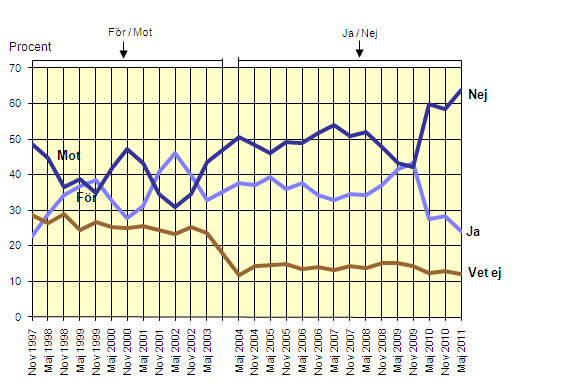
In a recent opinion poll, 64% of Swedes said they would vote no the euro - with only 24% in favour. See the graph illustrating the recent surge in opposition to the euro (Click to enlarge. Nej=No, Ja=Yes, Vet ej=Don't know).

Game over in other words.


Wednesday, August 17, 2011

Right said fred

This is some very sensible stuff, from the usually very sensible Swedish Prime Minister Frederik Reinfeldt, reacting to yesterday's meeting between Merkel and Sarkozy.

On economic governance

“The best thing would be clear formulas for advancing decontamination of public finances.”

On financial transaction tax

“I do not believe in this idea, if it is not adapted globally, for everyone at the same time. What was expressed yesterday was the idea to only impose it in the Eurozone.”

“Sweden is interesting because we are the only country with any real experience on this type of transaction tax. If it is only imposed on one part of a market, our experience is that it brings small amounts of income, but transactions move away. If this is imposed on the Eurozone, it is easy to see how a large part of international transactions move to London, or why not Stockholm?”

On Eurobonds

“In reality this means that well managed countries accept higher interest rates, in order to push rates down in less well managed countries."

All of which of course is true, though a rules-based system for public spending - where Sweden clearly takes a similar line to to Germany - is fine in theory, but difficult in practice (read: national democratic politics).

Incidentally, when will Reinfeldt come out against Sweden joining the euro? The Swedish centre-right parties' support (their leaderships, not members) for the euro - a manifestly flawed project which has nothing to do with liberal economics - remains one of the greatest political anomalies in Europe today.