• Facebook
  • Facebook
  • Facebook
  • Facebook

Search This Blog

Visit our new website.
Showing posts with label angela merkel. Show all posts

Monday, September 01, 2014

The CDU's 'AfD problem': too big to ignore, too controversial to team up with

Yesterday’s regional elections in Saxony saw Germany's anti-euro Alternative für Deutschland (AfD) score an impressive 9.7%  netting the party its first ever seats in one of Germany’s regional parliaments. The lead candidate of the Green party, Antje Hermenau, described the AfD result as an “earthquake” while AfD leader Bernd Lucke celebrated that they “finally arrived on the German party landscape.”

It is now up to German Chancellor Angela Merkel’s CDU party to find a new coalition partner after Saxony's FDP followed the national party in losing all its seats. The CDU's lead candidate and current Prime Minister of Saxony, Stanislaw Tillich, categorically excluded a potential coalition with the AfD describing it as a protest party that due to its inner turmoil was completely unfit to govern. He only waited until after the election result was announced to make this statement however, following a debate within the CDU which continues.

Commenting on the prospects for a CDU-AfD coalition, Bild columnist Bela Anda writes that if it were to enter into a coalition with the AfD,
“The CDU would saw off the branch on which it itself is sitting." 
A CDU-SPD grand coalition is therefore the most likely option although a CDU-Green coalition could also be on the cards.

So is the AfD 'Gekommen um zu bleiben' (here to stay)?

This is not only the title of a famous German pop song but now the question everyone is asking themselves. Regional elections in Thüringen and Brandenburg are coming up in two weeks and the AfD has a good chance of enter both regional parliaments. However, the party's objective remains winning Bundestag seats in 2017 having narrowly missed the 5% threshold in 2013. There will be another eleven regional elections before 2017 and the challenge for the party will be to keep the momentum going. The AfD leadership will no doubt remember the fate of the Pirate party in 2011 - polled at a spectacular 13% before plummeting into virtual non-existence.

In Saxony a large share of AfD vote came from ‘Sonstige’ (other parties) and ‘Nichtwähler’ (non-voters) which is typical for protest parties. But at the same time there is a considerable spread across most mainstream parties with the largest share coming from the CDU (34,000 votes).


This would be a particular headache for Angela Merkel’s party. The worst case scenario for Merkel is that the AfD becomes to the CDU what Die Linke is to the SPD - and indeed, some would say, UKIP to the Tories in Britain: too big to ignore, too controversial to team up with. This headache will become particularly severe if the liberal FDP's decline is irreversible, dooming the CDU to always have to look to the SDP (or the Greens), in turn making left-right coalitions more or less a permanent feature of German politics.

Tuesday, July 01, 2014

Would Cameron have been able to block Juncker if the Tories were members of the EPP?

No major party in the UK backed Jean-Claude Juncker, or any other 'Spitzenkandidat'. It is therefore fair to say that the UK electorate had no influence over the course of what some describe as an 'election'.

The counter-charge is that David Cameron is to blame because he 'left' the main centre-right group - the European People's Party (EPP).  Former Lib Dem leader Charles Kennedy made this point yesterday in the Commons - which was also alluded to by Labour MPs. If Cameron was a member, so the argument goes, he could have blocked Juncker's appointment as the candidate and then had some say over the 'election campaign' and associated deals. Critics are zooming in on the meeting of EPP-affiliated leaders in Dublin in early March, at which Juncker was selected (behind closed doors no less).

It may not be that simple though:
  • The Conservative Party was never a member of the EPP. It was a member of the European Democrats (ED) that was linked to the EPP in the so-called EPP-ED. As such, the Tories didn't have offical 'voting rights' and therefore David Cameron would not have had a vote over Juncker's appointment. 
  • It's also worth noting that the Labour Party, although being a member of the S&D group failed to block Martin Schulz as their group's Spitzenkandidaten.
  • Likewise the Liberal Democrats failed to block Guy Verhofstadt as the ALDE candidate
There's an argument that Cameron could have used the political influence and clout garnered from being associated with the EPP to stop Jucnker, even absent a formal vote. However, other EPP leaders had limited influence on the EPP candidate. Sweden's Moderaterna were opposed but were over-ruled. Berlusconi failed to attend and Hungary's Orban was hostile.

In any case, we will never know.

The reason the Conservative Party left the EPP-ED is because they did not agree with the EPP's push for further integration. The wider problem for the UK political parties - and reform-minded parties in other countries too - is that their views are grossly under-represented in the main groups. This, in turn, links to to the fundamental problem with the European Parliament itself (as we argued here).

Note:

For the record this is how the EPP delegates voted to adopt Juncker, so Cameron's vote would have made little difference - but again, we won't know:

EPP delegate votes to adopt Juncker as candidate

Monday, June 30, 2014

Is Cameron the greatest pro-European of all EU heads of state and government?

As we've noted, the Juncker-hangover is already taking hold in parts of the German commentariat. In a hard-hitting piece, Lisa Nienhaus, the Economics Editor of Frankfurter Allgemeine Sonntagszeitung argues that the EU "needs more Cameron, not less".
"Hang on a minute, how exactly [was Cameron's opposition to Juncker] a mistake? He only said publicly what many think. Juncker may well be a jovial, cheerful bloke, but he is also an example of political mediocrity, who represents more of the same, a lack of ideas. Whoever wants to change Europe, and above all the opaque, hyper-bureaucratic European Commission, needs someone else in that post."

"Cameron did exactly the right thing. He did not only win the hearts of Brits but also of citizens in many other countries who worry about what will ultimately remain of the European Union, a bureaucratic entity that offers occupational therapy and valediction opportunities for veteran politicians. In this sense, Cameron is the greatest pro-European of all the heads of state and government."
She continues that Juncker did not enjoy a democratic mandate from the German people, and that Angela Merkel made a mistake by backing him:
"The Germans, for example, did not vote for the European People’s Party (of whom Juncker was the leading candidate) but the CDU. Juncker did not feature on the posters, it was Merkel. It is not the case that voters would have driven crazy if Merkel had ultimately arranged that someone else would have become the Commission President. In doing so, she would have shown that she takes this post seriously. Now she has only shown that she doesn't really care who takes this job."
As we have been arguing as well, Nienhaus adds that the European Parliament (EP) does not have more democratic legitimacy than the European Council, and the appointment of Juncker is effectively a power grab by the Parliament. She calls on Germans who share this view to support the UK:
"The heads of state and government are ultimately at least as democratically legitimised as the European Parliament. After all, they won national elections in their respective countries." 
"We can only hope that Angela Merkel does not take offence at [Cameron's] 'No’. We need the Brits in Europe, also for other reasons. The belief of the Brits that freedom is good for the economy, and that not everything has to be regulated by the state, is exactly that what the EU is currently missing."
Nienhaus concludes that the UK is vital for the future of the EU, and that the EU debate is missing some of the UK's beliefs:
"The suspicion among the Brits that the powers that have won want to initiate a redistribution of powers and favour a super-powerful state is widespread. That does not appeal to the liberal Brits. Those in Germany who share this view – and there are many – has to support the UK playing a greater role in the EU. We need more Cameron, not less."
Neinhaus's line is not universally accepted in Germany of course. Others have been sticking the boot into Cameron. Nonetheless, Berlin will be aware that last week’s EU summit is a foretaste of what life in the EU could be if the UK were to leave. Without Britain in the EU, Germany would face a bigger risk of being cornered by a block of Southern eurozone countries lead by Italy and France: something that is absolutely not in its long-term interests.

Wednesday, June 25, 2014

If you force 26 EU countries to choose between Berlin and London. 26 will choose Berlin.

The knife in the battle over the next Commission President has just been twisted a little deeper into David Cameron's side.

Both Swedish PM Fredrik Reinfeldt and Dutch PM Mark Rutte today announced that they will not seek to block Jean-Claude Juncker for the top post.

Both countries have huge reservations, (Sweden and Hungary were the only two countries to oppose the idea of Spitzenkandidaten from the get-go), but they apparently don't want to be standing on the wrong side of the fence from Germany.

Speaking in the Dutch Parliament today, Rutte said:
I’m set on [Juncker. He is] in a position to implement important Dutch wishes.
A slight departure, then, from remarks Rutte made previously, that the Spitzenkandidaten process is “not my preference,” and that he wants to initiate a fundamental debate on it “possibly during the Dutch presidency” over the European Council in 2016.

Importantly, Rutte also remarked:
Under no circumstances, will I make agreements over adapting the fiscal rules, or making them more flexible, in order to make the nomination of a candidate possible.
Meanwhile, Reinfeldt told the Swedish Parliament:
If Jean Claude Juncker musters a qualified majority amongst heads of state and governments, and also has the support of the European Parliament, well then, the rules set out in the Lisbon Treaty have been followed and Sweden will also join this majority. 
Though Reinfeldt doesn't actually state how he would act in an outright vote, it probably means he will not vote against Juncker. 

So that only leaves the Hungarian Prime Minister, Viktor Orban, on 'Team Cameron'. Orban said "there is no way" he would vote for Juncker, even before the European Parliamentary election.

Absent changes, Cameron is now a long way off a blocking minority to Juncker in the Council. With Italy trading support for Juncker in exchange for more "flexible" EU fiscal policy, and the Netherlands and Sweden dropping out too, Cameron will lose the vote on Friday. This is the grim reality, even though most EU heads of state are far from convinced about Juncker, and of the Spitzekandidaten process itself.

The top line is that if you pit London against Berlin, and ask other EU member states to choose between them, they won't choose London.

So the trick is to avoid that choice - which in this case was rather difficult. For reasons we've explained numerous times, the likely consequence of repeatedly forcing this choice is that the UK will leave the EU. That most certainly isn't in Berlin's interest either - or Stockholm's, or the Hague's, or Copenhagen's, or Warsaw's...

Thursday, June 12, 2014

Germany reacts to ECR vote "Britain knights AfD"

As soon as the news that Germany's anti-euro Alternative für Deutschland (AfD) had joined the Tories' ECR group in the European Parliament - as we predicted would happen - hit the Twittersphere, the German reaction has been swift and pretty condemning.

Although the vast majority of Tory MEPs voted against the AfD joining, they were outvoted by their partners in the ECR.  Nonetheless, the top line is that this is not going to go down well in Germany, and the Conservatives and David Cameron should brace themselves for a lot of backlash.

Germany's Die Welt leads on the home page of its website with "British Conservatives cooperate with AfD."


Leading financial daily Handeslblatt also leads with the story on its front page, with the headline, "Britain knights the AfD."

It is also front-page news on the website of Frankfurter Allgemeine Zeitung, under the headline, "AfD to be in a faction with the Tories in future".

Süddeutsche hasn't missed it either. On their front page, the story is written up as "The AfD docks with Cameron's Conservatives."


Spiegel also puts it on their front page, arguing, "Merkel forced Cameron to say no, but the European Conservatives thought otherwise: The AfD is now a member of their faction."


As we have argued before, Berlin is London's most important ally in achieving a reformed EU. And news of the AfD in the Tories' Conservative group could prove to be a major stumbling block in that process.

Monday, June 09, 2014

What happens when four EU leaders get into a rowing boat?

Swedish PM Fredrik Reinfeldt is today hosting David Cameron, Angela Merkel and Dutch PM Mark Rutte, in Harpsund, Sweden - a recreational estate for Swedish PMs throughout the years. The summit apparently features a trip on the "Harpsundsekan" - a worryingly small rowing boat. The tradition involves various world leaders holding on for life and limb in the boat, and was introduced by Tage Erlander, Swedish PM in the 1960s. Nikita Krushchev, Willy Brandt and Kofi Annan have all been in the boat.

Merkel has already had the dubious honour of going on a trip with Reinfeldt in 2008. It should be said that getting four people into any rowing boat is actually a bit of a mission. Given that Rutte is 6'4, Reinfeldt 6'2 and Cameron not a small guy either, this will require some focus.

So what will be discussed?

Well, the summit was decided ages ago and pre-dates the ongoing Juncker row. Initially, the idea was that the leaders of the EU's most competitive economies were going to meet in order to hammer out the priorities for the next European Commission in particular and the EU in general, with a focus on the jobs and growth agenda.

Reinfeldt has said that there won't be any "discussions about personalities" at the summit, but no one really believes that. It'll probably be a mixture of the two. If Cameron can get a better idea of whether Merkel can find a away out of the corner the SPD has pushed her into (a very rare occasion) over Juncker, as well as some reasonably concrete commitments on EU reform, linked to the mandate for the next Commission, he should be happy.

Is it wishful thinking to see this as the "EU reform quad"?  If they could speak with one voice, it would no doubt be a very powerful group which would be hard to ignore. Together with Finland, they are the only EU countries on the World Economic Forum's list of the top 10 most competitive countries in the world. They also account for 41% of the gross contributions to the EU budget (much more if we count net).

The four leaders formed a formidable alliance in February, achieving the first ever cut to the EU's long-term budget. Sweden's Reinfeldt has been very helpful to Cameron on numerous occasions, including shooting down a bunch of proposals for financial regulations. In those EU budget talks, Stockholm deliberately positioned itself further out than London so as not to isolate the Brits. Reinfeldt was also quite helpful after Cameron's "Bloomberg speech" (in contrast to the Swedish Foreign Minister, Carl Bildt). If Juncker is stopped, it'll be in no small part due to Reinfeldt's willingness to stick his head over the parapet, giving Cameron much needed political cover. However, Reinfeldt will probably lose the Swedish elections in September, meaning Cameron will have to negotiate with a centre-left coalition ahead of the potential 2017 referendum.

Likewise, Rutte was key in the EU budget talks and the Dutch have very much emerged as the thought leaders on EU reform, not least when it comes to the role of national parliaments in the EU. In fact, the Hague has been more vocal on many occasions than London itself. Encouragingly, EU reformers in the Netherlands did better than expected in the European elections in May.

As for Merkel - well, we've written endlessly on the need for Germany to row behind EU reform. As the debate over Juncker shows, the country is currently embroiled in a hugely complex debate about how Europe should be governed, and what role Germany should play within it. The Juncker episode was Cameron's first real encounter with Germany's grand coalition politics. It won't be easy.

What's clear is that if Cameron is to achieve the sweeping change needed for the UK to stay in the EU, these four countries will have to be able to agree a common position.

Wednesday, April 09, 2014

Anglo-German partnership on EU reform could prove crucial at the negotiating table

Die Welt's Economic Editor Tobias Kaiser has an opinion piece in today's paper entitled entitled “Stay with us, Brits”, in which he argues that:
“Berlin needs London as a partner in the fight for fiscal reason [in the EU].” 
Kaiser highlights that:
“Berlin and London have to put their ideas of Europe against the French coined version of European etatism... The openness of the European economy has to be guaranteed and the protectionist regulations and national rules – which still prevent the development of a genuinely free exchange of goods, people, and ideas within Europe – have to be dismantled.”
This is an argument we have been making for a while. In 2012, following the election of Francois Hollande as French President, Open Europe Director Mats Persson argued that:
"Hollande simply rubs the Germans up the wrong way. His spending rhetoric is an outright challenge to German Chancellor Angela Merkel’s vision of a euro firmly grounded in Prussian budget discipline."
"Therefore, though it won’t be easy, the scope for a new bargain between London and Berlin – based on Britain needing new terms of EU engagement if it is to remain inside, and Germany needing the UK’s quiet support for a more economically sustainable euro – is possibly greater than ever."
While Hollande's push against austerity has waned, the process of Anglo-German cooperation has gained pace - exemplified by the recent joint op-ed in the FT where George Osborne and Wolfgang Schäuble agreed on the need for safeguards for the single market in the face of tighter political and economic integration in the eurozone.

Kaiser's call for greater economic openness within the EU also echoes the argument in favour of greater services liberalisation by Die Zeit's London correspondent John F. Jungclausen, who cited Open Europe's report which found that removing barriers to cross-border services trade could alone produce a permanent increase to EU-wide GDP of up to 2.3% or €294bn.

It's good to see the process beginning to bear fruit and gain wider traction in the German media, particularly on the specific areas where reform is necessary. As we pointed out ahead of Chancellor Merkel's recent visit to the UK, there is scope for a wide ranging 'Anglo-German bargain' in areas such as EU migrants' access to benefits, greater powers for national parliaments, and the devolution of some EU back to the national or local level. According to a recent Open Europe/YouGov poll, an EU reform agenda built on these pillars would enjoy significant public support in both countries.

With all this in mind, now would seem the perfect time for the UK government to begin road-testing specific reforms in Germany and other countries. 

Thursday, February 27, 2014

Merkel's speech: far too early to jump to conclusions

Chancellor Angela Merkel has delivered her much hyped and anticipated speech to both Houses of Parliament - so what conclusions can we draw and was it good or bad news for David Cameron's EU strategy?

In short, Merkel delivered a very statesmanlike speech but there was little new here.

The Chancellor was never going to set out a definitive list of reform proposals or endorse/reject Cameron's EU reform agenda. She made the point explicitly in (perfect) English that her speech would disappoint both those who hoped it would "pave the way for a fundamental reform of the European architecture which will satisfy all kinds of alleged or actual British wishes" and those who expected she would "deliver the clear and simple message that the rest of Europe is not prepared to pay almost any price to keep Britain in the European Union".

Here are some of our key observations:
  • Merkel opened with a long passage about Britain's role in both world wars and its commitment to Europe's democratic values. She emphasised that "the UK has no need to prove its commitment to Europe". This was a clever gesture of diplomatic goodwill that she didn't necessarily have to make. She also highlighted Germany's view that the EU remains a vehicle to ensure stability across the Continent.
  • There were few specifics but she made it clear that in order to strengthen the eurozone the EU treaties will have to be adapted in a “limited, targeted and swift” manner, adding that if the UK and Germany show they are serious about reform, they will find the legal mechanisms to make it happen. 
  • In terns of EU reform generally, she stated that that Europe had to change to adapt to new realities - a clear acknowledgement that the status quo is untenable. She said the EU policies needed to be evaluated by all member states. "For all EU member states it is essential that all EU policies – whether energy and climate, shaping the single market or external trade relations – have to be measured by whether they contribute to the European economic strength or not," she said.
  • Merkel reiterated her statements on the need to cut red tape and ensure the EU is competitive.
  • She emphasised the benefits of the four freedoms of the single market and that they are inseparable, but added that "it is also true that, to maintain and preserve this freedom of movement and gain acceptance for it from our citizens... we need to muster the courage to point out mistakes and tackle them" - a clear hint at the possibly of reforming the rules around EU migrants' access to benefits. She further expanded on this in the press conference by pointing out that free movement could not involve unrestricted access to benefits and that this was as much of a concern in Germany as in the UK.
  • Merkel called on the EU to be more outward looking, particularly given that 90% of global growth over next five years will take place outside EU, despite it occupying 25% of the global economy. She was clear on the need for the EU-US free trade deal (TTIP).
  • She also argued that the principle of "subsidiarity must be respected more in Europe".
  • She stressed the importance of the City of London to the EU economy - a nod to those who fear that the City remains in Brussels' sights.
  • While Merkel stressed the need for the EU to change economically and politically, the was little more on addressing the EU democratic deficit, which Cameron has been keen to emphasise.
In summary, Merkel's speech was a statesmanlike address. The rhetoric reflected Germany's cultural and historical affinity with the EU but, without being specific, Merkel was equally clear about the need for the EU to change. She added, "Our ideas of how the future European Union ought to look like may vary on the details but we, Germany and Britain, share the goal of seeing a strong, competitive European Union join forces."

Her pitch to Cameron could be summed up with her comments that "we need a strong United Kingdom with a strong voice inside the European Union. If we have that, we will be able to make the necessary changes for the benefit of all." As we noted in our briefing, there is ample scope to translate these shared principles into concrete reforms which would attract a lot of public support in both countries. It is also worth remembering that when it comes to reforms, Merkel is a believer in a more gradual, step-by-step process as opposed to the huge all-encompassing package that many UK observers are looking out for.

It is now up to David Cameron to put forward concrete policy proposals, not only to the German Chancellor but to the wider EU negotiating table.

Wednesday, February 26, 2014

New OE poll shows Merkel and Cameron should have plenty to talk about

We’ve put out a new poll this morning in conjunction with You Gov ahead of German Chancellor Angela Merkel’s visit to the UK tomorrow. The results make for some interesting reading and suggest there are plenty of areas of agreement between the Brits and the Germans. Whether this can translate into a new Anglo-German bargain and wider EU reform remains to be seen, but it provides a good basis for discussions.

The results suggest that Germans are split on the future development of the EU. While 38% say they’d like a more integrated Europe with more decisions taken at the European level, 31% say they’d like a less integrated Europe and 9% favour complete German withdrawal. 14% favour the status quo.

Among British respondents, a less integrated Europe with more decisions taken nationally or locally, is by far the most favoured option (37%). 24% want complete British withdrawal, 15% favour the status quo and only 10% would like more integration with more decisions taken at the European level. This illustrates that rather than a straight in or out choice, the British public has a clear desire for reform. It is now up to the UK Government to deliver a clear reform programme.


While more German than British respondents were sympathetic towards the prospect of more EU integration, a majority in both countries think that national parliaments rather than the European Parliament should be the ultimate check on new EU laws (see graph above, click to enlarge).

In the UK, 55% believe that every country’s national parliament should have the right to block new EU laws and 18% believe that a group of national parliaments working together should have the power to block EU laws – a total of 73%. In Germany, 36% favour a veto for the Bundestag over new EU laws and 22% are in favour of a group of national parliaments being able to block EU laws – a total of 58%. Only 8% of Britons and 21% of Germans think the European Parliament, rather than national parliaments, should have the right to block new EU laws.


Furthermore, in four out of six key policy areas – EU migrants’ access to benefits, police and criminal justice laws, employment laws and regional development subsidies – a majority in both countries said that decisions should be taken at the national rather than at the EU level (see table above).


Of the EU’s three flagship projects – the single market, enlargement and the euro – the single market was considered to be beneficial by the biggest share of voters in both countries. 52% of British voters said the single market is beneficial while 26% said it is not beneficial and 23% are undecided. 74% of German voters said it was beneficial, while 19% said it isn’t, and 8% said they don’t know.


Both British (55%) and German (48%) voters tend to view the impact of EU migrants on their country negatively. A smaller share of voters in both Britain (42%) and Germany (42%) said EU migrants negatively impacted on them personally, while a larger share in Germany (41%) than in Britain (30%) feel that EU migrants have a positive impact on them personally.

Plenty of scope for agreement then, but we’ll end on a note of caution. Merkel remains keen on a step by step approach and is somewhat hamstrung by her new coalition partners. Cameron will have to secure a much wider base for reform than just her, while she is also more likely to publicly back him if he has formed other alliances.

Thursday, February 06, 2014

All hail Angela Merkel – No 10 goes all out for the Chancellor

Painting in the Royal Gallery - the Duke of Wellington with Field Marshal Blucher at the Battle of Waterloo - harking back to an earlier age of Anglo-German cooperation.
Angela Merkel will visit London on 27th February, in what will be, no doubt, a much hyped affair. Though the details are yet to be confirmed, in addition to meeting David Cameron and the Queen, Merkel could also “be given the rare privilege” – as the Telegraph’s Chris Hope put it – of addressing both Houses of Parliament at the Royal Gallery, perhaps in an attempt to rekindle the spirit of the early 19th Century when Anglo-German cooperation was the norm (see painting).


The last head of government to address the Royal Gallery was apparently Nicolas Sarkozy – then French President – in 2008. We suspect that for Merkel this is more a case of “business as usual” rather than “privilege” but in any case, it’s significant.

There’s no doubt that the Tory leadership hopes for encouraging signs from the Chancellor, following Francois Hollande’s predictable comments last week that EU treaty change “is not a priority” (which nonetheless generated headlines). Far worse for Cameron et al was that the German Foreign Minister Frank-Walter Steinmeier proved such hard work when he was here on Monday – holding a rather awkward press conference alongside William Hague, which included some tempered language on Treaty change (which even came close to contradicting the German Coalition agreement).

As we’ve noted before, the German Grand Coalition isn’t a deal-breaker for Cameron’s plans but it does mean a lot more work. In contrast to the Steinmeier visit, which was barely publicised (most lobby journalists - the parliamentary correspondents who often set the agenda in UK press - were unaware of the meeting instead basing their write-ups on the news wires, which arguably triggered even worse headlines for Hague / Cameron), the Government will go all out for Merkel.

As we’ve argued since the start, Merkel holds the key to a new settlement in Europe, so No 10 is right to step it up. However, at the same time, it must be wary of not being seen as desperate – Merkel is by far the most important leader in Europe, and the big Europe questions are decided by the Kanzleramt and even the Finanzministerium, not the Auswärtiges Amt. Nevertheless, the strategy cannot entirely rest on Merkel, also keeping in mind that this is her last term, with her potentially getting weaker closer to the end.

Merkel’s visit will mark the start of a fresh attempt by No 10 to court EU leaders (read: explain to Europe what in the world Britain actually wants to achieve apart from creating emergency headlines to appease backbenchers). It won’t be a day too early. 

Friday, October 18, 2013

Like its election, Germany's coalition talks will be dominated by domestic issues


Coalition, coalition, coalition – this is all par for the course in German politics. It’s been almost a month since the BTW13, and the new government has yet to be formed. This is no cause for alarm, of course, Germans like their coalitions, and they understand that they take time to form.

With the Greens now out of talks, Angela Merkel’s CDU/CSU has to try and form a Grand Coalition with the SPD (the most popular choice for government among the public.) The parties  held third-round talks in Berlin yesterday, finally agreeing to enter formal Grand Coalition negotiations. Talks will start next week, subject to approval by an SPD party convention on Sunday.

Merkel's priorities are clear. On Wednesday she laid out her agenda for government as she starts her third-term as Chancellor. They are: ending the eurozone crisis; cutting the costs of Germany’s energiewende (or its move from nuclear to renewable power); dealing with the problem of its ageing population and federal reform of the states.

Although the eurozone crisis is Merkel’s top priority, as we have been arguing for quite some time now, regardless of coalition outcome, the German approach to the eurozone will not change significantly: expect more of the same. The SPD influence may cause some change in style, but not substance. It is unlikely that eurozone policy will feature as the key headline during coalition negotiations.

From a domestic perspective, the focus on demographic challenges is interesting. As we have noted, this is a huge deal for Germany, with its population set to shrink significantly over the coming decades and the pension burden set to jump accordingly. How this is dealt with will play a role in determining for how long Germany retains its current status as the powerhouse of Europe. This is a question that will worry SPD and CDU alike.

Equally important, will be the cost of  Germany's energiewende. A recent report by the FT estimates that that German consumers will have spent over €100bn on subsiding green energy by 2014. The pressure to reform Germany's renewable energy law to lower costs will run across party lines.

Given this, the domestic issues that are bound to dominate coalition talks will be the question of introducing a minimum wage, taxation and spending. Here, the SPD will fight hard for a 'victory'. The party knows that it lost a lot of support the last time it entered into a Grand Coalition with a significantly more powerful CDU/CSU in 2005. And this time around, Merkel’s party is even stronger (it is just a few seats shy of an absolute majority in the Bundestag). Not surprising, that reports emerging from Germany say that the SPD is fighting hard to win the Finance and Labour Ministries over the less-influential Foreign Ministry, (although, this was denied by SPD general secretary Andrea Nahles this morning.)

Although it is unlikely that the CDU/CSU will hand over the Finance Ministry, it will be willing to compromise elsewhere, giving the SPD the 'prize' it is looking for. This could be a compromise on mimumum wage. But it is important to distinguish here (and this is a detail that has not been grasped by some English reports on this issue), that BOTH the CDU/CSU and the SPD are in favour of a minimum wage.The question, then, is what the rate and scope of the wage should be. The SPD favour a statutory (national) minimum wage of €8.50/hr, while the CDU/CSU wants to allow trade unions and employers to negotiate the level individually in each German Bundesland, or state.

As already indicated by CDU-leader Horst Seehofer, he would be inclined to accept the SPD's €8.50 demand under ‘certain conditions’. The caveat being that the SPD demand is OK if it doesn’t cost jobs - given that Germany is already facing some labour shortages this is plausible. Presumably, however, this means that the SPD will have make concessions on other domestic fronts – such as agreeing not to raise taxes further (one of the SPD’s key campaigning platforms) and no further creation of debt. (Like the CDU/CSU, the SPD believes in cleaning-up budgets, but it favours a less-strict austerity schedule.)

So, while the SPD is likely to win the domestic victory it is looking for – it  will not be a huge blow to Merkel’s CDU/CSU, which will be sure to win concessions elsewhere.Compromise in coalition are all part of the course in German politics.

From a wider European angle, however, the coalition talks will be broadly reminiscent of the campaign: domestic issues will supersede.

Wednesday, September 25, 2013

AfD: The party of the youth?


AfD chief Bernd Lucke on the campaign trail
It's barely been half a year since the German anti-euro party Alternative für Deutschland (AfD) emerged onto  the political scene (and we were one of the first to flag up the then-unknown party), but its ascent has been rapid.

On Sunday's federal elections,  AfD managed to convince two million Germans to back it. With 4.7% of the final vote, the party just narrowly missed the 5% threshold to enter the Bundestag. Had AfD made it in, it would have had over 30 seats.

Age plays an interesting part in the AfD story. Had the elections been decided by younger voters, AfD would now be preparing to enter parliament. Lead by economist Bernd Lucke, the party won 6%  of  the overall share of votes from those aged between 18 to 24. It won the same amount from those aged between 25 - 44. Support for AfD drops to 5% in the 45-59 group, and to below 3% in the over-60's category.

The 60+ voters are the clear conservative stronghold in Germany, with over 50% of them voting to conserve the status quo with Angela Merkel's CDU/CSU. In short: the younger generations are more likely to vote for Germany's euro-rebels than the older ones. And there is a logic to this: the older voter is more likely to feel the weight of Germany's recent history, therefore, rejecting anything  they may perceive as 'anti-European.'


Now, the interesting dynamic in all this, is, of course, that AfD has been depicted by many commentators as the "Bourgeois protest party;" or as an old and boring "party of professors." But obviously something about it speaks to younger voters.

One of AfD's actual professors, Prof. Dr. Lothar Maier, argued last month he didn't agree with the 'boring AfD' image, saying:
"We have 20,000 members in Germany and there aren't so many professors in Germany. Our membership is coming from all stratas of the population."
Another interesting element to highlight is that AfD won enough votes to take it over the 5% barrier, in all but one of the eastern German states.

The AfD's candidate in Brandenburg, Alexander Gauland, thinks that this is because “people are not so strongly bound to parties in the east”, while another prominent AfD candidate, Konrad Adam, adds: "eastern Germans haven't got bad experiences with experiments." And indeed, if a new currency were introduced in Germany (the AfD argues against the euro), it could be easier for east Germans to stomach: it would be their fourth currency in 25 years.

So what side of the political spectrum does AfD gets its votes from?

Richard Hilmer from leading German pollser Infratest Dimap, explains that “AfD voters come from all political directions,” stressing that the "party of professors" actually received most support from workers. The graph below shows that AfD got its largest share of votes from the FDP and Die Linke, but also a sizeable part from the CDU/CSU and the SPD:

Commenting on his party's future on Phoenix TV, Lucke said: “We need to become more professional for the elections in 2014,  [during] this campaign we had to improvise a lot.”

But it looks like Lucke, (who is yet to decide whether or not he will run in the European elections in May 2014) may enjoy further success. Bear in mind that the threshold to enter the European Parliament is only 3%. In the last European elections in 2009, the CSU and Die Linke got about 2 million votes, resulting in 8 MEP seats. AfD has already shown that it can mobilise such numbers.

Moreover, EU-protest parties (such as UKIP, for example) tend to perform their strongest in European elections. And while this is not to gloss over the considerable differences between UKIP and AfD as parties, this should raise expectations for AfD's showing next year.

It may not have made it into the Bundestag, but we still may have a lot more to hear from AfD.

Friday, September 20, 2013

The top 10 'spiciest' moments of the German elections

How do we put this delicately...the Germans aren't exactly known for their sense of humour. Equally neither are politicians, other than attracting derisory chuckles at their attempts to seem cool or in touch with the common man. Combine the two and result is often enough to drive large swathes of people to watch the handwork of their decorator dry slowly. 

This round of German elections has been little different, not least because Angela Merkel has actively employed the tactic of trying to bore people into voting for her (see cartoon below). We haven't seen so many references to 'Safe Hands' since David Seaman's auto biography.

Fortunately, there have been a some spicier moments (though we refrain from call them "highlights"), here are the top 10:


The FDP, neo-nazis and a cream cheese discover they have something in common

An awkward moment for the FDP when someone spotted that a stock image of an all-German family used in one of their televised ads also featured in a campaign video for the far-right/neo-Nazi NPD party. Bizarrely, the same family also featured in an advert for a Finnish cream cheese. Unfortunately for the FDP, the moment has not proved as embarassing as being seen as a photocopy of the CDU.


The necklace that won the #tvduel

We all know Germans love gold but this takes the nugget. The only TV debate between Angela Merkel and Peer Steinbrück was considered so dull that it prompted many to proclaim Merkel's fetching patriotic necklace the real winner of the debate, and it quickly gained its own Twitter account with over 8,700 followers to date.

Peer's 'Stinkefinger'

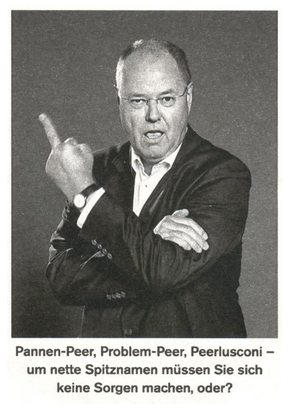
After losing his only televised debate to a necklace, Peer felt the need to take drastic action. But what to do? Well, apparently, if your words aren't working, go 'wordless'. Peer Steinbrück signed up for a 'wordless interview' with Süddeutsche Magazin which ended up receiving widespread coverage in Germany and abroad after he responded to a question by unapologetically flipping the bird. Unfortunately, rather than inspiring the electorate they simply replied in kind...


Lucke's Greek toga party

If you thought Peer's wordless interview was bizarre, wait until you see this. AfD leader (and serious German professor) Bernd Lucke held an interview with German channel Tele 5 on why Greece should leave the euro, during most of which he wore a Greek flag as a toga. He then proceeded to sing a duet with the host, of the AfD's official song to the backing music of Take That's 'Back for good' (a song which Lucke had apparently never heard before). On top of all of this, as some of the papers noted, one of the producers of the show is Greek and proceeded to periodically alter Lucke's voice so that he sounded like Mickey Mouse. A truly bizarre election interview, which is well worth watching even if you don't speak German.

Don't mess with the Currywurst

While pushing for the humane treatment of animals, the Green party ironically managed to shoot themselves in the foot. In an almost inexplicable move, they proposed forcing all public canteens to make one day a week vegetarian day. Unsurprisingly, the suggestion did not go down well in a country famous for loving its meat. “How dare the Greens tell us what to eat!” thundered Germany’s mass circulation Bild newspaper, the day after the proposal was floated. What next? Banning nudism, autobahns or the Hoff...? You simply don't mess with the Currywurst or the Schweinshaxe. The Greens have recently slipped a couple of points in the polls - clearly no coincidence...

Beating the kids at their own game 

The new anti-euro party Alternative für Deutschland was widely derided as a party for old, white and grumpy men or alternatively as the 'Professor party' (if only it was true some would say). The contrast with the young, swinging and tech savvy Pirate party could hardly be greater. However, the AfD has proved it is no slouch when it comes to online campaigning with one of its election campaign videos getting over a million hits, while a Pirate video has received only just over 10,000 views.

Die Partei's whole election campaign


The brilliantly named Partei für Arbeit, Rechtsstaat, Tierschutz, Elitenförderung und basisdemokratische Initiative (Party for Work, Rule-of-Law, Protection of Animals, Advancement of Elites, and Grassroots-Democratic Initiative) - shortened to Die Partei - is a German satirical party akin to the UK's Monster Raving Loony Party, but much funnier. Set up by Martin Sonneborn, editor of the satirical Titanic magazine, its campaign pledges include razing the City of London to the ground and putting Angela Merkel on trial in a cage. Die Partei also released an election video on 'family policy' featuring (pixelated) scenes from an adult film with a soundtrack of "moaning and groaning, accompanied by light-hearted background music".

The hypnotic Chancellor 

We're not sure if it is her or her necklace, but Merkel has certainly lulled the electorate into a state of tepid contentedness. This cartoon perfectly captures the excitement of the CDU's election campaign. Merkel: "You are going to sleep. Everything is good. You are going out to vote..."


A rough ride for AfD

In their misguided attempts to stop the AfD expressing its alleged intolerant views the members of the Green youth decided to physically halt AfD activists from their right to freedom of speech and expression, with no sense of irony. Green with envy of the AfD's media coverage perhaps? In any case, as reported by Spiegel, this is likely to help the anti-euro party's chances, rather then hurt them.

Merkel drones on...

Just when the scandal surrounding the government's bungled purchase of the multi-million euro 'Euro Hawk' surveillance drone was beginning to fade, a CDU event with Angela Merkel and Defence Minister de Maizière in Dresden was interrupted by a miniature drone operated by remote control. The Pirate party claimed responsibility, saying that "The goal was to make Chancellor Merkel and Defence Minister de Maizière realise what it's like to be subjected to drone observation". Judging by the results above maybe they should just make her watch their election video...

David Hasselhof singing on the Berlin wall

Oh, sorry, that was in 1989...maybe it just seems like yesterday since we watch it on a daily basis...

Friday, September 13, 2013

How one finger livened-up the German election campaign

Peer Steinbrück, the SPD’s Chancellor Candidate graces the front cover of today’s Süddeutsche Magazine unapologetically flicking the bird.

Here's Steinbrück's picture interview in full, (quick fire questions, with 'wordless answers'):

" You’re called Mishap Peer, Problem Peer, Peerlusconi -- you’ve got no worries about being given nice nicknames?”
"Mr. Steinbrück, you and your wife have been married for 38 years. Your advice on a long and happy marriage?"

"Only 26% would vote currently for the SPD. Is that because of you?"


"The FDP leader Philipp Rösler says you don’t have capabilities to be Chancellor. Do you have a message for him?"

"Do you still wear a vest under your shirt?"

"On  scale of one-10: how good is Angela Merkel as a crisis manager? (1= terrible, 10= expert.)"


"How would you react if the Greens go into coalition with the CDU/CSU after the election due to a lack of alternatives?"


Wednesday, September 11, 2013

No fundamental change in eurozone policy after the German elections

Today we released an in-depth briefing on the German elections, and their implications on the eurozone. The top line: don’t expect any fundamental change in Germany’s eurozone policy after the elections.

Of the nine proposals being floated to pull the eurozone out of crisis, we expect clear movement in only one or two areas, including the most important but most unclear one: the proposal for a single eurozone resolution authority for banks.

Moreover, Germany is unlikely to depart from its emphasis on ‘sparkpolitik’ or austerity. Any change here will be largely superficial: a continuation of same policies wrapped up differently. This is based on Germany desire to ‘lead by example,’ and the broad support for austerity enjoyed among the German public.

The German insistence on structural reforms, and strong controls on taxation and spending of other eurozone states won’t change either. A government lead by Angela Merkel, could, however, push for a formalised “competitiveness pact” where by struggling eurozone countries commit to reforms  in return for aid.

The question of debt pooling will remain a contentious one  –  with the recent Open Europe/ Open Europe Berlin poll, conducted by YouGov Deutschland, showing that 64% of Germans are opposed to such a step. A debt redemption fund, as has been proposed by the influential Council of Economic Experts that advises the government, may be a possibility – however, this won’t be without opposition.

See our table below (click to enlarge) which breaks down and analyses the key eurozone policy areas on a party-by-party basis, detailing if we can expect to see movement after the elections:


Wednesday, September 04, 2013

Germany's anti-euro party may still yet make it into the Bundestag

Don’t think the German elections are a done deal – and, in particular, don’t rule out Germany’s anti-euro party, Alternative für Deutschland.

Though Merkel’s CDU/CSU is doing well the polls – as has been noted – her party could still flunk this one. German election surveys are notoriously  unreliable – and in the past, the polling figures for the CDU/CSU in particular, have tended to be higher than the actual election results. The central scenario for the new German government is still definitely a CDU/CSU-FDP coalition. However, a grand coalition of CDU/CSU-SPD is very much on the cards. If the FDP fails to get into the Bundestag, we could even be looking at a SPD-Green coalition – but that’s still unlikely.

The thing to remember is that the share needed to secure a majority in Bundestag isn’t the same as overall support in the polls, as the votes below the 5% threshold  parties need to win seats in the Bundestag will be dropped, while some seats are actually first past the post. So it’s not all that straightforward.

One interesting question, though: will Alternative für Deutschland shock Europe and make it into the Bundestag? A Forsa opinion poll for RTL/Stern today put the party on 4% .

This means we’re very close to a scenario where AfD is in and FDP is out. The assumption so far – including initially from us – was that AfD would struggle to get above 5%. Its window would instead be the European Parliament elections (without 5% threshold and possibly following a series of tough decisions in the Eurozone). However, we’re not confident of that any longer. Before the Italian elections, we predicted that Beppe Grillo’s (at least semi anti-euro) Five Star Movement would do better than many assumed. Deja Vu?

Possibly.

First, there are a huge number of swing voters swirling around Germany – over 30 per cent are undecided according to some polls, with one recent one even claiming 72 per cent. We literally have no idea where all these votes will go, but they could prove favourable for AfD. They could, of course, also go against the party.

Secondly, polls can easily underestimate the strength of  a new, protest party – as in the case of Grillo. Online polls tend to put AfD higher than polls conducted over the phone, suggesting that voters are still embarrassed to actually admit publicly, and to pollsters, that they'll vote AfD. German polls aren’t actually that great at predicting outcomes, for various reasons.

Now, AfD won’t do a Grillo  - who absolutely exploded onto the scene. However, a lot more sensational things have happened in politics than AfD landing a spot in the Bundestag.

We won’t call this one either way.

Monday, September 02, 2013

Merkel's necklace aside, who won yesterday's German election debate?

Some 17 million Germans – and, we dare to say, a record number of keen international analysts - tuned in yesterday to watch the first and last televised debate between Angela Merkel and SPD contender Peer Steinbrück, ahead of the country’s elections on 22 September.

The debate only briefly touched on the Eurozone crisis and EU policy, with Steinbrück criticising Merkel’s policy over Greece in particular. Though some Anglo-Saxon commentators have written this up as the SPD candidate “criticising austerity” , in fact, he was more criticising the pace of austerity and its balance with more 'growth orientated' policies – not austerity itself.

As we've argued before, you just don’t criticise Sparpolitik in Germany – next to plagiarism, this is the best way to end a mainstream political career. Steinbrück did, however, criticise the pace and scale of Merkel’s austerity policies, again repeating his calls for an as yet very vague new “Marshal Plan” for Europe. “There must be budget consolidation”, he said, but must not be “a deadly dose”. Merkel hit back, saying that if, as Steinbrück claims, the need for a third Greek bailout is a sign of her Eurozone policies failing, why did he and his party vote in favour of all the bailouts so far?

So who won the debate?

The view in the German media and commentariat seems to be pretty unanimous that though the debate itself was pretty much a draw, it involved a bit of a boost for Steinbrück – which wasn't entirely unexpected, given that the man started from an exceptionally low base.
Snap post-debate polls also suggested a draw, with one putting Steinbrück in the lead (49% to 44%), and two others putting Merkel ahead (40% to 33% and 44% to 43% respectively). A fourth poll put both candidates on 50%.

However, Steinbrück did see a boost to his head-to-head ratings. An ARD poll (see below) has a massive swing in favour of Steinbrück on the question: who would you vote for if the Chancellor could be elected directly?


AnFG Wahlen poll for ZDF shows a much smaller swing for Steinbruck – but still a clear swing.


However, the real winner of the debate, according to many, was Merkel's fetching patriotic necklace, which has now has its own twitter account with over 6,000 followers.