• Facebook
  • Facebook
  • Facebook
  • Facebook

Search This Blog

Visit our new website.
Showing posts with label AFD. Show all posts

Monday, September 15, 2014

The AfD bandwagon rolls on - what are the implications?

Germany's anti-euro AfD party has hit a rich vein of electoral form building on its success in Saxony two weeks ago (where it scored 9.7% and won its first seats in one of Germany's 16 regional parliaments) to win 12.2% in Brandenburg and 10.6% in Thuringia; a considerable improvement on pre-election polls.


As the graphic below shows, AfD won votes across the political spectrum, In net terms, its success came at the expense of the left - Die Linke in Brandenburg and the SPD in Thuringia - although in gross terms it also won a lot of votes from the CDU and FDP.

Where did the AfD's votes come from in Brandenburg and Thuringia?
This reflects the nature of the AfD campaign in these areas which combined an explicit pitch to Die Linke voters emphasising Ostalgie (nostalgia for East Germany), AfD's opposition to TTIP and to the sanctions on Russia with more traditional 'small c' conservative messages on crime and immigration (for example, AfD wants to re-impose border checks). On the whole, the question of Europe and the euro barely featured.

While AfD's recent successes should not be over-interpreted, inflated as they are by higher rates of disaffected voters in East Germany and low turnouts, it does nonetheless pose difficult questions for the established parties. This is particularly true for the CDU/CSU for whom, as we've noted, AfD is too big to ignore, yet too controversial to team up with. In the longer term however this might change if it becomes evident that the AfD is the only alternative to permanent 'grand coalitions' at the regional and federal level, a scenario which would arguably strengthen AfD even more.

We expect that this will be hot debate within the CDU in the coming months and years. Meanwhile, the AfD itself faces a big test; 12 months on from narrowly missed out on winning Bundestag seats the party has performed well in European and regional elections, however, with next year's Hamburg regional elections the only significant entry in the electoral calendar over the next year and a half, can the party sustain its recent momentum? If it stalls, could we see deeper splits between the economic liberals and protectionists/social conservatives who make up the party's uneasy internal coalition?

Monday, September 01, 2014

The CDU's 'AfD problem': too big to ignore, too controversial to team up with

Yesterday’s regional elections in Saxony saw Germany's anti-euro Alternative für Deutschland (AfD) score an impressive 9.7%  netting the party its first ever seats in one of Germany’s regional parliaments. The lead candidate of the Green party, Antje Hermenau, described the AfD result as an “earthquake” while AfD leader Bernd Lucke celebrated that they “finally arrived on the German party landscape.”

It is now up to German Chancellor Angela Merkel’s CDU party to find a new coalition partner after Saxony's FDP followed the national party in losing all its seats. The CDU's lead candidate and current Prime Minister of Saxony, Stanislaw Tillich, categorically excluded a potential coalition with the AfD describing it as a protest party that due to its inner turmoil was completely unfit to govern. He only waited until after the election result was announced to make this statement however, following a debate within the CDU which continues.

Commenting on the prospects for a CDU-AfD coalition, Bild columnist Bela Anda writes that if it were to enter into a coalition with the AfD,
“The CDU would saw off the branch on which it itself is sitting." 
A CDU-SPD grand coalition is therefore the most likely option although a CDU-Green coalition could also be on the cards.

So is the AfD 'Gekommen um zu bleiben' (here to stay)?

This is not only the title of a famous German pop song but now the question everyone is asking themselves. Regional elections in Thüringen and Brandenburg are coming up in two weeks and the AfD has a good chance of enter both regional parliaments. However, the party's objective remains winning Bundestag seats in 2017 having narrowly missed the 5% threshold in 2013. There will be another eleven regional elections before 2017 and the challenge for the party will be to keep the momentum going. The AfD leadership will no doubt remember the fate of the Pirate party in 2011 - polled at a spectacular 13% before plummeting into virtual non-existence.

In Saxony a large share of AfD vote came from ‘Sonstige’ (other parties) and ‘Nichtwähler’ (non-voters) which is typical for protest parties. But at the same time there is a considerable spread across most mainstream parties with the largest share coming from the CDU (34,000 votes).


This would be a particular headache for Angela Merkel’s party. The worst case scenario for Merkel is that the AfD becomes to the CDU what Die Linke is to the SPD - and indeed, some would say, UKIP to the Tories in Britain: too big to ignore, too controversial to team up with. This headache will become particularly severe if the liberal FDP's decline is irreversible, dooming the CDU to always have to look to the SDP (or the Greens), in turn making left-right coalitions more or less a permanent feature of German politics.

Headlines are all for AfD and UKIP, but the biggest shocker for traditional parties may come from Spain...

The surge of anti-EU, anti-euro and protest parties across Europe continues. Germany's anti-euro Alternative für Deutschland (AfD) is making headlines after winning 9.7% of votes in yesterday's regional elections in Saxony and securing its first ever seats in one of the country's regional parliaments.

In the UK, a Survation poll for the Mail on Sunday found that, following the defection of Douglas Carswell from the Conservatives to UKIP last week, UKIP is set to win the ensuing Clacton by-election with 64% of the vote - which would grant Nigel Farage's party its first elected MP.

However, the biggest shocker for mainstream parties seems to be coming from Spain. According to a new Sigma Dos poll for El Mundo, the anti-establishment (but not anti-EU) party Podemos would finish third in a general election with 21.2% of votes - only 1.1% less than the opposition Socialist Party. Being neck-and-neck with one of Spain's two traditional parties is an absolutely extraordinary result for Podemos, given that it was founded in March. The poll puts Spanish Prime Minister Mariano Rajoy's centre-right Partido Popular in the lead on 30.1% - a 14.5% fall from the 44.6% the party scored at the November 2011 general election (click on the picture to enlarge).

 
If you didn't read it at the time, here is a portrait of Podemos and its leader, Pablo Iglesias, that we published in the aftermath of the European Parliament elections in May - when Podemos came from nowhere to win five seats in Strasbourg. We noted:
Call it left-wing, anti-establishment, anti-austerity (but clearly not anti-EU), the rise of Podemos is significant because - similar to what the Five-Star Movement has done in Italy - it can give Spaniards a channel through which they can voice their dissatisfaction with the political establishment (and the current eurozone economic policies), something which has been lacking at the peak of the eurozone crisis.
Indeed, looking at the latest polls, Podemos seems to be following exactly the same trajectory as Beppe Grillo's Five-Star Movement in terms of rocketing (potential) electoral support. And exactly as in Italy, the rise of a strong anti-establishment party may well force the centre-right Partido Popular and the Socialists to consider an unusual (and uncomfortable) 'grand coalition' if none of the two big traditional parties wins a majority in the next general election - due in November 2015.

While the speed of the rise of Podemos is certainly surprising, there has undoubtedly been a huge gap in the market for a protest party in Spain over the past few years - as we noted on this blog at the end of May. Despite sky-high unemployment, a struggling economy, a few political scandals and regional discontent, no party or movement had so far managed to shake the solid support for the two mainstream parties. But since Podemos entered stage, things seems to have changed. With a Catalan independence referendum potentially coming up in November and thoughts turning towards next year's general election, these are certainly interesting times in Spanish politics.

Thursday, June 12, 2014

Germany reacts to ECR vote "Britain knights AfD"

As soon as the news that Germany's anti-euro Alternative für Deutschland (AfD) had joined the Tories' ECR group in the European Parliament - as we predicted would happen - hit the Twittersphere, the German reaction has been swift and pretty condemning.

Although the vast majority of Tory MEPs voted against the AfD joining, they were outvoted by their partners in the ECR.  Nonetheless, the top line is that this is not going to go down well in Germany, and the Conservatives and David Cameron should brace themselves for a lot of backlash.

Germany's Die Welt leads on the home page of its website with "British Conservatives cooperate with AfD."


Leading financial daily Handeslblatt also leads with the story on its front page, with the headline, "Britain knights the AfD."

It is also front-page news on the website of Frankfurter Allgemeine Zeitung, under the headline, "AfD to be in a faction with the Tories in future".

Süddeutsche hasn't missed it either. On their front page, the story is written up as "The AfD docks with Cameron's Conservatives."


Spiegel also puts it on their front page, arguing, "Merkel forced Cameron to say no, but the European Conservatives thought otherwise: The AfD is now a member of their faction."


As we have argued before, Berlin is London's most important ally in achieving a reformed EU. And news of the AfD in the Tories' Conservative group could prove to be a major stumbling block in that process.

Wednesday, June 11, 2014

Anti-euro Alternative für Deutschland now likely to join Tories' European Parliament group - what will it mean for Anglo-German relations?

Relations between Berlin and London are potentially about to become a lot more complicated.

The Tories raised some eyebrows last week when they allowed the Finns Party and Danish People’s Party – two parties with controversial histories, but who, according to Tory MEPs, have cleaned up their act – to join their European Conservatives and Reformers (ECR) group in the European Parliament.

Even more eyebrows could be raised soon as it now looks highly possible that Alternative für Deutschland (AfD) will also join the ECR.

A vote amongst ECR MEPs is imminent. Number 10 isn't keen at all on the idea, but doesn't actually have a veto over who joins. That’s entirely down to a vote amongst the actual MEPs in the group, with a simple majority needed to approve new applicants.

Number 10 will probably try to make Tory MEPs vote against AfD, but the Tories account for only 19 of 55 ECR MEPs. Most non-UK MEPs will likely vote in favour of allowing AfD to join. This means Number 10 is effectively powerless, short of removing the whip from Tory MEPs or withdrawing from the ECR altogether. Cameron could try to hit the phones to the national leaders of the other parties to try to get them to convince their MEPs to vote against AfD. If successful, he could maybe still block AfD joining.

If AfD joins, it will be explosive. The party would bring seven MEPs to the ECR group, allowing it to potentially overtake the liberals, ALDE, as the third-largest group in the European Parliament (unless ALDE also gets some new recruits). An enlarged ECR would attract additional cash and staff, as well as more important committee posts. Also, the group may well become a more influential voice by virtue of being bigger, and therefore much harder to ignore. It can serve to put significant pressure on the European People's Party (EPP) in particular. You can’t blame Tory MEPs for seeking to maximise their influence.

Also, the ECR strategy appears to involve a concerted effort to strip UKIP's EFD group of its member parties, leading to the its collapse, depriving them of cash and demolishing their platform. Denying them the DPP, the Finns and AfD as members (assuming AfD would even want to join Farage) is a key part of the strategy – which seems to be working so far.

However, with AfD, as with the DPP and the Finns, there’s a big trade-off here: numbers versus image. With the Nordic parties, it was the risk of turning off allies on the liberal right, who are vital to achieving EU reform.

With AfD, it’s all about Angela Merkel. She doesn't deal with AfD. In fact, she barely acknowledges its existence. She once said,
"We consider a collaboration [with AfD] to be out of the question."
Merkel wasn’t happy when Cameron left the EPP-ED group to form the ECR in 2009. Now, joining forces with her arch-enemy will be like chucking a tank of fuel onto the fire. It will also surprise Berlin, since Number 10 has previously ruled out this possibility. In fact, only in February he said:
"In terms of the parties that are going to join that, we have a sister party in Germany, the CDU/CSU. We’re not looking for a new sister party. So I don’t anticipate that situation arising at all."
With AfD, the Independent Greeks (interesting to see whether the two of them will get along) and 'Germany-wary' Law & Justice, the new-look ECR could perceived by some in Berlin as outright anti-Merkel. It's hard to see how this will help Cameron's 'stop Juncker' campaign.

But is it a deal-breaker for a wider Anglo-German bargain on EU reform? Well, to some to some extent the European Parliament follows its own logic. And by having Tory MEPs vote against AfD joining, Cameron will seek to convey a “I did what I could” approach. Indeed, if the plan is for the ECR to become a vehicle for pushing a reformist agenda, there was always going to be a time when the group was no longer going to be “owned” by David Cameron.

Here's a second big potential risk though: yes, these parties share a basic scepticism of current EU. However, parties like the Danish People's Party, Finns Party, Law & Justice are, at best, lukewarm on issues like free trade, reflecting their social democratic core for the first two, and the small 'c' conservative base of the last one. Even AfD has come out against the EU-US trade deal - TTIP - as currently proposed. Remember, TTIP is one of the key items in Cameron's reform package. So, much like the AfD itself, there will be a massive struggle within the ECR over whether it wants to be a solid force for EU reform and free trade or a catch-all sceptical block with a penchant for populism, protectionism and illiberal economics.

You can say that Cameron has no control over his party, or you can say this is an example of a type of devolved democracy (if you’re a federalist, ‘European’ democracy over national politics: this is the system you want) but only time will tell whether this trade-off will be worth it for the wider goal of sweeping reform in Europe.

Merkel and Cameron won't run out of conversation topics any time soon...

Wednesday, May 28, 2014

Who will win the race for the most anti-EU MEPs: Farage or Le Pen?

***Update 18:30*** 

We flagged up earlier that Beppe Grillo was in talks with Nigel Farage and it looks like they have gone well:
This could be a very interesting development - stay tuned!

***Original Post***

The dust is beginning to settle after the European elections, and aside from the drama over the appointment of the European Commission President, the other big developing story is the exact composition of the groups within the new European Parliament.

As we predicted in our pre-elections briefing, despite many commentators predicting the its demise, the ECR group survived, albeit in a diminished state. However, there is a chance it could still end up making up its loses by attracting fresh recruits such as the Belgian N-VA, the Finns party, and, more controversially, the AfD or the Danish People's Party. There has been speculation that Law and Justice could move to the EPP but we consider this unlikely.

Therefore, the big question is: how will the record number of seats for a whole range of anti-EU and protest parties translate into EP groups? (regular readers will know you need at least 25 MEPs from at least 7 different member states). Assuming there will be no formal alliance between the two, the question is whether there will be two 'anti-EU' groups - a 'moderate' group headed by UKIP and Nigel Farage and a 'far right one' headed by Front National and Marine Le Pen, and if so, which one will be larger. Farage and Le Pen virtually have the requisite number of MEPs on their own but it remains to be seen whether they can get 6 other national factions on board.

As we illustrate below (click to enlarge), theoretically, the numbers are there for both but it depends heavily on how exactly the parties end up lining up. UKIP's EFD group are potentially more attractive to new members, but they are also more vulnerable to losing MEPs both to the ECR and to Le Pen's new European Alliance for Freedom (EAF) group, with Lega Nord having already jumped ship.

Click image to enlarge
Le Pen has just given a press conference in Brussels, but nothing new emerged. For the moment, her alliance includes five countries and 38 MEPs - what she described as an "extremely solid basis". Therefore, two more countries (and parties) are needed to wrap up a group, but Le Pen, Wilders & co. were all extremely tight-lipped when asked what these parties could be.

While the neo-fascist MEPs will remain beyond the pale for everyone, the question is will Farage and Le Pen want to link up with parties like Janusz Korwin-Mikke's Congress of the New Right? This could be the missing piece of the jigsaw for both Farage and Le Pen but given that Korwin-Mikke has said that it is "not possible to rape a woman" and that "there is no proof Hitler knew about the Holocaust" the question is whether the domestic reputational costs of such an association would outweigh the benefits. An intriguing possibility would be a Farage-Grillo alliance (the two met today) but ultimately we think this is unlikely.

One potential - and highly ironic - scenario would be if neither group attracts enough national factions in order to satisfy EP rules thereby missing out both on lucrative taxpayer subsidies as well as a highly visible platform from which to undermine the EU from within. In the longer term, could this yet lead to a rapprochement between Le Pen and Farage?

Tuesday, March 25, 2014

What does Alternative für Deutschland really stand for? Its getting hard to tell

Beatrix says change direction - but where to?
When the anti-euro Alternative für Deutschland was first founded, it was derided as a fringe party for professors obsessed with ordoliberalism that would struggle to make a lasting impact on the German political scene.

However, the party got within 0.3% of the vote of winning seats in the Bundestag in September and is polling at around 6%-7% ahead of the European elections, meaning it looks certain to win seats in Brussels/Strasbourg. Yet the party's relatively strong showing in the polls masks serious internal divides along personnel and policy lines.

At the start of the year, it was being reported that some founding members were leaving in disillusionment in the belief that the party was abandoning its liberal roots and embarking on a sharply 'rightward' trajectory, which was manifested by the embracing of traditional Christian moral values and taking a tough line on immigration - AfD were notably the only mainstream German party to praise the results of the Swiss referendum on curbing free movement.

Initially, it seemed that this shift to the 'right' was limited to social policy, with AfD still maintaining its liberalism on economic policy; Hans-Olaf Henkel - the former head of the Federation of German Industries - described it as "Germany's last liberal party". However, this also seems to have been consigned to the past following the party's convention over the weekend at which it voted on its manifesto for the European elections.

Crucially, the party's grassroots voted to reject the EU-US free trade deal (TTIP) currently under negotiation despite strong support from the leadership including party leader Bernd Lucke, who argued that it was a "positive, constructive objective which is very much in Germany's interest". Beatrix von Storch (pictured), an MEP candidate and high profile AfD activist - who for many epitomises the party's recent lurch towards conservatism - argued that the agreement "is not fair and will burden our country".

Interestingly, when it came to the recent events in the Crimea, the party's deputy federal spokesperson criticised the independence referendum but also called for greater "understanding" for Moscow and described the interim Ukrainian government as "not democratically legitimate". A motion was passed (to thundering applause according to FAZ) rejecting German taxpayer assistance for Ukraine and economic sanctions on Russia.

Such sentiments - scepticism of free trade deals (or 'directed trade' as libertarians would say) and emphasises on isolationism in world affairs, puts the AfD closer to either the American "Old Right" (which Europeans tend not to even remotely understand) or the European Socialist Left.

So what does all this mean? Well it seems that AfD are at risk of becoming a catch-all populist party with strongly ideologically contradictory factions rather than one which can be easily placed on the traditional 'left/right' axis. This applies to a number of other European parties which combine elements of both including the National Front, PVV, the (True) Finns party and UKIP (although UKIP economic policy is more liberal than the others'). It also shows that those Tories keen for AfD to join the ECR group in the European Parliament may wish to pause for thought.

To some extent this is not surprising given that even in its early stages the party paradoxically drew disproportionate support from former FDP and Die Linke voters. We also noted after the elections that the party had done particularly well in Eastern Germany, which tends to vote more heavily for left-wing parties than West Germany. In the East, AfD has also struggled to contain creeping take-over attempts by more nationalist elements.

The question for the party is where does it go from here: does it establish itself as a permanent protest party borrowing ideas and policies from the political smorgasbord as it sees fit  - there is clearly a gap in the market - or does it try to remain a genuine economically liberal party angling for a spot in the mainstream?

Friday, February 14, 2014

#DEvote? Majority of Germans want to restrict migration

The Swiss referendum #CHvote to cap the number of EU migrants has sparked strong reactions across Europe. But would other European people vote differently if they were to be asked?

An Infratest dimap poll for Deutsche Welle from Wednesday suggests that a relative majority of Germans would like to restrict immigration as well. 48% say they are in favour of capping migration, while 46% are not. A very close call.  Note though, that the question was about "immigration" in general rather than "EU migration".

When broken down by party affiliation breakdown, it's clear where these views are most concentrated: 84% of Alternative für Deutschland's  supporters say they want a cap on migration. 51% of Angela Merkel's CDU/CSU say the same. Meanwhile, the Greens are least keen, with only 29% supporting the cap.
Courtesy of Deutsche Welle
In France, the picture might be even more distinct. A TNS Sofres/Le Monde poll recently showed that 34% of French “agree with the ideas” of Marine Le Pen’s Front National. Greens MEP Danile Cohn-Bendit estimates that 60% of French would vote in favour of limiting immigration.

Monday, February 10, 2014

Europe responds to the Swiss referendum - and it ain't pretty

We suspect the reverberations from the decision in the Swiss referendum to cap the number of EU migrants might be felt for some time (we look at what the long term implications could be for the UK here). The Swiss case is interesting because unlike the debate on migrants from Central and Eastern Europe in the UK, Germany and the Netherlands, it primarily affects citizens of the wealthier member states, primarily Germany, France and Italy. Here are some immediate reactions from around Europe.

The tone from the Berlin has been quite tough with Steffan Seibert, Merkel's spokesperson commenting that:
"The government takes note of the result and respects it but it is also the case, in our view, that it throws up considerable problems... It's in our interest to keep EU-Swiss relations as close as possible."
Foreign Minister Frank-Walter Steinmeier (SPD) added that "I believe that with this result Switzerland has harmed itself". He also dusted off the classic line so beloved of his predecessor in the post:
"there can be no cherry-picking when it comes to the EU
The new FDP leader Christian Linder echoed this sentiment arguing that "The Swiss are taking from the European buffet only that what they want" (which is kind of the point of a buffet). Interestingly however he added that he was "open-minded" about having more referenda in Germany.

Meanwhile Alternative für Deutschland leader Bernd Lucke didn't explicitly argue for capping EU migration although he struck a different tone compared with the established German parties, arguing that:
"Irrespective of the result of the Swiss referendum we can also achieve in Germany an immigration law which is based on qualifications and he ability to integrate while preventing benefits migration... If necessary we could have such referendums [in Germany]."
The least diplomatic response came from Ralf Stegner, leader of the SPD faction in Schleswig-Holstein who took to twitter to describe the Swiss as "crazy".
The response in France has also been quite tough with Foreign Minister Laurent Fabius arguing that:
“This is bad news for Europe and the Swiss, because Switzerland will be penalised from withdrawing into itself... There’s a so-called ‘guillotine clause’ establishing that if one of the elements [of the Swiss-EU bilateral deal] is put into question – in this case, the free movement of workers – everything falls down. Therefore, this means we’ll have to renegotiate […] This means we’re going to reconsider our relations with Switzerland.”
Former French PM Fillon (UMP) was commented that:
“It would be totally incomprehensible if Switzerland put a barrier to the access of cross-border workers… On the other hand, that [Switzerland] wants to reduce the overall number of foreigners on its territory is a perfectly natural demand.”
Italy's Foreign Minister Emma Bonino said that:
“The impact [of the Swiss referendum] is undoubtedly very worrying, with regard to both Italy and the other agreements with the EU.” 
Matteo Salvini, the leader of Lega Nord, said:
“Hurrah for Switzerland’s democratic referendum. We’ll propose one in Italy, too.”
However, his fellow party member Roberto Cota – the governor of Piedmont – voiced concern over the future of cross-border workers from his region, claiming that:
“Respect is needed, because we’re talking about honest and regular workers. Together with [Roberto] Maroni [the governor of Lombardy, another senior Lega Nord member] we’ll request a meeting with [Italian Prime Minister Enrico] Letta on this issue as soon as possible.”
UK Foreign Secretary William Hague was quite restrained, commenting that he did not want to prejudge the results of the negotiations, adding that:
"We will be mindful of the position of 40,000 British nationals who work in Switzerland".
Irish foreign minister Eamon Gilmore warned that “We are seeing signs of the rise of the far-right in Europe” while the Luxembourgian foreign minister Jean Asselborn has been the most outspoken, claiming that the vote has put the Swiss in “good company” with people such as Marine Le Pen, the leader of the French Front National.

There have also been some strong responses coming out of Brussels with EU Commission spokeswoman Pia Ahrenkilde-Hansen commenting that:
"The message is clear today: free movement of people is a sacred right for the EU... This will clearly have implications for the rest of the agreements [with Switzerland]."
EU Justice Commissioner Viviane Reding, never knowingly understated, argued that "the single market is not a Swiss cheese. You cannot have a single market with holes in it" which is a silly statement given that the Swiss trading relationship actually is a bit like a Swiss cheese, with patchy market access in services, for example.

The response from MEPs is also interesting as they might have a say in the negotiations (although this is a bit of a grey area). While EP President Martin Schulz was relatively restrained, other senior MEPs were quick to stick the boot in.
So a lot of posturing. These negotiations will be very, very interesting...

Wednesday, September 25, 2013

AfD: The party of the youth?


AfD chief Bernd Lucke on the campaign trail
It's barely been half a year since the German anti-euro party Alternative für Deutschland (AfD) emerged onto  the political scene (and we were one of the first to flag up the then-unknown party), but its ascent has been rapid.

On Sunday's federal elections,  AfD managed to convince two million Germans to back it. With 4.7% of the final vote, the party just narrowly missed the 5% threshold to enter the Bundestag. Had AfD made it in, it would have had over 30 seats.

Age plays an interesting part in the AfD story. Had the elections been decided by younger voters, AfD would now be preparing to enter parliament. Lead by economist Bernd Lucke, the party won 6%  of  the overall share of votes from those aged between 18 to 24. It won the same amount from those aged between 25 - 44. Support for AfD drops to 5% in the 45-59 group, and to below 3% in the over-60's category.

The 60+ voters are the clear conservative stronghold in Germany, with over 50% of them voting to conserve the status quo with Angela Merkel's CDU/CSU. In short: the younger generations are more likely to vote for Germany's euro-rebels than the older ones. And there is a logic to this: the older voter is more likely to feel the weight of Germany's recent history, therefore, rejecting anything  they may perceive as 'anti-European.'


Now, the interesting dynamic in all this, is, of course, that AfD has been depicted by many commentators as the "Bourgeois protest party;" or as an old and boring "party of professors." But obviously something about it speaks to younger voters.

One of AfD's actual professors, Prof. Dr. Lothar Maier, argued last month he didn't agree with the 'boring AfD' image, saying:
"We have 20,000 members in Germany and there aren't so many professors in Germany. Our membership is coming from all stratas of the population."
Another interesting element to highlight is that AfD won enough votes to take it over the 5% barrier, in all but one of the eastern German states.

The AfD's candidate in Brandenburg, Alexander Gauland, thinks that this is because “people are not so strongly bound to parties in the east”, while another prominent AfD candidate, Konrad Adam, adds: "eastern Germans haven't got bad experiences with experiments." And indeed, if a new currency were introduced in Germany (the AfD argues against the euro), it could be easier for east Germans to stomach: it would be their fourth currency in 25 years.

So what side of the political spectrum does AfD gets its votes from?

Richard Hilmer from leading German pollser Infratest Dimap, explains that “AfD voters come from all political directions,” stressing that the "party of professors" actually received most support from workers. The graph below shows that AfD got its largest share of votes from the FDP and Die Linke, but also a sizeable part from the CDU/CSU and the SPD:

Commenting on his party's future on Phoenix TV, Lucke said: “We need to become more professional for the elections in 2014,  [during] this campaign we had to improvise a lot.”

But it looks like Lucke, (who is yet to decide whether or not he will run in the European elections in May 2014) may enjoy further success. Bear in mind that the threshold to enter the European Parliament is only 3%. In the last European elections in 2009, the CSU and Die Linke got about 2 million votes, resulting in 8 MEP seats. AfD has already shown that it can mobilise such numbers.

Moreover, EU-protest parties (such as UKIP, for example) tend to perform their strongest in European elections. And while this is not to gloss over the considerable differences between UKIP and AfD as parties, this should raise expectations for AfD's showing next year.

It may not have made it into the Bundestag, but we still may have a lot more to hear from AfD.

Sunday, September 22, 2013

German election exit polls suggest plenty of scenarios still in play

The first exit polls are in and it looks to be a very close run election. However, not at the top but at the bottom.
ARD: CDU/CSU 42%, SPD 26%, Greens 8%, Die Linke 8.5%, FDP 4.7%, AfD 4.9%. 
ZDF: CDU/CSU 42.5%, SPD 26.5%, Greens 8.0%, Die Linke 8.5%, FDP 4.5%, AfD 4.8%.
Both polls suggest German Chancellor Angela Merkel CDU/CSU is the clear winner. Well above expected. However the results of the others mean there is plenty of scenarios still open. Below we run through them.

Merkel gains her own majority: Unbelievably this could happen. If both AfD and the FDP miss out, with other small parties garnering around 5% of the vote but not entering the Bundestag, Merkel’s party could gain its own majority with around 42%. Currently they look to be around three seats short of this but after having been barely considered during the campaign, this is now a very real scenario.

CDU/CSU and FDP coalition continues: Despite exit polls suggesting FDP has missed out, they are so close to the threshold that they could easily still make it in. If the FDP gets in and the AfD still misses out then the current governing coalition could be maintained.

Grand Coalition: If the FDP and AfD sneak in above the 5% threshold, as is possible, then a grand coalition would likely ensue, albeit with some very complex negotiations. This could also happen if both the FDP and AfD miss out but Merkel fails to garner enough votes for her own majority.

Plenty of scenarios still possible then, even one which was barely considered. Stay tuned as we update this blog and tweet @OpenEurope throughout the evening.

Friday, September 20, 2013

Open Europe predictions for the German election

Despite presenting a ubiquitous front on our blog, our team does often have varying views on the issues we cover. As on twitter, there has been a debate going on within the office about the ins and outs of the German elections - everything from "Veggie Day" to whether the anti-euro AfD will make it into the Bundestag. And, of course, what type of coalition will be formed.

We all agree it will be a close run thing. But below we lay out each of our analysts predictions. Feel free to stick your own in the comments! (Click to enlarge)

Interestingly, it's five to four thinking the AfD will just fall short of the threshold, reflecting what we agree can be a case of AfD being underestimated in the polls. But six to three in terms of backing for a 'Grand Coalition' - which, in aggregate, must be considered a bit of a revision in favour of a grand coalition from what we laid out in our pre-election briefing. There's also one rogue analyst predicting FDP won't get in at all...

The top 10 'spiciest' moments of the German elections

How do we put this delicately...the Germans aren't exactly known for their sense of humour. Equally neither are politicians, other than attracting derisory chuckles at their attempts to seem cool or in touch with the common man. Combine the two and result is often enough to drive large swathes of people to watch the handwork of their decorator dry slowly. 

This round of German elections has been little different, not least because Angela Merkel has actively employed the tactic of trying to bore people into voting for her (see cartoon below). We haven't seen so many references to 'Safe Hands' since David Seaman's auto biography.

Fortunately, there have been a some spicier moments (though we refrain from call them "highlights"), here are the top 10:


The FDP, neo-nazis and a cream cheese discover they have something in common

An awkward moment for the FDP when someone spotted that a stock image of an all-German family used in one of their televised ads also featured in a campaign video for the far-right/neo-Nazi NPD party. Bizarrely, the same family also featured in an advert for a Finnish cream cheese. Unfortunately for the FDP, the moment has not proved as embarassing as being seen as a photocopy of the CDU.


The necklace that won the #tvduel

We all know Germans love gold but this takes the nugget. The only TV debate between Angela Merkel and Peer Steinbrück was considered so dull that it prompted many to proclaim Merkel's fetching patriotic necklace the real winner of the debate, and it quickly gained its own Twitter account with over 8,700 followers to date.

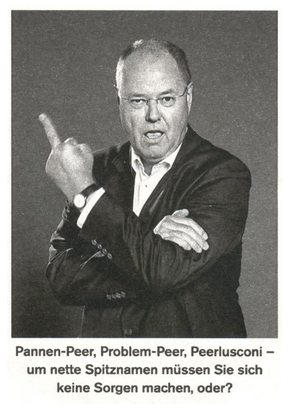
Peer's 'Stinkefinger'

After losing his only televised debate to a necklace, Peer felt the need to take drastic action. But what to do? Well, apparently, if your words aren't working, go 'wordless'. Peer Steinbrück signed up for a 'wordless interview' with Süddeutsche Magazin which ended up receiving widespread coverage in Germany and abroad after he responded to a question by unapologetically flipping the bird. Unfortunately, rather than inspiring the electorate they simply replied in kind...


Lucke's Greek toga party

If you thought Peer's wordless interview was bizarre, wait until you see this. AfD leader (and serious German professor) Bernd Lucke held an interview with German channel Tele 5 on why Greece should leave the euro, during most of which he wore a Greek flag as a toga. He then proceeded to sing a duet with the host, of the AfD's official song to the backing music of Take That's 'Back for good' (a song which Lucke had apparently never heard before). On top of all of this, as some of the papers noted, one of the producers of the show is Greek and proceeded to periodically alter Lucke's voice so that he sounded like Mickey Mouse. A truly bizarre election interview, which is well worth watching even if you don't speak German.

Don't mess with the Currywurst

While pushing for the humane treatment of animals, the Green party ironically managed to shoot themselves in the foot. In an almost inexplicable move, they proposed forcing all public canteens to make one day a week vegetarian day. Unsurprisingly, the suggestion did not go down well in a country famous for loving its meat. “How dare the Greens tell us what to eat!” thundered Germany’s mass circulation Bild newspaper, the day after the proposal was floated. What next? Banning nudism, autobahns or the Hoff...? You simply don't mess with the Currywurst or the Schweinshaxe. The Greens have recently slipped a couple of points in the polls - clearly no coincidence...

Beating the kids at their own game 

The new anti-euro party Alternative für Deutschland was widely derided as a party for old, white and grumpy men or alternatively as the 'Professor party' (if only it was true some would say). The contrast with the young, swinging and tech savvy Pirate party could hardly be greater. However, the AfD has proved it is no slouch when it comes to online campaigning with one of its election campaign videos getting over a million hits, while a Pirate video has received only just over 10,000 views.

Die Partei's whole election campaign


The brilliantly named Partei für Arbeit, Rechtsstaat, Tierschutz, Elitenförderung und basisdemokratische Initiative (Party for Work, Rule-of-Law, Protection of Animals, Advancement of Elites, and Grassroots-Democratic Initiative) - shortened to Die Partei - is a German satirical party akin to the UK's Monster Raving Loony Party, but much funnier. Set up by Martin Sonneborn, editor of the satirical Titanic magazine, its campaign pledges include razing the City of London to the ground and putting Angela Merkel on trial in a cage. Die Partei also released an election video on 'family policy' featuring (pixelated) scenes from an adult film with a soundtrack of "moaning and groaning, accompanied by light-hearted background music".

The hypnotic Chancellor 

We're not sure if it is her or her necklace, but Merkel has certainly lulled the electorate into a state of tepid contentedness. This cartoon perfectly captures the excitement of the CDU's election campaign. Merkel: "You are going to sleep. Everything is good. You are going out to vote..."


A rough ride for AfD

In their misguided attempts to stop the AfD expressing its alleged intolerant views the members of the Green youth decided to physically halt AfD activists from their right to freedom of speech and expression, with no sense of irony. Green with envy of the AfD's media coverage perhaps? In any case, as reported by Spiegel, this is likely to help the anti-euro party's chances, rather then hurt them.

Merkel drones on...

Just when the scandal surrounding the government's bungled purchase of the multi-million euro 'Euro Hawk' surveillance drone was beginning to fade, a CDU event with Angela Merkel and Defence Minister de Maizière in Dresden was interrupted by a miniature drone operated by remote control. The Pirate party claimed responsibility, saying that "The goal was to make Chancellor Merkel and Defence Minister de Maizière realise what it's like to be subjected to drone observation". Judging by the results above maybe they should just make her watch their election video...

David Hasselhof singing on the Berlin wall

Oh, sorry, that was in 1989...maybe it just seems like yesterday since we watch it on a daily basis...

Why Germany's 'boring' elections should still concern David Cameron

Our Nina Schick wrote this op-ed for today's City AM:
For a vote touted as decisive to the future of the Eurozone, the German election campaign – which reaches its climax on Sunday – has been lacklustre. With barely any talk of Europe, it’s been defined by domestic issues – from data protection, to rent control and taxation.

We Germans love a good debate on taxation. But while Germany’s main parties can differentiate on domestic policies, there is no substantial difference on the Eurozone. Long after the vote, and regardless of which coalition takes the helm in Berlin, Germany will remain a slow and deliberating player. No surprise, then, that commentators have dismissed the campaign as the “most boring” in recent memory.

Coalition dynamics may make the vote more interesting, however – and the UK, especially, should take heed. While most initially thought the likely outcome would be a continuation of the current centre-right coalition between Angela Merkel’s CDU/CSU and the liberal free market FDP, this may be changing. With as many as 30 per cent of voters undecided, this election will go down to the wire.

Recent polls show support for Merkel’s CDU/CSU dropping, while support for the centre-left Social Democrats (SPD) has risen. The latest figures predict that Merkel would not be able to form a parliamentary majority with the FDP. There is even a chance the FDP won’t make it past the 5 per cent threshold needed to win seats in the Bundestag. Last weekend, the party crashed out the Bavarian parliament after state elections.

We may see a backflip to the grand coalition of 2005: Merkel’s CDU/CSU and the SPD. While these dynamics won’t change much in the Eurozone, they are important to the UK.

It would be in Britain’s best interest to see a continuation of Merkel’s current coalition. She is a key ally for David Cameron, and will have a decisive influence in determining the success of his EU renegotiation strategy. Both Merkel and Cameron have a similar vision of the EU: based on free trade, reduced regulation, and improved competitiveness. It’s unlikely that anyone other than Merkel will become Chancellor. But if she enters a grand coalition with the SPD, things might not look so rosy for London.

First, in German politics, the foreign ministry usually goes to the junior coalition partner. While relations between Paris and Berlin have been strained since Francois Hollande took office (his spending rhetoric rubs Germans up the wrong way), a SPD foreign minister would be more likely to turn to Paris than London. Under the last grand coalition, the SPD’s foreign minister Frank Walter Steinmeier (also a contender for the post this time around) notably undermined some of Merkel’s foreign policy plans.

Second, the SPD is keen on further financial regulation. Only a few days ago, its parliamentary spokesman vowed that pushing forward delayed plans for a financial transactions tax would be a “high priority” for the SPD if they enter into a grand coalition. Not great news for the City of London.

In short, German coalition semantics may not mean much to the Eurozone – but they certainly will to the UK.

Thursday, September 19, 2013

Germany's anti-euro party mobilises non-voters and FDP supporters

Three days ahead of the German election, Germany's anti-euro party, Alternative für Deutschland is polling at 5%, according to the latest INSA Poll.

If AfD actually wins 5% of the vote, it will enter the Bundestag. The poll  has caused a bit of a stir, as most commentators didn't think AfD would make it into parliament.

Now INSA head Hermann Binkert has broken down where the potential AfD voters come from for FAZ:


22% FDP
16% CDU
9% Linke
6% SPD
3% Greens
3% first-time voters
13% other parties
28% non-voters


- It's interesting that the largest share of the AfD vote comes from non-voters, so it has mobilised non-voters in a way that other parties have not been able to.

- The second largest share of the AfD vote comes from FDP supporters. The FDP haven't been doing too well in the polls (currently at 6%), so there is  the outside possibility that the AfD will make it into the Bundestag while the FDP won't.

Wednesday, September 18, 2013

No quantum leap on eurozone integration after the German elections

Our Director Mats Persson has an op-ed in today's Wall Street Journal, where he argues,
A satirical cartoon in the Italian magazine L'Espresso, depicting a father and son, illustrated it best: "Papa," says the son, "I have to go to the toilet."

"Hush," answers the father. "Hold it until after the German elections."

By now most commentators have realized that there won't be a quantum leap toward more eurozone integration following the German elections. However, while most have focused on coalition dynamics, there are in fact three far more profound limitations that will continue to restrict Germany's ability to act in Europe long after the Sept. 22 elections, and will prevent any swift move toward a euro-zone banking union or fiscal union: One of these limitations is political, one is constitutional and one is economic.

First, German public support for the euro remains highly conditional. According to a recent Open Europe/Open Europe Berlin poll, a majority of Germans support more euro-zone integration if it means more central controls over other countries' taxation and spending. However, a clear majority remain opposed to any policy that involves putting German cash on the line, such as further loans to struggling euro-zone countries, write-downs of existing loans, a joint banking backstop or fiscal transfers.

This is neither surprising nor new. In the 1990s when the euro was forged, the gulf between public and elite opinion was already conspicuous. But despite mounting scepticism, the cost of saving the euro hasn't actually trickled through to people's wallets. If that ever changes, via a slow-down in the German economy, or if savers start to really feel the pinch from the European Central Bank's low interest rates or future possible money printing, we may quickly hit the limit of what the public is willing to endure.
Let's not forget that, given Germany's regional structure, there's almost always another election on the horizon. Between now and when Greece is supposed to exit its bailout program in June 2015, for example, there will be at least five state elections in Germany, as well as the European elections in 2014. German politicians cannot escape public opinion.

Second, the German republic was set up after World War II specifically to prevent hasty centralizations of power. Ironically, this was done at the behest of the Americans and the British—though both Washington and London have been vocal critics of Berlin's cautious approach in the euro-zone crisis. Systemic circuit-breakers such as Germany's Constitutional Court were put in place to counter rash decision-making, while the modern German constitution in 1949 got rid of the federal government's Weimar-era emergency powers.
Today, slowness and consensus are encoded in the very fabric of the German constitutional DNA. This will not change after the elections, nor should we wish it to. While it is unlikely to rule against the ECB's bond-buying program, the Constitutional Court will continue to lay down new red lines for what Germany can and cannot do. The Court has already said that before the euro zone moves to a transfer union, a change to the German constitution will be needed, which will first require a referendum.
It's constitutionally complicated, for example, to write down Greek debt, given that 75% of it is now owned by taxpayer-backed institutions in Germany and the rest of the euro zone. If those institutions take losses on what until now have been loan guarantees, that will in effect turn the euro zone into a transfer union for the first time, which the Constitutional Court has said is illegal. German politicians will continue to have one hand tied by the court in Karlsruhe for years to come.

Then there is the third and most fundamental limitation: Germany can't afford to underwrite the euro forever. If implicit debt, such as the liabilities of Germany's social-security system, are taken into account, the real level of German public debt would be 192% of GDP—much higher than Italy's 146%. Germany has also racked up an exposure to the struggling peripheral countries of around €1 trillion—equivalent to some 40% of its GDP. If Berlin were to begin accepting losses on this, the cost could snowball quickly, as all its sovereign debtors would look for equal treatment. Furthermore, Germany faces a demographic time bomb.

By 2050, the country's current population of 82 million is projected to have declined to around 70 million—less than in 1963. Far fewer workers will be around to finance the country's pay-as-you-go social-security system. This is worse than it looks. Germany, of course, already has its own deeply unpopular transfer union. In this system, out of 16 federal states, only three—Bavaria, Hesse and Baden-Wurttemburgh—are permanent net contributors, with Hamburg moving in and out of that status. Under a hypothetical euro-zone transfer union, these four German regions would proportionally carry a huge burden.

All of this means that there's a relatively stable trajectory to German's EU politics, which defies electoral cycles. So can we expect any movement after Sept. 22? Maybe a little. Particularly in a coalition government that included the center-left Social Democratic Party, we may see some easing of austerity in favor of structural reforms in countries such as Greece or Portugal. But Germans won't give up their deep-held belief in frugality overnight.

Almost any German government is also likely to continue to insist on strong controls over other countries' taxation and spending, most likely via the EU institutions, as quid pro quo for more cash. So the complicated sequencing that's pitting the Germans against the French will continue to dog the euro zone. Make no mistake, Germany will remain a slow, deliberating and frustrating actor for years to come.

Tuesday, September 17, 2013

Germany's anti euro party clashes with major pollster ahead of election

As we have noted in the past, it is possible that Germany’s anti-euro party, Alternative für Deutschland,  has a wider support base than polls suggest. 

Voters may still be embarrassed to admit support for AfD via telephone polling (popular in Germany), and because polls are weighted to include past vote recall, they are inherently biased in favour of the established parties.

Though polls usually put AfD  on about 2-3%, recent polls have put them as high as 4%: just one point short of the 5% threshold needed to enter the Bundestag.

And this issue has been stewing. Last month AfD leader Bernd Lucke claimed that employees of  the major German polling companies, Forsa and Allensbach,  had informed him that AfD was polling well above 5% in the pollsters' raw data, but that they were deliberately fudging AfD’s results.

Pretty sensational stuff if true.

But now the regional court in Cologne has slapped AfD on thewrist, ruling that it is not allowed to make such allegations against Forsa.

Forsa Chief Manfred Güllner (who has previously admitted that the AfD may do better than predicted by polls), called Lucke’s allegations “disgraceful,” adding that AfD hasn’t  “even come close to 5% -- let alone over.”

Güllner isn’t holding back his punches, saying of the Afd leader "I only call him liar Lucke...[he] is completely insane. We handle AfD just like every other party. What Mr Lucke is claming is utter rubbish, a complete conspiracy theory. None of our employees spoke to Mr Lucke, absolute nonsense.”

But with the federal election taking place in less than a week, we will soon know just how accurate the polls have been about AfD.
 

Monday, September 16, 2013

What do the Bavarian election results tell us about next week's general elections?

Yesterday’s Bavarian state elections saw a clear victory for the CSU, Merkel’s CDU sister party at the federal level, securing 47.7% of votes in the 180-seat state legislature. That translates into 101 seats for the conservatives, 10 more than needed to form a majority government.
Results of the Bavarian state elections

So what could that mean for next week’s general elections?
  • Could the results provide a boost to the CDU/CSU and push them an absolute majority at the federal level? This is very unlikely given that the CDU/CSU haven't won an absolute majority at the federal level since 1957 whereas an outright majority for the Conservatives in Bavaria is rather the status quo (except for the previous coalition with the FDP, the CSU has enjoyed an absolute majority for 56 years). 
  • Furthermore, both the CSU and the SPD gained percentage points compared to the previous elections. This result was basically in line with the large majority of pre-election polls. So it won’t necessarily give either party an edge for the next week’s general elections.
  • The FDP lost 4.7% compared to previous state elections and, with overall result of 3.3%, missed the threshold to enter the Bavarian state parliament. This could be seen as a bad omen for next week's general election and may raise the chances of a grand coalition. That said, tactical voting (from CDU/CSU) voters is an important part of FDP support. This result could prompt an increase of such voting at the general election, as CDU/CSU voters fear an FDP failure and the move towards a grand coalition. FDP leader, Philipp Rösler, called its party’s result in the Bavaria elections “a wake-up call”. It could end up being exactly what the party needed to secure its entry to the Bundestag.
  • It's also worth noting that the FDP has traditionally faired badly in Bavaria and rarely makes it into the parliament - the last election then was an exception, rather than the rule. Furthermore, the CSU feared losing an absolute majority so many supporters voted tactically at the previous election, at this one the majority was essentially assured.
  • The usefulness of the Bavarian elections as a bellwether for the general elections should not be overestimated either - the CSU dominates, while the Free voters also have a strong support base but the Greens traditionally struggle. It's also worth keeping in mind that Alternative fur Deutschland did not run in the elections.
The general reading seems to have been that this is a bad sign for the current coalition government with the FDP struggling. That could well be true, but it may just end up being the sign that supporters of the current coalition needed to vote in a way which ensures extra FDP support. All still to play for then next week.

Wednesday, September 11, 2013

No fundamental change in eurozone policy after the German elections

Today we released an in-depth briefing on the German elections, and their implications on the eurozone. The top line: don’t expect any fundamental change in Germany’s eurozone policy after the elections.

Of the nine proposals being floated to pull the eurozone out of crisis, we expect clear movement in only one or two areas, including the most important but most unclear one: the proposal for a single eurozone resolution authority for banks.

Moreover, Germany is unlikely to depart from its emphasis on ‘sparkpolitik’ or austerity. Any change here will be largely superficial: a continuation of same policies wrapped up differently. This is based on Germany desire to ‘lead by example,’ and the broad support for austerity enjoyed among the German public.

The German insistence on structural reforms, and strong controls on taxation and spending of other eurozone states won’t change either. A government lead by Angela Merkel, could, however, push for a formalised “competitiveness pact” where by struggling eurozone countries commit to reforms  in return for aid.

The question of debt pooling will remain a contentious one  –  with the recent Open Europe/ Open Europe Berlin poll, conducted by YouGov Deutschland, showing that 64% of Germans are opposed to such a step. A debt redemption fund, as has been proposed by the influential Council of Economic Experts that advises the government, may be a possibility – however, this won’t be without opposition.

See our table below (click to enlarge) which breaks down and analyses the key eurozone policy areas on a party-by-party basis, detailing if we can expect to see movement after the elections:


Thursday, September 05, 2013

This is how Merkel could flunk the elections: enter the Far Left

Coalition politics combined with proportional representation and a fundamentally regionalised system can create the most fascinating potential outcomes – and do your head in. Like this: Merkel could still lose the German elections. Die Linke – the far-left party with a touch of DDR-nostalgia – could become the Kingmaker, paving way for a Social Democrat (SPD)-Green coalition.
This is how it could work:

The latest polls put the CDU/CSU at 41% and the SPD on 26% - with 59% of voters supporting Merkel as Chancellor compared to 30% who support the SPD’s Steinbrück. With the SPD and Greens still far off an absolute majority as a block, and with the FDP – Merkel’s current junior coalition partner polling at 5-6% ( the Bundestag threshold is 5%), it may seem as if Merkel has bagged it, either as part of a CDU/CSU-FDP coalition, or a CDU/CSU-SPD grand coalition.

However, this race isn’t over yet. If the FDP fails to make the 5% threshold, a lot can happen. The FDP could fail for two reasons: AfD could be nicking more votes from the FDP than expected, and ironically, the FDP scoring well in the Bavarian State elections on 15 September, could divert strategic CDU votes away from the FDP (voters who might vote strategically may have a false sense of confidence in FDP’s chances).

With the FDP out, the CDU/CSU is unlikely to get an absolute majority of Bundestag seats of its own, so it all becomes a matter of which constellation can reach a relative majority.

Enter Die Linke. The political divide between SPD-Greens and Die Linke is far too wide for them to actual joining forces in a coalition – in some SPD circles, Die Linke is, frankly, considered to be full of nutters. However, these parties do have one common interest: get rid of Merkel. So instead of SPD or Greens entering a very messy coalition arrangement with CDU/CSU (which no one wants, except the voters), they can strike a dirty deal with Die Linke whereby the former offer its passive support in the Bundestag on a policy-by-policy basis. A minority government with Die Linke’s blessing.

SPD/Greens would have to offer Die Linke something in return, of course, and the question if there’s any policy area where there’s sufficient overlap – or at least not outright conflict - between the parties manifestos for a deal to be struck. A new wealth tax perhaps? What’s clear is that Germany would take a quantum leap to the left.

What’s interesting is that though Die Linke leadership has previously hinted at this option being ruled out, the party never moved to rule it out completely. Die Linke head Bernd Riexinger said recently “If there is a majority against Merkel [after the elections], I will not exclude any option…only content will decide.” This is a clear invitation. However, we still hold this is as unlikely.

It would be interesting though to observe how Germany, governed by an SPD-Green coalition with Die Linke’s blessing, would continue its leadership role in the eurozone.

UPDATE: 6 September 2013

Speaking on the campaign trail yesterday, the SPD's Chancellor Candidate, Peer Steinbrück reiterated that "The SPD does not consider Die Linke appropriate as a coalition partner." It remains unclear, however, if  Steinbrück is rejecting cooperation with Die Linke until election night, or for the entire duration of the new government term.