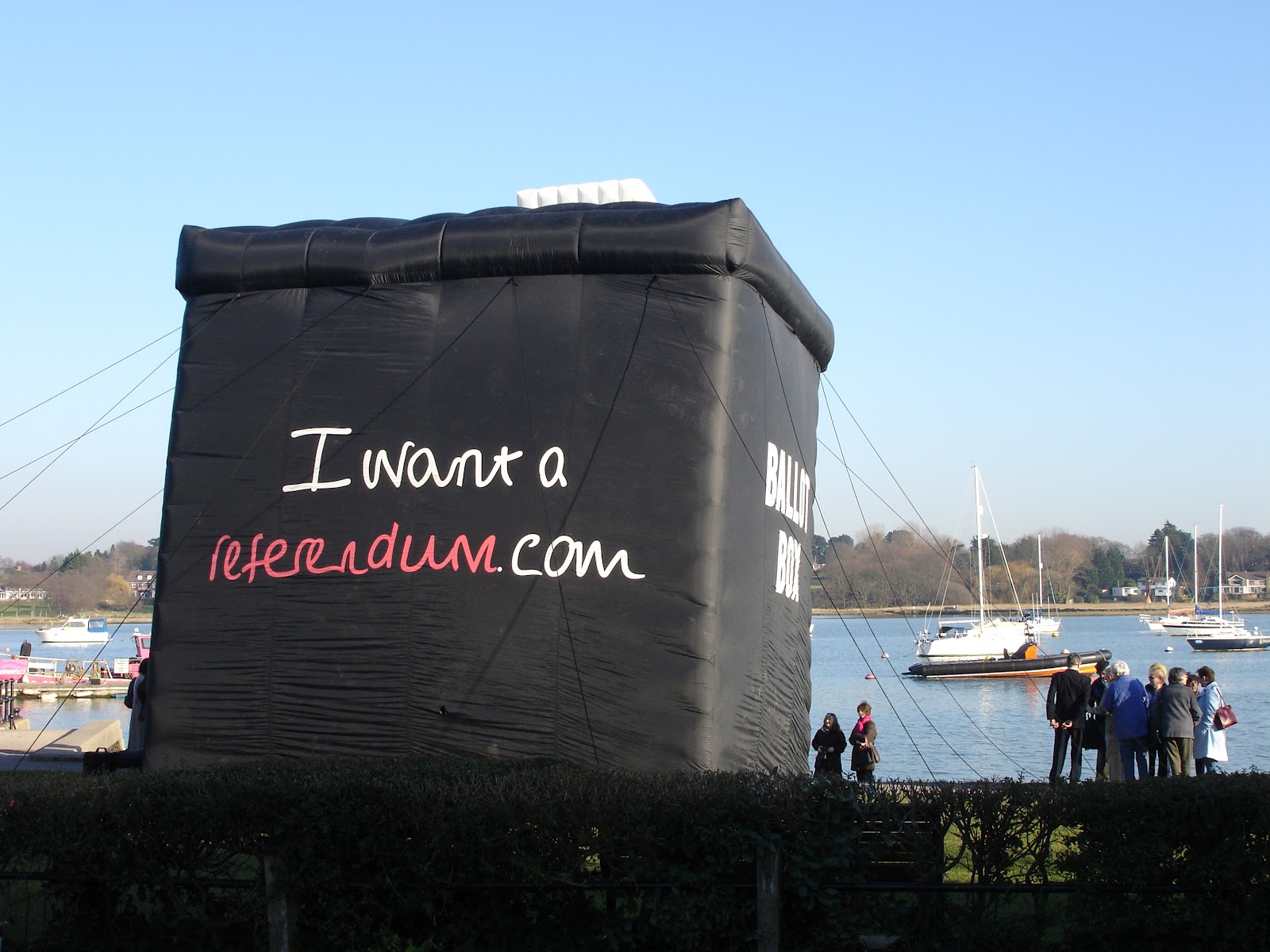
We don’t want to be over-dramatic, but 2017 could shape up to be the toughest year for the EU in a very, very long time. Perhaps ever.
If David Cameron gets re-elected, there will be an In/Out EU referendum in the UK in 2017 (though it could perhaps be delayed). With the appointment of Jean-Claude Juncker as new European Commission President and the symbolic defeat that involved, the risk of Brexit is now arguably higher than ever. The UK could leave the EU in 2017.
At the same time, there’s a growing possibility that Front National leader Marine Le Pen – who’s said she expects “nothing from Europe apart from destruction” – could win the French Presidential election due in April/May 2017. According to a new IFOP poll for French weekly Marianne, Le Pen would finish ahead in the first round of the 2017 presidential election with 26% of votes – followed by former President Nicolas Sarkozy on 25%, and President François Hollande or Prime Minister Manuel Valls on 17%. This means Le Pen and Sarkozy would make it to the final run-off. Although, the chances of her winning the run-off are relatively slim, it is notable that her closest challenger could yet be drowned in a corruption investigation.
As we noted yesterday, Swiss voters will likely be asked to vote again on the country’s relationship with the EU “at the latest by the end of 2016, or the beginning of 2017,” according to Swiss President Didier Burkhalter. It could be a “take it or leave it” vote in response to Swiss voters' opposition to the current free movement arrangements and the EU’s refusal to budge on the issue. If the Swiss vote “leave it”, there will be a huge crisis between Switzerland and the EU.
This wouldn’t be pretty at all. Now, we still don’t see this triple-whammy as a central scenario, but it’s hard to find a more ample illustration of why the status quo in Europe is the biggest threat to its survival.
Get on with EU reform. Now.
Visit our new website.
Showing posts with label switzerland. Show all posts
Friday, August 01, 2014
Thursday, July 31, 2014
EU referendum to be held in 2016 or 2017...No, not that one!
Swiss President Didier Burkhalter (see picture) has today announced that Swiss voters will be asked to vote on the future of their bilateral relationship with the EU "by the end of 2016 or the beginning of 2017."
There have been long-running negotiations over the Swiss-EU bilateral deals, with the EU keen on greater supranational oversight, but these talks gained more urgency in the wake of February's referendum in which the Swiss electorate voted in favour of renegotiating rules on the free movement of persons.
The result stipulated that Switzerland will have to renegotiate its bilateral accord with the EU on free movement within three years or revoke it. This in turn could threaten Switzerland's other bilateral agreements with the EU.
Last week, the EU told Switzerland that it was not prepared to negotiate quotas on free movement. In other words, in that choice between accommodating Swiss demands or playing hardball that we identified back in February, the EU has definitely opted for the latter approach. Interestingly, the decision not to negotiate was apparently reached by unanimity amongst EU governments, meaning that the UK opposed allowing the Swiss to 'renegotiate'. This is awkward for David Cameron, he was left with a choice of either giving Better Off Outers fresh ammunition ("see what the Swiss can do outside the EU") or accusations of denying the Swiss a similar right to which he wants to give Britain. In addition, in that old EU tradition, the Swiss are effectively being asked to 'vote twice', with a view to them voting 'the right way' the second time around.
In any case, faced with this impasse, the Swiss government's approach seems to be to put a 'take it or leave it' package to the public in the hope they vote to renew the bilateral relationship with the EU, even if this means little or no change to the rules on free movement.
Given that Switzerland is already outside the EU, a rejection of the package by the Swiss electorate could see relations return to square one - what that means is anyone's guess at this stage.
If David Cameron is re-elected, Switzerland's 'renegotiation and referendum' could coincide or foreshadow the Conservatives' efforts, which could be interesting.
There have been long-running negotiations over the Swiss-EU bilateral deals, with the EU keen on greater supranational oversight, but these talks gained more urgency in the wake of February's referendum in which the Swiss electorate voted in favour of renegotiating rules on the free movement of persons.
The result stipulated that Switzerland will have to renegotiate its bilateral accord with the EU on free movement within three years or revoke it. This in turn could threaten Switzerland's other bilateral agreements with the EU.
Last week, the EU told Switzerland that it was not prepared to negotiate quotas on free movement. In other words, in that choice between accommodating Swiss demands or playing hardball that we identified back in February, the EU has definitely opted for the latter approach. Interestingly, the decision not to negotiate was apparently reached by unanimity amongst EU governments, meaning that the UK opposed allowing the Swiss to 'renegotiate'. This is awkward for David Cameron, he was left with a choice of either giving Better Off Outers fresh ammunition ("see what the Swiss can do outside the EU") or accusations of denying the Swiss a similar right to which he wants to give Britain. In addition, in that old EU tradition, the Swiss are effectively being asked to 'vote twice', with a view to them voting 'the right way' the second time around.
In any case, faced with this impasse, the Swiss government's approach seems to be to put a 'take it or leave it' package to the public in the hope they vote to renew the bilateral relationship with the EU, even if this means little or no change to the rules on free movement.
Given that Switzerland is already outside the EU, a rejection of the package by the Swiss electorate could see relations return to square one - what that means is anyone's guess at this stage.
If David Cameron is re-elected, Switzerland's 'renegotiation and referendum' could coincide or foreshadow the Conservatives' efforts, which could be interesting.
Friday, February 14, 2014
#DEvote? Majority of Germans want to restrict migration
The Swiss referendum #CHvote to cap the number of EU migrants has sparked strong reactions across Europe. But would other European people vote differently if they were to be asked? An Infratest dimap poll for Deutsche Welle from Wednesday suggests that a relative majority of Germans would like to restrict immigration as well. 48% say they are in favour of capping migration, while 46% are not. A very close call. Note though, that the question was about "immigration" in general rather than "EU migration".
When broken down by party affiliation breakdown, it's clear where these views are most concentrated: 84% of Alternative für Deutschland's supporters say they want a cap on migration. 51% of Angela Merkel's CDU/CSU say the same. Meanwhile, the Greens are least keen, with only 29% supporting the cap.
![]() |
| Courtesy of Deutsche Welle |
In France, the picture might be even more distinct. A TNS Sofres/Le Monde poll recently showed that 34% of French “agree with the ideas” of Marine Le Pen’s Front National. Greens MEP Danile Cohn-Bendit estimates that 60% of French would vote in favour of limiting immigration.
Labels:
#CHvote,
#DEvote,
AFD,
CDU,
CSU,
germany,
poll,
referendum,
switzerland
Monday, February 10, 2014
Europe responds to the Swiss referendum - and it ain't pretty
We suspect the reverberations from the decision in the Swiss referendum to cap the number of EU migrants might be felt for some time (we look at what the long term implications could be for the UK here). The Swiss case is interesting because unlike the debate on migrants from Central and Eastern Europe in the UK, Germany and the Netherlands, it primarily affects citizens of the wealthier member states, primarily Germany, France and Italy. Here are some immediate reactions from around Europe.
The tone from the Berlin has been quite tough with Steffan Seibert, Merkel's spokesperson commenting that:
Meanwhile Alternative für Deutschland leader Bernd Lucke didn't explicitly argue for capping EU migration although he struck a different tone compared with the established German parties, arguing that:
There have also been some strong responses coming out of Brussels with EU Commission spokeswoman Pia Ahrenkilde-Hansen commenting that:
The response from MEPs is also interesting as they might have a say in the negotiations (although this is a bit of a grey area). While EP President Martin Schulz was relatively restrained, other senior MEPs were quick to stick the boot in.
The tone from the Berlin has been quite tough with Steffan Seibert, Merkel's spokesperson commenting that:
"The government takes note of the result and respects it but it is also the case, in our view, that it throws up considerable problems... It's in our interest to keep EU-Swiss relations as close as possible."Foreign Minister Frank-Walter Steinmeier (SPD) added that "I believe that with this result Switzerland has harmed itself". He also dusted off the classic line so beloved of his predecessor in the post:
"there can be no cherry-picking when it comes to the EU"
The new FDP leader Christian Linder echoed this sentiment arguing that "The Swiss are taking from the European buffet only that what they want" (which is kind of the point of a buffet). Interestingly however he added that he was "open-minded" about having more referenda in Germany.Meanwhile Alternative für Deutschland leader Bernd Lucke didn't explicitly argue for capping EU migration although he struck a different tone compared with the established German parties, arguing that:
"Irrespective of the result of the Swiss referendum we can also achieve in Germany an immigration law which is based on qualifications and he ability to integrate while preventing benefits migration... If necessary we could have such referendums [in Germany]."The least diplomatic response came from Ralf Stegner, leader of the SPD faction in Schleswig-Holstein who took to twitter to describe the Swiss as "crazy".
Die spinnen, die Schweizer!
— Ralf Stegner (@Ralf_Stegner) February 9, 2014
The response in France has also been quite tough with Foreign Minister Laurent Fabius arguing that:“This is bad news for Europe and the Swiss, because Switzerland will be penalised from withdrawing into itself... There’s a so-called ‘guillotine clause’ establishing that if one of the elements [of the Swiss-EU bilateral deal] is put into question – in this case, the free movement of workers – everything falls down. Therefore, this means we’ll have to renegotiate […] This means we’re going to reconsider our relations with Switzerland.”Former French PM Fillon (UMP) was commented that:
“It would be totally incomprehensible if Switzerland put a barrier to the access of cross-border workers… On the other hand, that [Switzerland] wants to reduce the overall number of foreigners on its territory is a perfectly natural demand.”Italy's Foreign Minister Emma Bonino said that:
“The impact [of the Swiss referendum] is undoubtedly very worrying, with regard to both Italy and the other agreements with the EU.”Matteo Salvini, the leader of Lega Nord, said:
“Hurrah for Switzerland’s democratic referendum. We’ll propose one in Italy, too.”However, his fellow party member Roberto Cota – the governor of Piedmont – voiced concern over the future of cross-border workers from his region, claiming that:
“Respect is needed, because we’re talking about honest and regular workers. Together with [Roberto] Maroni [the governor of Lombardy, another senior Lega Nord member] we’ll request a meeting with [Italian Prime Minister Enrico] Letta on this issue as soon as possible.”UK Foreign Secretary William Hague was quite restrained, commenting that he did not want to prejudge the results of the negotiations, adding that:
"We will be mindful of the position of 40,000 British nationals who work in Switzerland".Irish foreign minister Eamon Gilmore warned that “We are seeing signs of the rise of the far-right in Europe” while the Luxembourgian foreign minister Jean Asselborn has been the most outspoken, claiming that the vote has put the Swiss in “good company” with people such as Marine Le Pen, the leader of the French Front National.
There have also been some strong responses coming out of Brussels with EU Commission spokeswoman Pia Ahrenkilde-Hansen commenting that:
"The message is clear today: free movement of people is a sacred right for the EU... This will clearly have implications for the rest of the agreements [with Switzerland]."EU Justice Commissioner Viviane Reding, never knowingly understated, argued that "the single market is not a Swiss cheese. You cannot have a single market with holes in it" which is a silly statement given that the Swiss trading relationship actually is a bit like a Swiss cheese, with patchy market access in services, for example.
The response from MEPs is also interesting as they might have a say in the negotiations (although this is a bit of a grey area). While EP President Martin Schulz was relatively restrained, other senior MEPs were quick to stick the boot in.
Disappointing Swiss referendum will lead to disadvantages for CH in new negotiations with EU. #abst14 #CHvote
— Hannes Swoboda (@Hannes_Swoboda) February 9, 2014
So a lot of posturing. These negotiations will be very, very interesting...
Labels:
AFD,
free movement,
immigration,
italy,
Laurent Fabius,
Merkel,
referendum,
steinmeier,
switzerland,
William Hague
EU immigration: Why Ukip should pay close attention to what happens next in Switzerland
Our Director Mats Persson writes on his Telegraph blog:
In a referendum yesterday, the Swiss voted by a narrow margin in favour of restricting immigration from the EU. Switzerland is not an EU member but via around 100 agreements, Switzerland is partly integrated into the EU, including in the contentious area of free movement of workers.
Ukip’s Nigel Farage has been quick to stick the boot in, calling the vote "wonderful news for national sovereignty and freedom lovers throughout Europe." Equally predictable, Vivanne Reding – Vice President of the EU Commission – said that while "we respect the democratic vote of the Swiss people… The single market is not a Swiss cheese. You cannot have a single market with holes in it."
Which is a silly statement. One of the basic flaws with the Swiss trading relationship with the EU is precisely that it suffers from holes, including patchy market access in areas such as services, making it a sub-optimal model for the UK to follow. But Reding’s comments still highlight what an important test case this will be of the feasibility of the pick and mix relationship with the EU from outside, which the UK might have to adopt should it leave the EU.
Here it gets tricky. The Swiss-EU agreement on free movement was part of a bundle of agreements known as Bilaterals I, which also covered six other areas including market access for various Swiss exporters and firms, from trade in agricultural products to civil aviation. Crucially, it contains a "guillotine clause: which says that that the contents – including the market access – can only take effect together: if one of the agreements is terminated, the others would also cease to have effect. This sets Bern up for very difficult talks with Brussels. If the EU wants to play hardball, it could scrap the entire agreement.
There are a huge number of issues captured in the Swiss vote: support for immigration in Europe, the risk for an open economy in erecting new barriers to the world (think labour costs), how the EU responds to referendum results and much more. However, for the UK the implications are clear. If this escalates into other areas of Swiss-EU trade, including restricted market access, many in the UK will argue that a “pick and mix” deal with the EU will be hard to pull off. If, on the other hand, Switzerland was able to renegotiate its relationship to impose some form of restrictions on EU migration, however minor, those who favour UK exit would no doubt see it as a politically palatable precedent.
The Swiss referendum question doesn't specify what shape the immigration quotas would take, but only instructs the Swiss Parliament to draft legislation addressing the issue within the next three years. Much can still happen. However, no matter what, the EU will most certainly negotiate any revised deal with one eye firmly fixed on London, worrying about giving the Brits ideas. And for anyone with even the slightest interest in Britain’s future place in Europe, this is a key one to watch.
Labels:
Farage,
immigration,
Mats Persson,
referendum,
Swiss-EU,
switzerland,
Telegraph,
trade,
UKIP
Friday, February 07, 2014
Switzerland's free movement referendum could provide key test of what life outside the EU is like
On Sunday the Swiss electorate will be asked to vote in a referendum on whether to impose migration quotas on European Union and European Economic Area nationals – a system the country currently uses for non-EU/EEA migrants. The referendum question doesn't specify how large or what shape the quotas would take, but would instruct the Swiss Parliament to draft legislation addressing the immigration issue within the next three years.
Ahead of Sunday’s vote, it is looking very tight with 43% expected to vote in favour of the quotas and 50% against, according to a recent poll by GFS.Bern. If the referendum result goes in favour of introducing quotas, not only would it potentially end free movement between Switzerland and the EU as we currently know it, there could be much wider ramifications for the Swiss-EU relationship that would provide a landmark test case.
The Swiss-EU agreement on free movement was part of a bundle of agreements known as ‘Bilaterals I’, which covered six other areas including the Mutual Recognition Agreement, which simplifies the admission of Swiss products in to the EU market, trade in agricultural products and civil aviation (other aspects of Swiss-EU relations are governed by a 1972 free trade agreement and there is also a Bilaterals II – in total there are 20 main and 100 subsidiary agreements in place). Crucially, Bilaterals I contains a ‘guillotine clause’ stipulating that the contents can only take effect together: if one of the agreements were not to be prolonged or terminated, the others would also cease to have effect.
Nothing will happen immediately on Monday morning, irrespective of the referendum result, because if the Swiss government is mandated to impose quotas it would have to decide what form this would take. Nevertheless, it would set up a very difficult negotiation with Brussels, which, if it wants to play hardball, could scrap the entirety of the rest of the agreement.
Now, it is not difficult to see why this could have consequences beyond Switzerland's relations with the EU (some would argue, it will also be another test of how the EU responds to referendum results). But, should the row escalate and other aspects of Switzerland's trade cooperation with the EU be cut off, many would argue that it illustrates that a pick and mix UK relationship with the EU from outside (particularly a carve out from EU immigration that UKIP would favour) would be difficult or impossible to pull off. If, on the other hand, Switzerland was able to renegotiate its relationship to impose some form of restriction on EU migration, however minor, this would give those who favour UK exit an important precedent to point to.
For this reason, we suspect the EU will take a very hard line with the Swiss government if the Swiss people vote for quotas on Sunday.
Ahead of Sunday’s vote, it is looking very tight with 43% expected to vote in favour of the quotas and 50% against, according to a recent poll by GFS.Bern. If the referendum result goes in favour of introducing quotas, not only would it potentially end free movement between Switzerland and the EU as we currently know it, there could be much wider ramifications for the Swiss-EU relationship that would provide a landmark test case.
The Swiss-EU agreement on free movement was part of a bundle of agreements known as ‘Bilaterals I’, which covered six other areas including the Mutual Recognition Agreement, which simplifies the admission of Swiss products in to the EU market, trade in agricultural products and civil aviation (other aspects of Swiss-EU relations are governed by a 1972 free trade agreement and there is also a Bilaterals II – in total there are 20 main and 100 subsidiary agreements in place). Crucially, Bilaterals I contains a ‘guillotine clause’ stipulating that the contents can only take effect together: if one of the agreements were not to be prolonged or terminated, the others would also cease to have effect.
Nothing will happen immediately on Monday morning, irrespective of the referendum result, because if the Swiss government is mandated to impose quotas it would have to decide what form this would take. Nevertheless, it would set up a very difficult negotiation with Brussels, which, if it wants to play hardball, could scrap the entirety of the rest of the agreement.
Now, it is not difficult to see why this could have consequences beyond Switzerland's relations with the EU (some would argue, it will also be another test of how the EU responds to referendum results). But, should the row escalate and other aspects of Switzerland's trade cooperation with the EU be cut off, many would argue that it illustrates that a pick and mix UK relationship with the EU from outside (particularly a carve out from EU immigration that UKIP would favour) would be difficult or impossible to pull off. If, on the other hand, Switzerland was able to renegotiate its relationship to impose some form of restriction on EU migration, however minor, this would give those who favour UK exit an important precedent to point to.
For this reason, we suspect the EU will take a very hard line with the Swiss government if the Swiss people vote for quotas on Sunday.
Tuesday, May 21, 2013
EEA plus: a model for the future of the UK in Europe?
For all the noise about Europe in the UK, British sceptics (with some exceptions) aren't necessarily great at thinking outside the box.
We have previously looked at the existing models used by countries that have decided against/been refused EU membership (i.e. Norway's EEA membership, Switzerland's Free Trade Agreements, Turkey's customs union with the EU, or simply the WTO) and concluded that they would all have drawbacks for a country and economy as large and diverse as the UK. In particular, the Norwegian model is pretty much a non-starter.
However, there is another hypothetical model, which we will set out in a forthcoming briefing, that could be more attractive if it could be secured: let's call it 'EEA plus'.
Now, we don't necessarily advocate this particular option and this is only a blogpost, but intellectually and politically, it's far more attractive than anything we've seen so far in terms of a fundamental replacement for the current EU structure.
Over the last decade, several figures, including Jacques Delors, former EU Commission President, and Valery Giscard d’Estaing, former French President and author of the EU Constitution, have suggested the UK be given ‘associate membership’ or ‘special status’. Neither concepts have been fully fleshed out, but Giscard d’Estaing suggested that a ‘special status’ could allow the UK to opt-out of future EU policies, which could allow it to continue to vote on policies it took part in but not on those it didn’t. Lord Owen has made a similar argument - which he will expand on in a speech today.
From where we sit, there is one absolutely vital element that has to be added if this is going to work for the UK: voting rights. The great weakness of the EEA model at the moment is that a country like Norway, as we have noted repeatedly, is out of the EU but run by the EU. It just wouldn't work for the UK (which is home to 36% of the EU's wholesale finance market, for example).
So what 'EEA plus' would involve is single market access but with votes on all laws which are EEA relevant. For EU geeks, it would be a bit like EEA-EU co-decision over single market laws. There are several ways in which this could work. For example, an "EEA council" already exists with members from both the EU and EEA states. This could be expanded to be the effective decision-making body for the EU as a whole in the fields that apply to both constituencies. Alternatively, a majority could be needed in both the EU Council of Ministers and a comparable EEA body for it to become law in both. A range of other issues, such as an arbitrage mechanism and ECJ jurisdiction, would have to be thought through. Also, it would have to be designed so that only genuine single market measures made it into the agreement - not the add-ons such as employment laws (which Norway has to accept) - whilst the UK may wish to stay inside the EU customs union (which Norway and Switzerland are not part of). The UK may also want to be part of other areas, such as crime and police cooperation (perhaps on a bilateral opt-in basis) and there would also need to be consideration about the merits of retaining its veto over EU foreign policy for example.
But, crucially, such an arrangement would get around the massive drawbacks inherent in the Norwegian model. Another great advantage of this model is that it could provide an institutional wrapping for all those countries that for one reason or another cannot be full EU members, and certainly not eurozone members: the UK, Norway, Switzerland and maybe even Turkey. It would be a new mode of European membership - and, if the UK can get its act together, very much the "economic growth" tier.
If you think this is far-fetched, you might be right, but it's actually not a new idea. In 1989, ahead of the negotiations that would establish the EEA agreement, Delors mooted a “more structured partnership with common decision-making and administrative institutions”, which would have potentially given those countries market access and decision making powers, rather than the limited right of refusal that EEA countries currently have.
In a speech in 1989, discussing the potential approach to those countries who had remained in the European Free Trade Association (EFTA), Delors said:
A final sobering thought: the final result of the EEA talks only granted EEA states ‘decision-shaping’ powers through representation on non-legislative committees and consultation with the EU Commission and a right of refusal that is relatively weak becuase it can result in loss of market access – giving an indication that this will be a challenge to achieve.
We have previously looked at the existing models used by countries that have decided against/been refused EU membership (i.e. Norway's EEA membership, Switzerland's Free Trade Agreements, Turkey's customs union with the EU, or simply the WTO) and concluded that they would all have drawbacks for a country and economy as large and diverse as the UK. In particular, the Norwegian model is pretty much a non-starter.
However, there is another hypothetical model, which we will set out in a forthcoming briefing, that could be more attractive if it could be secured: let's call it 'EEA plus'.
Now, we don't necessarily advocate this particular option and this is only a blogpost, but intellectually and politically, it's far more attractive than anything we've seen so far in terms of a fundamental replacement for the current EU structure.
Over the last decade, several figures, including Jacques Delors, former EU Commission President, and Valery Giscard d’Estaing, former French President and author of the EU Constitution, have suggested the UK be given ‘associate membership’ or ‘special status’. Neither concepts have been fully fleshed out, but Giscard d’Estaing suggested that a ‘special status’ could allow the UK to opt-out of future EU policies, which could allow it to continue to vote on policies it took part in but not on those it didn’t. Lord Owen has made a similar argument - which he will expand on in a speech today.
From where we sit, there is one absolutely vital element that has to be added if this is going to work for the UK: voting rights. The great weakness of the EEA model at the moment is that a country like Norway, as we have noted repeatedly, is out of the EU but run by the EU. It just wouldn't work for the UK (which is home to 36% of the EU's wholesale finance market, for example).
So what 'EEA plus' would involve is single market access but with votes on all laws which are EEA relevant. For EU geeks, it would be a bit like EEA-EU co-decision over single market laws. There are several ways in which this could work. For example, an "EEA council" already exists with members from both the EU and EEA states. This could be expanded to be the effective decision-making body for the EU as a whole in the fields that apply to both constituencies. Alternatively, a majority could be needed in both the EU Council of Ministers and a comparable EEA body for it to become law in both. A range of other issues, such as an arbitrage mechanism and ECJ jurisdiction, would have to be thought through. Also, it would have to be designed so that only genuine single market measures made it into the agreement - not the add-ons such as employment laws (which Norway has to accept) - whilst the UK may wish to stay inside the EU customs union (which Norway and Switzerland are not part of). The UK may also want to be part of other areas, such as crime and police cooperation (perhaps on a bilateral opt-in basis) and there would also need to be consideration about the merits of retaining its veto over EU foreign policy for example.
But, crucially, such an arrangement would get around the massive drawbacks inherent in the Norwegian model. Another great advantage of this model is that it could provide an institutional wrapping for all those countries that for one reason or another cannot be full EU members, and certainly not eurozone members: the UK, Norway, Switzerland and maybe even Turkey. It would be a new mode of European membership - and, if the UK can get its act together, very much the "economic growth" tier.
If you think this is far-fetched, you might be right, but it's actually not a new idea. In 1989, ahead of the negotiations that would establish the EEA agreement, Delors mooted a “more structured partnership with common decision-making and administrative institutions”, which would have potentially given those countries market access and decision making powers, rather than the limited right of refusal that EEA countries currently have.
In a speech in 1989, discussing the potential approach to those countries who had remained in the European Free Trade Association (EFTA), Delors said:
“There are two options:
(i) we can stick to our present relations, essentially bilateral, with the ultimate aim of creating a free trade area encompassing the Community and EFTA;
(ii) or, alternatively, we can look for a new, more structured partnership with common decision-making and administrative institutions to make our activities more effective and to highlight the political dimension of our cooperation in the economic, social, financial and cultural spheres.
It would be premature to go into the details of this institutional framework. I have my own ideas, but they need to be discussed by the new Commission and then informally, without obligation, with the countries concerned. It should be noted however that the options would change if EFTA were to strengthen its own structures. In that case the framework for cooperation would rest on the two pillars of our organizations. If it did not, we would simply have a system based on Community rules, which could be extended — in specific areas — to interested EFTA countries and then perhaps, at some date in the future, to other European nations.
But if we leave the institutional aspect of such a venture aside for a moment and focus on the substance of this broader-based cooperation, several delicate questions arise. It becomes clear in fact that our EFTA friends are basically attracted, in varying degrees, by the prospect of enjoying the benefits of a frontier-free market. But we all know that the single market forms a whole with its advantages and disadvantages, its possibilities and limitations. Can our EFTA friends be allowed to pick and choose? I have some misgivings here.”This option could probably qualify as both "in" and "out". For one, it would be very similar to the Single Market plus deal that Boris Johnson has argued for in the past and, could be defined as staying in the EU, although on a radically different basis.
A final sobering thought: the final result of the EEA talks only granted EEA states ‘decision-shaping’ powers through representation on non-legislative committees and consultation with the EU Commission and a right of refusal that is relatively weak becuase it can result in loss of market access – giving an indication that this will be a challenge to achieve.
Labels:
Brixit,
eea,
EEA plus,
EU reform,
norway,
renegotiation,
single market,
single market plus,
switzerland,
Turkey,
wto
Thursday, July 19, 2012
What Cameron should have told the Telegraph
David Cameron is quoted in today’s Telegraph saying that he wants to negotiate a “new settlement” with the EU with powers returned to Britain, but that he would never campaign for an “out” vote in a referendum. “If your vision of Britain was that we should just withdraw and become a sort of greater Switzerland, I think that would be a complete denial of our national interests”, he said.
The ‘never’ part doesn’t seem to be a direct quote so it’s not entirely clear how to interpret it. However, several commentators have already laid in to Cameron over ‘revealing his negotiation hand’. In order to make demands for renegotiation credible, so the argument goes, Cameron must be willing to keep the “out” option open, in order to have a fall-back plan should negotiations fail. Otherwise, other member states have nothing to fear and can just tell the UK to go and stuff itself. A couple of things:
Therefore, the smartest thing for Cameron to say would be: As we set out in the Tory manifesto, we remain committed to EU membership and will not seek an “Out” vote. However, we must also acknowledge that the UK public is understandably growing more restless by the day. Absent new EU membership terms for Britain, while I personally would be against it, there may come a day, when it will no longer be possible to resist pressure for the UK leaving the EU, which would create a hugely unpredictable situation that would be in Berlin’s and Brussels’ interest to avoid.
David Cameron should frame the renegotiation of the UK’s membership terms as a bid to save the UK’s EU membership – that is a far more powerful negotiating tool than any short term threat for him to campaign to leave because, it could potentially gain support from some unexpected quarters, it is true and does not rely on the promise of a politician.
The ‘never’ part doesn’t seem to be a direct quote so it’s not entirely clear how to interpret it. However, several commentators have already laid in to Cameron over ‘revealing his negotiation hand’. In order to make demands for renegotiation credible, so the argument goes, Cameron must be willing to keep the “out” option open, in order to have a fall-back plan should negotiations fail. Otherwise, other member states have nothing to fear and can just tell the UK to go and stuff itself. A couple of things:
- As the Telegraph’s James Kirkup has pointed out, when he said he wants to stay in the EU, Cameron merely restated what was in the 2010 Tory manifesto, so it’s not as if he’s changed position
- There’s virtually no clean ‘out’ option to fall back on. Whether EEA, bilateral FTA or Turkey+, all alternative models also require renegotiation with, and approval by, the other 26 member states, meaning that the ‘what happens if they say no’ question still applies also under an ‘out’ scenario. The only way Cameron can get around that is by explicitly stating that he’s willing to fall back on WTO rules – which would not require anything – but which would instantly turn the entire UK business community, amongst others, against him.
Therefore, the smartest thing for Cameron to say would be: As we set out in the Tory manifesto, we remain committed to EU membership and will not seek an “Out” vote. However, we must also acknowledge that the UK public is understandably growing more restless by the day. Absent new EU membership terms for Britain, while I personally would be against it, there may come a day, when it will no longer be possible to resist pressure for the UK leaving the EU, which would create a hugely unpredictable situation that would be in Berlin’s and Brussels’ interest to avoid.
David Cameron should frame the renegotiation of the UK’s membership terms as a bid to save the UK’s EU membership – that is a far more powerful negotiating tool than any short term threat for him to campaign to leave because, it could potentially gain support from some unexpected quarters, it is true and does not rely on the promise of a politician.
Labels:
david cameron,
free trade,
referendum,
renegotiation,
switzerland
Friday, May 11, 2012
EU Referenda games: staying in, leaving or renegotiation - it's all complicated
With Europe as fluid as ever, talk of some sort of EU referendum is heating up in the UK (well at least in the Westminster bubble).
The always excellent James Forsyth of the Spectator argued in the magazine yesterday that London Mayor Boris Johnson’s support for a referendum and UKIP’s rise taken together “make it highly likely that Britain will have its first vote on Europe since 1975 within the next five years."
He also notes that,
"The popularity of Cameron’s EU veto made his circle realise how much of a political asset Euroscepticism could be, if used in the right way. There is also concern in No. 10 that if the Tories don’t offer the public a vote, Labour will."
He goes on to say that,
And Forsyth's colleague Alex Massie also picks up on this on the Speccie's Coffee House blog, looking at all the complications involved in trying to square an EU renegotiation with a referendum (the "on what?" question always looms large). We've looked at the various options for a referendum in detail before, so this is all familiar (if you're interested in the different options, we strongly recommend reading this piece). Massie makes a good point though. An EU referendum is too often seen in Tory leadership ranks as being about "a matter of party morale, discipline and tactical positioning", not getting something that actually works for the UK.
We agree. The thing is, this is far too complicated an issue to make a matter of mere party management. It will be part of the equation, of course, but making it subject to pure party politics will reduce the discussion to the usual Westminster back-and-forth on vague concepts such as "influence", "isolation" or "sovereignty" - it will be Mandelson land.
But where Massie - and a whole range of other commentators and politicians - get it wrong is when they say that in contrast to the renegotiation option, "an in/out plebiscite at least offers a choice between easily-grasped options."
No it doesn't. Staying in raises a whole range of complicated questions - what does the UK do if the eurozone takes that quantum leap towards further integration? What happens if the EU merely becomes a political extension of the eurozone (which Britain can't join)? In other words, if we want things to stay as they are, things will have to change.
And the "out" option? It sounds easy at a superficial glance, but in a serious discussion, it would raise far more questions than answers. In fact, there's virtually no "out" option (save perhaps one) - all options to withdraw from the EU treaties (which is what 'out' must mean, though it is rarely defined), involves joining something else. Doing a "Norway" would be suicide for UK, i.e. accepting 2/3 of EU laws but with no say over them; a Switzerland would be slightly better but still immensely complicated. A different type of Free Trade Agreement altogether involving business paying hefty fees or facing new admin burdens on exports to the EU, which contain some imported components? A customs union a la Turkey meaning being stuffed on market access on services? Simply falling back on the WTO's Most Favoured Nation (MFN) rules, with a range of costly barriers to trade and movement?
Answers anyone? The truth is that most of the complications that apply to renegotiation, also apply to the "out" option, including the need for some sort of "approval" from other countries for whatever alternative arrangement the UK enters into (apart from the WTO option) possibly. The truth is that all three options: staying in on current terms, renegotiation or withdrawal from the EU treaties are massively complicated. To whet your appetite, we're about to publish a comprehensive report looking at the different options for the UK was it to vote to decide to leave. And trust us, it's complicated.
What we do know is that both Britain and the eurozone will simply have to move. It's therefore right that No 10 is now considering different options.
But again, it should be for the right reasons.
The always excellent James Forsyth of the Spectator argued in the magazine yesterday that London Mayor Boris Johnson’s support for a referendum and UKIP’s rise taken together “make it highly likely that Britain will have its first vote on Europe since 1975 within the next five years."
He also notes that,
"The popularity of Cameron’s EU veto made his circle realise how much of a political asset Euroscepticism could be, if used in the right way. There is also concern in No. 10 that if the Tories don’t offer the public a vote, Labour will."
He goes on to say that,
"One source intimately involved in Tory electoral strategy told me recently that a referendum in the next manifesto was ‘basically a certainty’...My understanding is that, at the moment, the favoured option is to propose renegotiation, followed by a referendum on the new arrangements within 18 months. During the campaign, the Tories would argue for staying in if new terms could be agreed but leaving if the rest of Europe refused to play ball."The equally excellent Paul Goodman over on Conservative Home today echoes Forsyth, listing a range of reasons why a referendum draws nearer.
And Forsyth's colleague Alex Massie also picks up on this on the Speccie's Coffee House blog, looking at all the complications involved in trying to square an EU renegotiation with a referendum (the "on what?" question always looms large). We've looked at the various options for a referendum in detail before, so this is all familiar (if you're interested in the different options, we strongly recommend reading this piece). Massie makes a good point though. An EU referendum is too often seen in Tory leadership ranks as being about "a matter of party morale, discipline and tactical positioning", not getting something that actually works for the UK.
We agree. The thing is, this is far too complicated an issue to make a matter of mere party management. It will be part of the equation, of course, but making it subject to pure party politics will reduce the discussion to the usual Westminster back-and-forth on vague concepts such as "influence", "isolation" or "sovereignty" - it will be Mandelson land.
But where Massie - and a whole range of other commentators and politicians - get it wrong is when they say that in contrast to the renegotiation option, "an in/out plebiscite at least offers a choice between easily-grasped options."
No it doesn't. Staying in raises a whole range of complicated questions - what does the UK do if the eurozone takes that quantum leap towards further integration? What happens if the EU merely becomes a political extension of the eurozone (which Britain can't join)? In other words, if we want things to stay as they are, things will have to change.
And the "out" option? It sounds easy at a superficial glance, but in a serious discussion, it would raise far more questions than answers. In fact, there's virtually no "out" option (save perhaps one) - all options to withdraw from the EU treaties (which is what 'out' must mean, though it is rarely defined), involves joining something else. Doing a "Norway" would be suicide for UK, i.e. accepting 2/3 of EU laws but with no say over them; a Switzerland would be slightly better but still immensely complicated. A different type of Free Trade Agreement altogether involving business paying hefty fees or facing new admin burdens on exports to the EU, which contain some imported components? A customs union a la Turkey meaning being stuffed on market access on services? Simply falling back on the WTO's Most Favoured Nation (MFN) rules, with a range of costly barriers to trade and movement?
Answers anyone? The truth is that most of the complications that apply to renegotiation, also apply to the "out" option, including the need for some sort of "approval" from other countries for whatever alternative arrangement the UK enters into (apart from the WTO option) possibly. The truth is that all three options: staying in on current terms, renegotiation or withdrawal from the EU treaties are massively complicated. To whet your appetite, we're about to publish a comprehensive report looking at the different options for the UK was it to vote to decide to leave. And trust us, it's complicated.
What we do know is that both Britain and the eurozone will simply have to move. It's therefore right that No 10 is now considering different options.
But again, it should be for the right reasons.
Labels:
britain in europe,
Cameron,
EU reform,
norway,
referendum,
renegotiation,
switzerland,
trade,
wto
Subscribe to:
Posts (Atom)