• Facebook
  • Facebook
  • Facebook
  • Facebook

Search This Blog

Visit our new website.
Showing posts with label CDU. Show all posts

Thursday, October 23, 2014

Michael Wohlgemuth: Why the EU cannot bank on Germany’s economy

Open Europe Berlin Director Michael Wohlgemuth has written an interesting piece for World Review, looking at the current status of the German economy. Here it is:
The German economy is showing clear signs of weakening. GDP declined by 0.2 per cent in the second quarter of 2014 and German business sentiment fell for a fifth straight month in September to its lowest level in 17 months. Manufacturing orders dropped during August to the lowest level since May 2013.

Germany’s problems will remain and get worse.

Much of the resilience of the German economy during the last years can be attributed to harsh labour market and social security reforms. These were introduced by the Social Democrat Chancellor Gerhard Schroder (1998-2005) in 2003 with his ‘Agenda 2010’.

The new centre-right / centre-left coalition led by Chancellor Angela Merkel has rolled back many of these reforms by reintroducing early retirement, granting extra pensions for mothers and installing an unprecedented legal minimum wage - of 8.50 euros per hour - in all sectors and all regions of Germany.

The German government has been forced to admit that the minimum wage will increase labour costs by 10 billion euros. It is still unclear how many jobs will be lost after its introduction in 2015.

The new pension benefits will cost around 200 billion euros until 2030. Early retirement could take up to 250,000 elderly off the job market over the coming years when skilled and experienced labour is becoming increasingly scarce and valuable.

Demographic decline will be Germany’s greatest challenge in the long run: coming decades could see Germany’s workforce shrink by about 200,000 every year. The old age dependency ratio - between those older than 65 and those of working age - could increase from 31 per cent in 2013 to 57 per cent in 2045.

Immigration to boost the workforce would be essential. Experts calculate that net-migration of around 400,000 people a year - preferably young and educated - would be needed to avoid demographic decline.

So where should Germany’s future economic growth, desperately needed to pay for pensions and somehow to rescue the eurozone, come from?

The answer is from productivity and innovation, in short: smart investment. Labour participation rates, labour productivity and entrepreneurial ingenuity would have to increase dramatically.

However, Germany’s productivity growth is lagging behind almost all other economies in the world.

The established German Mittelstand - its economic backbone of small and medium-sized enterprises - and some big exporting firms, are still good at innovation. However, Germany holds a dismal 111th place in the World Bank’s ranking for ‘ease of starting a business’ and its service sector is under-developed and over-regulated, while Germany’s education system fails to produce enough matching skills.

Germany’s capital stock is depreciating faster than new investments are replacing it. A declining capital stock combined with a declining workforce, leaves no hope for a growing economy.

That does not mean Germany’s government must add more public debt to the mix.

Many observers are demanding that the government abandons its ‘austerity obsession’ and take advantage of the historically low interest rates for more debt-financed ‘stimulus’.

But the Merkel government is still in the position to do the right thing and increase investment without abandoning the new constitutional balanced budget rule. German politics should also provide better regulatory and tax environments for private domestic investment and lower barriers to entry for its service sector.

Domestic industrial investment is also increasingly discouraged by the ‘lonely revolution’ to wean Germany off both fossil and nuclear energy.

This policy may cost consumers, taxpayers and business up to one trillion euros over the next two decades, according to Peter Altmaier, the former minister for the environment, who is now chief of the Chancellery and minister for special affairs.

German energy costs are now more than double those in the US, while Germany’s greenhouse emissions have increased.

German entrepreneurs and foreign investors have always had these negative factors on their radar.

Germany’s problem is not austerity, but demography and complacency. The message is you cannot bank on Germany.

Monday, September 01, 2014

The CDU's 'AfD problem': too big to ignore, too controversial to team up with

Yesterday’s regional elections in Saxony saw Germany's anti-euro Alternative für Deutschland (AfD) score an impressive 9.7%  netting the party its first ever seats in one of Germany’s regional parliaments. The lead candidate of the Green party, Antje Hermenau, described the AfD result as an “earthquake” while AfD leader Bernd Lucke celebrated that they “finally arrived on the German party landscape.”

It is now up to German Chancellor Angela Merkel’s CDU party to find a new coalition partner after Saxony's FDP followed the national party in losing all its seats. The CDU's lead candidate and current Prime Minister of Saxony, Stanislaw Tillich, categorically excluded a potential coalition with the AfD describing it as a protest party that due to its inner turmoil was completely unfit to govern. He only waited until after the election result was announced to make this statement however, following a debate within the CDU which continues.

Commenting on the prospects for a CDU-AfD coalition, Bild columnist Bela Anda writes that if it were to enter into a coalition with the AfD,
“The CDU would saw off the branch on which it itself is sitting." 
A CDU-SPD grand coalition is therefore the most likely option although a CDU-Green coalition could also be on the cards.

So is the AfD 'Gekommen um zu bleiben' (here to stay)?

This is not only the title of a famous German pop song but now the question everyone is asking themselves. Regional elections in Thüringen and Brandenburg are coming up in two weeks and the AfD has a good chance of enter both regional parliaments. However, the party's objective remains winning Bundestag seats in 2017 having narrowly missed the 5% threshold in 2013. There will be another eleven regional elections before 2017 and the challenge for the party will be to keep the momentum going. The AfD leadership will no doubt remember the fate of the Pirate party in 2011 - polled at a spectacular 13% before plummeting into virtual non-existence.

In Saxony a large share of AfD vote came from ‘Sonstige’ (other parties) and ‘Nichtwähler’ (non-voters) which is typical for protest parties. But at the same time there is a considerable spread across most mainstream parties with the largest share coming from the CDU (34,000 votes).


This would be a particular headache for Angela Merkel’s party. The worst case scenario for Merkel is that the AfD becomes to the CDU what Die Linke is to the SPD - and indeed, some would say, UKIP to the Tories in Britain: too big to ignore, too controversial to team up with. This headache will become particularly severe if the liberal FDP's decline is irreversible, dooming the CDU to always have to look to the SDP (or the Greens), in turn making left-right coalitions more or less a permanent feature of German politics.

Friday, February 14, 2014

#DEvote? Majority of Germans want to restrict migration

The Swiss referendum #CHvote to cap the number of EU migrants has sparked strong reactions across Europe. But would other European people vote differently if they were to be asked?

An Infratest dimap poll for Deutsche Welle from Wednesday suggests that a relative majority of Germans would like to restrict immigration as well. 48% say they are in favour of capping migration, while 46% are not. A very close call.  Note though, that the question was about "immigration" in general rather than "EU migration".

When broken down by party affiliation breakdown, it's clear where these views are most concentrated: 84% of Alternative für Deutschland's  supporters say they want a cap on migration. 51% of Angela Merkel's CDU/CSU say the same. Meanwhile, the Greens are least keen, with only 29% supporting the cap.
Courtesy of Deutsche Welle
In France, the picture might be even more distinct. A TNS Sofres/Le Monde poll recently showed that 34% of French “agree with the ideas” of Marine Le Pen’s Front National. Greens MEP Danile Cohn-Bendit estimates that 60% of French would vote in favour of limiting immigration.

Monday, February 03, 2014

German Foreign Minister welcomes discussion on EU Treaty Change


German Foreign Minister, Frank-Walter Steinmeier, is visiting his counterpart, William Hague, in London today. Although the visit doesn't seem to have received much media coverage, we've just been at the press conference, and Herr Steinmeier had some interesting things to say. Unsurprisingly, Steinmeier said he wanted the UK in the EU.

Further Eurozone integration

Steinmeier said that the UK could play a pivotal role in making the EU more effective and competitive, but he also said that it was important not to "backtrack on European integration", but it was not clear if he was referring to Eurozone integration – which the UK actually isn’t against. Hague opened the press conference, saying that both government agreed to work together to ensure a "fairer system" to all Member States in the EU.

Repatriation of Powers 

Steinmeier also made clear that the EU should govern on the "big questions" - that it should rule where it is most effective. In this context, then, he said that there should be a further discussion on which competences would be best regulated on the national level. It was unfortunate that we didn't get a chance to ask Herr Steinmeier to comment on CDU's draft European Parliament election manifesto, which Handelsblatt reported on today as explicitly saying:
“A repatriation of competences to the national level should be possible.” 
Treaty change

The German government – particularly the CDU/CSU wing continue to insist on Treaty Change in some form to provide more central control in the eurozone over spending. At the same time, Cameron wants a Treaty Change to institutionalise flexible integration including the possibility to pursue “less Europe”. The idea is to combine the two in a new grand bargain. Remember, last week French President Francois Hollande restated that Paris didn’t see Treaty Change as a “priority” for fear of a referendum (which would be politically hard to avoid due to the German-style Treaty Change, not the British one). This created headlines in the UK.

Steinmeier said that discussions over Treaty Change are far more nuanced than a polarised vision of Britain on one side asking for the all the Treaties to be opened up, and France on the other, resisting any such discussion – which is exactly what we’ve said. In fact, Steinmeier said he "welcomes a debate" and is "not against discussing an adaptation of the Treaties." He added that there’s a debate raging in Germany at the moment over how to put Eurozone integration on a constitutionally and politically sound footing.

However, he also said that Germany and Britain aren’t completely aligned over Treaty Change, and, somewhat uncomfortably for Hague et al, argued that any major revision to the Treaties along the lines of what the UK is calling for, should perhaps be deferred until the eurozone stabilises further.  "It's not just to do with the UK and Germany that some things are stalling," said Steinmeier.

When asked the crucial question whether he believed that Treaty Change would coincide with David Cameron's 2017 timeline, Steinmeier said it "was too complicated a prognosis" to be able to give a straight answer.

Free movement 

Steinmeier said that the Bundestag has set up a working group to present solutions on how square sensible rules on access to benefits with free movement. He said that the debate in Germany on free movement – while it was definitely was an intense debate - was in "sensible boundaries", a nod to the UK press and its handling of Romania and Bulgaria.

Rückführung alert: CDU says repatriation of EU powers must be possible

This is interesting from today’s Handelsblatt. The paper has apparently seen the CDU’s draft manifesto ahead of the European elections. As a reminder: the CDU is Angela Merkel's party, which, along with its sister party, the CSU, won a landslide with 41.5% of the vote in the last federal election. It's what you would call the very definition of mainstream. 
 
The CDU manifesto calls for an “an effective regulation brake” with decisions needing to be “effective and more transparent.” Interestingly, the CDU manifesto suggests that the European Commission should be required to scrap an EU law if a majority of national parliaments says it could be handled better at the national or regional level . This seems to be very similar to the idea of a “red card”, which we long have argued for and which Dutch Foreign Minister Frans Timmermans, for example, has championed.

Perhaps even more interestingly, according to Handelsblatt, the CDU draft manifesto  also explicitly states that:
“a repatriation of competences to the national level should be possible.”
This is significant since German politicians tend to avoid using the word “repatriation” – or Rückführung – since it has strong connotations, instead preferring a range of other more guarded expressions including Dezentralisierung, Regionalisierung, Übertragung, Subsidiarität and Verhältnismäßigkeit.

Handelsblatt’s take on this is that that the :
“CDU is reacting to growing euroscepticism in the country” including to anti-euro party Alternative für Deutschland (AfD).
However, the take of CDU's campaigners is (as to be expected) that the party is simply becoming more realistic - which is a neat way of putting it:
 
Meanwhile, the Today programme has an interview with Hans-Olaf Henkel – formerly the head of the BDI (The German equivalent of the CBI) – now with AfD.

Henkel argues that though he wants return of EU powers, he also wants Germany to stay in the EU. Today's take on this is that "British sceptics may be disappointed" if they look to Berlin, concluding that “Even the German sceptics are not very sceptical when compared to their British counterparts.” Now, this isn't necessarily right nor wrong -- but just not very insightful.
  • First, as we’ve argued before, the main clash in Germany is not between the “pro-European” and “anti-European” schism that the BBC is constantly looking for, but rather between two key pillars of post-WWII Germany: Europe and sound money.
  • Secondly, is the BBC saying that the definition of “Eurosceptic” is now wanting to leave the EU?  If so -- it will have made a lot of "Better Off Outers" very happy. However, that also means that it can no longer use the "Eurosceptic" label for a whole of host of other actors, including large chunks of the current Conservative government which, irrespective of the rights or wrongs, want to stay in a reformed EU.

This isn't becoming too complicated for black-and-white labels, is it?

Tuesday, January 21, 2014

Day 2 of the #EUReform conference: Powerful debate on all levels

Day two of the Open Europe / Fresh Start #EUReform conference saw a thriving exchange of reform ideas between panelists and conference delegates, viral Twitter action for #EUReform via the Twitter wall, as well as numerous media interviews. 
Eva Kjer Hansen, Chair of the EU Affairs Committee the Danish Parliament discussing the role of national parliaments in the EU.
Swedish columnist Katrine Kielos of Aftonbladet moderated the "Where does democractic authority lie" panel.

Susanna Koski , President of Youth Wing of the National Coalition Party (Finland) and Cecilia Ackerman of Citi in discussion.
German CDU MP  Klaus-Peter Willsch debating how to make the EU more accountable to its member states during a roundtable  discussion with Eva Kjer Hansen, Chair of of the European Affairs Committee (Liberal party) at the Danish Parliament, and Fresh Start MP Chris Heaton-Harris who is member of the European Scrutiny Committee
Several screens showed the lively #EUReform exchange on Twitter
Irish Minister for European Affairs Paschal Donohoe debating with conference delegates

Open Europe's Nina Schick with Fresh Start Project co-founder Andrea Leadsom MP (left) and Latvian MP Daina Kazaka (right)

Irish Minister for European Affairs Paschal Donohoe interviewed by Open Europe's Nina Schick.
Ebba Busch, Deputy Mayor of Uppsala and one of the top MEP candidate for Sweden's governing Christian Democrats on the Future of Europe Panel.
MPs from around Europe getting involved in the #EUreform agenda.
Open Europe's Nina Schick moderating the final panel of the Conference.

Rachida Dati, MEP and Deputy President of the French UMP Party, in an TV interview before her keynote speech in which she called for a "realist revolution" in Europe.


 Susanna Koski, President of the National Coalition Party's Youth Leage (Finland) adresses the Conference during the Future of Europe Panel.


Angel Martin Oro, Director of the Economic Trends Reporter (Spain) in conversation with a fellow delegate.

 
 Delegates attend the interactive round-table discussions.

Tuesday, October 08, 2013

Row alert: Germany and the Commission clash head on over EU migration

The European Commission isn't winning many popularity contests at the moment. The Italians are furious, and the Dutch aren't happy with it either. A recent Open Europe/Open Europe Berlin opinion poll showed that, out of 13 EU and national institutions, Germans trust the European Commission the least.

As we've noted previously, one now hears more rude things about the Commission in Berlin than in London. And sure enough, Germany is now heading for an almighty row with Brussels over EU migrants' access to benefits. 

EU Commissioner for Employment and Social Affairs, László Andor last week told Der Spiegel that migration to Germany from Bulgaria and Romania "only involves benefits for both sides." The fuss over access to benefits - and potential cost to the welfare state of EU migration - is overblown, claimed Andor.

German politicians have responded with an unusual degree of fury. The CDU/CSU faction’s spokesman for interior policy, Hans-Peter Uhl, labelled the claim “an outrageous denial of reality” and a “first-class frivolity.” In case people didn't get the message, he added that some Commissioners are as far removed from reality “as the moon from the earth” (which is about 384,000 km, so a considerable distance).

German Interior Minister Hans-Peter Friedrich also weighed in, telling Die Welt that
freedom of movement is not the freedom to change country because of higher benefits...The Commission needs to take this concern seriously.
Following a meeting of Interior Ministers this morning, interestingly, Friedrich has now demanded
a clear statement from the European Union whether we can send back those people who come to Germany to surreptitiously obtain benefits and also to prevent their re-entry
There are similar noises coming out of the Netherlands - and of course the UK. Issues related to free movement of persons are on Interior Ministers' agenda this afternoon. Expect this one to run and run.

Wednesday, September 25, 2013

Merkel: Queen of the black forest

In case you wondered about just how crushing Merkel's victory in Sunday's German elections was, check this out.

Courtesy of Die Welt, these maps have been doing the rounds on twitter, showing the strongest party for each constituency in comparison to the previous two elections.


Merkel's black forest also gives an indication of how different the coalition negotiations will be this time around...

Friday, September 20, 2013

The top 10 'spiciest' moments of the German elections

How do we put this delicately...the Germans aren't exactly known for their sense of humour. Equally neither are politicians, other than attracting derisory chuckles at their attempts to seem cool or in touch with the common man. Combine the two and result is often enough to drive large swathes of people to watch the handwork of their decorator dry slowly. 

This round of German elections has been little different, not least because Angela Merkel has actively employed the tactic of trying to bore people into voting for her (see cartoon below). We haven't seen so many references to 'Safe Hands' since David Seaman's auto biography.

Fortunately, there have been a some spicier moments (though we refrain from call them "highlights"), here are the top 10:


The FDP, neo-nazis and a cream cheese discover they have something in common

An awkward moment for the FDP when someone spotted that a stock image of an all-German family used in one of their televised ads also featured in a campaign video for the far-right/neo-Nazi NPD party. Bizarrely, the same family also featured in an advert for a Finnish cream cheese. Unfortunately for the FDP, the moment has not proved as embarassing as being seen as a photocopy of the CDU.


The necklace that won the #tvduel

We all know Germans love gold but this takes the nugget. The only TV debate between Angela Merkel and Peer Steinbrück was considered so dull that it prompted many to proclaim Merkel's fetching patriotic necklace the real winner of the debate, and it quickly gained its own Twitter account with over 8,700 followers to date.

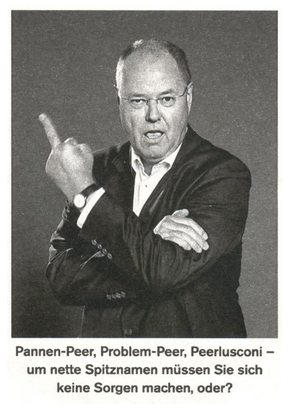
Peer's 'Stinkefinger'

After losing his only televised debate to a necklace, Peer felt the need to take drastic action. But what to do? Well, apparently, if your words aren't working, go 'wordless'. Peer Steinbrück signed up for a 'wordless interview' with Süddeutsche Magazin which ended up receiving widespread coverage in Germany and abroad after he responded to a question by unapologetically flipping the bird. Unfortunately, rather than inspiring the electorate they simply replied in kind...


Lucke's Greek toga party

If you thought Peer's wordless interview was bizarre, wait until you see this. AfD leader (and serious German professor) Bernd Lucke held an interview with German channel Tele 5 on why Greece should leave the euro, during most of which he wore a Greek flag as a toga. He then proceeded to sing a duet with the host, of the AfD's official song to the backing music of Take That's 'Back for good' (a song which Lucke had apparently never heard before). On top of all of this, as some of the papers noted, one of the producers of the show is Greek and proceeded to periodically alter Lucke's voice so that he sounded like Mickey Mouse. A truly bizarre election interview, which is well worth watching even if you don't speak German.

Don't mess with the Currywurst

While pushing for the humane treatment of animals, the Green party ironically managed to shoot themselves in the foot. In an almost inexplicable move, they proposed forcing all public canteens to make one day a week vegetarian day. Unsurprisingly, the suggestion did not go down well in a country famous for loving its meat. “How dare the Greens tell us what to eat!” thundered Germany’s mass circulation Bild newspaper, the day after the proposal was floated. What next? Banning nudism, autobahns or the Hoff...? You simply don't mess with the Currywurst or the Schweinshaxe. The Greens have recently slipped a couple of points in the polls - clearly no coincidence...

Beating the kids at their own game 

The new anti-euro party Alternative für Deutschland was widely derided as a party for old, white and grumpy men or alternatively as the 'Professor party' (if only it was true some would say). The contrast with the young, swinging and tech savvy Pirate party could hardly be greater. However, the AfD has proved it is no slouch when it comes to online campaigning with one of its election campaign videos getting over a million hits, while a Pirate video has received only just over 10,000 views.

Die Partei's whole election campaign


The brilliantly named Partei für Arbeit, Rechtsstaat, Tierschutz, Elitenförderung und basisdemokratische Initiative (Party for Work, Rule-of-Law, Protection of Animals, Advancement of Elites, and Grassroots-Democratic Initiative) - shortened to Die Partei - is a German satirical party akin to the UK's Monster Raving Loony Party, but much funnier. Set up by Martin Sonneborn, editor of the satirical Titanic magazine, its campaign pledges include razing the City of London to the ground and putting Angela Merkel on trial in a cage. Die Partei also released an election video on 'family policy' featuring (pixelated) scenes from an adult film with a soundtrack of "moaning and groaning, accompanied by light-hearted background music".

The hypnotic Chancellor 

We're not sure if it is her or her necklace, but Merkel has certainly lulled the electorate into a state of tepid contentedness. This cartoon perfectly captures the excitement of the CDU's election campaign. Merkel: "You are going to sleep. Everything is good. You are going out to vote..."


A rough ride for AfD

In their misguided attempts to stop the AfD expressing its alleged intolerant views the members of the Green youth decided to physically halt AfD activists from their right to freedom of speech and expression, with no sense of irony. Green with envy of the AfD's media coverage perhaps? In any case, as reported by Spiegel, this is likely to help the anti-euro party's chances, rather then hurt them.

Merkel drones on...

Just when the scandal surrounding the government's bungled purchase of the multi-million euro 'Euro Hawk' surveillance drone was beginning to fade, a CDU event with Angela Merkel and Defence Minister de Maizière in Dresden was interrupted by a miniature drone operated by remote control. The Pirate party claimed responsibility, saying that "The goal was to make Chancellor Merkel and Defence Minister de Maizière realise what it's like to be subjected to drone observation". Judging by the results above maybe they should just make her watch their election video...

David Hasselhof singing on the Berlin wall

Oh, sorry, that was in 1989...maybe it just seems like yesterday since we watch it on a daily basis...

Why Germany's 'boring' elections should still concern David Cameron

Our Nina Schick wrote this op-ed for today's City AM:
For a vote touted as decisive to the future of the Eurozone, the German election campaign – which reaches its climax on Sunday – has been lacklustre. With barely any talk of Europe, it’s been defined by domestic issues – from data protection, to rent control and taxation.

We Germans love a good debate on taxation. But while Germany’s main parties can differentiate on domestic policies, there is no substantial difference on the Eurozone. Long after the vote, and regardless of which coalition takes the helm in Berlin, Germany will remain a slow and deliberating player. No surprise, then, that commentators have dismissed the campaign as the “most boring” in recent memory.

Coalition dynamics may make the vote more interesting, however – and the UK, especially, should take heed. While most initially thought the likely outcome would be a continuation of the current centre-right coalition between Angela Merkel’s CDU/CSU and the liberal free market FDP, this may be changing. With as many as 30 per cent of voters undecided, this election will go down to the wire.

Recent polls show support for Merkel’s CDU/CSU dropping, while support for the centre-left Social Democrats (SPD) has risen. The latest figures predict that Merkel would not be able to form a parliamentary majority with the FDP. There is even a chance the FDP won’t make it past the 5 per cent threshold needed to win seats in the Bundestag. Last weekend, the party crashed out the Bavarian parliament after state elections.

We may see a backflip to the grand coalition of 2005: Merkel’s CDU/CSU and the SPD. While these dynamics won’t change much in the Eurozone, they are important to the UK.

It would be in Britain’s best interest to see a continuation of Merkel’s current coalition. She is a key ally for David Cameron, and will have a decisive influence in determining the success of his EU renegotiation strategy. Both Merkel and Cameron have a similar vision of the EU: based on free trade, reduced regulation, and improved competitiveness. It’s unlikely that anyone other than Merkel will become Chancellor. But if she enters a grand coalition with the SPD, things might not look so rosy for London.

First, in German politics, the foreign ministry usually goes to the junior coalition partner. While relations between Paris and Berlin have been strained since Francois Hollande took office (his spending rhetoric rubs Germans up the wrong way), a SPD foreign minister would be more likely to turn to Paris than London. Under the last grand coalition, the SPD’s foreign minister Frank Walter Steinmeier (also a contender for the post this time around) notably undermined some of Merkel’s foreign policy plans.

Second, the SPD is keen on further financial regulation. Only a few days ago, its parliamentary spokesman vowed that pushing forward delayed plans for a financial transactions tax would be a “high priority” for the SPD if they enter into a grand coalition. Not great news for the City of London.

In short, German coalition semantics may not mean much to the Eurozone – but they certainly will to the UK.

Wednesday, September 18, 2013

No quantum leap on eurozone integration after the German elections

Our Director Mats Persson has an op-ed in today's Wall Street Journal, where he argues,
A satirical cartoon in the Italian magazine L'Espresso, depicting a father and son, illustrated it best: "Papa," says the son, "I have to go to the toilet."

"Hush," answers the father. "Hold it until after the German elections."

By now most commentators have realized that there won't be a quantum leap toward more eurozone integration following the German elections. However, while most have focused on coalition dynamics, there are in fact three far more profound limitations that will continue to restrict Germany's ability to act in Europe long after the Sept. 22 elections, and will prevent any swift move toward a euro-zone banking union or fiscal union: One of these limitations is political, one is constitutional and one is economic.

First, German public support for the euro remains highly conditional. According to a recent Open Europe/Open Europe Berlin poll, a majority of Germans support more euro-zone integration if it means more central controls over other countries' taxation and spending. However, a clear majority remain opposed to any policy that involves putting German cash on the line, such as further loans to struggling euro-zone countries, write-downs of existing loans, a joint banking backstop or fiscal transfers.

This is neither surprising nor new. In the 1990s when the euro was forged, the gulf between public and elite opinion was already conspicuous. But despite mounting scepticism, the cost of saving the euro hasn't actually trickled through to people's wallets. If that ever changes, via a slow-down in the German economy, or if savers start to really feel the pinch from the European Central Bank's low interest rates or future possible money printing, we may quickly hit the limit of what the public is willing to endure.
Let's not forget that, given Germany's regional structure, there's almost always another election on the horizon. Between now and when Greece is supposed to exit its bailout program in June 2015, for example, there will be at least five state elections in Germany, as well as the European elections in 2014. German politicians cannot escape public opinion.

Second, the German republic was set up after World War II specifically to prevent hasty centralizations of power. Ironically, this was done at the behest of the Americans and the British—though both Washington and London have been vocal critics of Berlin's cautious approach in the euro-zone crisis. Systemic circuit-breakers such as Germany's Constitutional Court were put in place to counter rash decision-making, while the modern German constitution in 1949 got rid of the federal government's Weimar-era emergency powers.
Today, slowness and consensus are encoded in the very fabric of the German constitutional DNA. This will not change after the elections, nor should we wish it to. While it is unlikely to rule against the ECB's bond-buying program, the Constitutional Court will continue to lay down new red lines for what Germany can and cannot do. The Court has already said that before the euro zone moves to a transfer union, a change to the German constitution will be needed, which will first require a referendum.
It's constitutionally complicated, for example, to write down Greek debt, given that 75% of it is now owned by taxpayer-backed institutions in Germany and the rest of the euro zone. If those institutions take losses on what until now have been loan guarantees, that will in effect turn the euro zone into a transfer union for the first time, which the Constitutional Court has said is illegal. German politicians will continue to have one hand tied by the court in Karlsruhe for years to come.

Then there is the third and most fundamental limitation: Germany can't afford to underwrite the euro forever. If implicit debt, such as the liabilities of Germany's social-security system, are taken into account, the real level of German public debt would be 192% of GDP—much higher than Italy's 146%. Germany has also racked up an exposure to the struggling peripheral countries of around €1 trillion—equivalent to some 40% of its GDP. If Berlin were to begin accepting losses on this, the cost could snowball quickly, as all its sovereign debtors would look for equal treatment. Furthermore, Germany faces a demographic time bomb.

By 2050, the country's current population of 82 million is projected to have declined to around 70 million—less than in 1963. Far fewer workers will be around to finance the country's pay-as-you-go social-security system. This is worse than it looks. Germany, of course, already has its own deeply unpopular transfer union. In this system, out of 16 federal states, only three—Bavaria, Hesse and Baden-Wurttemburgh—are permanent net contributors, with Hamburg moving in and out of that status. Under a hypothetical euro-zone transfer union, these four German regions would proportionally carry a huge burden.

All of this means that there's a relatively stable trajectory to German's EU politics, which defies electoral cycles. So can we expect any movement after Sept. 22? Maybe a little. Particularly in a coalition government that included the center-left Social Democratic Party, we may see some easing of austerity in favor of structural reforms in countries such as Greece or Portugal. But Germans won't give up their deep-held belief in frugality overnight.

Almost any German government is also likely to continue to insist on strong controls over other countries' taxation and spending, most likely via the EU institutions, as quid pro quo for more cash. So the complicated sequencing that's pitting the Germans against the French will continue to dog the euro zone. Make no mistake, Germany will remain a slow, deliberating and frustrating actor for years to come.

Thursday, September 05, 2013

This is how Merkel could flunk the elections: enter the Far Left

Coalition politics combined with proportional representation and a fundamentally regionalised system can create the most fascinating potential outcomes – and do your head in. Like this: Merkel could still lose the German elections. Die Linke – the far-left party with a touch of DDR-nostalgia – could become the Kingmaker, paving way for a Social Democrat (SPD)-Green coalition.
This is how it could work:

The latest polls put the CDU/CSU at 41% and the SPD on 26% - with 59% of voters supporting Merkel as Chancellor compared to 30% who support the SPD’s Steinbrück. With the SPD and Greens still far off an absolute majority as a block, and with the FDP – Merkel’s current junior coalition partner polling at 5-6% ( the Bundestag threshold is 5%), it may seem as if Merkel has bagged it, either as part of a CDU/CSU-FDP coalition, or a CDU/CSU-SPD grand coalition.

However, this race isn’t over yet. If the FDP fails to make the 5% threshold, a lot can happen. The FDP could fail for two reasons: AfD could be nicking more votes from the FDP than expected, and ironically, the FDP scoring well in the Bavarian State elections on 15 September, could divert strategic CDU votes away from the FDP (voters who might vote strategically may have a false sense of confidence in FDP’s chances).

With the FDP out, the CDU/CSU is unlikely to get an absolute majority of Bundestag seats of its own, so it all becomes a matter of which constellation can reach a relative majority.

Enter Die Linke. The political divide between SPD-Greens and Die Linke is far too wide for them to actual joining forces in a coalition – in some SPD circles, Die Linke is, frankly, considered to be full of nutters. However, these parties do have one common interest: get rid of Merkel. So instead of SPD or Greens entering a very messy coalition arrangement with CDU/CSU (which no one wants, except the voters), they can strike a dirty deal with Die Linke whereby the former offer its passive support in the Bundestag on a policy-by-policy basis. A minority government with Die Linke’s blessing.

SPD/Greens would have to offer Die Linke something in return, of course, and the question if there’s any policy area where there’s sufficient overlap – or at least not outright conflict - between the parties manifestos for a deal to be struck. A new wealth tax perhaps? What’s clear is that Germany would take a quantum leap to the left.

What’s interesting is that though Die Linke leadership has previously hinted at this option being ruled out, the party never moved to rule it out completely. Die Linke head Bernd Riexinger said recently “If there is a majority against Merkel [after the elections], I will not exclude any option…only content will decide.” This is a clear invitation. However, we still hold this is as unlikely.

It would be interesting though to observe how Germany, governed by an SPD-Green coalition with Die Linke’s blessing, would continue its leadership role in the eurozone.

UPDATE: 6 September 2013

Speaking on the campaign trail yesterday, the SPD's Chancellor Candidate, Peer Steinbrück reiterated that "The SPD does not consider Die Linke appropriate as a coalition partner." It remains unclear, however, if  Steinbrück is rejecting cooperation with Die Linke until election night, or for the entire duration of the new government term.

Thursday, August 22, 2013

German parties scramble as third Greek bailout drops into the election campaign

The parties scramble on Greece in the election campaign
As we discussed yesterday, Germany has finally owned up to what everyone already knew – Greece needs more help. Not exactly ground breaking news some might say, but given that the German federal elections are 4 weeks away, the response in Germany has been frantic – providing a bit more insight into how each party views the eurozone crisis.

CDU
German Chancellor Angela Merkel said yesterday:
“I cannot say today what amount would possibly be needed…I cannot put forward a number, or confirm one. I don't know. One cannot know…We can only decide in the middle of next year." 
“I have to say I am a little surprised. Each Member of Parliament has all materials [relating to Greece.] And that, what [German Finance Minister Wolfgang] Schäuble said yesterday about Greece, everyone already knew that.”
Since Schäuble let the cat out of the bag a few days ago, the government, (via numerous politicians and spokespeople) has been tirelessly trying to display the comments as being in line with existing party policy. It has also tried to dispel the discussion altogether, suggesting no decision will be taken until mid-2014.

SPD
As expected in an election campaign, the opposition has jumped on the slip up. In an interview with Osnabrücker Zeitung, SPD Chancellor Candidate Peer Steinbrück said:
“I say clearly that saving Europe and the cohesion of the continent will cost something, also us Germans. It is time that Mrs Merkel tells that honestly to the people.”
In an interview with Handelsblatt, SPD Chairman Sigmar Gabriel said:
“[This] is the difference between the Chancellor and the SPD. Mrs Merkel says Germany will not go into a debt-union. In reality, the Chancellor has already long-organised such debt union secretly via the ECB. Mr Draghi has taken over state financing in the crisis states. But even before the election, the bill is going to arrive, in that Greece will guaranteed apply for another debt haircut.”
Former German Chancellor Gerhard Schröder also made his first foray into the election, telling a party rally:
“It is a big lie that Germany will not have to pay for Europe.”
For all the SPD's attempts to push the CDU into admitting that the eurozone will need further aid, it still isn’t entirely clear what the SPD sees as the solution to the eurozone crisis. This has hampered its attempts to take advantage of the situation. It’s also telling that interventions by SPD party 'big beasts' seem to make Chancellor candidate Steinbrück look timid and uninspiring -- rather than helping him.

CSU
The Bavarian sister party of the CDU has been notoriously pessimistic over the eurozone crisis and is, expectedly, none too happy about the timing and the substance of the admission that Greece needs more aid.

CSU leader and President of Barvaria, Horst Seehofer said that a new aid package for Greece "is not in question," and that he is "not very happy," with the current discussion. Meanwhile, Bavarian Finance Minister Markus Soeder warned that:
“It was completely wrong to announce a third programme [for Greece] now.”
ECB
The ECB has offered veiled support to the German government. ECB Executive Board member Jörg Asmussen, who was visiting Athens yesterday, said that the plan remained to assess Greece’s situation once it registers an annual primary budget surplus -- likely at the end of this year.

Meanwhile, Bundesbank President Jens Weidmann commented that, “Nobody here [in Germany] longs for the D-Mark…We are fighting for a stable euro,” playing down fears this could revive talk of a eurozone break up.

Other parties have weighed in as well, with Alternative für Deutschland and Die Linke slamming the prospect of any further bailouts as expected. This incident could potentially help increase their share of the vote, although it may well come at the expense of the junior coalition partner, the FDP, which has been fairly quiet throughout this episode – that of course could make creating a governing coalition a bit trickier.

Despite the CDU's attempts then, this issue seems here to stay, although it is unlikely to have a significant bearing on the outcome of the election.

That said, it doesn't paint a rosy picture for the German approach to the eurozone crisis after the election. Those expecting huge change are likely to be dissapointed. Another bailout simply suggests more of the same. Meanwhile, all parties seem short of any real policies for how to change the current approach and/or find a real solution to the eurozone's economic woes.

Tuesday, April 30, 2013

Criticise it all you want, Germany is not going to drop austerity

Writing on his Telegraph blog, Open Europe Director Mats Persson argues that anyone who prays for Germany to U-turn on its eurozone policy after the September election will probably be left sorely disappointed.


Read the full article below:

"Fuelled by an intensified wider debate about the merits or otherwise of austerity as a remedy to economic problems, the last few weeks have seen politicians, commentators and economists coming out in droves to criticise Germany’s austerity-for-cash approach to the eurozone crisis.

The new Italian Prime Minister Enrico Letta – who is today meeting his German counterpart, Angela Merkel – said yesterday that Italy “will die of fiscal consolidation alone”, leading some to conclude that Italy will lead the revolt against austerity in the Eurozone.

Everyone is now looking ahead to the German election in September, with the idea being that with election season gone and perhaps with a Conservative/Social Democrat "grand coalition" at the helm, Germany will flinch and drop the whole austerity thing.

Unlikely. We might see some easing of targets and toned down rhetoric, but no fundamental shift. The German consensus on austerity runs incredibly deep.

Although, strictly speaking, in Germany, austerity is actually not called austerity at all (it sounds “evil” as Angela Merkel has pointed out). Instead, the term used is sparkurs (savings course) or sparpolitik (savings politics). Or as a verb; Hausaufgaben machen – to do your homework. The opposite is schuldenpolitik (debt politics) or Schulden machen (to make debt).

Such semantics matter. Fundamentally, they illustrate that the perceived dichotomy between ‘austerity’ and ‘growth’ – which strikes a chord with some other electorates in Europe – is a non-starter in Germany. It would be electoral suicide for a German politician to advocate schuldenpolitik – akin to an American Presidential candidate professing himself an atheist or a Swedish politician denying climate change (the latter would most likely also involve being stripped of one’s Swedish passport). This logic drives politicians’ approach both at home and abroad.

By and large the main opposition party, the centre-left SPD, does not advocate a radical departure from Merkel’s blueprint. Instead, it merely nit-picks at the edges while garnishing the whole exercise with concerned rhetoric about the social consequences. A typical SPD critique is that expressed by Nils Schmidt, the leader of the Party in Baden-Württemberg: “We have to make cuts, but step-by-step, we can’t make them all at once.” The key there is “we have to make cuts”. And remember, in an effort to be seen as tough on irresponsible banks it was the SPD that was the most hawkish over Cyprus. Even the Green party is keen to be seen as fiscally responsible taking a tough line on paying down public debt.

German opinion polls have also consistently backed the austerity-for-cash approach abroad with a recent opinion poll showing that 65 per cent said they agreed with Merkel’s handling of the crisis – up from 46 per cent in July 2011.

In other words, even under a grand coalition between Merkel’s CDU/CSU and SPD, the basic course in Germany’s Europe policy will remain fairly steady. Crucially, the complicated sequencing for any further eurozone integration – such a resolution fund for banks or public debt pooling – will likely stay broadly the same: constitutionally-anchored eurozone-wide supervision first, cash later. This also means that Franco-German axis will continue to suffer from tensions.

There is, of course, an intense debate going on within Germany over the country’s position in Europe – and a worry about being seen as the neighbourhood bully. As I’ve argued previously, the crisis sees Germany’s two post-war pillars clashing head-on – firm commitments to both Europe and sound money.

Exactly how this debate will play out remains unclear. However, anyone – say a French socialist – who prays for Germany to U-turn on its eurozone policy after the September election will probably be left sorely disappointed."